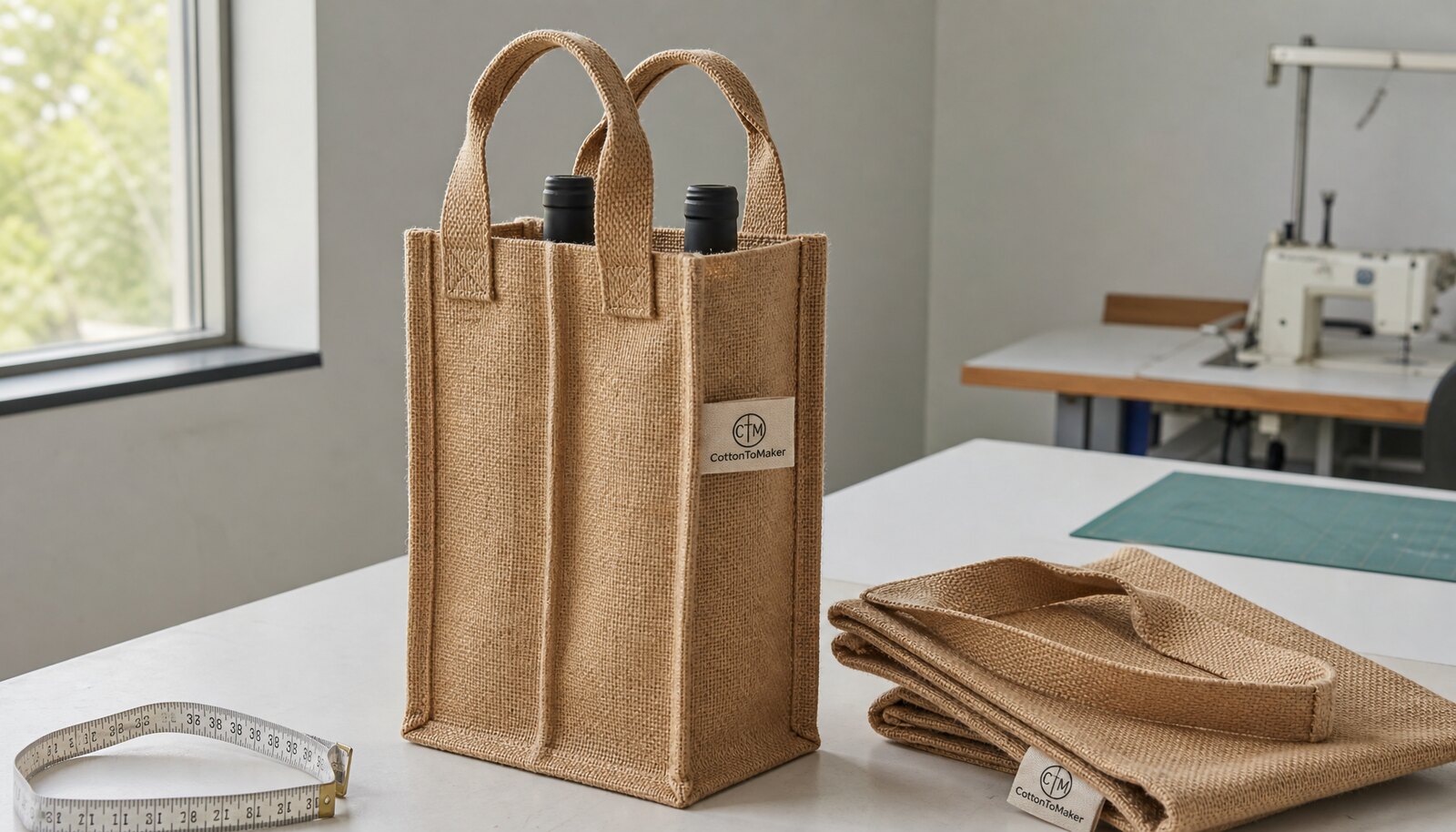
Start With the Bottle Count, Then Write the Bag Job Correctly
The first mistake buyers make is treating every jute tote as the same product. A one-bottle gift bag, a two-bottle carry bag, and a retail tote for shelf merchandising are different constructions, even if they share a similar look. The bag should be specified from the use case outward, not from a catalog photo inward. If you start with the bottle count, the supplier can size the gusset, handle drop, and base support around the load instead of guessing from appearance.
For boutique wineries, this is especially important because the bag often becomes part of the product story. A cellar-door gift bag may only need to travel a short distance, while a club or retail bag may be carried home, stored, and reused. That changes the choice between plain jute, laminated jute, lined jute, and a more structured build with board reinforcement. It also changes the way the handles should be sewn. A bag that looks attractive on a table can still fail if it is not designed for the intended bottle weight and center of gravity.
Write the buying brief in practical terms. Say whether the tote will hold a standard 750 ml bottle, two bottles side by side, a boxed bottle, or a mixed gift set with inserts. If the winery sells different bottle shapes, include the heaviest and widest bottle in the spec. That avoids under-sizing the gusset or over-compressing the sidewalls during packing. For procurement teams, the safest rule is simple: define the bottle load first, then let the supplier propose the construction.
Useful buyer inputs for the first RFQ are short but specific: bottle count, bottle size, target use, display environment, and whether the bag must stand on shelf. Once those are fixed, the rest of the quote becomes far easier to compare.
- Two-bottle carry: prioritize gusset depth, handle reinforcement, and base stability.
- Retail display tote: prioritize print clarity, shape retention, and repeatable dimensions.
- Gift pack: prioritize presentation, insert compatibility, and clean folding for packing.
Choose the Right Jute Build, GSM, and Surface Finish
Jute pricing changes quickly once you move beyond a basic body-only tote. Fabric weight, lamination, lining, and handle build all affect cost and performance. A common starting range for a standard promotional tote is roughly 300–350 GSM, but that is only a starting point. A two-bottle tote or a premium retail bag may need heavier cloth, a stronger base, or a denser weave so the bag does not sag after it is filled. If a supplier quotes only "good quality jute," the answer is not procurement-ready. Ask for the GSM, the weave description, and a sample reference from a recent run.
The next decision is whether the bag should be laminated. Lamination can make the tote feel stiffer and can help the bag keep its shape in retail packing. It can also reduce fiber shedding and make the surface easier to handle in the warehouse. But lamination is not free. It changes the hand feel, can introduce odor if process control is poor, and may affect how ink sits on the surface. For wineries that want a rustic, natural look, unlaminated jute may be the better aesthetic choice. For a retail-facing bag that has to stand up neatly on a shelf, laminated or partially structured jute can be more practical.
A lining is another useful lever, especially when the bag is intended for repeated use. Cotton lining, a light nonwoven, or a simple internal board can improve bottle protection and presentation. The buyer should ask whether the lining is sewn in, glued in, or loose. Sewn construction is usually more durable, but it can add labor and lead time. The best spec is not the heaviest material; it is the one that meets the carrying requirement and still fits the winery’s brand position and cost target.
A good quote comparison should separate body fabric, lamination, lining, and reinforcement. Those are different cost drivers and different quality risks. If the supplier cannot explain which layer is doing what, the bag is not yet fully specified.
- 300–350 GSM is a common starting range, but load and gusset size may push the spec higher.
- Lamination improves structure but can change odor, flexibility, and print behavior.
- Ask for a swatch and a photo of a completed bag, not just a fabric description.
Specify Handles, Stitching, and Bottle-Safe Structure
On a jute wine tote, the handle is not a decorative detail. It is the part most likely to fail if the bag is overloaded, handled roughly, or packed too tightly. Cotton webbing handles are common for a cleaner retail look and better grip. Jute self-fabric handles can feel more natural but may need stronger reinforcement to match the load. Some buyers prefer a folded-and-stitched handle with bartacks at the anchor point. The right choice depends on the bottle weight, the expected carry distance, and whether the winery wants the tote to feel premium or rustic.
Stitching details should be written into the tech pack or RFQ in practical terms. Ask for the seam allowance, stitch density, bartack count, and handle anchoring method. If the tote is for two bottles, the handle should usually be attached through multiple layers or with reinforced stitching that spreads the load. The supplier should show where the stress points are and how they are protected. If the bag has a divider, a base board, or a side insert, those components should also be secured so they do not shift in transit.
A bottle tote also needs to work mechanically. The gusset must be deep enough for the bottle diameter. The base should be stable enough that the bag does not collapse when set down. If the bag is narrow at the bottom, bottles can lean and create pressure on the seam. That kind of issue does not show up in a flat mockup. It shows up in a loaded sample test. For procurement buyers, the useful question is not only "Does it look good?" but "What happens when the actual bottle is inside it?"
If you want fewer surprises, ask the supplier to identify the stress points on the sample and mark the stitching path on a photo. That makes the final approval much easier and reduces the chance of a glossy sample hiding a weak build.
- Cotton webbing is often easier to grip and can feel more retail-friendly.
- Ask for handle reinforcement, bartacks, and the sewing path in writing.
- Test the loaded bag with the actual bottle size before bulk approval.
Choose Decoration That Works on an Open Jute Weave
Jute is not a smooth printing substrate. The weave is open, the fiber texture is uneven, and very fine artwork can disappear into the surface. That is why simple screen printing remains one of the most practical decoration methods for boutique wineries. A one-color logo, a short slogan, or a badge-style mark usually prints cleaner than a highly detailed image. If the design includes thin lines, gradients, or tiny type, the supplier should either simplify the artwork or recommend a different decoration method before quoting.
For a more premium look, woven labels, sewn patches, or side labels often perform better than forcing detailed art onto the front panel. These methods can make the bag feel more deliberate and can help the brand stand out without relying on heavy ink coverage. If the winery wants a luxury-leaning presentation, a restrained printed front and a stitched brand detail on the side can look more refined than a large all-over logo. The buyer should not assume that more decoration means a better retail result. On jute, simpler is often stronger.
Lock the decoration spec in measurable terms: print size in centimeters, exact placement from seam or top edge, number of colors, and acceptable color reference. Digital proofs are useful, but they do not replace a physical sample. Print on jute can shift slightly because the surface absorbs ink unevenly. A clean proof can still land poorly if the ink density or registration is not controlled. For that reason, the best practice is to approve both the artwork and the actual sample together.
If the supplier suggests an alternate method, ask for the reason. A good factory explanation usually references weave openness, surface stiffness, or durability. A vague answer is a warning sign. The commercial objective is not to maximize decoration complexity; it is to get a clean brand mark that survives handling, packing, and shelf display.
- Best-fit methods: simple screen print, woven label, sewn patch, or a restrained mix.
- Avoid fine gradients and micro-type unless the supplier proves the result on an actual sample.
- Specify print position in centimeters instead of saying "centered" or "near the top."
Compare Supplier Routes Before You Compare Unit Price
A low quote is not useful if the supplier cannot deliver the same bag twice. The sourcing route affects control, lead time, and defect risk more than many buyers expect. A direct factory usually gives the strongest control over GSM, handle build, stitching, and final packing, but it may require higher MOQ and more disciplined artwork files. A trading company can be efficient when it already knows the right factory and can manage consolidation, but the buyer needs transparency on who is actually making the bag. If the bag changes hands between quoting and production, quality accountability becomes harder to manage.
Domestic decorators and stock/private-label suppliers can be useful when speed matters and the bag is already close to the desired format. This is common for tasting-room retail items, seasonal event bags, and small launch quantities. The tradeoff is less flexibility on structure. You may be able to change the logo and label, but not the gusset depth or handle spec. That is fine if the buyer understands the constraint upfront. It is a problem only when a procurement team assumes a decorator can customize a structural bag like a factory can.
For buyers comparing suppliers, the better question is not "Who is cheapest?" It is "Who is quoting the actual bag I need, with the actual production path I can verify?" Ask for the factory name, the production city, and whether the supplier will use the same source for reorders. Ask where the sample was made. Ask who signs off on pre-shipment inspection. Those are practical questions because they tell you whether the quote can be repeated.
If the supplier cannot explain the production route clearly, treat that as a sourcing risk. In custom jute work, visibility matters because the bag body, the sewing, and the packing are all part of the final quality outcome.
- Direct factory: strongest control, usually clearer on construction details.
- Trading company: useful if factory visibility and responsibility are documented.
- Stock or decorator route: good for speed, but limited on structural changes.
Read the Quote Like a Buyer, Not a Shopper
Buyer-facing quotes should separate the real cost drivers. If two suppliers send you a single blended number, ask them to break it apart. Bag body, handles, print, lining or lamination, labels, cartons, inserts, and setup charges should all be visible. That matters because jute tote pricing can look similar across suppliers while the underlying spec is very different. One quote may include a heavier cloth or better sewing, while another may be based on a lighter build that only looks comparable on paper.
For winery programs, packaging can hide cost as easily as it creates value. A bag quoted as a loose promotional item is not the same as a retail-ready tote with tissue, barcode sticker, and a clean folding standard. Carton count also matters. If one supplier packs more units per carton, the freight looks cheaper until you see the damage risk. If another supplier uses a more protective pack, the unit price may be higher but the landed result may be better. Procurement should normalize the quote around the full landed path, not the invoice line only.
Ask each supplier to identify the top three price drivers. On jute totes, the usual levers are GSM, handle type, print colors, and custom packaging. Add a divider, add a board, or add a woven label, and the process changes again. A commercial quote should tell you what is included and what will trigger a re-quote. If the supplier is reluctant to break out the numbers, that usually means the buyer is being asked to compare incomplete offers.
A useful internal practice is to convert every quote into one comparison sheet with the same columns: exact size, fabric spec, handle spec, print method, packing, MOQ, sample timing, production lead time, and freight basis. That way the team is comparing real equivalents, not mixed assumptions.
- Separate unit price from setup, packaging, and freight.
- Compare like-for-like only after the sample is aligned.
- Ask for a line-item quote if the tote includes multiple materials or multiple production steps.
Set MOQ and Reorder Logic Before You Approve Artwork
MOQ is not just a supplier preference; it is the point where material booking, sewing efficiency, and packing setup begin to make economic sense. A plain stock-style jute tote with a simple print may support a lower minimum. A fully custom bag with a special size, custom handle, label, insert, and retail packaging usually needs a higher MOQ because every step adds changeover time. For boutique wineries, the mistake is often to split the order into too many tiny variants. Three small versions can cost more than one properly scaled program.
The right MOQ discussion should cover at least three things: MOQ per design, MOQ per colorway, and MOQ per packing format. If the winery wants a holiday edition and a year-round edition, those should be costed separately. If one SKU has a woven label and another uses screen print only, the factory may treat them as different production setups. You need that distinction early because it affects both budget and timeline. A lower MOQ is only helpful if it applies to the exact build you intend to buy.
Reorder logic matters too. Ask whether the second order can run at the same minimum or whether the supplier will revise MOQ based on remaining materials and print screens. Some factories price the first run with setup recovered over a larger quantity and then offer a better second-run structure; others reset the economics if materials change. A practical buyer keeps the first approved sample, the final artwork file, and the exact spec sheet so the reorder can be matched without relearning the job.
One good rule for winery buyers: if the bag is meant to become a recurring retail item, plan the first order and the reorder as one program. That helps you judge whether the chosen MOQ makes sense for the brand, not just for the initial purchase.
- MOQ changes with structure, decoration, and packaging, not just quantity.
- One design with one pack format is easier to quote and repeat than several micro-variants.
- Write the MOQ by SKU and by reorder scenario, not as a single blanket number.
Approve Samples Against Load, Finish, and Packaging Reality
A sample should prove more than appearance. Before bulk approval, load the tote with the actual bottle type and move it through the same handling it will see in real use: pick up, carry, set down, shelf display, and carton packing. This is where handle comfort, gusset behavior, and base stability become visible. If the sample only looks good empty, it has not yet passed the buyer test. The real question is whether the bag still looks and performs well once the intended product is inside it.
The pre-production sample should also be checked against the artwork and the color reference. Compare the print size, placement, and ink density directly against the approved spec. Check stitch lines, edge finishing, label placement, and the way the bag folds into the carton. If the bag includes a liner, divider, or insert, those should be in the sample too. A sample with the right body but missing a pack component is only a partial approval.
When the sample needs a correction, document the correction in writing before bulk begins. Do not rely on phone memory or a marked-up photo only. Change-control should say what was adjusted, what remains fixed, and whether the change affects lead time or cost. That matters because a small change to handle length or label placement can create a new sewing setup on the floor. If the factory says the bulk will be slightly different, ask exactly how and why. If the answer is vague, the approval is not complete.
The best sample process for procurement teams is boring in a good way: one sample, one revision if needed, one signed approval, one archived reference. That keeps the production phase clean and reduces the chance of a surprise at shipment.
- Test the tote with real bottle weight and dimensions.
- Record every correction in writing before bulk approval.
- Archive one approved sample for reorder and QC reference.
Specify Packing So the Tote Arrives Retail-Ready, Not Crushed
Packing is often treated as a minor detail, but for jute totes it can determine whether the bag arrives ready to sell. A crushed tote can look cheap even if the construction is good. For boutique wineries, packing should match the channel. If the tote will go straight into gift baskets or club shipments, a simple inner pack may be enough. If it will sit on a retail shelf, the fold, face protection, and barcode placement become part of the product presentation.
The buyer should decide whether the bag needs a polybag, tissue, sticker, hang tag, or no extra wrap at all. Then define how the handles are folded, which side faces outward, and whether the print should be protected from scuffing. Master carton count needs attention too. Too many bags in one carton can compress the shape and flatten the base; too few can raise freight cost unnecessarily. For heavier or structured wine totes, the carton spec should be chosen to prevent corner crush and panel deformation during transit.
Outer cartons should be export-ready, with the correct count, SKU labels, country-of-origin marking, and any handling marks required by the market. If the winery buys for multiple channels, ask whether the supplier can separate retail-ready packs from bulk ship packs. That can save repacking cost at destination. It also reduces the chance that a distributor receives mixed cartons and has to sort them by hand. The best packing plan is the one that keeps the tote saleable without adding unnecessary cost.
A buyer-friendly packing instruction is simple and specific: how many per carton, how each unit is folded, what labels go on the carton, and whether any insert or barcode must be fixed to the unit before bagging. Once that is written, the supplier can price it correctly.
- Define inner pack, master carton count, and carton markings in the order confirmation.
- Protect print faces and structured bases from crush damage.
- Use retail-ready packing if the bag will sell off shelf, not only in bulk.
Plan Lead Time Around Samples, Materials, and Freight, Not a Single Date
Lead time on custom jute tote bags is usually driven by three separate clocks: material availability, sample approval, and shipping space. A supplier may quote a short production window, but that number often assumes the final cloth, trim, and artwork are already approved. If a special lining, custom handle, or branded label needs to be sourced, the project can stall before sewing starts. That is why the schedule should be broken down by step rather than given as a single promise.
For procurement teams, the most useful lead-time question is: "How many days from approved sample to ex-factory, and what happens if a revision is needed?" The answer should include material booking, pre-production confirmation, bulk sewing, inspection, and packing. A winery launch schedule usually has very little tolerance for vague timing. Vintage releases, holiday sets, and tasting-room resets all create fixed windows. If the supplier cannot map the route to shipment, the buyer cannot manage the risk.
Freight choice changes the whole project. Air shipment can rescue a deadline, but it is expensive for a bulky item like a jute tote. Sea freight is usually better for repeat orders and larger volumes, but it needs more planning and earlier booking. If the buyer is comparing quotes, compare lead time together with freight basis. A bag that looks cheaper but forces urgent air shipment can quickly become the most expensive option. The same is true if the supplier cannot book space or if cartons are too weak for the chosen transit mode.
A disciplined schedule has one more element: buffer. Keep room for one sample revision if the first version misses the brief. That small buffer is often what separates a controlled launch from a rushed compromise.
- Break lead time into sample, materials, bulk production, inspection, and freight.
- Build in room for one correction cycle if the first sample misses the brief.
- Treat shipping mode as part of the procurement schedule, not an afterthought.
Specification comparison for buyers
| Supplier route | Typical MOQ range | Lead-time implication | Cost impact | When it fits |
|---|---|---|---|---|
| Direct factory in a jute-producing region | 500–3,000 pcs per SKU is common for custom builds, though some factories will quote lower for simple stock-style runs | Usually fastest once sample is approved, but material booking and sample correction can add 1–3 weeks | Best unit cost at volume; setup costs are more visible, and small runs can look expensive | Repeat winery programs, private label launches, or orders where the bag itself is part of the brand experience |
| Trading company with factory network | 300–2,000 pcs per SKU depending on factory allocation and design complexity | Can be efficient for coordination, but timelines are only as good as the factory they assign | Often slightly higher than a direct factory because coordination and risk are built into the quote | Mixed-SKU programs, buyers who need one contact, or teams that want support on artwork and consolidation |
| Domestic decorator using imported blanks | 50–1,000 pcs per design for decoration-only work; structural changes are often limited or unavailable | Fastest route if blanks are in stock; otherwise lead time depends on blank replenishment | Higher unit cost for low quantities, but lower freight risk and less coordination effort | Event programs, tasting-room merchandise, and last-minute replenishment where the bag shape is already acceptable |
| Stock/private-label supplier | 100–2,000 pcs is common, with lower entry points for standard items | Usually the shortest timeline because the base bag already exists | Competitive on simple branding, less attractive once you need custom structure | Gift shops, club shipments, and promotional programs with limited construction changes |
| Integrated packaging supplier with a bag program | 300–3,000 pcs depending on how many components are bundled | Moderate timeline; coordination across labels, cartons, inserts, and bags can slow the critical path | Bundling can lower admin time, but mixed sourcing may hide component-level markups | Retail bundles, wine club kits, and distributor programs needing coordinated packaging |
| Small workshop or artisanal maker | 50–500 pcs, sometimes higher if the workshop has stable capacity | Lead times can be unpredictable because labor is less standardized and changeovers take longer | Higher labor cost per unit, but can support premium details on small orders | Ultra-small brand tests, local tasting-room exclusives, or limited editions |
| Regional exporter with in-house QC | 500–5,000 pcs is common for export-focused programs | Usually steadier scheduling because packing, inspection, and export paperwork are managed together | Moderate to strong value when defects and paperwork risk are important | Orders shipping to multiple markets or buyers who want a documented pre-shipment process |
| Marketplace broker with limited factory visibility | Often quotes attractively at 100–1,000 pcs, but true MOQ may be tied to a hidden factory minimum | Lead time can stretch if the broker has to re-source after quote acceptance | Appears low at quote stage, but risk of add-on charges is high | Simple low-risk stock buys or test orders where the bag is not the main value driver |
Buyer checklist before sampling
- Confirm the end use in one sentence: two-bottle carry, one-bottle gift, tasting-room retail, club shipment insert, or event giveaway. This determines size, gusset depth, handle drop, and how much structure the bag needs.
- Write the bottle dimensions into the RFQ. A standard Bordeaux, Burgundy, or boxed bottle program can require different inner widths and base support even when the outside bag looks similar.
- Set the jute spec in writing: natural or bleached, laminated or unlaminated, target GSM, lining if any, and whether the bag needs a rigid base, divider, or board insert.
- Approve the branding method before quoting: one-color screen print, two-color spot print, woven side label, sewn patch, or mixed decoration. Avoid asking for complex art on a coarse jute face unless the supplier proves the result.
- Request finished dimensions, not cut size only. Define tolerance for width, height, gusset, handle drop, handle center spacing, and logo placement.
- Specify handle construction: jute tape, cotton webbing, self-fabric handles, folded and stitched handle ends, or reinforced bartacks at the stress points.
- Ask for seam details in plain terms: seam allowance, stitch density, bartack count, and whether the handle anchoring is sewn through multiple layers or only surface stitched.
- Clarify MOQ by SKU, colorway, and packing format. A bag with the same body but different label or insert often carries a different minimum.
- Request a pre-production sample made from the final cloth, final trim, and final print method. A generic sample from another order is not enough.
- Define the packing format: polybag or no polybag, tissue, barcode sticker, hang tag, master carton pack, and whether the bags need retail-facing folds.
Factory quote questions to send
- What exact jute fabric weight in GSM will you use, and can you show a current swatch or a measured reference from a recent run?
- Is the bag body laminated, and if so, what type of lamination is used inside the bag? How does it affect stiffness, odor, and print adhesion?
- What are the finished dimensions, handle drop, gusset depth, and allowable tolerance after sewing? Please list them in centimeters.
- Which decoration method is included in the quote, how many print colors are included, and what setup charge applies if artwork changes after sample approval?
- What is your MOQ per design, per colorway, and per packing format? If I reorder the same artwork, does the minimum stay the same?
- Can you provide photos of a similar bag you have produced, including close-ups of stitching, corners, handles, and the print area?
- What carton pack do you recommend for wine totes, and how many pieces per master carton can you ship without crushing the shape?
- How many calendar days are needed for sample development, pre-production approval, bulk production, inspection, and export booking?
- What part of the price changes most if I adjust GSM, handle type, lining, print colors, or custom packaging? Please break out each item separately.
- Which parts of the work are done in-house, and which are outsourced? If a subcontractor is used, how do you control final inspection and packing?
Quality-control points to confirm
- Finished dimensions must stay within the agreed tolerance for height, width, and gusset. For bottle bags, even a small deviation can affect fit and bottle movement.
- Handle attachment should survive a pull test that reflects real use. Check for reinforced stitch lines, bartacks, and no tearing at the handle root. If the tote is for two bottles, the stress point matters more than the decorative print.
- Set measurable stitch acceptance rules: no skipped stitches across load-bearing seams, no loose thread tails longer than the agreed limit, and no seam puckering that distorts the front panel.
- Print registration should match the approved sample. Reject visible slanting, uneven ink density, broken edges, and bleed-through that is obvious at normal retail viewing distance.
- Base performance matters for wine totes. The bag should stand or at least recover shape without seam splitting, base collapse, or twisting when loaded with the intended bottle weight.
- If the tote includes a divider or insert, check that the separator stays centered and does not fold into the bottle cavity during handling.
- Natural jute variation is normal, but the buyer should define how much shade variation, fiber slub, and weave irregularity is acceptable across the run.
- Inspect for odor, especially if the bag is laminated or packed in polybags. A normal earthy jute smell is expected; strong chemical, adhesive, or ink odor should be flagged for review.
- Check carton quality before shipment: correct count, clean label data, export-strength board, no crushed corners, and no compression damage from overpacking.
- Use random carton pulls to verify that the first and last carton match the approved sample. Color drift, packing variation, and label placement often show up late in the run.