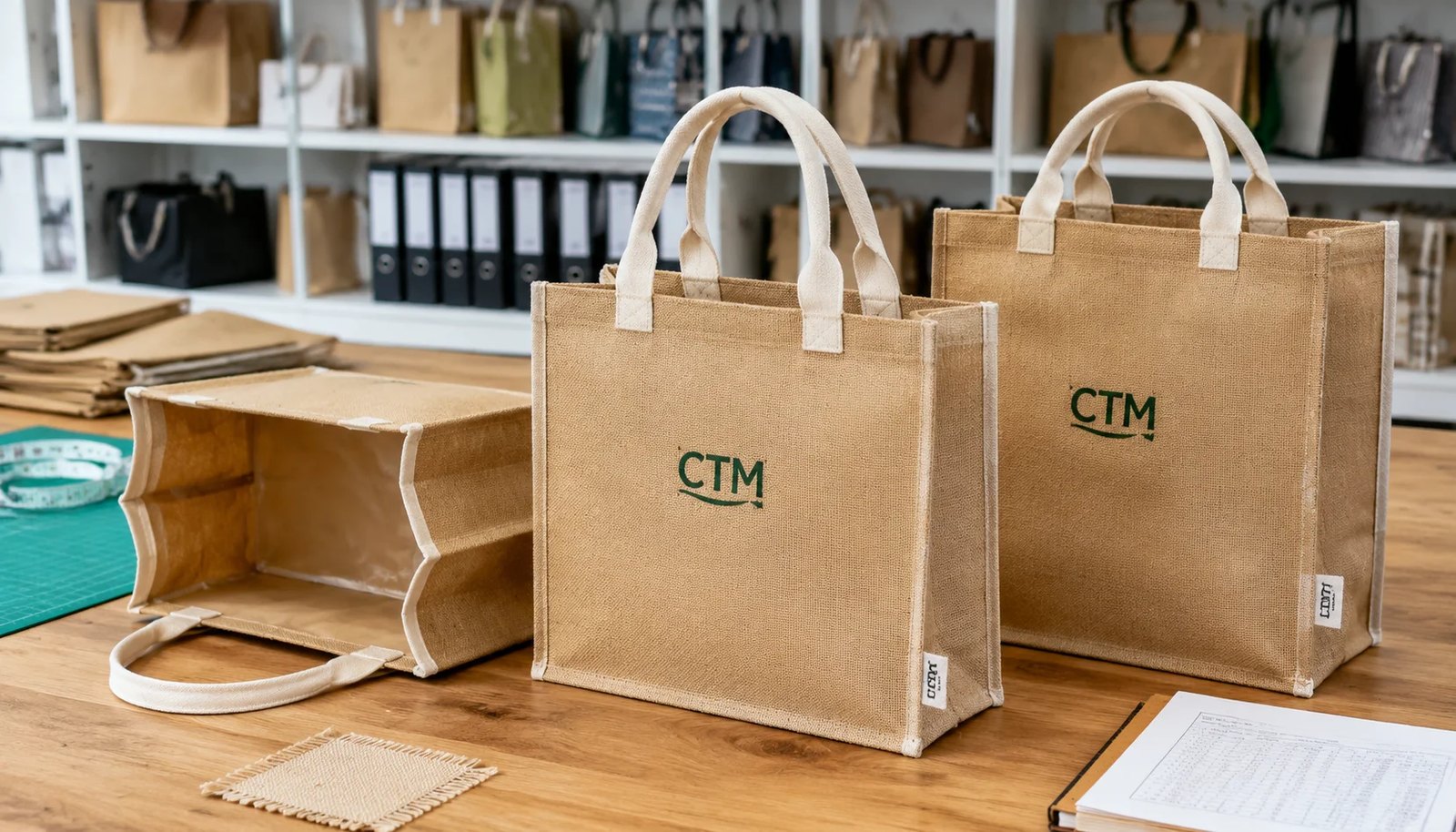
Why compliance is the main sourcing problem with custom jute tote bags
For natural grocers, the challenge is rarely finding a supplier willing to make a jute tote. The real problem is qualifying whether the quoted bag matches store expectations for material safety, brand presentation, and repeatable production quality. Jute is a natural fiber with wider variation than cotton canvas. That means color shade, fiber shedding, weave openness, odor, and print performance can change noticeably between suppliers even when the basic dimensions look similar on paper.
A compliance checklist matters because reusable grocery bags sit close to food retail environments and brand sustainability claims. Buyers need more than a low FOB price. They need a supplier file that explains what the bag is made from, how the logo is applied, whether lamination changes recyclability messaging, how the bag is packed for humid transit, and what inspection standard will be used before shipment. Without that structure, two quotes that look comparable can produce very different store outcomes.
- Main buyer risk: a bag that looks eco-friendly in concept but fails odor, print, or durability expectations in stores
- Main sourcing trap: comparing quotes without matching fabric weight, lamination, handle reinforcement, and packing basis
- Best control point: build compliance and construction requirements into the RFQ before sampling starts
Set the right base specification before comparing suppliers
Jute tote bag quotes become misleading when the base spec is still vague. A useful RFQ for natural grocers should define bag size, gusset depth, target load, handle drop, and whether the bag is intended for checkout resale, produce carry, event promotion, or premium private-label merchandising. Grocery use usually needs a wider gusset and stronger handle attachment than event giveaway use. If you leave usage open, suppliers will quote to different durability assumptions.
Fabric weight is one of the biggest variables. For most custom jute grocery totes, a practical range is around 280-320 GSM, often described commercially as 13-14 oz equivalent depending on weave and supplier convention. Lower GSM can reduce cost but often results in a softer body, more visible weave gaps, less controlled print coverage, and shorter service life. Higher GSM adds structure but also raises bag weight, carton weight, and freight cost. The right choice depends on whether shelf appearance or lowest landed cost matters more.
- Common grocery tote size example: 35-40 cm width x 35-38 cm height x 15-20 cm gusset
- Handle width commonly used: 25-30 mm cotton webbing for better comfort under grocery loads
- Useful RFQ detail: indicate whether bag must stand upright when filled, because gusset construction affects this
- Natural jute color variation should be accepted within a defined visual range unless a dyed finish is requested
Lamination, lining, and sustainability messaging need to match the retail program
Many natural grocer buyers assume jute automatically means one simple eco specification. In production, it is not that simple. Some bags are unlaminated and more natural in feel, while others have a thin inner lamination to improve shape retention, reduce dusting, and make the interior easier to wipe. Lamination can improve user experience for groceries, especially where moisture exposure from produce or chilled items is likely, but it changes both the bag feel and the wording buyers can safely use in product descriptions.
This decision should be locked before quote comparison. An unlaminated jute tote usually has a more authentic natural look, but can shed more fibers and print less cleanly on the opposite side if weave irregularity is high. A laminated bag may look neater and feel more structured, but can introduce odor concerns if the film quality is poor or the bags are packed too soon after processing. For a retail chain with sustainability-sensitive shoppers, the supplier should state exactly what the inner finish is and how it affects handling and packaging.
- Unlaminated jute fits buyers prioritizing a raw natural appearance
- Laminated jute fits buyers needing cleaner interior finish and better shape retention
- Request disclosure of lamination type and approximate thickness if used
- If sustainability claims will appear on swing tags or online listings, align wording with the actual bag construction
Choose print and branding methods that work on coarse jute surfaces
Natural grocers often prefer simple branding: one or two colors, earthy tones, and large readable logos. That usually makes screen printing the most practical method. It is cost-effective at volume and works well for bold marks, store names, and short sustainability messages. The limit is the jute surface itself. Coarse fibers and open weave can create a deliberately rustic print edge, but they can also make fine lines, small text, and large flood areas look broken or inconsistent if the artwork is not adapted.
A supplier who understands jute will talk about artwork simplification, print underbase where necessary, and realistic appearance on the approved sample. Heat transfer may be suggested for more detailed graphics or short runs, but it changes the hand feel and usually costs more per unit. Embroidery can work on side labels or small accents, though it is less common for large grocery panels. Buyers should approve print expectations against physical samples, not only digital renders.
- Best use for screen print: 1-3 solid colors, medium to large logo areas
- Avoid very small text on open-weave jute unless tested on strike-off sample
- Request print rub and adhesion review on approved pre-production sample
- If color match is important, specify Pantone target and acceptable visual tolerance under normal retail lighting
Supplier compliance evidence should go beyond a sales brochure
When the keyword is supplier, the buying decision is not just about the bag. It is about whether the vendor can document what they are shipping. Procurement teams should separate presentation claims from usable evidence. A strong supplier file for jute grocery totes may include material declarations, current test route information for relevant chemical restrictions, details on inks and lamination, packaging material data, and traceable sample references tied to the quoted style. The goal is not to create paperwork for its own sake. It is to reduce risk if a retailer, importer, or marketplace asks what exactly is in the product.
The weak version of supplier compliance is a folder of old certificates with no connection to the actual style. The stronger version ties documents to the approved materials and the current production process. If the supplier subcontracts printing or lamination, that should be visible in the quote discussion because quality accountability becomes more fragmented. For natural grocers, this matters especially when the product is sold under the store brand rather than as a generic promotional item.
- Useful evidence: material composition statement for body, handles, labels, thread, ink, and any inner film
- Useful evidence: current test route explanation instead of unrelated old reports from another item
- Useful evidence: packaging declaration if outer carton, polybag, or hangtag materials are controlled by the buyer
- Risk signal: supplier avoids naming which processes are in-house and which are outsourced
MOQ logic and quote structure can distort the real unit cost
Jute tote suppliers often present an attractive opening price while leaving out the commercial conditions that raise actual cost later. MOQ is one of the biggest areas where buyers lose clarity. A quoted MOQ may apply only to one size, one print colorway, and one packing setup. If a natural grocer needs multiple store regions, bilingual print, or mixed seasonal artwork, the true MOQ per variation may rise sharply. That changes both factory efficiency and dead-stock risk.
To compare quotes properly, buyers should break the offer into cost drivers: body material grade, lamination if any, handle material, print colors and print area, sewn label or hangtag, packaging, sample charges, and ex-factory lead time. A lower quote can become more expensive if it comes with oversized cartons, higher defect risk, or an unrealistic production window that later forces air shipment of replacement stock. Procurement should compare landed and operational cost, not only price per piece.
- Typical cost drivers: GSM, gusset depth, cotton webbing length, print colors, lamination, and packing density
- Mixed-SKU orders may need a clearer MOQ matrix by artwork and by color
- Request quote validity period if jute markets are fluctuating
- If the order is a pilot run, compare sample and setup charges separately from repeat-order pricing
Pre-production samples should prove construction, not just appearance
Many bag programs fail because the approved sample was treated as a branding sample instead of a production control sample. For jute totes, the pre-production sample should confirm actual fabric, actual handle, actual seam build, actual print process, and realistic final shape. A neat showroom sample made from a different lot or hand-finished outside the line is not enough. Natural grocers often care about how the bag feels in hand, whether it stands neatly on a shelf hook or bin, and whether jars or produce make the side gusset collapse awkwardly.
Sample review should include simple physical checks. Lift the bag with realistic grocery weight. Inspect whether the top hem stays even, whether the handle pair sits at equal height, whether the gusset folds cleanly, and whether the print cracks, rubs, or disappears into the weave. If the bag uses lamination, smell the inside after the sample has been sealed overnight. This catches odor problems before bulk material is booked.
- Approve with dimensions and tolerances written on the sample record
- Record handle drop length from top edge to highest inside handle point
- Note whether side seams and base seams must be single stitched, double stitched, or reinforced at stress areas
- Photograph key details: top hem, handle attachment, inside finish, print close-up, side gusset, and care or origin label placement
Quality control thresholds for grocery-use jute totes
Jute is not a sterile, precision-perfect material, so quality control needs practical thresholds rather than unrealistic cosmetic standards. The best QC approach identifies what must be consistent for retail acceptance and functional performance. For natural grocers, that usually includes stable dimensions within agreed tolerance, secure handles, acceptable print visibility, manageable natural color variation, no mildew or strong process odor, and packaging that arrives dry and undamaged. If those points are controlled, small fiber irregularities are usually acceptable as part of the material character.
Inline inspection is more useful than waiting until cartons are closed. Handle placement, stitch density, seam allowance, and print position drift can be corrected during production if they are reviewed early. Final inspection should then focus on count accuracy, packing integrity, labeling, and major visual or functional defects. Buyers using third-party inspection should provide the approved sample file and acceptance notes, because jute requires style-specific judgment and not just generic bag criteria.
- Critical defects: mildew smell, wet packing, detached handle, severe print transfer, wrong artwork, sharp contamination, major holes
- Major defects: uneven handle heights beyond tolerance, incorrect size beyond tolerance, visible lamination peel, severe print misregistration
- Minor defects: light natural shade variation or small fiber slubs within approved sample range
- Useful final test: random carton pull with loaded carry test based on expected grocery use
Packing and carton planning matter more than most buyers expect
Packing decisions affect both product condition and landed cost. Jute bags are bulky compared with flat cotton pouches, so carton planning can swing freight cost significantly. Overpacked cartons may reduce carton count, but they can also crease gussets, flatten piping, and press fresh ink onto adjacent bags. Underpacked cartons waste cube and raise shipping cost per unit. The right packing plan balances bag protection, warehouse handling, and container efficiency.
Moisture is the hidden problem. Natural-fiber bags that are not fully conditioned before packing can trap odor and encourage mildew during long sea transit. This is especially risky in humid seasons or when containers sit at port. Buyers should specify whether polybags are allowed, whether moisture barriers are needed inside export cartons, and what maximum carton weight their warehouse accepts. These details belong in the original quote, because changes later can move the unit cost.
- State units per carton and target carton gross weight, often keeping cartons practical for manual handling
- Request flat packing with handles tucked consistently to reduce deformation
- If retail labeling is needed, define whether labels are attached, packed loose, or applied at destination
- Include carton mark format: SKU, color, PO, quantity, country of origin, and carton number range
Lead time risk is usually in materials, approvals, and seasonal congestion
Jute tote production itself is often straightforward once materials and artwork are approved, but lead time problems begin earlier. Fabric booking, lamination scheduling, print screen preparation, and sample courier rounds can consume more time than buyers expect. For natural grocer programs tied to store openings, seasonal promotions, or reusable bag regulations, the practical schedule should include approval buffers rather than only factory sewing days.
A realistic quote should split timing into sample lead time, approval turnaround, material readiness, bulk production, and ex-factory date. Buyers should also ask how the supplier handles booking during peak periods or before major holidays. A supplier that simply offers one total lead time without explaining dependencies is harder to manage. Schedule control improves when approvals are consolidated: artwork, color, construction, labeling, and packing should be signed off in one formal pre-production package.
- Typical schedule risks: delayed artwork release, revised print color, handle material shortage, and vessel rollovers
- Pilot runs often take longer per unit than repeat orders because setup and approval time are proportionally higher
- If launch timing matters, ask which materials are stock-supported versus booked only after deposit
- Request milestone dates, not only one shipment promise
Specification comparison for buyers
| Supplier option | What to verify | Commercial advantage | Buyer risk to control |
|---|---|---|---|
| Direct sewing factory | jute roll photos, lamination sample, odor-control process, handle pull evidence, and pre-shipment carton condition photos | Better sample-to-bulk control and faster production feedback | May be weaker on export paperwork or branded packing unless checked early |
| Trading company | Factory name, production photos, trim-source proof, and who owns QC decisions | Can coordinate small mixed orders and extra services | Markup can hide real factory capability and slow defect decisions |
| Specialized bag workshop | handle stitching, side gusset, lamination edge control, inner seam cover, and fiber shedding tolerance | More practical for detailed construction, trims, and repeat programs | Capacity may be limited during peak seasons |
| Low-price general supplier | laminated or unlaminated jute, cotton-jute blend, inner coating, odor control, yarn thickness, and color shade variation | Useful for simple promotional runs with loose specs | Material downgrades, weak packing, and vague inspection scope can erase savings |
| Retail-ready supplier | airing time, moisture absorber, carton liner, bundle wrap, odor separation, and warehouse ventilation before loading | Can handle labels, SKU separation, carton marks, and receiving rules | Higher unit cost must be compared against reduced warehouse work |
| Compliance-focused supplier | Fabric records, labeling review, test plan, and production traceability | Safer for retail programs and repeat brand orders | Documentation claims need evidence, not only sales language |
| Local sample room plus bulk factory | Signed sample, bulk factory handoff, first-piece photos, and deviation owner | Good for complex branding before large production | Sample room quality may not match bulk line unless handoff is controlled |
Buyer checklist before sampling
- Define whether the bag is a retail resale item, promotional giveaway, or store-use reusable grocery bag, because compliance depth and durability targets differ.
- State finished bag size with width x height x gusset in centimeters or inches, and identify whether the tolerance applies before or after sewing.
- Specify jute fabric construction, including target GSM or ounce range, expected weave density, and whether natural color variation is acceptable.
- Decide early whether the bag needs lamination, because it affects print, odor, sustainability claims, and carton weight.
- Name the handle material, width, drop length, and attachment method; do not leave 'strong handles' open to interpretation.
- Provide artwork with print size, print colors, Pantone references if needed, and note whether broken ink appearance on coarse jute is acceptable or not.
- Set a realistic load target, such as jars, produce, or mixed groceries, so the supplier can match seam construction and reinforcement.
- Require a pre-production sample showing final fabric, handle, print, and side gusset shape rather than approving only a digital layout.
- Confirm packaging requirements, including units per polybag if any, units per export carton, carton size limit, and shipping mark format.
- Request compliance evidence tied to the actual material set used for production, not only old generic reports from unrelated styles.
Factory quote questions to send
- What exact jute fabric weight and weave are included in the quote, and what is the finished GSM tolerance allowed in production?
- Is the quoted bag unlaminated, PE laminated, or PP laminated, and where is the lamination applied?
- What handle material, width, length, and stitch reinforcement are included in the standard price?
- What print method is quoted, how many colors, what print area, and what artwork limitations apply on coarse jute?
- What is the MOQ by size, by color, and by artwork, and can mixed colorways share one production run?
- What sample stages are chargeable: blank sample, print strike-off, pre-production sample, and courier cost?
- What compliance documents can be provided for fabric, print ink, lamination, and packaging materials for the current production batch?
- What are the standard carton dimensions, units per carton, carton gross weight, and whether carton optimization can reduce freight cost?
- What lead time is needed for sample, material booking, bulk production, and ex-factory date after deposit and artwork approval?
- What common defects does the factory monitor inline for jute bags, and what rework actions are used if print, odor, or seam issues appear?
Quality-control points to confirm
- Fabric weight and weave should be checked against approved sample, with no major open-weave patches that distort print or weaken seams.
- Finished size tolerance should be agreed in advance; for grocery totes, many buyers use practical sewing tolerances such as plus or minus 1 cm to 1.5 cm depending on bag size.
- Handle attachment must resist lifting stress without skipped stitches, loose ends, or uneven handle height from left to right.
- Print should show acceptable adhesion, color consistency, and legibility on textured jute; broken coverage beyond approved sample should be rejected.
- Lamination, if used, should be even, with no peeling, trapped debris, strong off-odor, or delamination at fold points.
- Top hem, side seams, and gusset alignment should be straight enough for upright shelf presentation and retail acceptance.
- Loose fibers, sharp jute ends, oil marks, mildew smell, and damp packing are critical red flags for natural grocer programs.
- Cartons should be dry, correctly labeled, and packed to agreed quantity with no over-compression that permanently creases the bags.