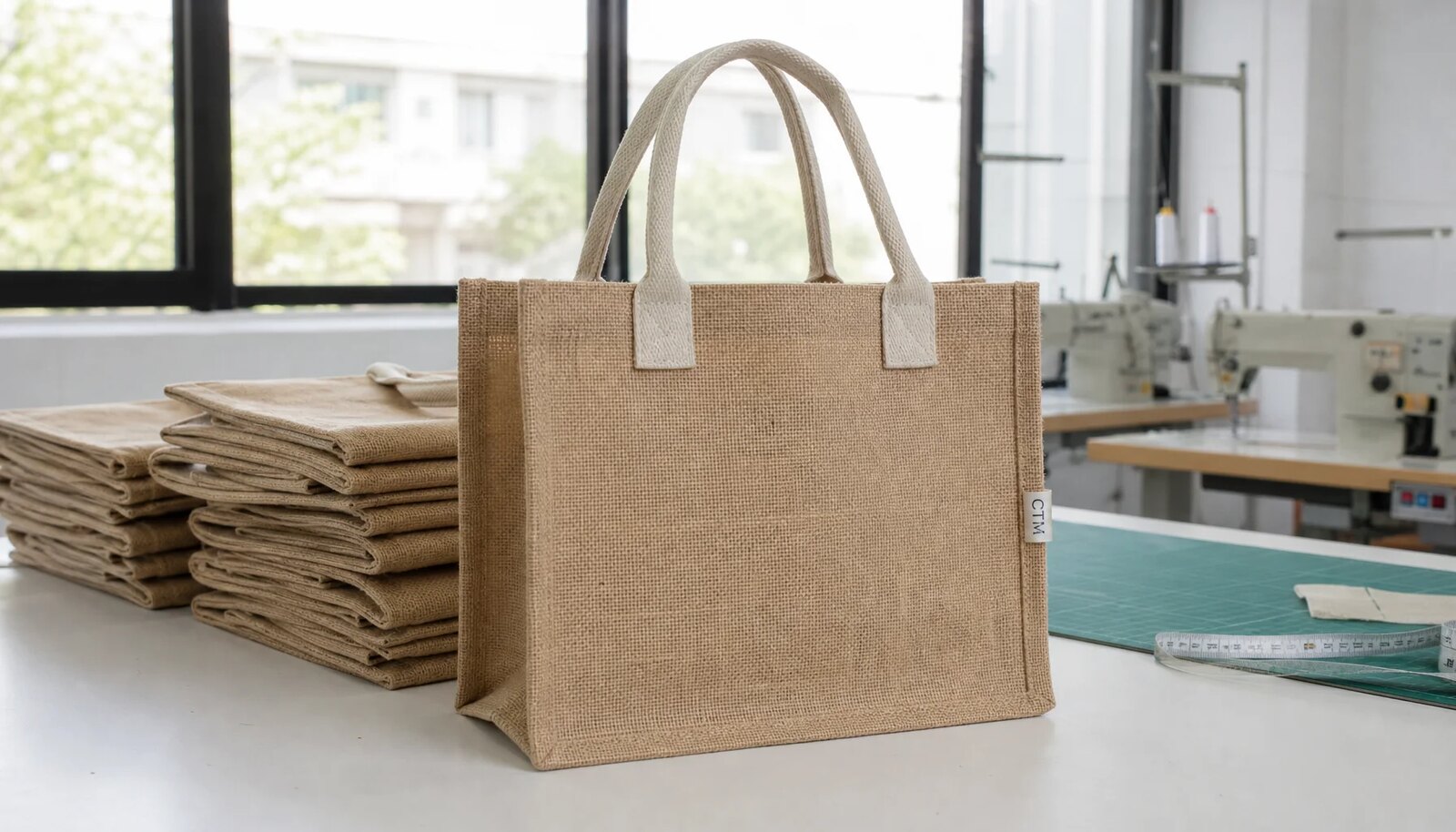
Why this sourcing job fails when the quote sheet is too thin
Jute tote bags look simple, but event orders fail for predictable reasons: the supplier quotes a low unit price, then changes the fabric weight, prints too small, ships late, or packs the wrong way for distribution. Event planners often buy for a one-day activation, so there is no time to recover from a weak sample or a carton problem. The goal is not just to buy a bag. The goal is to receive a consistent item that can be packed, handed out, and branded without last-minute fixes.
A proper compliance checklist gives the supplier a narrow lane. It tells them what fabric to use, how the logo must print, what carton format the warehouse can receive, and what evidence they need to show before bulk starts. That reduces quote ambiguity and makes supplier comparison possible. If two quotes are based on different fabric weights, different print methods, and different packing assumptions, the lower price is usually false economy.
- Compare quotes only after the bag size, fabric weight, print method, and pack count are fixed.
- Treat sample approval as part of compliance, not as a courtesy step.
- Use the quote to expose hidden costs such as logo setup, inner packing, or carton marking.
Lock the bag spec before you compare suppliers
For event use, the most common mistake is leaving the bag specification vague. A supplier may interpret 'medium jute tote' as almost any size or cloth weight. That is a problem because jute fabric behaves very differently at 10 oz, 12 oz, and 14 oz. A light bag may be acceptable for flyers and a T-shirt, but it will distort or strain if the event kit includes a bottle, catalog stack, or boxed sample. If the bag is a premium giveaway, specify the body weight and handle reinforcement before you ask for price.
The same logic applies to construction. State the finished dimensions, gusset depth, handle drop, stitch allowance, and whether you need a laminated inside, lining, or cardboard insert. A supplier that knows the true requirement can quote accurately and flag risks early. A supplier that receives only a sketch will often fill the blanks with standard assumptions, and that is where production mistakes start.
- Use finished dimensions in millimeters or inches, not only a marketing-size name.
- Write the target fabric weight in oz or GSM and allow only a narrow tolerance.
- Define whether the bag must stand upright, fold flat, or stay soft and unstructured.
Choose the right jute construction for event use
Jute is not one material class in practice. There is variation in weave density, yarn thickness, surface finish, and how the bag is stitched. A 12 oz natural jute tote with reinforced handles is a common starting point for event planners because it balances appearance, cost, and strength. For a premium kit, moving up to 14 oz or adding a laminated lining can improve shape retention and make the bag feel more controlled on a table or registration desk.
For lighter handouts, 10 oz can work if the contents are small and the bag is not expected to survive repeated reuse. The buyer risk is not only fabric failure; it is also presentation. A very light weave can show irregularity in printing and can look loose or unfinished once filled. Ask for a fabric reference swatch and a sewn sample that matches the intended load. If the bag will carry sharp corners or heavy inserts, the stitch density and handle anchor become as important as the cloth weight.
- 10 oz: suitable for flyers, event maps, and light swag.
- 12 oz to 14 oz: suitable for mixed kits, retail promotions, and premium giveaway bags.
- Laminated lining: useful when the event contents need stiffness or moisture resistance.
Print method drives appearance, cost, and reject rate
The best print method depends on the artwork, run size, and finish you want. Screen print is usually the strongest choice for simple logos, one to three spot colors, and repeat orders. It is cost-efficient at scale and gives better ink build on textured jute than many transfer methods. The tradeoff is that registration has to be managed carefully, because the weave can distort fine detail and thin lines can break up visually.
Heat transfer or digital transfer can help when the artwork is detailed, multicolor, or needed in a smaller pilot run. It reduces setup burden, but the buyer should not treat it as a free substitute. On rough jute, transfers can crack, lift, or look plastic if the base material is too coarse. For event buyers, the right test is not the digital mockup. It is a physical sample inspected under normal handling light, with rub and fold checks where the print will be touched most.
- Simple brand mark: screen print is usually the cleanest and most durable choice.
- Detailed graphics: transfer methods may be faster, but require extra durability review.
- Always approve logo size, placement, and color against the actual fabric texture.
Compare supplier routes before you decide who should quote
Not every supplier route creates the same risk. A direct factory with sewing, printing, and packing in one place gives the clearest chain of responsibility. That is usually the best route when the event date is fixed and the order needs one accountable production manager. A trading company can still be a workable partner if they name the real factory, share the process, and can explain how they control print and packing quality. The problem is not the middleman itself; the problem is opacity.
If you are buying for a distributor network or a multi-city event program, supplier route matters as much as price. A factory that can show work-in-process photos, sample sign-off, and carton labeling control is easier to manage when the order must move through warehouse receiving and field distribution. A reseller who only forwards a mockup and a price is not enough. Ask the supplier how they will prove material identity, who approves the pre-production sample, and who owns the final packing standard.
- Direct factory: best for control, tighter specs, and repeat replenishment.
- Trading company with named factory: acceptable if documents and inspection steps are clear.
- Local decorator: useful for tiny runs, but often weak on exact fabric matching and packing discipline.
Use a quote format that exposes hidden costs
A good quote for custom jute tote bags should not stop at unit price. It should show fabric basis, print setup, sample cost, packing count, carton size, lead time, and any surcharge for lining, lamination, or special handles. If the supplier offers a low unit price but charges extra for carton marks, inner packing, or artwork revisions, the final landed cost can move quickly. Event buyers need to see the full cost structure before the order is approved.
Ask for pricing tiers by quantity, because MOQ logic in jute products is often tied to printing setup and cutting efficiency. A run of 500 bags may carry a much higher percentage of setup cost than a run of 5,000. That does not mean the cheap quote is bad. It means the buyer has to read the breakpoints and decide whether the order is a one-time event purchase or the first replenishment of a continuing program.
- Request separate lines for bag body, print, sample, packing, and special trim.
- Compare quote tiers at the same fabric weight and print method.
- Watch for vague language such as 'standard packing' or 'as per actual' without detail.
Sample approval should test structure, print, and packing together
A sample is not approved just because the logo looks acceptable. For jute tote bags, the sample should prove three things at once: the bag structure holds shape, the print sits correctly on the weave, and the packing format works for receiving and distribution. If the sample has the right art but the handles twist, the bottom seam puckers, or the carton overfills, the order is not ready. That is especially true for event planners who may need to move thousands of units into a venue in a narrow window.
Use a gold sample process. Approve one physical sample as the standard for bulk, then keep it on file with annotated notes on measurements, print placement, and acceptable variation. If the supplier revises the fabric lot or print screen after approval, you need an updated sign-off. A fast correction now is cheaper than a field issue when staff discover bags are uneven or the print is off-center on the opening day.
- Measure width, height, gusset, and handle drop on the physical sample.
- Review print edge sharpness, color density, and alignment on textured weave.
- Approve the carton count and pack orientation with the sample, not after mass production.
Packing details matter more than most event teams expect
Jute bags are bulky, and packing mistakes create receiving delays fast. If the supplier compresses the bags too hard, they arrive creased and may need time to recover. If the carton count is inconsistent, the warehouse team loses time recounting units. If dust, loose fibers, or odor are present, the bags may require repacking or rejection. Packing is not a minor detail; it is the last stage where a supplier either preserves or destroys the quality that was achieved in sewing and printing.
For event planning, carton packing should support downstream handling. That means a clear pack count per carton, a reasonable carton size, proper corner protection if needed, and external marks that help warehouse staff identify the product quickly. If the bags go directly to a venue, add a label format that makes distribution simple. If they go to retail storage, confirm whether the cartons are stackable and whether the bag handles will be crushed under load.
- Set carton pack count by warehouse handling, not by supplier convenience.
- Require clean, odor-free packing with no visible dust or fiber contamination.
- Ask for carton dimensions and gross weight so freight and receiving can be planned accurately.
Lead time risk is usually a materials problem, not a sewing problem
Many jute orders slip because the supplier did not book the correct fabric, print screens, or packing materials early enough. Sewing a bag is often the last part of the schedule. The real timing risk sits in material confirmation, sample approval, and any artwork revision loop. For event buyers, that means the timeline should be broken into stages: art sign-off, sample production, sample approval, bulk material booking, mass production, packing, and dispatch. A single flat lead time is too vague to manage.
The buyer should also separate factory time from shipping time. A supplier may quote a short production window, but that does not include transit, customs clearance, or local warehouse appointment booking. If the event has a hard date, build in slack. A good supplier will tell you where the schedule can slip: fabric availability, print curing, inspection backlog, or carton shortages. If the answer is only 'no problem,' the quote is not detailed enough.
- Get a dated milestone schedule, not just one total lead time number.
- Allow time for one sample revision if artwork or color must be corrected.
- Treat shipping and customs as separate risk items from production.
A practical landed-cost view for event buyers
The cheapest ex-factory quote is not always the best landed cost. For jute tote bags, freight can move materially with carton volume because the product is light but bulky. Packing density, carton size, and the number of bags per carton can change transport cost more than a small unit-price difference. If one supplier packs 50 units per carton and another packs 100, the same order may land very differently even before duty or local handling is added.
When comparing sources, calculate the full landed picture: unit price, print setup, sample cost, carton count, volume weight, and any local receiving fees. Also think about failure cost. If a cheaper supplier misses the event date, the replacement run can cost far more than the original savings. A careful buyer uses the quote to estimate both the direct spend and the operational risk.
- Compare by landed unit cost, not just factory unit cost.
- Watch carton volume because jute bags create air space even when folded.
- Include rework risk and emergency freight in the supplier comparison.
Specification comparison for buyers
| Supplier option | What to verify | Commercial advantage | Buyer risk to control |
|---|---|---|---|
| Direct sewing factory | jute roll photos, lamination sample, odor-control process, handle pull evidence, and pre-shipment carton condition photos | Better sample-to-bulk control and faster production feedback | May be weaker on export paperwork or branded packing unless checked early |
| Trading company | Factory name, production photos, trim-source proof, and who owns QC decisions | Can coordinate small mixed orders and extra services | Markup can hide real factory capability and slow defect decisions |
| Specialized bag workshop | handle stitching, side gusset, lamination edge control, inner seam cover, and fiber shedding tolerance | More practical for detailed construction, trims, and repeat programs | Capacity may be limited during peak seasons |
| Low-price general supplier | laminated or unlaminated jute, cotton-jute blend, inner coating, odor control, yarn thickness, and color shade variation | Useful for simple promotional runs with loose specs | Material downgrades, weak packing, and vague inspection scope can erase savings |
| Retail-ready supplier | airing time, moisture absorber, carton liner, bundle wrap, odor separation, and warehouse ventilation before loading | Can handle labels, SKU separation, carton marks, and receiving rules | Higher unit cost must be compared against reduced warehouse work |
| Compliance-focused supplier | Fabric records, labeling review, test plan, and production traceability | Safer for retail programs and repeat brand orders | Documentation claims need evidence, not only sales language |
| Local sample room plus bulk factory | Signed sample, bulk factory handoff, first-piece photos, and deviation owner | Good for complex branding before large production | Sample room quality may not match bulk line unless handoff is controlled |
Buyer checklist before sampling
- Lock the bag size in finished dimensions, not just flat cut size, and state acceptable tolerance for width, gusset, and handle length.
- State the jute weight target in oz or GSM and require the supplier to identify the exact cloth construction they will use.
- Define print method, logo size, placement, and acceptable color shift against a reference sample or Pantone target.
- Set the minimum handle strength expectation and require bar-tack or reinforced stitching at the handle joins.
- Confirm whether the bags need lining, lamination, or a cardboard insert to protect the contents and keep shape.
- Ask for pre-production samples, photo approval of bulk materials, and a final sealed sample before mass production.
- Specify carton pack count, carton strength, polybag requirement, and whether inner packing must stay free of odor or dust.
- Require a lead-time schedule that separates sample approval, material booking, sewing, printing, packing, and ship date.
- Ask for the supplier's inspection process, including defect thresholds for stitches, print registration, stain, and size variance.
Factory quote questions to send
- What exact jute fabric weight, weave, and finish will you use for the quoted bag, and can you share a cut sheet or spec sheet?
- Is printing done in-house, and if not, who is the subcontractor and what quality control does your team perform before packing?
- What is your MOQ by color, print method, and size, and how does the unit price change at each volume tier?
- Can you quote sample cost, sample lead time, bulk lead time, and the earliest ship week if artwork is approved today?
- What carton pack count, carton dimensions, and gross weight should we expect for shipping and warehouse receiving?
- Which defects are counted as major versus minor in your inspection standard for seams, handles, print, odor, and staining?
- Do you support carton marks, barcode labels, and destination labels, and are those included in the quote or charged separately?
- What payment terms, material deposit timing, and production start trigger do you require before booking materials?
Quality-control points to confirm
- Measure finished bag dimensions after pressing, not only after sewing, because jute can relax and shift after handling.
- Inspect handle stitching at both ends with a pull test on a reasonable sample from each lot, especially for heavy event kits.
- Check print placement against a centerline and verify that the ink sits cleanly on the weave without skipping or bleeding.
- Look for loose fibers, oil spots, glue marks, and odor, because these are common rejection causes in natural-fiber bags.
- Confirm seam allowance consistency at the side gussets and bottom, where weak control leads to split corners.
- Open cartons randomly to verify the pack count, stack direction, and whether bags are crushed or creased before shipment.
- Record actual net and gross carton weight, because large variances can point to missing units or packing errors.
- Approve one golden sample that captures fabric, color, print, stitch, and trim before the bulk run starts.