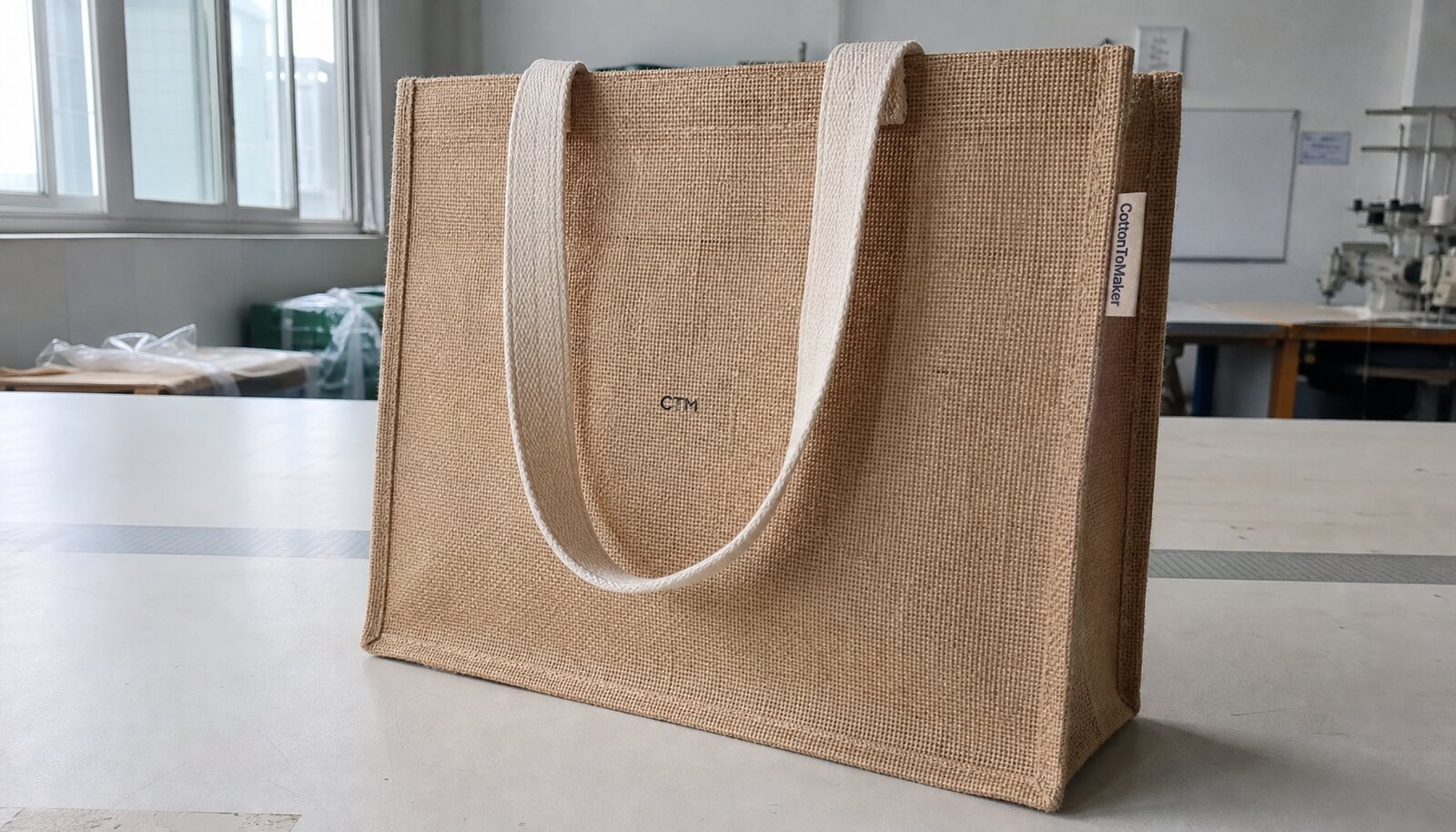
Start With The Winery Use Case Before You Ask For A Quote
Procurement problems on custom jute tote bags usually start before the supplier ever prices the order. The buyer sends a logo file, a rough size idea, and maybe a reference photo. The supplier responds with a unit price, but the order is still too loose to protect the winery brand, the warehouse team, or the retail shelf. Compliance in this context is not only about certificates. It is also about whether the bag can be made to the correct size, finish, print quality, and carton standard without rework.
Boutique wineries use jute tote bags in a few very different settings: tasting-room retail, wine club fulfillment, bottle gifting, event merchandising, and resale packaging. Those channels do not tolerate the same mistakes. A bag that looks good in a sample photo can still fail during receiving if the handles feel weak, the print bleeds into the weave, the odor is heavy, or the cartons are packed in a way that slows put-away. The most reliable sourcing process is to define the use case first, then build the supplier compliance checklist around that exact use.
- Name the channel in the RFQ: retail, club, gift-with-purchase, event giveaway, or resale.
- State the intended load before pricing so the factory can match handle and seam construction.
- Treat the first order as a production standard, not as a one-off promotional buy.
Choose A Jute Construction That Fits Bottles, Gifts, And Shelf Display
For winery tote programs, the fabric construction matters more than a broad label like natural jute. Plain woven jute in a lighter build can work for soft goods or simple retail use, but it can feel floppy and lose shape when the bag needs to carry bottles or heavier gift sets. A heavier build gives more body, better seam behavior, and a more premium hand-feel, but the buyer should ask for the actual spec rather than a marketing range. If the quote only says heavy quality, it is not comparable.
Geometry matters as much as fabric. A flat tote without a gusset is cheaper, but it is harder to pack neatly and often looks underbuilt beside premium wine packaging. A bottom gusset improves shelf presentation and bottle stability; a side gusset helps with broader gift sets and multi-item purchases. Handle construction is equally important. Wide cotton webbing handles are usually easier to carry than thin jute handles, and a reinforced anchor with X-box or bar-tack stitching is safer than a simple straight seam when the bag is meant to hold weight.
For boutique wineries, the decision is rarely just about whether the bag can carry a bottle. It is about how the bag behaves in a tasting room, at a club pickup counter, or on a retail shelf. A structured bag that stands better may justify a higher unit cost if it reduces customer complaints and looks more intentional at point of sale. The right supplier should be able to explain how the construction supports that use, not only how it lowers cost.
- Tie fabric choice to load and shelf presentation, not just price.
- Ask for a measured fabric weight and the supplier’s measurement method.
- Specify handle width, length, and reinforcement style in the RFQ.
- For bottle carriers, ask for a physical fit check with the exact bottle diameter or a sample bottle class.
Verify The Supplier Is The Actual Producer Of The Build You Are Buying
A compliance checklist is only useful if the supplier can show evidence instead of only saying yes. Start with business legitimacy: factory legal name, address, registration details, and the exact legal entity that will appear on the invoice. Then move to process proof: which steps happen in-house, what is outsourced, and where the printed bag is actually cut, sewn, and packed. If the bag uses coating, lining, a sewn patch, or special packing, the evidence should cover those parts too.
The document set should match the risk of the order. If your winery has retail or customer-facing standards around chemical exposure, odor, or packaging, ask for the relevant declarations or test reports for the exact build, not a generic catalog file. The common sourcing mistake is to accept a document that belongs to another factory, another fabric weight, or an older version of the product. That creates a false sense of compliance and usually shows up later as a quality claim or a warehouse rejection.
It also helps to separate production evidence from sales language. Ask for recent photos of the current line, not only polished catalog images. A current photo set should show the stitching area, handle attachment, print station, and packed carton condition. If the supplier hesitates to identify the production site or cannot explain which workshop does the sewing, treat that as a sourcing risk, not a minor admin issue.
- Request documents tied to the quoted factory name and current production site.
- Ask whether the quoted supplier is the actual manufacturer or a trading layer.
- Verify that any test report matches the exact fabric, handle, print, and packing build.
- Ask for current production photos, not only brochure images.
Use A Supplier Route That Matches Order Size, Complexity, And Reorder Behavior
Supplier type changes compliance risk as much as price does. A direct sewing factory usually gives the best control over stitch quality, print repeatability, and production feedback. A trading company can help when the buyer needs one contact for several bag styles or a lower-volume mix, but it adds a layer between the quote and the production floor. A workshop or local converter can be practical for a small replenishment run, yet it may have less control over fabric sourcing or document consistency. The buyer should not choose the route only by headline price.
For boutique winery programs, the real question is how the order will be used. If the bag will reorder through the season, direct factory control is usually worth the setup work because the spec can be repeated. If the order is a seasonal trial, a trading company may be acceptable as long as QC ownership is written down. If the job is urgent and the spec is already frozen, a converter can be the fastest path. What matters is who owns defects, who can approve a deviation, and who can remake a failed lot without argument.
Seasonal behavior matters here. Winery demand is often tied to harvest events, tasting-room launches, holiday gifting, and club renewal periods. A supplier who can produce well in spring may still struggle if the same order is placed during a peak gifting window. Ask about queue timing, not only standard lead time, and ask how the factory handles partial reorders when only one artwork or size needs a refill.
- Direct factory: strongest fit for repeat orders and tighter process control.
- Trading company: useful for mixed programs, but the QC owner must be named in writing.
- Local converter: fast for repeats, but verify that materials still match the approved spec.
- Ask how the supplier handles rush periods and whether seasonal queueing changes the promised lead time.
Approve The Sample As A Production Standard, Not As A Nice Photo
The fastest way to lose a tote order is to approve a sample by eye only. For custom jute tote bags, the pre-production sample should be treated as the production standard. Measure the finished dimensions, verify the fabric weight, compare the print position to the artwork proof, and check the handle placement against the spec sheet. If the sample is off in size or finish, the bulk order will usually drift further, not improve. A photo is not enough; a physical sample is the only practical approval tool for jute.
Use realistic functional checks. For a retail tote, a simple static load check is useful, especially if the bag is expected to carry bottles or heavier gifts. The test does not need a lab story; it needs to show whether the handles creep, the seams open, the print distorts, or the body sags badly under normal use. Also inspect the details buyers often miss: loose threads, uneven gussets, needle marks, glue spots from labels, odor from finishing agents, and how the print looks when the bag is folded.
A good sample review also answers packaging questions. Does the bag recover after folding? Does the jute surface shed onto the print? Does the handle sit flat, or does it twist during use? These are practical issues that affect how the product presents at a tasting room counter or inside a gift box. If the supplier wants approval on one sample but the sample is visibly cleaner than the bulk plan, ask them to explain what changes in production will keep the bulk aligned with the approved version.
- Approve one golden sample and use it as the production reference.
- Record dimensions, handle placement, print location, and seam quality on the sample form.
- Test load, rub resistance, and fold-line behavior before releasing bulk production.
- Ask what production changes, if any, are still permitted after sample signoff.
Write The Print And Branding Rules So The Artwork Survives The Fiber
Jute is an irregular, textured surface, so branding choices that work on cotton or coated canvas may not transfer cleanly. For most boutique winery programs, one- or two-color screen print is the most practical option because it gives solid logo coverage and predictable cost. Fine typography, hairline rules, and dense gradients can fill in on the weave, so the art should be simplified before the supplier prints. If the brand wants a more premium or more controlled look, a woven label or sewn patch often performs better than forcing a complex print onto an uneven surface.
Placement matters as much as the decoration method. A logo that crosses a seam or lands too close to the handle anchor can distort when the bag is filled. The buyer should specify the print area, the clear space around the logo, and whether the mark should sit centered, low, or aligned to one edge. For some wineries, a small side label plus a clean front print is enough. For others, a single woven patch with the winery name works better. The point is to keep the decoration tied to the product use and the retail shelf, not to over-decorate a material that already has visual texture.
For a procurement team, the useful question is not only what branding method is cheapest. It is what method will still look intentional after the bag has been folded, handled, and carried. A supplier that understands jute should be able to advise on artwork simplification, print contrast, and placement so the final bag does not lose legibility at the shelf or look crowded on the weave.
- Use screen print for simple logos and controlled cost.
- Use a woven label or sewn patch when the logo has fine detail or the brand wants a more premium finish.
- Do not place artwork over seams, folds, or the handle anchor zone.
- Simplify typography before print if the design relies on thin strokes or small taglines.
Set Measurable Quality-Control Tolerances Before Production Starts
This is the part many buying teams leave too vague. If the supplier says the bags are good but you never defined a pass/fail band, the factory will make its own judgment. Put the acceptance limit into the PO or spec sheet. For a small retail tote, a practical example is a tight finished-size tolerance, with no more than a stated number of sample units outside the band. The exact limit should fit the channel, but the point is to avoid a phrase like close enough.
Set measurable criteria for visible and functional defects. If the bag is printed, define acceptable registration drift, ink coverage, and whether minor weave pinholes are allowed. If the handles are sewn, define the stitch pattern, the anchor reinforcement, and the pull-test result you expect. If the bag has a woven label or sewn patch, define the placement tolerance and the allowed edge condition. Also define what counts as a major defect: open seam, missing stitch line, torn handle, strong odor, contamination, or a mismatch in color that would be obvious on shelf.
Inspection should not be a single visual glance. Ask for first-piece approval, in-line checks if the run is large enough, and a final carton audit. If you use an external inspector, tell them to check carton count, master carton mark, pack consistency, and at least one opened carton per the sampling plan. For boutique wineries, the most expensive problem is often not a catastrophic failure; it is a lot that looks acceptable until the retail team opens cartons and finds variation across the run.
A useful QC file should read like a short operating guide, not a generic inspection slogan. Put the acceptance criteria in the same language the factory uses on the floor. If the buyer and supplier share the same defect list, there is less room for disagreement after production starts.
- Put finished-size tolerance in the spec sheet; do not rely on the sample alone.
- Define defect categories: critical, major, and minor, with examples for each.
- Require first-piece approval before the full run continues.
- Use an opened-carton check so hidden pack issues do not pass undetected.
Build Packing And Carton Requirements Around Receiving, Not Just Freight
Packing is where a strong product can still become an expensive receiving problem. Jute can pick up dust and it can release loose fibers, so the buyer has to decide whether each bag needs a polybag, a paper wrap, or no inner pack at all. Retail programs often want cleaner individual packing, while club shipments or warehouse replenishment may prefer a simpler bulk pack to control cost and reduce plastic. The right method should come from the channel requirement, not the supplier’s default.
Master carton planning should be part of the quote. The carton count affects handling labor, warehouse put-away, and damage rate. If the bags are going to multiple store locations, ask for carton packing by SKU and by store if needed. If the order will move by pallet, check outer carton strength, gross weight, and whether the supplier can keep carton dimensions within your freight target. A carton that is too large raises freight cost; a carton that is too weak can crush the jute surface before it reaches the shelf.
Ask for carton photos before dispatch, not only after the truck leaves. The receiving team should know the carton marks, SKU code, count per carton, and whether the bags are folded the same way across the lot. If your wine club or retail operation uses barcode scanning, make that a packing requirement upfront. It is better to pay a little more for packing that speeds receiving than to save on the invoice and pay for labor in the warehouse.
- Choose individual packing only if the channel needs it; do not pay for unnecessary plastic.
- Ask for carton count, carton size, gross weight, and carton marks in the quote.
- Require SKU labels and receiving marks so the warehouse does not need to relabel the goods.
- Request carton photos before dispatch and verify the fold method across samples.
Price The Order As A Landed Program, Not A Bag Price
A meaningful quote compares the full cost structure, not just the unit price on the first line. For custom jute tote bags, ask the supplier to break out the bag body, handle spec, print setup, sample fee, packing method, carton spec, and any charges for color changes, label application, or test reports. If the supplier only gives a lump-sum number, you cannot tell whether the low price is real efficiency or hidden scope gaps. The same order can look cheap at factory level and expensive once packing, rework, and inland freight are added back in.
Boutique winery buyers should compare quotes by landed cost and receiving cost. A slightly higher factory price may be cheaper if it includes tighter QC, cleaner packing, and fewer compliance gaps. A lower-priced supplier can become expensive if artwork shifts, cartons are weak, or the print method needs rework after sampling. The commercial question is simple: which offer delivers the right bag at the shelf with the least recovery work from your team? That is the number that matters, not the headline unit price alone.
This is also where the buyer should ask for quote clarity on overruns and underruns. If a winery needs exact counts for club fulfillment or retail launch packs, a loose quantity policy can create mismatches even when the unit price looks attractive. Make sure the supplier states whether the approved quantity includes acceptable variance and how they handle under-shipment versus over-shipment.
- Separate base bag cost from setup, packing, and document cost.
- Compare offers on the same incoterm only after the scope is identical.
- Include defect risk and rework cost in the decision, not only invoice price.
- Confirm the overrun/underrun policy before comparing suppliers.
Plan For Seasonal Reorder Behavior And Wine-Channel Operations
Boutique wineries do not buy tote bags like a generic promotional buyer. Reorders often follow harvest events, tasting-room campaigns, wine club renewals, holiday gifting, and special releases. That makes timing and replenishment behavior part of the procurement spec. A bag that works for one launch can become a headache if the winery needs a refill in a shorter window. Ask whether the supplier can repeat the same build later without changing fabric tone, print setup, or packing style.
Bottle formats matter too. A tote meant for one standard bottle is a different product from a carrier meant for two bottles, a boxed gift set, or a mixed item bundle. Internal dimensions should be checked against the actual bottle diameter, neck height, and the way the bag will be used at the counter. If the winery sells a narrow bottle, a wide bottle, or a boxed item, that should be stated in the spec. A supplier who understands bottle presentation will ask whether the bag needs to sit upright on a shelf, slide into a gift box, or move directly from counter to car.
Retail presentation is another practical issue. In a tasting room, the bag is not just packaging; it is part of the brand experience. Buyers should decide whether they want a clean natural finish, a premium woven label, a bold front print, or a more understated mark that complements the bottle label. The bag should look deliberate next to the winery’s existing packaging and point-of-sale display. If the retail team will hand the bags across a counter, ask how the handles hang, whether the bag stands flat, and whether the decoration remains visible when folded or stacked.
- Match tote dimensions to the actual bottle or gift format, not only to a generic bag size.
- Plan reorder timing around harvest, holidays, and club renewal periods.
- Ask whether the bag must stand upright, stack cleanly, or fit into an existing gift box.
- Treat the tote as retail-facing brand packaging, not only as a carry item.
Specification comparison for buyers
| Supplier option | What to verify | Commercial advantage | Buyer risk to control |
|---|---|---|---|
| Direct sewing factory | jute roll photos, lamination sample, odor-control process, handle pull evidence, and pre-shipment carton condition photos | Better sample-to-bulk control and faster production feedback | May be weaker on export paperwork or branded packing unless checked early |
| Trading company | Factory name, production photos, trim-source proof, and who owns QC decisions | Can coordinate small mixed orders and extra services | Markup can hide real factory capability and slow defect decisions |
| Specialized bag workshop | handle stitching, side gusset, lamination edge control, inner seam cover, and fiber shedding tolerance | More practical for detailed construction, trims, and repeat programs | Capacity may be limited during peak seasons |
| Low-price general supplier | laminated or unlaminated jute, cotton-jute blend, inner coating, odor control, yarn thickness, and color shade variation | Useful for simple promotional runs with loose specs | Material downgrades, weak packing, and vague inspection scope can erase savings |
| Retail-ready supplier | airing time, moisture absorber, carton liner, bundle wrap, odor separation, and warehouse ventilation before loading | Can handle labels, SKU separation, carton marks, and receiving rules | Higher unit cost must be compared against reduced warehouse work |
| Compliance-focused supplier | Fabric records, labeling review, test plan, and production traceability | Safer for retail programs and repeat brand orders | Documentation claims need evidence, not only sales language |
| Local sample room plus bulk factory | Signed sample, bulk factory handoff, first-piece photos, and deviation owner | Good for complex branding before large production | Sample room quality may not match bulk line unless handoff is controlled |
Buyer checklist before sampling
- Define the channel first: tasting-room retail, wine club shipment, bottle gift, event giveaway, or resale packaging. The use case determines bottle fit, finish level, and packing needs.
- Lock the bag size, gusset, handle length, and intended load before requesting pricing. A tote that looks good flat can behave very differently once it carries bottles or boxed gifts.
- Specify the fabric construction in the RFQ: plain woven jute, laminated jute, jute-cotton blend, or another approved build. Do not rely on the phrase natural jute alone.
- State the target fabric weight and ask the supplier to explain how it is measured. If their method is different from yours, note it before sample approval.
- Send vector artwork and state the print count, placement, and any minimum line width your design can tolerate. Jute weave can close in fine detail faster than smoother fabrics.
- Decide whether the bag needs a woven label, sewn patch, inside coating, or print only. Extra branding can improve shelf appeal, but it also changes cost and lead time.
- Request the legal factory name, address, and the legal entity that will appear on the invoice, packing list, and any export paperwork.
- Ask for a pre-production sample and define it as the approval standard. Bulk production should not start until the sample matches the frozen spec sheet.
- Require written defect handling terms: remake, credit, replacement, and who pays return freight if the batch fails the agreed criteria.
- Confirm carton count, carton dimensions, gross weight, pallet pattern if used, and whether store barcodes or SKU labels are needed at receiving.
Factory quote questions to send
- What is the exact fabric build in this quote, including weave type, surface treatment, and whether the material is laminated or unlaminated?
- Can you state the measured fabric weight you will cut to, and what tolerance you hold on that material lot?
- Which steps are completed in-house at your facility, and which steps are outsourced to another workshop or converter?
- What is the MOQ for this exact size, print method, handle style, and packing method?
- Can you provide a pre-production sample, and which details are still allowed to change after sample approval?
- What is your measurement tolerance for finished width, height, and gusset depth?
- What is the stitch specification for handle attachment, and do you use bar-tack, X-box, or another reinforcement method?
- What are the standard carton pack, carton dimensions, inner pack method, and master carton gross weight?
- What is your lead time after sample approval and deposit, and what events extend it?
- What is your overrun/underrun policy, and how do you handle remake or replacement for rejected lots?
Quality-control points to confirm
- Finished dimensions should be checked against the frozen spec with a stated tolerance. Record width, height, and gusset depth on samples from each lot or carton group, especially when the bag must fit bottles or shelf dividers.
- Fabric weight should match the approved target, and the supplier should show how it was measured. Avoid accepting a generic description such as standard quality without a number or method.
- Handle width, handle length, and handle placement should match the approved sample. Check that both handles align and that anchor points are symmetrical, with no visible twist or uneven pull.
- Run a handle pull test on samples using an agreed load and hold time. For winery retail bags, the useful screen is whether the handles tear, creep, or show stitch failure under the intended bottle or gift load.
- Seam quality should be checked for straightness, back-tack consistency, trimmed threads, and no raw edges. Reject open stitches, skipped stitches, broken thread ends beyond the buyer limit, or seam distortion that affects appearance or strength.
- Print placement should stay within the approved position window. Require the supplier to define the acceptance band in millimeters or centimeters so the logo does not drift over seams, folds, or the handle anchor zone.
- Print clarity should be checked under normal retail viewing distance and under close inspection. Accept only even ink coverage, no major pinholes, no heavy bleeding, and no obvious cracking at the sample stage.
- Odor should be checked on arrival and after unpacking. Strong chemical, moldy, or musty smell should trigger quarantine until the supplier explains the source and resolves it.
- Surface cleanliness should be inspected for loose jute fibers, glue spots, oil marks, dust, and stray lint. Define the cosmetic limit before production so minor visible defects do not become a dispute later.
- Woven labels, sewn patches, or side labels should be centered and firmly attached. Check that edges are not scratchy, the label is not folded, and no stitch break is visible from the face side.