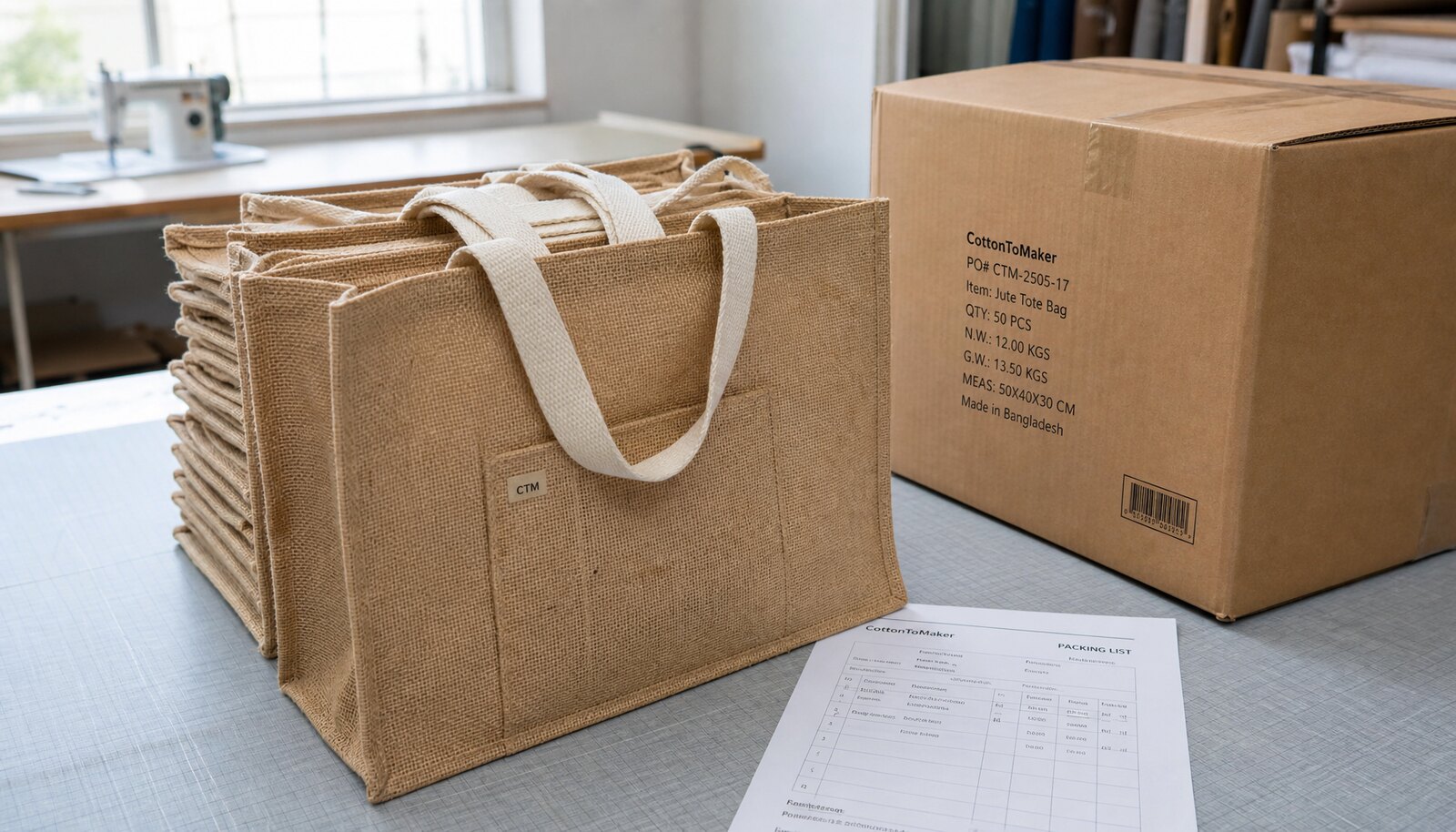
Why carton planning changes the real cost of jute tote bags
For gift shops, a jute tote is not just a bag with a logo. It is a shelf item, a checkout impulse buy, a seasonal gift add-on, and sometimes a branded giveaway that needs to arrive looking intentional. That is why carton planning matters so much. The carton controls how many bags move per shipment, how much the freight costs, how much receiving labor the store or warehouse spends, and how many units are still neat enough to display when they arrive. The wrong carton plan can erase the savings from an otherwise competitive bag price.
Jute behaves differently from cotton or nonwoven fabric. It is stiffer, it holds folds, and it can crease in a way that looks permanent once packed too tightly. It also sheds a little fiber dust, especially at cut edges and around rough seams. If the pack is too loose, the bags rub against each other and the print can scuff. If the pack is too tight, the handle bend marks and corner creases become visible when the store opens the carton. That is why procurement buyers should think of the order as a combined bag-plus-pack system.
The most useful quote is the one that shows the product, the fold, the carton, and the freight effect in one view. A quote that only gives unit bag cost often hides the real landed-cost driver: a poor carton dimension that wastes cube or creates damage on arrival. For gift shop replenishment, a slightly higher unit cost is often cheaper in practice if the bags arrive flat, neat, and ready to go onto a shelf or into a display basket.
- The carton affects freight cube, damage rate, and store-ready presentation.
- Jute can crease permanently if the pack is too tight or too uneven.
- Compare landed cost per sellable bag, not only bag cost per piece.
Start with the end use: display, resale, or carry performance
Before you ask a factory for a carton quote, define how the bag will be used. A gift shop bag that sits on a shelf and carries small purchases has different requirements from a tote that must survive daily use. If the bag is primarily a display item, structure and appearance matter more than maximum load capacity. If it is meant to be sold as a reusable shopper, the handle reinforcement and seam quality become much more important. The carton plan should follow that decision.
A useful starting spec for many gift shop programs is 250–300 GSM jute. In that range, the bag normally has enough body to stand visually better than a thin craft tote, but it is still manageable in a shipping carton. Once the fabric becomes significantly heavier, the bag weight itself starts to affect carton gross weight, pallet density, and freight cost. If you add lining, a pocket, or a stiff board insert, those additions also change the packed volume even when the outside dimensions stay the same.
Handle construction should be decided at the same time as the bag body. Cotton webbing handles usually fold flatter and can be easier to pack neatly. Jute-wrapped handles can look more unified with the body but may create a thicker fold line. If the handle is bulky, the bag may need a slightly larger carton or a lower pack count to avoid squashing the handle base. That is a procurement decision, not just a design decision.
- 250–300 GSM is a practical retail range for many gift shop jute totes.
- Define the bag’s purpose first: display, resale, or heavier carry.
- Handle thickness affects carton count and fold quality as much as the bag body does.
How to compare bag builds without creating quote noise
Procurement buyers often receive quotes that cannot be compared because each supplier assumed a different build. One quote includes lining, another omits it. One uses cotton webbing handles, another uses jute handles. One packs 20 pieces per carton, another packs 30. If those differences are not normalized, the cheapest-looking offer can be the most expensive after freight and damage are included. The solution is to compare one locked spec across all suppliers.
A clean normalization sheet should include bag size, gusset depth, fabric weight, handle length, stitching reinforcement, print method, print area, and the exact packing format. If a supplier proposes a lower GSM or fewer reinforcement stitches, that is not a cheaper quote for the same item; it is a different item. Likewise, a custom carton with print marks and a standard brown export carton are not the same packaging solution. Ask each supplier to quote both the base bag and the packing structure so the comparison is apples-to-apples.
For gift shop buyers, the most common mistake is to treat decorative detail as a minor add-on. In reality, small details can change the carton plan. A sewn patch, an extra-thick handle, or a paper board insert might only raise unit cost slightly, but it can also reduce carton count, increase cube, or force a bigger carton. That is why the quote should show not only what the bag is, but what the bag becomes after it is packed for shipment.
- Normalize all quotes to the same GSM, handle, print, and carton assumptions.
- Do not compare a standard carton against a custom printed carton without adjusting the landed cost.
- A small product feature can change cube and freight more than expected.
Print method choices for rough jute surfaces
Jute is textured, porous, and visually irregular, so print decisions need to be made against the actual fabric rather than a flat mockup. Simple one- or two-color screen printing is usually the safest procurement choice for most gift shop programs because the result is legible, repeatable, and easier to control at scale. If the art has fine lines, gradients, or photographic detail, the supplier may suggest heat transfer or another specialized method, but that option should be tested carefully on the actual jute batch.
When evaluating print, ask for the print area in millimeters, the ink coverage, the number of colors, and whether the artwork sits anywhere near a fold or handle stress zone. Logos placed across a fold line often crack during packing even if they look fine in a flat sample. A woven label or stitched patch can create a premium look, but it also adds a little thickness and can affect how tightly the bag nests in the carton. The point is not to avoid premium finishing; the point is to price its packing impact correctly.
For practical gift shop sourcing, the best decoration method is the one that survives normal handling without forcing a larger carton or a lower pack count than necessary. If the design is simple, do not overcomplicate it. If the design is detailed, ask the supplier whether a label, patch, or simplified print version would preserve legibility while keeping the pack efficient.
- Screen print is often the most stable option for simple retail branding.
- Test any detailed art on the actual jute surface, not a smooth reference material.
- Avoid placing critical artwork across fold lines or handle anchor zones.
Packing formats, fold methods, and what to document in the sample
The pack method should be written down before bulk production starts. Flat packing is usually the starting point for gift shop jute totes, but “flat” can mean many things. Some factories fold the bag once, some twice, some tuck the handles inward, and some wrap the bag in tissue or a paper board. If the supplier does not show the fold sequence, the result may vary from operator to operator, which leads to uneven carton fill and inconsistent appearance at receiving.
Only use inserts if they solve a real problem. A paper board can help keep a printed front panel clean and prevent the handle from embossing into the logo area. Tissue can reduce surface rubbing on matte or lightly printed bags. But if the insert is too rigid or too large, it can increase pack thickness and reduce the carton count. Many buyers assume inserts are harmless because they are thin; in practice, they often change the whole pack geometry.
For RFQs, request two pack scenarios whenever freight or warehouse efficiency matters. For example, ask for a lower-count carton and a higher-count carton, each with the same bag spec, then compare carton dimensions, gross weight, pallet density, and handling risk. A 20-piece carton may cost more per bag on paper, but if it significantly lowers cube and reduces damage, it may be the better landed-cost choice. For some programs, the best answer is not the largest carton, but the most stable one.
- Document the exact fold sequence with photos or a diagram.
- Use inserts only when they improve appearance or prevent scuffing.
- Request at least two pack-count options to compare cube and handling risk.
Sourcing-route comparison: factory-direct, trading company, or distributor
The sourcing route is not just a commercial preference; it changes how much packaging control you actually have. Factory-direct sourcing is usually the best route when you need the carton plan built into the production quote, because the maker can control cutting, stitching, printing, packing, and export cartons in one process. That makes it easier to tune pack counts and carton dimensions. The trade-off is that the buyer must be more precise in the brief and more disciplined about sample approval.
A trading company can be helpful when communication, project management, or multi-item consolidation matters. The downside is that carton and pack details may pass through another layer before they reach the factory, which can create ambiguity if the buyer is not specific. A distributor or stockholder can be useful for speed and low internal coordination, but they often offer a fixed pack configuration. That is fine if the need is urgent and simple, but it is less useful when the carton needs to be optimized for a retail program or a seasonal ship window.
For a gift shop buyer comparing offers, the main question is: which route gives you control over the things that affect landed cost and shelf quality? If the supplier cannot show a sample carton size, a packing-list draft, and a clear fold method, then the route may be too opaque for a repeat procurement program. Reorders matter here. The best source is the one that can replicate the approved pack the same way next season without renegotiating every small detail.
- Factory-direct is strongest when you need carton optimization and repeatability.
- Trading companies can help coordination, but may add a layer of packaging ambiguity.
- Distributors are faster, but their carton format is often fixed and less configurable.
Comparison table: how sourcing routes differ in landed cost and operational control
Use the table below to normalize supplier offers. The key is to compare the same bag spec and then examine how each route changes freight, labor, and reordering risk. Landed cost is not only the ex-factory price; it includes carton efficiency, packing labor, repack risk, and the time spent resolving mismatched documents or unclear pack instructions.
If you are sourcing for gift shops, the most expensive failure is usually not a defect that is obvious on day one. It is the hidden operational cost of cartons that do not stack well, bags that arrive wrinkled, or a reorder that cannot be reproduced because the first supplier never documented the fold and carton logic. That is why route comparison should include operational control, not only price.
Sample approval: approve the bag in its carton, not just on a table
A pre-production sample should be judged in the same state the bulk order will ship in. A loose sample on a table can look excellent and still fail once folded, stacked, and placed in a carton. For this reason, procurement teams should ask for both a loose sample and a packed sample photo. If possible, request one actual packed sample carton so the team can inspect the fold, the bag compression, and the carton fill.
The sample review should check three things at once: appearance, repeatability, and shipping behavior. Appearance covers stitch neatness, print position, handle alignment, and overall presentation. Repeatability covers whether the fold can be reproduced by the production line without special attention. Shipping behavior covers whether the packed bags rub, crush, or spring open inside the carton. If you receive only one perfect sample and no packed reference, you still do not know whether the carton plan is safe.
For buyers with retail deadlines, one practical test is to simulate receiving. Shake the carton lightly, inspect the corners, and reopen it to see whether the bags shifted enough to leave fold marks or edge rub. Then check one bag after it has rested for a day. If the crease relaxes naturally, that may be acceptable for a retail display bag. If the bend remains sharply visible, the packing method needs adjustment before bulk shipment.
- Approve a packed sample, not only a loose sample.
- Inspect seam tension, handle alignment, print position, and fold behavior together.
- Simulate receiving by checking whether packed bags shift or mark each other.
Carton strength, drop behavior, and practical test thresholds
Carton quality advice becomes much more useful when it has thresholds. For export cartons carrying jute totes, a 5-ply carton is a sensible baseline in many programs, especially when the order will be palletized or moved through more than one handling point. That does not mean every 5-ply carton is sufficient; the final answer depends on pack count, gross weight, and the route. A lighter carton can still fail if it is oversized and underfilled. A stronger carton can still fail if the bags are packed in a way that concentrates pressure on one corner.
Ask the supplier what test method they use before shipment. For practical buyer control, the carton should be tested on the actual packed configuration, not as an empty board. A simple drop test from a modest handling height, along with a compression check under stacked cartons, is often enough to reveal whether the carton can survive normal warehouse and transit handling. The goal is not laboratory perfection; it is to prevent avoidable damage before the cartons leave the factory.
Useful acceptance language can be written into the purchase order or QC sheet. For example: no carton collapse at the corners, no seam opening, no noticeable bulging at the flaps, and no bag deformation that cannot be recovered after unpacking. If the route is long or the handling is rough, add a tighter standard for carton compression and edge crush. If the supplier cannot explain what they test, ask them to show the packed carton after testing, not just the empty carton spec.
- Use 5-ply as a starting point, then verify it against weight and route.
- Test the actual packed carton, not the empty board alone.
- Write clear failure language: corner crush, seam opening, bulging, or non-recoverable bag deformation.
Carton size planning: practical scenarios for gift shop orders
Carton planning becomes much easier when you think in scenarios. Suppose you have a medium tote at 35 x 40 cm with a 10 cm gusset and standard webbing handles. In one pack option, you may fit 20 pieces per carton with a safer headroom for the handles and sidewalls. In a denser option, you may fit 30 pieces per carton, but the carton may get heavier, the top layer may press on the lower handles, and the chance of permanent fold marks may rise. The best option depends on your freight model and your store presentation standard.
Here is the procurement logic buyers often use. If the bags are going directly to a warehouse and then to stores, a slightly denser carton can work if the carton is strong and the bags are not displayed immediately after arrival. If the bags go straight from carton to retail display or gift basket, a looser carton with better recovery may be worth the extra freight cube. This is why the pack count should be chosen together with the selling model, not treated as an afterthought.
A second scenario is a smaller tote, such as a 25 x 30 cm souvenir bag. Because the body is smaller, pack count may rise without creating as much deformation. Even then, do not assume the smaller tote automatically allows more units per carton. Handle thickness, print patch, and fold method can still create a thicker packed bundle. The carton should be designed around the actual folded sample dimensions, not only the flat bag dimensions on the spec sheet.
- Compare at least two pack-count scenarios before locking the carton.
- Warehouse-to-store flow may support denser packing than direct-to-shelf programs.
- Use folded sample dimensions, not only flat bag dimensions, to size the carton.
Specification comparison for buyers
| Spec decision | Recommended option | When it fits | Buyer risk to check |
|---|---|---|---|
| Sourcing route | Factory-direct with carton plan built into the quote | Best for repeat gift shop programs, seasonal replenishment, or private-label orders where the buyer needs consistent pack behavior and stable reorders | Some suppliers quote only the bag and later add repack, carton, pallet, or documentation costs; compare on landed cost per sellable bag, not factory unit price |
| Bag fabric weight | 250–300 GSM jute for a retail-facing tote with visible body | Fits gift shops that want the bag to stand up on shelves, hold shape after fold, and avoid the limp look common in thinner builds | Too light creates wrinkling and print distortion; too heavy increases unit cost, carton weight, and sometimes chargeable freight |
| Handle construction | Cotton webbing or jute-wrapped webbing with reinforced cross-stitch or bartacks | Fits bags that will be carried often by customers and need a cleaner retail feel | Weak handle anchoring can fail in pull tests; bulky handles can make flat packing uneven and raise carton cube |
| Print method | 1–2 color screen print for straightforward branding; woven label or stitched patch for premium positioning; heat transfer only when the art requires it | Fits gift shops that want legible logos, moderate decoration, and predictable repeatability | Fine artwork can blur on textured jute; heat transfer may look good on approval but crack or lift if the surface prep is poor |
| Packing format | Flat pack with a documented fold method; use tissue or paper board only if it prevents mark transfer or keeps the silhouette consistent | Fits buyers who need shelf-ready presentation, lower deformation, and efficient carton use | Overstuffed inserts create distortion and reduce pack efficiency; under-packed cartons allow movement, edge rub, and corner crush |
| Carton type | 5-ply export carton with clear carton marks, gross/net weight, and batch identification | Fits export shipments, palletized freight, and mixed-handling routes where cartons may be stacked or rehandled | Thin cartons or oversized cartons crush at edges, especially when bags are folded loosely or cartons are underfilled |
| MOQ logic | MOQ based on bag construction, print setup, and carton configuration rather than bag count alone | Fits buyers with one or two SKUs, seasonal drops, or replenishment programs needing repeatable specs | Low MOQ can hide higher packing cost; changing carton size later can be more expensive than agreeing to a standard pack upfront |
| Quality route | Pre-production sample plus packed-sample approval, then carton drop and compression check on the agreed pack | Fits first orders, new suppliers, or any order with a short retail window | Skipping packed-sample validation often leads to handle creases, print rub marks, crushed corners, and receiving delays |
| Freight planning | Optimize carton dimensions for pallet fit and chargeable weight, not only bag count | Fits importers focused on landed cost and warehouse efficiency | A few millimeters of wasted carton space can reduce pallet efficiency and raise the cost of every sellable bag |
Buyer checklist before sampling
- Confirm the jute GSM, whether the bag is lined, the handle material, and whether it is meant primarily for shelf display or heavier carry use.
- Lock the print method, artwork placement, and color count before requesting quotes; ask the supplier to show the exact printable area in centimeters.
- Define the fold method, carton pack count, and whether the bag ships flat, half-folded, or with a paper board or tissue insert.
- Request carton dimensions, gross weight, inner pack details, and estimated pallet count for at least two packing options.
- Ask for a pre-production sample plus a packed sample photo so you can inspect seam tension, handle anchoring, and fold behavior in the actual carton.
- Set acceptance limits for odor, fiber shedding, loose stitches, print rub, visible creasing, carton bulging, and corner damage.
- Require a packing list draft that matches the commercial invoice and carton marks before shipment is booked.
- If the order is seasonal, freeze the bag spec and carton spec before bulk cutting begins to avoid late rework.
- Ask the factory whether they can quote a standard carton with sticker labels as a lower-MOQ alternative to a custom printed carton.
- Check whether the shipment will be palletized, floor-loaded, or mixed with other SKUs, because the packaging answer changes with the route.
Factory quote questions to send
- What exact jute GSM, handle spec, seam reinforcement, and lining status are included in the unit price?
- What is the folded pack method, how many pieces per carton, and what are the gross and net weights per carton?
- Can you quote at least two carton options, for example 20 pcs/carton and 30 pcs/carton, so we can compare cube and freight impact?
- What are the carton dimensions for each packing option, and how many cartons fit on a standard pallet layer?
- Is the bag packed flat, folded once, or protected by tissue, paper board, or a polybag? If a polybag is used, is it vented?
- What is the print method, the included color count, and any setup fee for screens, plates, or color matching?
- Can you show a pre-production sample that reflects the final handle, print placement, and carton pack method, not only the loose bag?
- What is the MOQ by color, by print setup, and by carton configuration?
- What is the expected lead time after sample approval and deposit, including material sourcing, packing, and carton printing?
- What QC checks do you perform before shipment on stitching, handle pull strength, print registration, carton compression, and packing count?
Quality-control points to confirm
- Fabric weight should match the approved range with an acceptable tolerance agreed in writing; do not accept random substitution by feel alone.
- Cut edges should not show excessive fraying, open weaving gaps, or loose fiber shedding that transfers to the print or carton interior.
- Handle anchoring must survive a manual pull test and show even bartacks or cross-stitching on both sides; the stitching should not twist or pucker the panel.
- Print registration should sit within the approved tolerance, usually within a few millimeters for simple logo placement, and must not smear, crack, or rub off after fold handling.
- The folded bag should retain a clean silhouette after unpacking, with no permanent collapse at corners, gusset, or handle fold lines.
- Cartons should close without bulging; flaps should meet cleanly, and the carton should not show seam strain, corner crush, or soft sidewalls under normal stack pressure.
- Carton marks, SKU labels, batch references, gross weight, and destination information should be readable and consistent with the packing list and invoice.
- Finished bags should not carry a strong chemical odor, visible oil stains, or excessive dust that could transfer to retail shelving or other packed units.
- For export or long-haul routes, request a carton drop test and compression check on the actual packed configuration rather than on an empty carton.
- Accept only the sample fold method that can be reproduced consistently by the line; if operators improvise the fold, carton consistency will drift across production.