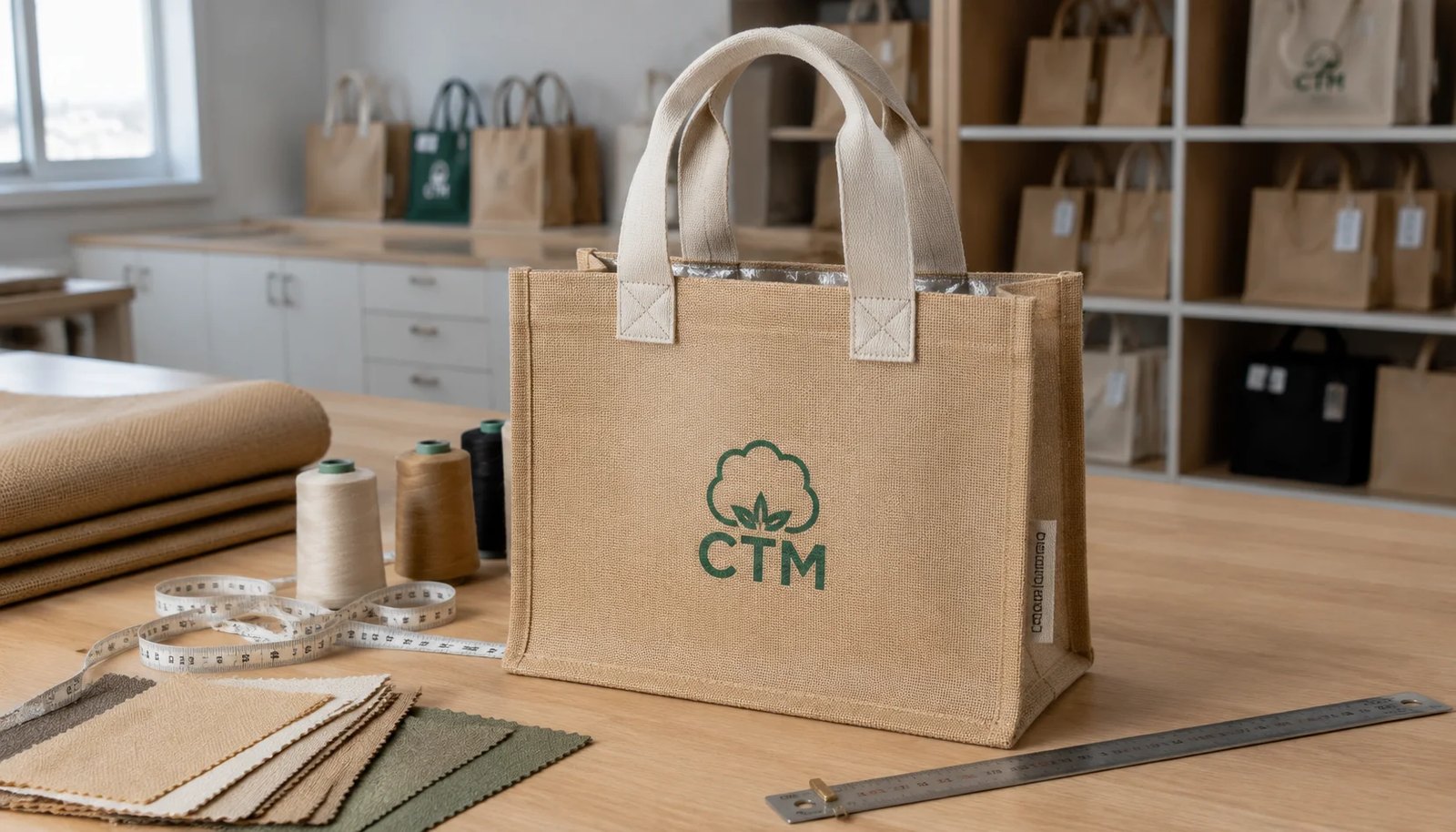
Why RFQs for jute tote bags often fail at quote-comparison stage
Procurement problems with custom jute tote bags usually do not start in production. They start in the RFQ. A buyer asks for a 'laminated jute grocery tote with cotton handles,' then receives several prices that look comparable but are not based on the same bag. One supplier assumes a loose decorative weave, another uses a firmer 300 GSM cloth, and a third quietly removes reinforcement at the handle root to hit target cost.
For natural grocers, that gap matters because the bag is expected to do real work. It may need to carry jars, produce, boxed pantry goods, and chilled items while still looking aligned with a natural-material brand story. If the request is vague, the factory fills in the missing decisions. Procurement then compares assumptions rather than true equivalents.
A tighter RFQ does not mean writing an overly technical document. It means naming the few variables that change performance, appearance, and landed value most: fabric GSM, weave character, lamination thickness, handle build, sample sequence, packing, and QC checkpoints. Once those are fixed, quote review becomes faster and internal approvals become easier.
- Weak RFQ symptom: unit prices are close, but samples feel completely different.
- Most common hidden variables: weave openness, lamination thickness, handle attachment, and packing compression.
- Best fix: define use case and measurable construction before asking suppliers to price.
Begin with use case and load, not just dimensions
A bag for checkout reuse is not the same as a bag sold as branded merchandise, even if both share similar dimensions. The checkout version should be priced and sampled around repetitive loading and rougher handling. The merchandise version may prioritize cleaner presentation, softer hand feel, or more decorative branding.
The RFQ should state the expected carried load in practical terms. For many natural grocer programs, 'repeated use carrying 6-10 kg mixed grocery contents including jars, cans, produce, and boxed goods' is more useful than generic wording like 'shopping tote.' This helps the factory choose realistic reinforcement and seam construction rather than the lowest acceptable interpretation.
Store conditions also matter. If the bag must sit neatly in a checkout stack, stand on a shelf, hang on pegs, or fit a compact urban store footprint, note that. These details can influence gusset depth, panel stability, and whether lamination is worth the cost.
- State the program type: checkout bag, retail item, loyalty reward, or event bag.
- Write a working load in kg, not just a general use description.
- Mention any fixture, display, or storage constraint that affects size or body structure.
Specify jute fabric with measurable buyer language
Terms like 'eco jute' or 'heavy burlap' are not reliable buying specs. They are marketing language. For procurement, the body fabric should be stated in measurable form with enough context for factories to quote the same thing.
A practical starting point for many grocery-use bags is jute cloth around 270-310 GSM. That range often balances natural look with better panel stability than very loose craft-grade burlap. But GSM alone is not enough. Two fabrics at similar weight can perform differently if one weave is noticeably more open, irregular, or slubby.
That is why the RFQ should pair weight with weave expectation. If your store brand needs a cleaner logo area and more upright presentation, ask for a moderately even weave. If the brand wants a rustic look, document that too and accept the likely tradeoffs in print sharpness, shedding, and shape retention. Buyers should also ask whether quoted GSM is before lamination and what tolerance applies, such as plus or minus 5 percent on roll-average fabric weight.
- Useful spec format: target GSM + weave character + tolerance.
- Ask for close-up weave photos or a swatch before approving the first sample.
- Do not compare finished bag weight alone; ask for raw fabric GSM basis.
Lamination should be quoted by type, micron range, and performance reason
Inside lamination can improve usability for grocery bags, but it should not be treated as a simple yes-or-no feature. It changes hand feel, fold behavior, odor risk, and price. For many natural grocers, PP lamination is chosen to reduce loose fiber shedding, improve wipe-clean behavior, and add modest resistance to moisture from produce or chilled goods.
The RFQ should ask for nominal film thickness in microns. A common working range for this category is around 18-25 microns, but the right choice depends on fabric base, fold pattern, and cost target. Without a micron range, one factory may quote a sturdier interior while another prices a thinner film that wrinkles or cracks more easily.
Lamination should also trigger QC language. Ask how adhesion is checked near folds, bottom corners, and stitched seams. On incoming samples or pre-shipment inspection, review bubbling, delamination, strong odor, and cracking after normal folding. If the program prefers a softer textile feel, unlaminated construction may still be right, but that choice should be made consciously rather than by default.
- Quote lamination by material and nominal micron thickness.
- State why lamination is needed: reduced shedding, moderate moisture resistance, or shape retention.
- Inspect adhesion, fold behavior, and odor, not just the presence of film.
Plan artwork around what coarse jute can actually print
Jute is attractive because it looks natural and textured, but the same texture limits print detail. Fine serif text, narrow reverse spaces, and delicate outlines often lose clarity once ink sits on a coarse woven surface. This is a substrate limitation, not necessarily a factory error.
For most natural grocer branding, 1-2 color screen print is still the most practical route. It is cost-efficient and works well for bold logos, icons, and short messages. The useful RFQ question is not 'Can you print our logo?' but 'What minimum positive line width and negative gap do you recommend on this exact weave?' That answer tells procurement whether the artwork and material match.
Color review also needs the right approval method. Pantone references are helpful, but the true standard should be a printed sample on the approved jute body. Natural fibers have warm undertones, and print on jute will never read exactly like print on white paper. If brand details are too fine, consider a woven label, cotton patch, or side flag label as a cleaner branding method.
- Best first option: 1-2 color screen print on a stable front panel.
- Request line-width and reverse-gap guidance from each supplier.
- Approve print on actual jute, not only on digital proof or paper mockup.
- Use labels or patches when artwork is too delicate for direct print.
Handle specification is where many low quotes cut too much
The handle and its attachment are often the first weak point on a reusable grocery bag, yet many RFQs describe them with only a few words. 'Cotton handles' is not enough. Buyers should define handle material, width, color, drop length, and attachment method because all of these change both comfort and durability.
For many grocery-use jute totes, cotton webbing around 25-30 mm wide is a sensible baseline. It tends to feel more comfortable in hand than narrow tape and gives a cleaner retail look than simple rope handles. But width alone is not the whole story. Tape density, softness, and color consistency vary by mill, so it helps to request approximate tape thickness or weight if that is available from the supplier.
Attachment construction should be explicit. A box-X stitch with reinforcement patch or extended folded anchor area is typically more reliable for repeated 6-10 kg carrying than a small straight stitch. Ask for close-up inside and outside photos of the handle root, or require the construction on the sample approval sheet. Also define top hem finish and seam build, because factories under cost pressure may simplify these areas unless the RFQ locks them down.
- Specify handle width, drop, color, and webbing type.
- Call out reinforcement method at the handle root.
- Review inside handle attachment during sample approval, not just front appearance.
- If comfort matters, compare actual tape samples, not generic descriptions.
A practical RFQ template for natural grocers
The most usable RFQ format is usually simple: commercial context, technical construction, branding, then packing and quality requirements. This keeps the request structured without overwhelming the supplier or the internal team reviewing responses.
In the commercial section, state quantity tiers, target shipment window, destination or Incoterm if known, and whether the order is a launch, test, or repeat program. In the technical section, define dimensions and measurement method, target GSM, weave expectation, lamination requirement, handle material and width, drop length, root reinforcement, seam finish, and top opening finish. In the branding section, include artwork files, print size, print locations, Pantone references if relevant, and any alternate label option allowed. In the logistics section, specify inner bundle count, carton target, barcode or hangtag needs, and inspection standard if required.
Controlled alternates are useful if kept narrow. For example, asking for laminated and unlaminated pricing on the same body can help the team decide based on cost and use. Asking for ten different body sizes and branding methods in one RFQ usually slows everything down and makes comparison weaker.
- Use quantity tiers such as 1,000, 3,000, and 5,000 pieces for clearer pricing.
- Limit alternates to one or two variables buyers may actually adopt.
- Ask suppliers to break out sample charges, screen charges, and repeat-order setup costs.
MOQ logic: standardize the body before splitting the artwork
MOQ for jute bags is shaped by material booking, print screens, webbing sourcing, and production efficiency. Buyers often get distorted pricing when they ask for many low-volume variants too early. The supplier may still quote, but the unit cost usually rises and shade or print consistency may weaken across small splits.
A better strategy is to standardize the main body first: same dimensions, same jute specification, same lamination decision, same handle, same packing. Once that base construction is stable, vary only what is easier to manage, such as artwork or a small label detail. This works well for regional natural grocer programs where the chain wants some localization without rebuilding the bag each time.
The RFQ should ask MOQ by total order quantity and by each variant, plus which charges repeat on reorder. A screen setup may not repeat if art is unchanged, but custom webbing dye or small split-run handling may. Procurement should also ask for quantity-break pricing on one standard body before requesting complex regionalization.
- Standardize body and handle before introducing artwork splits.
- Ask MOQ by total order and by each SKU variant.
- Clarify repeat versus non-repeat setup charges for reorders.
Use a staged sample path to reduce approval confusion
A single sample rarely answers every procurement question well. Construction, print, and packed arrival condition are different approval topics, so it is more efficient to review them in stages.
Stage one should be a blank construction sample. This is where buyers confirm size, gusset depth, body hand feel, lamination feel if relevant, handle drop, root placement, and top opening finish. Stage two should be a printed pre-production sample on the approved jute body so brand and procurement can judge line clarity, placement, and overall presentation on the real substrate. Stage three, when the program is more sensitive to retail presentation, should be a packed sample or shipping-fold sample to see how the bag behaves after compression and transport.
This staged approach prevents one common problem: approving artwork on a bag whose construction is still under debate. It also helps internal teams separate comments by function. Procurement can sign off dimensions and packing, while marketing or merchandising signs off brand presentation.
- Blank sample first, printed sample second, packed sample third.
- Keep approval notes separate by construction, print, and packing.
- Do not treat a digital render as final print approval for jute.
QC and packing checkpoints that belong in the PO
For jute tote bags, quality control should be specific enough to be inspected but realistic enough for a natural material. The PO and approved sample should define what is measurable and what variation is acceptable. That usually includes body dimensions, handle drop, weave appearance, GSM basis, lamination adhesion, seam integrity, print placement, and packing counts.
If the bag is meant for repeated grocery carrying, add a simple load-check requirement on production samples. This does not need to become a complex lab claim, but the factory and buyer should agree on a practical hang-load or pull check using the intended working load and hold time. Handle roots and side seams are the priority review points. For inspection, many buyers use a standard such as AQL 2.5 for major and AQL 4.0 for minor defects unless their internal process uses a different level.
Packing should be written with the warehouse in mind. Ask for pieces per inner bundle, bundles per carton, carton dimensions, gross weight, and estimated CBM. Include any carton weight ceiling if your receiving team has one. For laminated bags, avoid excessive compression and consider asking for a carton drop check and moisture review before loading if the route is humid or the bags are packed soon after production.
- Write measurable QC checkpoints into the PO, not only into email notes.
- Use practical load checks for grocery-use bags if durability matters.
- Request AQL level, carton details, and moisture condition review before shipment.
- Packing quality affects receiving speed and retail presentation, not just freight cost.
Specification comparison for buyers
| Spec decision | Recommended option | When it fits | Buyer risk to check |
|---|---|---|---|
| Base fabric weight and weave | Jute cloth around 270-310 GSM with moderately even weave; quote actual fabric GSM separately from finished bag weight | Best for reusable grocery totes that need better panel stability than loose decorative burlap | Some suppliers quote only '14 oz' or 'heavy jute' without test basis; loose weave at similar GSM can sag more, print less evenly, and vary more in finished size |
| Inside finish | PP lamination on inside, commonly around 18-25 microns, with folded and stitched edge finishing | Useful when the bag may carry produce, chilled packs, jars, or items with condensation | Quotes often omit film thickness and adhesion expectations; film that is too thin or brittle may wrinkle, split at folds, or peel near seams |
| Front-panel branding | 1-2 color screen print with artwork adapted for coarse weave; request minimum line and gap rules | Best value for natural grocer logos, simple slogans, and bold icons | Fine serif text, thin outlines, and dense reverse details often fill in on jute; approve actual print on approved weave before bulk |
| Handle material | Cotton webbing 25-30 mm width, specified by width and approximate tape thickness or weight | Better hand feel and comfort for repeated grocery use than narrow tape or rope handles | 'Cotton handle' is too vague; width, density, softness, and color consistency vary between mills and affect comfort and durability |
| Handle attachment | Box-X stitch plus reinforcement patch or extended folded anchor area inside the bag | Recommended for repeated 6-10 kg grocery loads including jars and cans | Low quotes may use simple straight or cross stitch only, smaller stitch area, or lighter thread, increasing failure risk at handle roots |
| Bag size route | Medium gusseted tote about 35-38 cm W x 30-35 cm H x 15-18 cm D, measurement method defined | Fits many natural grocery checkout and branded merchandise programs | Oversize bags increase carton cube, reduce print stability, and can look collapsed or awkward at fixture |
| MOQ structure | One body size and handle spec with limited artwork or colorway splits | Practical for chain launches that need some regional branding variation | Too many low-volume variants trigger extra screens, separate webbing dye lots, and weaker shade consistency |
| Packing method | Flat packed in counted inner bundles and export cartons; avoid excessive compression for laminated bags | Balances clean arrival, counting speed, and warehouse handling | High compression can create lamination creases, panel distortion, or print offset if ink cure is weak |
| Sample path | Blank construction sample, then printed pre-production sample, then optional packed sample | Reduces approval confusion by separating shape, artwork, and shipping-fold issues | Paper proof or digital render alone cannot validate print sharpness, weave appearance, or packed arrival condition |
Buyer checklist before sampling
- Define the end use clearly: checkout reusable bag, sold retail tote, loyalty item, seasonal private-label accessory, or event promotion.
- State the target repeated carried load in kg, for example 6-10 kg mixed grocery contents including jars, cans, boxed goods, and produce.
- List finished dimensions as width x height x gusset and specify whether measurements are taken on the outside, seam-to-seam, and with the bag laid flat.
- Specify body fabric target in GSM and note whether the supplier should quote fabric GSM before lamination; ask for acceptable tolerance, for example plus or minus 5 percent on roll-average fabric weight unless otherwise agreed.
- Describe the desired bag hand feel and presentation: structured for shelf display, moderate body, or softer rustic hand.
- State whether inside PP lamination is required, the intended performance reason, and whether odor, wipe-clean interior, or reduced fiber shedding matters.
- Specify handle material, width, color, drop length, thread color if important, and exact attachment construction including reinforcement patch or extended folded anchor.
- Attach artwork with print size, print locations, Pantone references if used, and approved minimum positive line width and minimum negative gap for coarse jute.
- State whether a woven label, cotton patch, side flag label, barcode label, hangtag, or inside care label is required or acceptable as an alternate branding route.
- Request a blank construction sample before printed sample if size, gusset depth, handle proportion, opening finish, or lamination feel is still under review.
Factory quote questions to send
- What is the actual jute cloth GSM before lamination, and what tolerance do you work to on roll-average fabric weight?
- What weave construction are you quoting: relatively tight and even, moderate weave, or loose rustic weave? Can you send close-up photos and a swatch before sample approval?
- If laminated, what film material and nominal thickness in microns are included, and where is the lamination applied?
- How do you check lamination adhesion during production, especially near fold lines, side seams, and bottom corners?
- What finished size tolerance can you hold for width, height, gusset, and handle drop on this construction?
- What print method are you quoting, how many screens are included, and what minimum positive line width and reverse gap do you recommend on this weave?
- What handle webbing specification is included: material, width, approximate thickness or weight, color process, and source?
- What stitch pattern, SPI or stitch-density range, thread type, and reinforcement method are included at the handle root?
- How is the top opening finished: folded hem, binding, or another method, and is any raw cut edge exposed inside or outside?
- What is the MOQ by body size, by colorway, and by artwork change, and which setup costs repeat on reorder?
Quality-control points to confirm
- Measure finished width, height, gusset, and handle drop on samples from different lot segments; a common working tolerance is often around plus or minus 1 cm for body dimensions and plus or minus 0.5-1 cm for handle drop, but the production tolerance should be agreed in the PO and approved sample.
- Verify fabric appearance under normal retail lighting for uneven weave, broken yarns, holes, stains, oil marks, mildew marks, and excessive loose fiber shedding beyond approved natural-character expectation.
- Check fabric weight by GSM verification on incoming fabric records or third-party material test if required; if the bulk lot feels noticeably lighter or looser than the approved sample, verify roll-average GSM before shipment.
- For laminated bags, inspect lamination adhesion and appearance at folds, corners, and seam areas; reject bubbling, delamination, severe wrinkling, cracking, or strong residual odor.
- Inspect handle webbing width, handle drop consistency, stitch pattern, reinforcement patch presence, and thread tension; skipped stitches, thread breaks, loose ends, and reduced stitch box area are major defects.
- Confirm side seam and bottom seam construction matches the approved sample, including seam allowance, fold method, and stitch density where specified.
- Review print against the approved sample on actual jute: check placement, color consistency, registration, edge spread, pinholes, smudging, and cure condition; judge by realistic jute standards, not paper-sharp expectations.
- If load performance is important, perform a simple pull or hang-load check on production samples using the agreed working load and hold time, with special attention to handle roots and side seams.
- Use an agreed inspection plan such as AQL 2.5 for major defects and AQL 4.0 for minor defects unless the buyer states a different standard.
- Check packing accuracy, bundle count, carton markings, carton drop resistance, and moisture condition; if bags are packed in humid conditions, monitor odor and condensation risk before container loading.