Start the RFQ With the Event Job to Be Done
A custom jute tote bags RFQ template guide for event planners should begin with the job the bag has to do, not with the logo mockup. Procurement buyers need to know whether the tote is a light registration giveaway, a sponsor welcome bag, a retail merchandise item, a VIP gift kit, or a pre-packed delegate bag moving through several warehouses. Those use cases may share the same natural jute look, but they do not require the same construction, packing, or delivery controls.
Give suppliers a short operating brief before the specification table. Include the event date, city, distribution point, audience profile, expected contents, total fill weight, and whether attendees will carry the bag by hand, shoulder, or only from a registration desk to a hotel room. A bag for flat brochures can use a different gusset and handle than a bag holding a metal bottle, catalog, notebook, snacks, and small sample boxes. Without that context, factories often quote the lowest plausible build because the RFQ has not told them what failure looks like.
For B2B procurement, the use case also determines risk. A tote handed out at a one-day local seminar has a different tolerance for cosmetic variation than a co-branded bag going to sponsor executives or retail buyers. If bags ship directly to a venue, carton labeling and pack counts become as important as the sewing. If bags move to a kitting warehouse, flatness, bundle size, and scannable outer marks matter. The RFQ should turn those operational details into requirements instead of treating them as afterthoughts.
- Write a two- to four-sentence event brief at the top of the RFQ so every supplier understands the same use case.
- List actual contents and target fill weight, including bottles, catalogs, notebooks, samples, boxed gifts, or inserts.
- State the distribution path: factory to port, warehouse, kitting partner, hotel, convention center, or multiple venues.
- Clarify whether the tote must stand upright for presentation, fold flat for kitting, or carry weight for repeated use.
- Name any brand or sponsor expectation that affects print quality, color control, label placement, or packaging presentation.
Define Finished Size, Capacity, and Bag Geometry
Size errors are common because buyers and suppliers sometimes use different reference points. Your RFQ should state finished dimensions after sewing, not cut-panel dimensions. Include width, height, gusset depth, handle drop, and handle width in both centimeters and inches if your internal team works in inches and the factory works in metric. A bag listed as 38 x 35 x 12 cm can behave very differently from one listed as 38 x 35 cm with no gusset detail.
Capacity should be based on what the event team will insert, not on a generic tote size. Ask the planner, warehouse, or sponsor team for the largest rigid item and the maximum stack height of the kit. A notebook and folded agenda may fit in a narrow gusset; a bottle, lunch box, and sample cartons need a deeper gusset and stronger base. If the tote must stand on a check-in counter or sponsor table, ask for a flat bottom construction or base support rather than hoping the fabric will hold its shape.
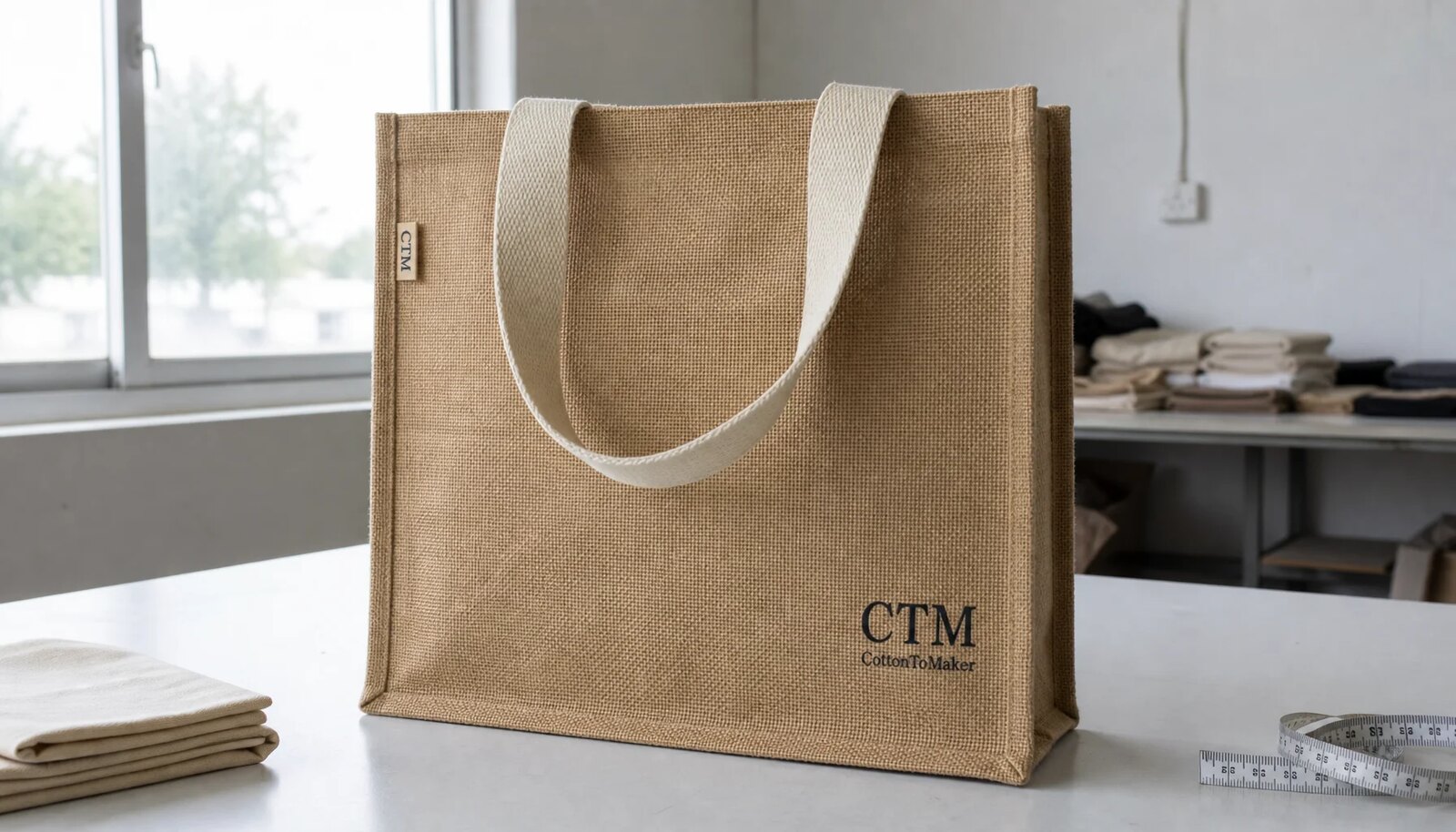
Also define shape preferences early. Some jute totes have a boxy structure with side gussets and a clear base, while others are flat shopping-bag styles that expand only when filled. A boxy bag photographs better for retail-style gifting and holds inserts more neatly, but it may use more material and pack into larger cartons. A flatter bag is efficient for shipping and handouts, but it can look less premium if bulky items are forced inside. These choices belong in the RFQ because they affect price, packing, and attendee experience.
- Use a size line such as finished size: W 38 cm x H 35 cm x D 12 cm, handle drop 22 cm, handle width 3 cm.
- Include the largest item dimensions, such as bottle height, catalog size, or kit box size, so the factory can check fit.
- Ask suppliers to confirm whether the quoted size is finished size after sewing and pressing.
- For stand-up presentation, specify box gusset, reinforced base, or insert board rather than only saying structured tote.
- Request a filled sample photo or short video if contents are heavy, tall, or unusually shaped.
Specify Jute Fabric, Finish, and Material Declarations
Jute is not one uniform material. Fabric weight, weave openness, lamination, lining, and finishing all change how the tote looks, prints, smells, folds, and carries weight. For lightweight giveaways, buyers often start around 320 to 350 GSM. For heavier event kits or a more retail-ready feel, roughly 380 to 420 GSM may be more appropriate. Those ranges are practical starting points, not universal rules, so the RFQ should ask the supplier to recommend construction based on the stated load and presentation requirement.
The RFQ must also state whether the bag should be laminated or unlaminated. Laminated jute usually feels stiffer, helps the bag hold shape, and can create a smoother surface for print, but it changes the hand feel and may complicate sustainability claims. Unlaminated jute feels more natural and is often preferred when the buyer wants visible fiber texture, but it can have more variation, fraying risk, and print irregularity. If a sustainability or packaging team will review the order, ask for a written material declaration that covers jute, handle material, lining, lamination, inks, labels, polybags, and cartons.
Natural jute can vary in shade and odor, so buyers should set realistic but clear acceptance rules. A mild natural fiber smell may be normal; damp, moldy, chemical, or storage odor is not acceptable for event distribution. Color variation should be expected within reason, but stains, dark oil marks, mildew spots, and excessive shedding should be rejectable. The factory quote should identify how material is stored, dried, and inspected before cutting.
- Request GSM, weave description, lamination status, lining material, and any coating or finishing in the quote.
- Ask for a material swatch or close-up fabric photo before approving the full sample.
- State whether natural shade variation is acceptable and define what stains, odor, or fiber shedding are not acceptable.
- If sustainability claims will be used, request written material composition instead of relying on sales copy.
- Confirm whether handles are cotton, jute, blended webbing, rope, or another material, and whether that affects declarations.
Engineer Handles, Gussets, and Load Support
Handles are where many event tote problems become visible. A bag body may look fine in a sample photo, but weak handle attachment will fail during venue handling or when attendees add personal items. Your RFQ should specify handle material, width, drop length, attachment method, stitch pattern, thread color, and reinforcement. Cotton webbing is common for jute totes because it is smoother in hand and easier to sew consistently than raw jute strips. Jute handles may support a more natural look, but they need careful edge control and comfort checks.
Handle drop should match how the bag will be carried. A short drop works for hand carry and controlled table handouts, while shoulder carry needs a longer drop and comfortable webbing width. If attendees will carry the bag through an exhibition hall or airport, do not treat handle dimensions as cosmetic. Specify the target fill weight and ask the factory to confirm the recommended construction. Bar tacks or reinforced box stitching at handle ends are often worth the small cost increase for heavier kits.
Gusset and base support should be treated as part of load engineering. A deeper gusset increases capacity but also increases stress on side seams and bottom corners when the bag is full. If the tote will carry bottles or rigid cartons, ask whether a stitched base, laminated body, inner lining, or removable base board is recommended. If the bag will be pre-packed, the warehouse may prefer a base that stays open; if the bag ships empty, the procurement team may prefer a construction that packs flat.
- Specify handle width, handle drop, material, color, reinforcement, and stitch pattern instead of saying standard handle.
- Set a target carry weight, such as 3 kg, 5 kg, or another realistic load based on event contents.
- Ask for bar tack or reinforced box stitching at handle attachment points for heavier event kits.
- Confirm whether gusset corners are reinforced or finished to prevent seam opening under load.
- Require the sample to be filled with representative contents during approval, not only photographed empty.
Match Decoration Method to Jute Texture
Decoration is where many attractive design files collide with the reality of coarse fiber. Direct screen printing on jute can work well for bold sponsor logos, short text, simple icons, and one to three solid colors. It is less forgiving for gradients, thin lines, small legal copy, fine sponsor lists, QR codes, or detailed artwork. The RFQ should ask the supplier to recommend the decoration method after reviewing the actual vector art, not after seeing only a low-resolution mockup.
The buyer should define print area, placement, color count, Pantone targets, and minimum readable text. On natural jute, the base shade and weave will influence color appearance, so exact brand color matching may require compromise or a different print surface. A laminated panel, cotton patch, sewn label, heat transfer label, or front pocket panel can improve artwork clarity, but each option changes price, lead time, and appearance. For sponsor-heavy events, it may be better to simplify the art or use a sewn label than to force small multi-logo artwork onto raw jute.
Artwork control should be written into the RFQ. Ask for vector files, print dimensions, placement measurements from bag edges, and a physical strike-off or printed pre-production sample when brand visibility matters. Also define whether the logo appears on one side, two sides, side gusset, inner label, hangtag, or handle wrap. A vague instruction like centered logo is not enough because the print may be visually centered on the panel but wrong relative to the bag shape, gusset, or fold line.
- Send AI, EPS, or PDF vector artwork and identify any must-hold brand colors.
- State print size, placement from edges, front/back orientation, and whether gusset or handle printing is included.
- Avoid small type, thin strokes, QR codes, and detailed sponsor grids unless the factory confirms readability on the chosen surface.
- Ask for print registration tolerance, especially for multi-color logos.
- Use a sewn label, cotton patch, or smoother panel when fine detail is more important than direct-on-jute texture.
Build MOQ, Tier Pricing, and Cost Breakdown Into the RFQ
MOQ is not only a quantity number. For custom jute tote bags, MOQ can apply per size, fabric color, handle color, artwork version, print color count, label type, and packing style. An event order for 5,000 bags may look simple until it becomes five sponsor versions of 1,000 pieces each, each with different print screens and carton labels. The RFQ should ask suppliers to state MOQ rules clearly so procurement can decide whether versioning is worth the added cost and complexity.
Tier pricing helps buyers see where setup costs are absorbed. Ask for the same specification at 1,000, 3,000, 5,000, and 10,000 pieces if those quantities are relevant to your event pipeline. Do not let one supplier quote 320 GSM and another quote 400 GSM under the same tier table. Every price tier must use the same finished size, same GSM, same handle, same print method, same packing, and same Incoterm. Otherwise, the comparison becomes a price illusion rather than a sourcing decision.
A clean RFQ asks for line-item pricing. Separate blank bag cost, decoration cost, screen or setup charges, sample cost, label cost, packing cost, export carton cost, inland delivery to port if applicable, and freight if the supplier is quoting beyond FOB. This makes negotiation more precise. If budget pressure appears, you can decide whether to reduce print colors, change packing, adjust GSM, remove a label, or increase quantity. Without line items, the supplier may reduce cost by changing construction in a way the buyer never approved.
- Ask whether MOQ is per artwork, per colorway, per handle color, per fabric color, or per combined purchase order.
- Request pricing at fixed tiers using the exact same technical specification on every tier.
- Separate blank tote, decoration, setup, sample, label, packing, and shipping-related charges.
- Ask how price changes for a second side print, second color, woven label, hangtag, or individual polybag.
- Require suppliers to list assumptions and exclusions directly under the price table.
Use a Procurement-Ready RFQ Line Table
A strong RFQ converts design intent into a table a factory can price without guesswork. Event planners often send a mood board, logo file, quantity, and date; procurement then receives quotes that cannot be compared because every supplier has filled in missing details differently. A line table makes the quote request disciplined. It also gives internal stakeholders one place to approve tradeoffs before the RFQ goes out.
The RFQ table should separate required fields from supplier recommendations. For example, the buyer can require the finished size, target fill weight, artwork placement, and in-hands date, while inviting the supplier to recommend GSM or reinforcement based on that use case. That approach lets the factory contribute expertise without changing the commercial basis secretly. It also helps procurement spot suppliers who quote vaguely or ignore important requirements.
Below is a practical structure to include in the RFQ body. It is not a legal contract by itself, but it gives the buyer, supplier, designer, warehouse, and event team a shared specification language. Attach artwork, packing diagrams, brand guidelines, and delivery instructions as separate files when needed, then reference those files in the RFQ table.
- Product: custom jute tote bag for event welcome kit, with event name and purchase order reference.
- Quantity tiers: 1,000 / 3,000 / 5,000 / 10,000 pieces, quote MOQ rules per artwork and colorway.
- Finished size: width, height, gusset, handle drop, handle width, and tolerance required.
- Material: jute GSM, lamination or unlaminated, lining, base board, handle material, thread, and labels.
- Decoration: print method, color count, Pantone targets, artwork dimensions, placement, and proof requirement.
- Sample: swatch, pre-production sample, sample cost, lead time, refund rule, and approval process.
- Packing: fold method, inner bundle quantity, individual polybag requirement, carton quantity, carton dimensions, carton marks, and pallet needs.
- Commercial: Incoterm, port, destination, payment term, production lead time, shipment lead time, quote validity, and exclusions.
Control Samples, Approvals, and Production Changes
A sample is useful only when it represents the bulk order. Many sourcing problems begin when a buyer approves a showroom sample, digital proof, or sample made from available fabric, then receives production from a different jute lot, handle tape, ink, or lamination. Your RFQ should define sample type and approval sequence. For most event orders with custom size or print, a pre-production sample made from bulk-intended materials is the right control point.
Approvals should be staged. First, confirm material swatch and fabric weight. Second, approve artwork layout and print method. Third, approve a physical pre-production sample with the correct dimensions, handle construction, print, and packing. Fourth, authorize bulk production only after all changes are written into the final specification. If a sponsor changes artwork after approval, the supplier should re-confirm print screens, lead time, cost, and waste risk. Do not let informal email notes replace a revised specification.
Keep two reference samples where possible: one with the buyer or inspection team and one at the factory. The signed sample should include the date, revision number, material, print approval, and any acceptable variation notes. For large or high-visibility events, ask for inline production photos showing fabric rolls, cut panels, printing, handle attachment, finished bags, and packing. Photos do not replace inspection, but they reveal problems early enough to act before everything is sewn and cartoned.
- Do not approve bulk production from a showroom sample unless it is confirmed to match all production materials.
- Use revision numbers for artwork, specification sheets, sample approvals, and packing instructions.
- Require written approval for any change to GSM, lamination, handle tape, thread, print method, carton count, or delivery term.
- Ask for a production start notification and inline photos before the order is fully packed.
- Keep a signed reference sample available for final inspection and dispute resolution.
Write QC Criteria Before the Supplier Quotes
Quality control should not be invented after the shipment is ready. The RFQ should tell suppliers what the buyer will inspect and what limits apply. This is especially important for event orders because there is often no time for repair, reprint, or replacement once cartons arrive. If the QC standard is vague, the supplier may treat defects as normal jute variation, while the event team sees them as unacceptable presentation issues.
Useful QC criteria for jute totes include finished size tolerance, handle drop tolerance, handle strength, seam security, print placement, print registration, color variation, odor, stains, dampness, carton marks, and quantity accuracy. A common finished size tolerance might be plus or minus 1 cm for width, height, and gusset, but the buyer should set the standard that fits the design. Print placement can be measured from the panel center or from fixed edges. For multi-color artwork, define acceptable registration drift before production starts.
Inspection should reflect the order risk. A small local event may rely on factory photos and buyer spot checks. A larger event, a direct-to-warehouse order, or a sponsor-critical launch may justify third-party inspection using an agreed sampling plan. The RFQ should ask whether inspection is allowed before shipment, when the goods will be ready, and what happens if defects exceed the agreed threshold. The goal is not to make the RFQ punitive; it is to make quality measurable while there is still time to correct problems.
- Set tolerance for finished dimensions, handle drop, print placement, and print registration in the RFQ.
- Define rejectable defects such as open seams, broken stitches, loose handles, mold smell, dampness, oil marks, and unreadable logos.
- Ask whether the factory performs incoming material checks, inline sewing checks, print checks, and final carton checks.
- Require carton quantity and artwork version counts to be verified before shipment.
- For larger orders, reserve the right to inspect at finished-and-packed stage before release.
Pack for Warehouses, Venues, and Kitting Teams
Packing is not a minor shipping detail for event planners. It controls how quickly bags can be received, counted, stored, inserted, and handed out. A beautiful jute tote can become an operational problem if it arrives crushed, damp, mislabeled, or mixed across cartons. The RFQ should specify whether bags are flat, folded, bundled, individually polybagged, pre-kitted, or packed loose. Each choice affects labor, carton size, material use, and moisture control.
If the order ships to a kitting partner, ask that cartons be packed in predictable quantities with inner bundles that match the kitting workflow. If the order ships directly to a convention center, carton marks should include event name, PO number, SKU, artwork version, quantity, carton number, destination, and any receiving labels required by the venue. If the bags are divided by sponsor, city, session, or attendee tier, the RFQ should state whether mixed cartons are allowed. In many event operations, mixed cartons create counting errors and delay.
Moisture control deserves attention because jute is a natural fiber and may move through humid storage or sea freight conditions. Depending on route and season, the buyer may ask for dry storage confirmation, lined cartons, desiccant, or moisture-protection practices. Individual polybags can protect presentation but may conflict with packaging reduction goals, so the RFQ should make that tradeoff explicit. Procurement should not discover after delivery that the supplier chose the cheapest packing format without considering the receiving environment.
- Specify fold method, bundle size, carton quantity, carton dimensions, gross weight, net weight, and total CBM.
- State whether individual polybags, paper bands, inner cartons, desiccants, or moisture barriers are required.
- Provide carton mark instructions before production, including event name, PO, SKU, artwork version, destination, and carton sequence.
- Avoid mixed-artwork cartons unless the warehouse has approved the receiving process.
- Ask for packed carton photos and a packing list before shipment release.
Specification comparison for buyers
| RFQ decision | Recommended buyer instruction | Why it matters for event procurement | Risk to verify before award |
|---|---|---|---|
| Use case definition | Describe the event, distribution method, contents, target fill weight, and expected carry time | Suppliers can size fabric, handles, gusset, and reinforcement around real use instead of guessing from a mockup | A bag quoted for brochures may fail when loaded with bottles, catalogs, and sponsor samples |
| Finished dimensions | Quote finished size in cm and inches, including width, height, gusset, and handle drop | Finished dimensions allow like-for-like pricing and prevent confusion between cut size and usable capacity | Loose size language can hide smaller gussets, shorter handles, or a bag that does not fit the insert kit |
| Fabric specification | State jute GSM, weave/finish, laminated or unlaminated construction, lining, and base support if needed | Fabric weight and finish drive stiffness, print clarity, smell risk, price, and carton weight | A lower quote may simply be a lighter fabric or a laminated substitute that changes the sustainability story |
| Handle and seam construction | Specify cotton webbing or jute handle, handle width, handle drop, stitch pattern, bar tacks, and load expectation | Handles are the most visible failure point during registration, venue movement, and attendee carry-out | Unreinforced handles can pull away even when the bag body looks acceptable |
| Decoration method | Lock print process, color count, artwork size, placement, Pantone targets, and minimum readable text size | Jute texture affects registration, edge sharpness, and fine detail; the RFQ must match art to substrate | Detailed logos, gradients, and small sponsor copy may not print cleanly on coarse jute |
| MOQ and price tiers | Ask for 1,000, 3,000, 5,000, and 10,000 piece tiers where relevant, with MOQ per artwork and per colorway | Event buyers can see where setup costs flatten and whether version splits change the economics | A blended MOQ can conceal screen charges, extra cutting, and packing complexity for multiple sponsors |
| Sample approval | Require a pre-production sample made with bulk fabric, handle tape, thread, print method, and packing format | The approved sample becomes the physical control point for production and inspection | Showroom samples or digital proofs do not confirm jute weight, handle strength, smell, or print behavior |
| Quality control limits | Define size, print placement, registration, stitching, odor, stains, carton labeling, and quantity tolerances | Written QC criteria reduce subjective disputes when the shipment is inspected under deadline pressure | If limits are not defined before production, defects become negotiation instead of acceptance criteria |
| Packing plan | Specify folding, inner bundles, individual polybags if required, desiccant, carton quantity, carton marks, and pallet needs | Event orders often move directly to venues, warehouses, or kitting teams, so receiving accuracy matters | Poor packing can create crushed bags, moisture issues, missing cartons, or expensive repacking labor |
Buyer checklist before sampling
- State the event type, distribution method, audience, and whether the tote is a giveaway, retail item, VIP kit, or sponsor welcome bag.
- List the expected contents, total fill weight, and any rigid items such as bottles, catalogs, boxes, or samples.
- Provide finished dimensions in centimeters and inches, including width, height, gusset depth, handle width, and handle drop.
- Specify jute fabric weight in GSM, weave or finish, laminated or unlaminated construction, lining, and whether a base board is required.
- Define handle material, reinforcement method, bar tack requirements, stitch density expectations, and acceptable load performance.
- Send vector artwork, print size, print placement, color count, Pantone targets, and a note on minimum readable text size.
- Request pricing at fixed tiers such as 1,000, 3,000, 5,000, and 10,000 pieces using the same specification on every tier.
- Ask the supplier to separate blank bag cost, decoration cost, setup charges, sample cost, packing cost, and freight or export charges.
- Confirm MOQ by size, bag color, handle color, artwork version, and print color count so version splits do not surprise the budget.
- Require a pre-production sample made from bulk materials, not only a showroom sample or digital mockup.
Factory quote questions to send
- What exact jute GSM, weave, lamination status, lining, and finishing will you use for the quoted bag?
- Are the quoted dimensions finished dimensions after sewing, and what tolerance do you apply to width, height, gusset, and handle drop?
- What handle material, width, reinforcement, stitch pattern, and bar tack method are included in the price?
- What load weight do you recommend for this construction, and how do you test or check handle strength during production?
- Will the pre-production sample use the same bulk fabric, handle tape, thread, print ink, lamination, and packing method as mass production?
- What is the MOQ per size, bag color, handle color, artwork version, and number of print colors?
- Can you quote blank bag cost, print cost, setup charges, sample cost, packing cost, and export charges as separate line items?
- Which print method do you recommend for our artwork, and what detail, type size, or registration limits should we adjust before approval?
- What setup charges apply for screens, woven labels, sewn labels, custom hangtags, inner bags, carton marks, or special packing?
- What is the lead time for swatch approval, pre-production sample, bulk production, packing, and export booking after deposit and artwork approval?
Quality-control points to confirm
- Finished width, height, and gusset match the approved specification within the agreed tolerance, commonly plus or minus 1 cm unless the buyer sets another limit.
- Handle width, handle drop, placement, bar tack location, and stitch pattern match the approved sample and remain symmetrical on both sides of the bag.
- Handle attachment does not twist, pull loose, distort the top seam, or show broken stitches when the agreed fill weight is applied.
- Print placement is consistent across the lot, centered or aligned as specified, and not blocked by seams, folds, handles, or heavy jute texture.
- Simple one-color or limited-color logos remain readable at arm's length, with registration held to the approved tolerance and no major bleeding, cracking, or missing ink.
- Pantone or brand color targets are checked against an approved standard with reasonable allowance for natural jute color and weave variation.
- Seams are even and secure, with no skipped stitches, open seams, broken threads, sharp ends, or loose threads longer than the agreed trimming limit.
- Edges, gusset corners, and top hems are finished cleanly so the bag does not shed excessive fiber during normal handling.
- Jute surface is free from mold smell, dampness, oil stains, heavy discoloration, insect contamination, dirt marks, and loose fiber clumps that affect presentation.
- Lamination, lining, or base boards, if specified, are present, correctly positioned, and not wrinkled, peeling, cracked, or misaligned.