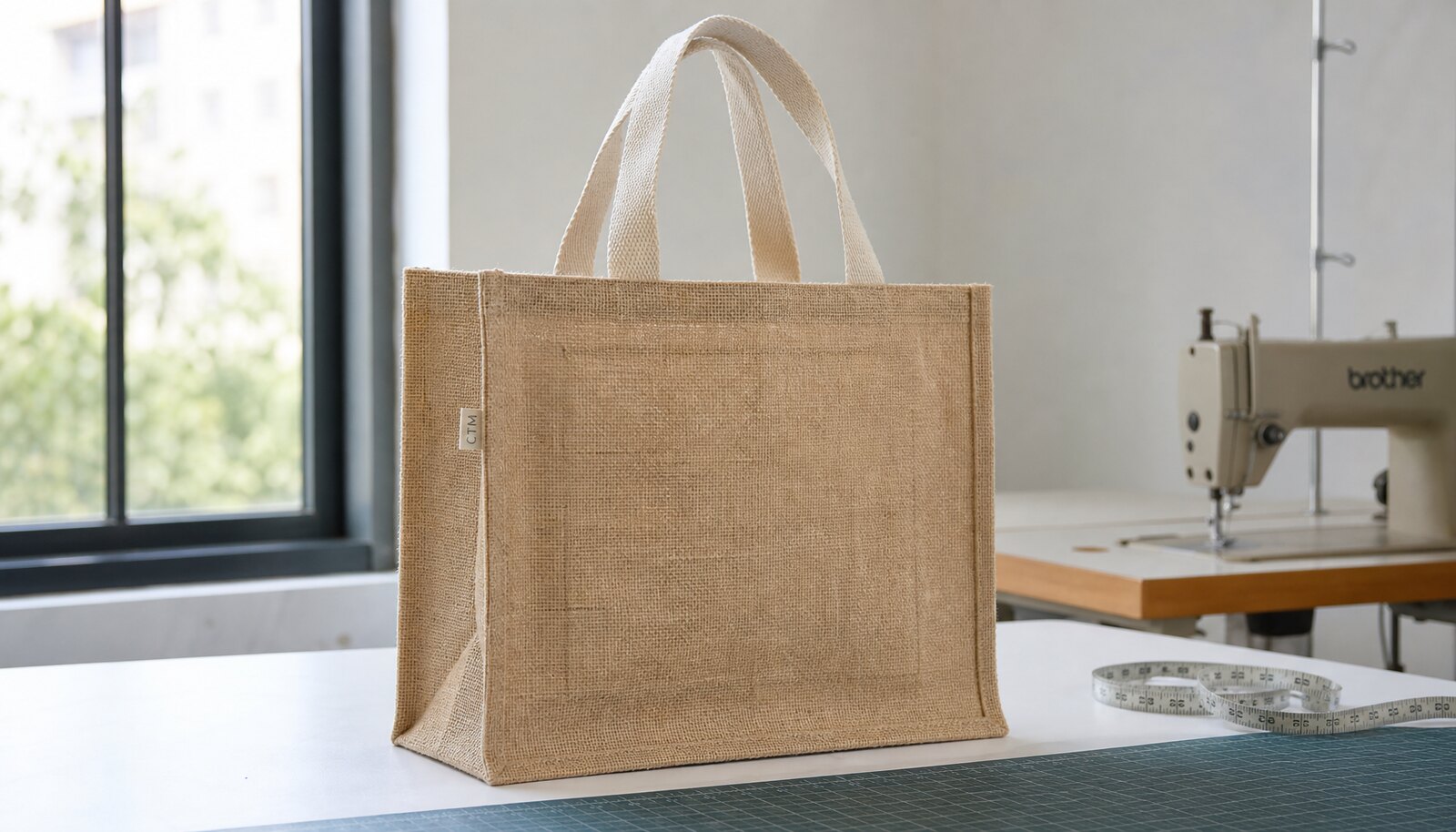
What this RFQ needs to solve for a winery buyer
A boutique winery does not buy jute tote bags the same way a grocery chain does. The bag has to carry bottles cleanly, look acceptable at retail, and hold up through tasting-room handling without turning into a fuzzy, warped sample that damages the brand. If the RFQ is vague, suppliers will quote different fabric weights, different handle builds, and different packing methods, which makes the lowest price meaningless.
The goal of this guide is to help you write an RFQ that gets comparable quotes. That means specifying the bag as a finished commercial item, not as a loose idea. A useful RFQ should describe the size, jute weight, print method, handle construction, lining or no lining, packing, sample approval, and the shipping term used for cost comparison.
- Define the bag use case: single bottle, two bottles, gift set, or tasting-room retail.
- State whether the bag is for shelf display, event giveaway, or repeated customer carry use.
- Treat size, print, and packing as fixed quote inputs, not optional conversation points.
Start with the right bag construction, not just the logo
For boutique wineries, the most common mistake is to lead with artwork and leave the structure open. Jute is a rough, natural fiber, so the finished look depends heavily on weight, weave density, and whether the body is lined. A thin jute bag with a heavy bottle set will slump at the base and feel underbuilt even if the print looks good.
As a buying rule, the RFQ should name the intended load first. If the bag is for one wine bottle, a 14–16 oz heavy jute body with a gusset and reinforced handles is usually safer than a light promotional bag. If the bag needs to hold a boxed bottle set or mixed merchandise, add bottom support and consider a cotton or laminated lining to reduce fiber shedding and improve structure.
- For retail presentation: specify finished size, gusset depth, and handle drop.
- For bottle programs: include target contents weight or number of bottles.
- For premium packaging: require lining or a cleaner internal finish.
How to specify jute weight, GSM, and fabric finish
Different suppliers describe jute in different ways. Some quote GSM, others quote ounces per square yard, and some describe it only as light, medium, or heavy. That is not enough to compare quotes. If you are asking for custom jute tote bags for boutique wineries, your RFQ should include the construction reference from the approved sample or at least a target range the supplier must follow.
A practical target for a premium winery tote is heavy-weight natural jute with a stable weave and minimal visible slub variation. If the supplier uses laminated jute or a jute-cotton blend, that should be written into the quote because the feel, cost, and print behavior all change. The same logo on coarse natural jute and on smoother laminated jute will not look identical, so those are not interchangeable options.
- State material: natural jute, jute-cotton blend, or laminated jute.
- State weight as GSM or oz/yd², and require supplier confirmation in the quote.
- Specify if the bag must be odor-controlled and free of visible oil stains or fiber shedding.
Print method decisions that affect retail appearance and cost
The print method is one of the biggest sources of quote mismatch. On jute, a bold one-color screen print is often the most reliable option for winery logos, because coarse fibers can break up fine lines and small text. If the brand wants a premium look and the run is small, a woven label, sewn patch, or embroidery can work better than forcing multi-color artwork into a process that is not suited to it.
Your RFQ should include the artwork file, the number of print colors, the exact placement, and the acceptable color standard. If you only say “logo print on front,” the supplier may choose a smaller print area, a different ink type, or a placement that looks off-center once the bag is stuffed with bottles. The quote should also say whether the price includes strike-off approval and whether a second print proof is charged separately.
- Use screen print for simple logos, large type, and strong contrast.
- Use woven label or embroidery only when the artwork and budget support it.
- Specify print size in centimeters or inches, not only by visual description.
MOQ logic: why the cheapest quote is often not the best order plan
MOQ is not just a supplier policy; it is tied to fabric cutting, printing setup, and packing labor. A factory may quote a low unit price for a stock-size jute tote with one-color print, then raise the MOQ sharply once you change the size, add lining, or request a different handle. Buyers often compare these quotes as if they are the same order type, which leads to false price wins.
For winery programs, a sensible RFQ should separate the base bag from custom work. Ask for pricing at one MOQ for the standard configuration and then ask for the cost of each change: custom size, extra print color, inside lining, woven label, or special carton pack. That gives procurement teams a realistic view of how much design freedom actually costs.
- Request a base price and itemized adders for each custom feature.
- Ask whether MOQ is per SKU, per color, or per artwork version.
- If the program may repeat, ask for re-order pricing and whether setup charges repeat.
Comparison table: sourcing routes and what each one changes
When buyers source custom jute tote bags for boutique wineries, they typically face three routes: direct factory, trading company, or local importer/distributor. Each route can work, but the quote structure and control level are not the same. The right choice depends on order size, need for repeat production, and how much of the spec you can standardize.
Use the comparison below to match the sourcing route to the buying situation. The key is not only the unit price; it is the total risk around spec drift, sample control, and landed cost after freight and handling.
- Write decisions in measurable language, not only descriptive wording.
- Ask for sample photos plus one physical approval sample for important orders.
- Keep quotation, sample approval, and inspection notes tied to the same spec version.
Sample approval: what must be signed off before bulk production
For jute bags, a blank sample alone is not enough if the bag is custom printed. The coarse surface changes ink appearance and can hide small placement errors until production is already moving. A better approval flow is blank sample first, then printed strike-off, then pre-production sample built with the correct fabric, handle, and packing method.
The approval should be written as a yes/no gate. If the print is off by a few millimeters but still looks acceptable, say so in advance. If not, define the exact acceptance criteria: logo centered within the approved zone, color close to the reference within practical textile tolerance, and stitching even with no loose threads longer than the agreed limit.
- Approve a physical sample whenever the order is for retail or premium gifting.
- Sign off on fabric tone, handle length, print placement, and internal finish.
- Record any allowed deviation in writing before bulk begins.
Packing and carton control for wholesale and distributor orders
Packing matters because jute bags can arrive bent, dusty, or stained if they are thrown into cartons without enough protection. For winery retail programs, the bag should arrive presentable enough to go straight into store inventory or a tasting-room display. If the order is for distribution, the carton spec also affects freight cost, because loose packing increases cubic volume and drives landed cost higher.
Your RFQ should tell the factory how to pack the goods. That includes whether each tote is folded with tissue, whether polybags are needed, how many pieces per carton, whether mixed sizes are allowed, and what carton marking is required. If there is a barcode or retail sticker, state where it goes and whether it must be applied at the factory or by the buyer.
- Define folding method and whether a polybag is required.
- State carton count per SKU and whether cartons can be mixed by size.
- Require dry, clean cartons with outer marks that match the packing list.
Lead time planning: where delays usually happen
Custom jute tote lead time is rarely lost in the sewing step alone. Delays usually happen earlier: artwork confirmation, sample revisions, color approval, or missing packing data. If the RFQ is incomplete, the supplier has to come back with questions, and the clock starts only after every open point is settled. That creates a false expectation that the quoted lead time is shorter than the real timeline.
For a boutique winery launch or seasonal campaign, separate the timeline into stages: sampling, approval, production, and freight. A quote that says “25 days” is not useful unless you know whether that means after deposit, after artwork approval, or after pre-production sample approval. Write that trigger into the RFQ so the schedule is comparable across suppliers.
- Ask for lead time from defined start point, not a vague promise.
- Add buffer for print proof approval and first article review.
- If the order is seasonal, lock the ship window before approving artwork.
Landed-cost comparison: what should be inside the quote
The cheapest ex-factory quote can become the most expensive delivered order if freight, packing, rework, or document charges are excluded. Procurement teams should compare quotes on the same basis: same product spec, same incoterm, same packing, and same sample terms. If one supplier includes carton marking, inner packaging, and local delivery to port while another excludes them, the unit price is not comparable.
For custom jute tote bags, ask for a quote that separates manufacturing cost from logistics. This helps you see whether the supplier is competitive on the bag itself or only on a favorable freight assumption. It also makes reorders easier because you can track which costs are stable and which move with the shipment route.
- Compare only quotes with the same incoterm.
- Separate bag cost, sample cost, packing cost, and freight cost.
- Ask whether export documents and carton labeling are included.
Specification comparison for buyers
| Spec decision | Recommended option | When it fits | Buyer risk to check |
|---|---|---|---|
| Jute weight / GSM | 14–16 oz natural jute or equivalent heavy-weight construction | Bottle gift sets, premium tasting-room retail, repeated carry use | Too light and the bag bags out, scuffs at the base, or feels cheap at shelf |
| Lining | Unlined for low-cost seasonal runs; laminated or cotton-lined for premium retail | Unlined for dry goods or simple handouts; lined for bottles, cheese kits, or high-end gifting | Unlined jute sheds and can stain contents; laminated lining can affect hand feel and recycle expectations |
| Handle style | Cotton webbing handles or jute rope handles with reinforced stitching | Tasting-room purchases and heavier bottle sets | Weak handle bar-tacks cause returns; rope handles can dig into hands if load is high |
| Print method | 1-color screen print for bold logo; woven label or embroidery for premium short runs | Simple winery logos, low artwork complexity, clear brand contrast | Multi-color art on coarse jute can look blurred; embroidery on thick jute can distort small type |
| Bottom / side gusset | Flat base with gusset for bottles and boxed sets | Carrying 1–3 bottles, boxed accessories, or mixed gift packs | No gusset limits capacity and creates shape distortion when loaded |
| MOQ route | Lower MOQ with stock base bag and standard print; higher MOQ for custom size, lining, and hardware | First-time testing, seasonal winery programs, fast retail launch | Custom dimensions and special trims raise cost and can extend lead time sharply |
| Sampling route | Pre-production sample plus approved print strike-off | Any launch where brand color, logo size, or packaging matters | Skipping print proofing creates shade mismatch and placement disputes at mass production |
| Packing method | Bulk packed with size-separated cartons and inner polybags only if needed | Wholesale distribution and low-damage freight optimization | Loose packing can deform bags; over-packaging adds cost and cube without protecting shape |
| Supplier route | Direct factory for custom spec; trading company only if it adds consolidation or smaller order flexibility | Brands needing consistent repeat orders and tighter cost control | Middleman quotes can hide fabric, print, and packing substitutions unless the RFQ is exact |
Buyer checklist before sampling
- Final bag size with tolerance, including gusset and handle drop
- Target jute weight/GSM and whether the bag is unlined, cotton-lined, or laminated
- Logo artwork file, print method, print size, Pantone reference, and approved placement
- Handle material, width, reinforcement stitching, and load expectation
- MOQ by color, by print version, and by custom size
- Sample requirements: blank sample, printed sample, pre-production sample, and approval sign-off rule
- Packing standard, carton quantity, and whether retail inserts or barcode labels are required
- Target ship date, delivery window, and the incoterm used for quote comparison
Factory quote questions to send
- What exact jute weight or GSM are you quoting, and can you state whether it is natural jute, jute-cotton blend, or laminated construction?
- Is the quoted price based on the same size, handle type, gusset, lining, and print method we specified, or are any of those items optional?
- What is the MOQ by artwork version and by color, and what is the surcharge for a second print color or non-standard size?
- What samples are included in the quote: blank sample, printed sample, and pre-production sample, and what is the charge for each?
- What carton packing standard are you using, how many bags per carton, and is carton marking included in the price?
- What production lead time starts from: artwork approval, deposit receipt, or sample approval?
- Which quality checks will you perform before shipment, and what defect limit applies to print misalignment, loose stitching, or stain marks?
- What incoterm is quoted, and what inland freight, export document, or destination charges are excluded?
Quality-control points to confirm
- Fabric weight must match the approved sample or stay within the agreed tolerance; lightweight substitution should not be accepted without written approval.
- Logo placement should stay within the approved print window; visible skew, double-hit, or blur on coarse jute is not acceptable for retail bags.
- Handle stitching must be even, with reinforced attachment points and no loose thread tails at the stress area.
- Bag body should stand reasonably upright when empty if that was part of the approved sample; collapsed side panels can change shelf presentation.
- No oil stains, black fibers, mildew smell, or color contamination from storage and handling.
- Cartons must be dry, well sealed, and labeled with size, quantity, color, and carton number if multiple SKUs ship in one order.
- Sample and bulk goods should match in color tone, especially if the order includes dyed jute, colored trim, or printed contrast areas.
- Any barcode, hangtag, or retail insert should be in the agreed position and scannable before full shipment release.