Start With the Real Craft Fair Job
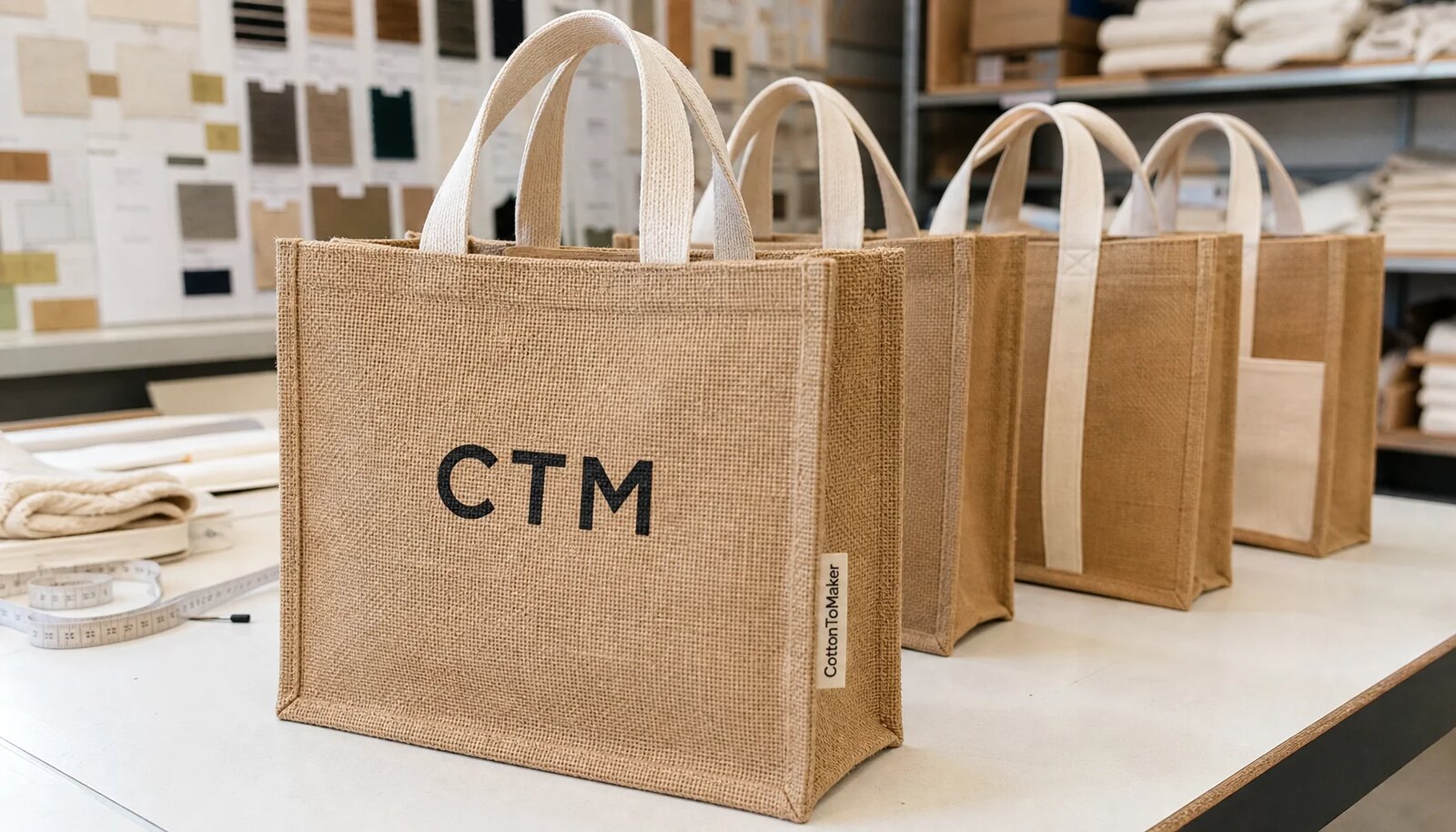
A strong RFQ for custom jute tote bags for craft fairs starts with the bag's job, not the artwork. The same natural jute tote can be a low-cost visitor giveaway, a vendor retail bag, a sponsor-funded gift, an exhibitor welcome kit, or a resale item after the event. Those uses may look similar in a mockup, but they call for different decisions on jute weight, gusset depth, handle reinforcement, printing, packing, and inspection.
Craft fairs are harder on bags than many buyers expect. Visitors combine uneven items: candles, soaps, stationery, books, glass jars, boxed food, ceramics, small apparel, and event literature. A tote made only for brochures can be lighter. A tote intended for vendor purchases needs better seam control, a deeper usable gusset, and handles that remain comfortable when the load shifts from side to side.
Open the RFQ with a short product brief. State the event type, order quantity, whether the bag is free or sold, target maximum load, distribution method, and required delivery date. Mention whether bags will be handed out at entry, packed into exhibitor kits, displayed at sponsor booths, or shipped to multiple locations. Suppliers quote more accurately when they understand how the bag will be handled before and during the fair.
Useful RFQ wording: We need custom jute tote bags for a craft fair visitor and vendor program. Bags will carry mixed retail purchases including candles, jars, paper goods, books, and small apparel. Target maximum load is 5 kg. Bags should stand reasonably well when filled, use reinforced cotton webbing handles, and show a clean one-color front logo suitable for sponsor visibility.
- For visitor giveaways, prioritize safe handles, low odor, clean logo visibility, and efficient carton packing.
- For vendor retail bags, prioritize gusset depth, seam strength, handle comfort, and a presentable natural finish.
- For sponsor programs, prioritize brand color control, print placement, artwork readability, and on-time event delivery.
- For outdoor fairs, evaluate laminated jute, stronger cartons, and moisture protection at pallet or carton level.
- For resale bags, tighten inspection for loose fibers, shade mismatch, label placement, print clarity, and individual presentation.
Make Dimensions Comparable
Many jute tote quotes drift apart because the buyer asks for a size without defining how that size is measured. A request for a 35 x 40 cm jute bag may lead one supplier to quote a flat tote, another to quote 35 x 40 x 15 cm with a gusset, and a third to price from cut-panel dimensions before sewing. These are not equivalent products. They use different fabric, pack differently, and carry different volumes.
State finished dimensions in the order width x height x gusset depth, measured after sewing and before packing. Width is the front panel width. Height is the top edge to bottom edge. Gusset depth is the side or bottom expansion that creates usable capacity. For craft fairs, practical starting sizes include 30 x 35 x 15 cm for compact visitor kits and 35 x 40 x 15 cm for larger shopping use. Bigger is not always better, because jute is bulky and freight-sensitive.
Clarify the gusset structure. A tote may have side gussets only, a bottom gusset only, or a full side-and-bottom gusset that helps it sit more neatly when filled. If the bag must stand on a vendor table or hold boxed sponsor items, say so before the factory cuts material. A soft folded gusset and a squared bottom can look close in photos but behave differently in use.
Add tolerances to the RFQ. Jute cutting and sewing will not be as exact as molded goods, so a commercial tolerance around plus or minus 1 cm on body dimensions and around plus or minus 1.5 cm on handle drop may be a reasonable starting point, subject to factory confirmation. If bags must fit pre-packed kits, retail trays, or carton allocation plans, tighten those tolerances before purchase order release.
- State dimensions as finished W x H x gusset, not flat size or cut-panel size.
- Confirm side gusset, bottom gusset, or full side-and-bottom gusset construction.
- Specify whether the tote must stand when empty, stand when filled, or only fold flat.
- Define measurement points for body, gusset, handle length, handle drop, and print location.
- Repeat dimensional tolerances on the sample approval record and final inspection sheet.
Define Jute Weight and Appearance
Jute fabric is often described in ounces, GSM, or supplier shorthand, and the same number can hide meaningful differences. For many custom jute tote bags used at craft fairs, 13-15 oz natural jute, roughly 270-330 GSM depending on weave and finish, is a practical B2B starting range. It gives the bag structure without making it overly stiff, bulky, or expensive.
Do not treat GSM as the whole specification. Two jute fabrics with similar weight can print and sew differently if one has a tighter weave and the other is more open. Tighter weaves usually give cleaner print edges and better resistance around stitch points. Open weaves may look more rustic, but they can shed more fiber and show more print distortion.
Ask for close-up fabric photos with a ruler, a physical swatch, or a previous production sample. Use plain specification language: natural jute, target 13-15 oz, medium-tight weave suitable for screen print, with large stains, holes, and severe broken yarn clusters not acceptable. Avoid words like premium, thick, or heavy-duty unless the factory connects them to measurable material details.
Natural shade variation is part of jute. Some lots look golden, others grey-brown, and many include darker slubs. Accept the natural character, but control the range. Approve a shade reference when sponsor marks or brand colors matter. A black print will usually tolerate more variation than a low-contrast light print. Odor belongs in this discussion too: a plant-fiber smell may be normal, but mold, mildew, oil, chemical, or storage odor should block shipment.
- Request jute weight in oz or GSM and approve weave appearance by photo or swatch.
- Avoid vague terms such as premium, thick, or heavy-duty unless tied to measurable specs.
- Define acceptable natural shade variation using an approved swatch or production sample.
- Reject large stains, oil marks, holes, mold odor, insect contamination, and severe broken yarn areas.
- Ask whether the quoted fabric is available from stock or must be woven or laminated for the order.
Choose Lamination Carefully
Lamination changes more than the look of a jute tote. It affects structure, hand feel, odor, fold marks, printing behavior, and the claims a buyer can safely make about the bag. Laminated jute normally has a backing layer, often PE or PP depending on the supplier's process, applied to the inner side of the fabric. The backing can help the bag hold shape, resist damp surfaces, and stand more cleanly when filled.
Unlaminated jute feels softer and closer to a natural-fiber material. It can be a good fit for artisan markets where the buyer wants a simpler, rustic bag and does not need strong shape retention. The tradeoff is that unlaminated jute absorbs moisture more readily, collapses more easily when empty, and may show more movement at seams.
Laminated jute may be the better choice for outdoor fairs, damp receiving areas, table displays, structured sponsor kits, and retail-style presentation. Still, it creates its own QC risks. New laminated bags can have plastic odor, bubbling, delamination near seams, whitening on folds, or permanent creases from carton compression. Ask for a folded sample, not only a flat beauty photo.
Be precise with sustainability language. A laminated jute bag can be reusable, but the backing layer may affect recyclability, compostability, or biodegradability claims. The RFQ should ask the factory to state the backing material. Unless documentation supports broader environmental wording, describe the product factually as reusable natural jute with specified backing rather than relying on unsupported marketing terms.
- Use unlaminated jute when natural feel, flexibility, and simple material messaging matter most.
- Use laminated jute when shape retention, damp-surface resistance, and table presentation matter more.
- Ask whether backing is PE, PP, or another material and whether thickness or backing weight can be stated.
- Define unacceptable lamination defects such as bubbling, delamination, cracking, strong odor, and severe crease whitening.
- Avoid unsupported recyclability, biodegradability, or compostability claims for laminated constructions.
Specify Handles by Load
Handles are the part most likely to turn a good-looking tote into a failed event product. A jute panel can feel thick and still have weak handle attachment. Craft fair visitors carry bags through crowded aisles, set them down repeatedly, and load them unevenly. One glass jar or ceramic item can concentrate stress at a single handle seam.
Cotton webbing handles are a practical default for many B2B jute tote programs. They stitch well, feel comfortable, and give a clean retail look. A width of about 2.5-3.5 cm is common for retail-style totes, with the final choice based on target load and budget. Narrow handles reduce cost but can dig into the hand. Wider handles improve comfort, add material cost, and require consistent placement.
Specify total handle length and handle drop. Total length is the full handle length according to the supplier's measuring method. Handle drop is the vertical distance from the top edge of the bag to the top of the loop when lifted. A short drop makes a hand-carry bag. A longer drop may allow shoulder carry, but it also changes leverage at the seam. Do not assume the same reinforcement works for both.
Replace vague phrases like strong handles with a testable condition. If the target use is 5 kg, ask the supplier to test at the agreed load for a stated period and confirm no handle pull-out, stitch breakage, seam tearing, or unacceptable panel distortion. The load, duration, and sample size should match the program's risk level. The important procurement control is that the handle requirement can be tested before shipment.
- Specify handle material, width, total length, handle drop, color, and insertion or attachment method.
- Use box stitch or cross stitch reinforcement for bags expected to carry mixed retail purchases.
- Define a static load test with load, duration, sample size, and pass/fail criteria.
- For dyed handles, require a dry and damp rub check if contact with light garments or labels is likely.
- For rope handles, check hole reinforcement, knot security, comfort, and pull-out resistance.
Control Artwork on Rough Jute
Jute is not a smooth cotton canvas. It has uneven yarns, slubs, fiber hairs, and shade variation, all of which affect print clarity. A digital mockup can make a fine logo look cleaner than it will look on the actual bag. Treat artwork as a production specification, not just a sales presentation image.
One-color screen printing is often the safest decoration for custom jute tote bags for craft fairs. It works well for bold event logos, sponsor names, simple icons, and short slogans. Two-color screen printing can also work, but registration tolerance must be realistic because jute does not create a perfectly flat print surface. Gradients, halftones, fine outlines, small serif type, booth maps, and dense sponsor grids carry more risk.
QR codes deserve a separate decision. A code that scans on paper may fail on jute because the yarn texture interrupts the square pattern and softens edges. If the QR code is necessary, make it large, keep contrast high, simplify the nearby artwork, and test the printed strike-off with multiple phones. In the RFQ, state that QR scanning is a functional requirement.
Define print placement in centimeters. State the distance from the top edge and side seams, or require centered placement on the finished front panel. If the bag has a gusset, confirm that centering applies after sewing. For two-sided prints, ask whether the same screen can be used or whether separate setup is required. Quote print cost by color count, print side, setup or screen charge, strike-off fee, and any transfer or curing process.
- Provide vector artwork, Pantone or brand color references, and final print size in centimeters.
- Define print position from top edge and side seam or centerline of the finished front panel.
- Set minimum text height and line thickness based on supplier strike-off confirmation.
- Require QR-code scanning on the actual printed sample if QR codes are included.
- Compare screen print, transfer, and digital options by sample result, not by mockup only.
Separate MOQ and Quote Lines
MOQ for custom jute tote bags is not one fixed number. A supplier may offer a low MOQ for stock blank bags with a one-color print, then require a higher MOQ for custom size, custom gusset, dyed handles, sewn labels, lamination, or special export packing. If the RFQ does not separate those choices, the cheapest quote may be for a different bag.
Ask each supplier to mark what is stock and what is made to order. Stock-size printed jute bags can be useful for smaller craft fairs, urgent schedules, or budget-driven giveaways. Fully custom production is better when the buyer needs a specific size, handle color, label, print placement, lamination, or packing format. Compare the options on total program fit, not only the unit price.
Request line-item pricing. At minimum, ask for unit price, print screen or setup fee, sample fee, strike-off fee, custom label charge, handle upgrade charge, lamination charge, packing charge, carton cost if separate, inland freight, export document cost, and tooling if any. Also ask how long the quote is valid. Jute, freight, and currency assumptions can change between sourcing and purchase order release.
Trade terms need attention because jute totes are bulky. EXW, FOB, CIF, DAP, and DDP quotes include different cost responsibilities and risk transfer points. A low EXW unit price can become expensive after inland freight, export handling, duties, and destination delivery. For a fair comparison, require carton dimensions, gross weight, and estimated CBM so landed cost can be calculated.
- Ask for stock-bag MOQ and full-custom MOQ as separate quote lines.
- Separate costs for bag body, print, setup, samples, labels, handles, lamination, packing, and freight.
- Require carton size, gross weight, and CBM for landed-cost comparison.
- State trade term and named port or delivery point in every quote.
- Confirm whether lead time starts after deposit, artwork approval, material approval, or sample approval.
Use Samples as Approval Gates
Sampling should match the risk of the order. For a repeat order using the same size, material, handle, print, and packing, a print strike-off and production photos may be enough. For a first-time craft fair program, a complete pre-production sample is usually worth the time because it reveals shade, hand feel, odor, handle comfort, gusset shape, print clarity, seam quality, and packing crease behavior.
A practical approval path has three gates. First, approve materials: jute weight, weave, shade range, lamination, handle webbing, and trim color. Second, approve the print strike-off on the actual jute or the closest confirmed production material. Third, approve the full pre-production sample with final dimensions, handle construction, stitch pattern, print placement, labels, and packing fold. For low-risk orders, some gates can be combined, but the approval record should still be clear.
Review samples like production goods. Measure the body, gusset, handle drop, handle width, and print position. Load the sample with likely craft fair products and lift it by both handles, then by one handle. Fold and unfold it. Leave it sealed in packaging long enough to check odor when opened. Look at the logo from normal customer distance, not only close up under perfect light.
Keep a controlled approval reference. Ideally, the buyer and factory each keep one labeled sample. If physical retention is not practical, use dated photos and a written measurement sheet, while recognizing that photos cannot document odor, hand feel, lamination crease behavior, or handle comfort. When natural fibers are involved, a clear sample gate prevents avoidable disputes.
- Approve material and lamination before approving final print color.
- Request a strike-off for sponsor logos, fine lines, QR codes, and brand-sensitive color.
- Measure the pre-production sample and record actual values against tolerances.
- Keep one approved reference sample for final inspection comparison.
- Do not release first-time mass production from a digital mockup alone.
Define Inspection Before Production
Jute is a natural material, so some shade variation, yarn slubs, and small texture differences are expected. That does not give the factory permission to ship stained, weak, misprinted, moldy, or incorrectly packed bags. QC rules should be agreed before production starts, when there is still time to build them into factory inspection.
Define critical, major, and minor defects in the RFQ or purchase order. Critical defects are safety, legal, or severe usability issues: sharp contamination, moldy or wet goods, severe chemical odor, wrong product, or handle failure under the agreed load test. Major defects are issues likely to cause complaints or functional failure, including loose handles, broken stitches at load points, wrong dimensions outside tolerance, wrong logo, severe misregistration, unreadable sponsor text, large stains, holes, delamination, short quantity, or crushed cartons. Minor defects may include small natural slubs, slight shade variation within the approved range, or trimable thread ends.
Inspection should combine measurement, visual review, functional checks, and packing checks. Measurements cover finished size, gusset, handle drop, handle width, and print position. Visual review covers panel cleanliness, print clarity, shade range, stitch neatness, and label placement. Functional checks cover handle pull, seam strength, standing ability if required, rub risk, and QR-code scanning. Packing checks confirm carton count, carton marks, carton condition, moisture protection, and consistency across cartons.
If the buyer uses AQL inspection, state the inspection level, AQL limits, and defect classifications in the purchase order. If the buyer does not use formal AQL, still define a sampling method and rejection triggers. Event goods need calendar discipline too: inspection should happen early enough to allow sorting, rework, replacement, or shipping changes before the craft fair date.
- Classify loose handles, wrong logo, mold odor, wet cartons, and severe stains as shipment-blocking issues.
- Measure units from multiple cartons, not only top pieces from one carton.
- Check load performance using the same target load stated in the RFQ.
- Open sealed cartons to inspect odor, moisture, print transfer, lamination condition, and carton count.
- Require final inspection photos or reports before balance payment or shipment release when practical.
Pack for Event Distribution
Packing is part of procurement, especially for craft fair programs. Bags may arrive at an event organizer, distributor, retail chain, warehouse, or fairground receiving area. Temporary staff may need to unpack hundreds or thousands of totes quickly and route them by booth, sponsor, artwork version, or location. A well-made bag can still cause operational trouble if cartons are hard to identify or packed inconsistently.
Flat packing is common because it protects shape and makes counting easier. Bundle packing can help when each vendor receives a fixed quantity, such as 25 or 50 bags. Individual polybags are usually unnecessary for basic giveaways and add cost and waste, but they may be justified for resale bags, premium sponsor kits, or clean retail presentation. Tissue interleaving can help with large transfer prints or high-risk print surfaces, but specify it only when needed.
Ask for pieces per carton, carton dimensions, gross weight, estimated CBM, carton board strength if available, and packing layout. For laminated jute, avoid excessive compression that can cause crease whitening, warped gussets, or permanent fold marks. For unlaminated jute, moisture and contamination are the main risks. If bags have large front prints, ask whether print transfer or abrasion is possible during shipping and whether curing time or interleaving is required.
Carton marks should be written for receiving staff, not only for the factory. Include purchase order number, event name, SKU, bag size, print version, quantity, carton number, destination, and sponsor or program identifier if applicable. When multiple artwork versions or delivery locations are involved, inaccurate carton marks can create more disruption than a small cosmetic defect. Request open-carton photos and outer-mark photos before shipment.
- Specify flat pack, bundle pack, or individual pack instead of leaving packing to the factory.
- Request pieces per carton, carton size, gross weight, CBM, and packing layout.
- Use carton marks with event name, SKU, quantity, carton number, PO number, and destination.
- Avoid over-compressed cartons for laminated jute or large printed panels.
- Request packed-carton photos, including open-carton view and outer shipping marks.
Specification comparison for buyers
| RFQ spec decision | Recommended procurement wording | Best-fit craft fair use | Quote or QC risk to verify |
|---|---|---|---|
| Finished size | Quote finished dimensions as W x H x gusset, measured after sewing; common sizes include 30 x 35 x 15 cm and 35 x 40 x 15 cm | Visitor shopping bags, vendor retail bags, sponsor kits, and reusable event totes | Suppliers may quote flat bags, cut-panel size, or different gusset structures unless the measurement basis is defined |
| Target load | State the realistic maximum load, such as 3 kg for literature kits, 5 kg for mixed retail purchases, or a higher load only if tested and justified | Candles, jars, soaps, books, boxed food, apparel, ceramics, and mixed craft purchases | Without a load target, factories may use narrow handles, light jute, or basic stitching that looks acceptable but fails in use |
| Jute weight and weave | Request natural jute at a specified range, for example 13-15 oz or about 270-330 GSM, plus close-up weave approval | Standard custom jute tote bags where structure, rustic texture, and screen print quality matter | GSM alone does not control openness of weave, shedding, yarn slubs, panel strength, or print edge definition |
| Lamination | Specify unlaminated jute or laminated jute with PE or PP backing, approximate backing weight or thickness if known, and acceptable odor and crease limits | Outdoor fairs, damp storage, table display, structured retail bags, and sponsor kits | Lamination affects hand feel, odor, folding marks, recyclability wording, carton compression, and print adhesion |
| Handle construction | Specify cotton webbing or rope, width, total length, handle drop, color, insertion depth, and box or cross stitch reinforcement | Bags carried through crowded aisles with uneven loads and repeated handling | Thin handles, shallow insertion, single stitching, or untested dyed webbing can cause pull-out, discomfort, or color transfer |
| Logo decoration | Use screen print for bold 1-2 color artwork; require strike-off on actual jute for fine lines, small text, sponsor marks, or QR codes | Event logos, sponsor branding, booth graphics, simple illustrations, and resale branding | Digital mockups overstate clarity; rough jute can break thin lines, distort QR codes, and shift color perception |
| Customization level | Quote stock blank plus print separately from fully custom size, handle, label, lamination, and packing | Comparing local quick-turn programs against overseas custom production | A low MOQ may apply only to stock bodies and may exclude custom gusset, dyed handles, labels, or export cartons |
| Sampling path | Request material swatch, print strike-off, and pre-production sample; state which approval releases bulk production | First-time orders, sponsor-funded programs, brand-sensitive events, and resale totes | Approving only a mockup hides odor, handle comfort, shade range, seam quality, and packing crease risk |
| Inspection standard | Define critical, major, and minor defects; use agreed AQL or a named sampling plan where required by the buyer | Distributor, retail, event organizer, and promotional procurement programs | Natural variation is acceptable only within approved range; stains, mold odor, loose handles, wrong print, and wet cartons are not |
Buyer checklist before sampling
- Define the commercial use: visitor giveaway, vendor retail bag, exhibitor welcome kit, VIP sponsor bag, resale tote, or post-event merchandise.
- List intended contents and maximum realistic load, including heavy items such as candles, glass jars, pottery, books, bottled sauces, or boxed goods.
- State finished dimensions as width x height x gusset depth, measured after sewing, and identify side gusset, bottom gusset, or full side-and-bottom gusset construction.
- Specify whether the bag must stand upright when empty, stand when filled, or only function as a flexible carry bag.
- Name the jute grade expectation: natural jute shade range, target weight in oz or GSM, weave tightness, acceptable slubs, and whether shedding must be minimized.
- Specify unlaminated or laminated construction; if laminated, ask for backing material, approximate backing thickness or weight, odor control, and fold-crease tolerance.
- Define handle material, handle width, total handle length, handle drop, color, insertion method, reinforcement stitch, and minimum static load test.
- Provide vector artwork, Pantone references, color count, print side, print size, print position from top and side edges, and minimum readable text height.
- If artwork includes QR codes, maps, sponsor grids, or fine logos, require a strike-off on production jute and a scan/readability check before bulk printing.
- Request quote lines for bag body, print setup, screens, sample fee, custom label, handle upgrade, lamination, packing, inland freight, export documents, and tooling if any.
Factory quote questions to send
- What exact jute weight are you quoting in oz or GSM, and can you provide a swatch or close-up photo with a ruler showing weave openness?
- Is the quoted construction unlaminated or laminated, and if laminated, is the backing PE, PP, or another material with what approximate thickness or weight?
- Are the finished bag size, gusset structure, jute fabric, handle color, label, and carton format stock items or custom-made for this RFQ?
- What MOQ applies to this exact specification, and how does MOQ change for custom size, dyed handles, sewn labels, lamination, or special packing?
- What are the finished width, height, gusset depth, handle length, handle drop, handle width, and measurement tolerances after sewing?
- How are handles attached: sewn into top hem, externally stitched, grommeted rope, or another method, and what insertion depth or reinforcement is used?
- What static load test can you perform before shipment, at what load and duration, and what is the pass/fail criterion for stitch breakage or handle pull-out?
- Which print method are you quoting, what maximum print area do you recommend, and what minimum line width and text height are safe on the actual jute?
- Can you quote one-color, two-color, and transfer print options separately, including setup, screens, strike-off cost, and any artwork limitations?
- Can you provide a production-material print strike-off before bulk production, and does sample approval start the production lead time?
Quality-control points to confirm
- Measure finished width, height, gusset depth, handle length, handle drop, handle width, and print position against the approved tolerance sheet.
- Use a defined static load test, such as the agreed target load held for a specified time, and reject units with stitch breakage, seam tearing, handle pull-out, or panel distortion beyond the approved limit.
- Compare print color and edge quality against the approved strike-off under neutral lighting, allowing only agreed variation caused by natural jute shade and texture.
- Check small text, sponsor logos, maps, and QR codes on actual printed bags; scan QR codes from normal viewing distance and reject codes that fail repeatedly.
- Inspect jute panels for large stains, oil marks, water marks, mold odor, holes, broken yarn clusters, heavy shedding, insect contamination, and shade outside the approved range.
- For laminated bags, check bubbling, delamination at seams, cracking or whitening on folds, strong plastic odor, and crease deformation after unpacking.
- Inspect top hems, side seams, bottom seams, gusset corners, handle insertion, thread tension, skipped stitches, loose thread, and seam allowance consistency.
- Check dyed handles and trims for rub-off risk against natural jute, printed panels, labels, and light-colored garments using a basic dry and damp rub check where required.
- Open cartons from different pallet positions to verify packing count, print direction, label placement, handle color, bag sequence, and consistency with the approved pre-production sample.
- Verify export cartons for board strength, correct marks, event/SKU details, carton number, gross weight, moisture protection, no crushing, and no wet or moldy odor.