Start With What Can Go Wrong
Custom jute tote bags rarely fail in abstract ways. They fail when a guest adds a bottle and the handle tears. They fail when the sponsor logo sits too low for photos, when a carton contains the previous artwork version, or when bags arrive with damp storage odor two days before registration opens. A clean digital mockup cannot control those risks. A clear specification, a production-equivalent sample, and a practical inspection checklist can.
For procurement buyers, the starting point should be the event use case, not the phrase "jute tote with logo." A registration tote carrying a badge, folded program, and pen does not need the same construction as a retail-style gift bag holding boxed merchandise. A sponsor-facing executive kit needs tighter logo and packing standards than a low-cost handout. A multi-city event needs carton labels and allocation controls as much as it needs tidy sewing.
Jute is a natural fiber, so some variation is normal. Small slubs, uneven texture, and shade movement can be acceptable when they match the approved sample and do not weaken the bag. Holes, oil stains, mildew odor, brittle yarns, open seams, poor ink adhesion, and crooked handle placement are defects. A useful custom jute tote bags quality inspection checklist for event planners makes that distinction plain, so receiving teams do not over-reject normal material or accept problems that damage the event experience.
Build the inspection standard in the same order the order will move: RFQ, sample, first production, final goods, packing, and delivery release. By the time cartons reach a hotel dock, trade show hall, or registration counter, there is very little time left to fix basic manufacturing mistakes.
- Define what the bag must carry, how it will be handed out, and where it will be delivered.
- Separate acceptable natural jute texture from rejectable defects in writing.
- Use the approved sample as the standard for material, dimensions, sewing, logo, and packing.
- Inspect packed cartons as well as individual bags, especially for direct-to-venue delivery.
Build a Quote-Ready RFQ
A supplier quote is only useful when every bidder is pricing the same bag. Vague RFQs invite different assumptions about GSM, size, handle length, logo method, lining, lamination, and packing. The lowest unit price may simply exclude the construction, carton quality, or inspection support the buyer needs.
Start with finished dimensions. State width, height, and gusset depth after sewing, not cut-panel dimensions. Add handle drop, handle width, handle material, top hem finish, seam allowance, body fabric GSM, and whether the bag is natural, laminated, lined, dyed, blended, or coated. Buyers often see jute tote body weights around 240 to 320 GSM, but that range is not a rule. A small handout bag, a structured gift tote, and a heavier shopper can require different choices. Ask for the exact GSM and tolerance instead of using words like premium, thick, or heavy duty.
Decoration details belong in the first RFQ, not in a later artwork email. Include logo width and height, placement measured from fixed references, number of colors, Pantone or closest-match expectation, print area, and any problem details such as thin lines, small sponsor marks, gradients, or QR codes. Coarse jute can reduce edge clarity, so actual-size testing matters when artwork is detailed.
Packing also affects cost. State bags per carton, flat or folded packing, inner bundle count, whether individual polybags are allowed, maximum carton weight, and carton marks for PO, event name, SKU, color, logo version, quantity, and destination. If the event has multiple venues or sponsor versions, make that visible before pricing.
- Quote finished measurements, not only the general bag style.
- Request exact GSM and a written fabric-weight tolerance.
- Define logo size, method, color expectation, and placement in measurable terms.
- Include inner packing, carton count, carton marks, and delivery requirements in the original RFQ.
Choose Material for the Load
Material selection should follow the contents, not just the look. Natural unlaminated jute gives the familiar rustic texture and is often used for sustainability-positioned events or simple sponsor giveaways. Laminated jute can add body and help the bag stand more neatly, but it must be checked for cracking, stiffness, trapped odor, and delamination. Lined jute creates a cleaner interior and can reduce fiber shedding onto contents, yet it adds cost and creates additional seams that need inspection.
GSM matters, but it does not tell the whole quality story. A heavier jute body can still fail if the handle anchors are weak or the bottom seam is poorly sewn. A moderate GSM can perform well when the bag is correctly sized, reinforced, and matched to the intended load. Ask the supplier to explain how the recommended fabric weight relates to the finished dimensions, gusset depth, handle material, and contents.
Structure changes performance. A deeper gusset increases capacity, but it also puts more stress on bottom corners when dense items are packed. A long handle drop may be better for shoulder carry, while narrow or twisted handles can be uncomfortable. A clean top hem strengthens the opening and improves presentation. Poorly folded edges can fray and make a decent material look cheap.
Material approval should leave a paper trail. Keep a labeled swatch with GSM, finish, shade, supplier name, date, and whether it represents the intended bulk lot. During final inspection, compare bulk fabric with both the swatch and the golden sample. That makes conversations about shade, stiffness, hand feel, and weave density much easier.
- Specify natural, laminated, lined, dyed, blended, or coated jute before sampling.
- Choose GSM together with bag size, gusset, lining, handle construction, and intended load.
- Check whether the top edge, bottom seam, and gusset corners suit the contents.
- Keep a labeled material swatch with the approved sample record.
Approve Samples With Measurements
Sample approval should be a measured review, not a quick visual signoff. Lay the sample flat and record finished width, height, gusset depth, handle drop, handle spacing, handle width, logo size, and logo position. Measure logo placement from fixed points such as the top edge, side edges, or centerline. Once the sample is approved, those numbers become the reference for bulk inspection.
The sample should also be loaded. Put in the actual event contents or a realistic substitute: notebook, brochure stack, water bottle, product box, sponsor insert, badge pack, or gift set. Lift the bag by both handles and then by one handle. Watch the handle anchors, top hem, bottom seam, and gusset corners. This is not a replacement for a formal lab test when one is required, but it often catches a mismatch between appearance and real use.
Branding review must happen on bulk-equivalent material. A logo that looks crisp on a digital proof can lose clarity on coarse jute. Screen print may work for bold one-color marks. Small type, gradients, multiple sponsor logos, and QR codes may need transfer, patch, embroidery, or woven label. If the supplier sends a substitute-method sample, mark it as a layout prototype only and request a production-equivalent decoration sample before bulk approval.
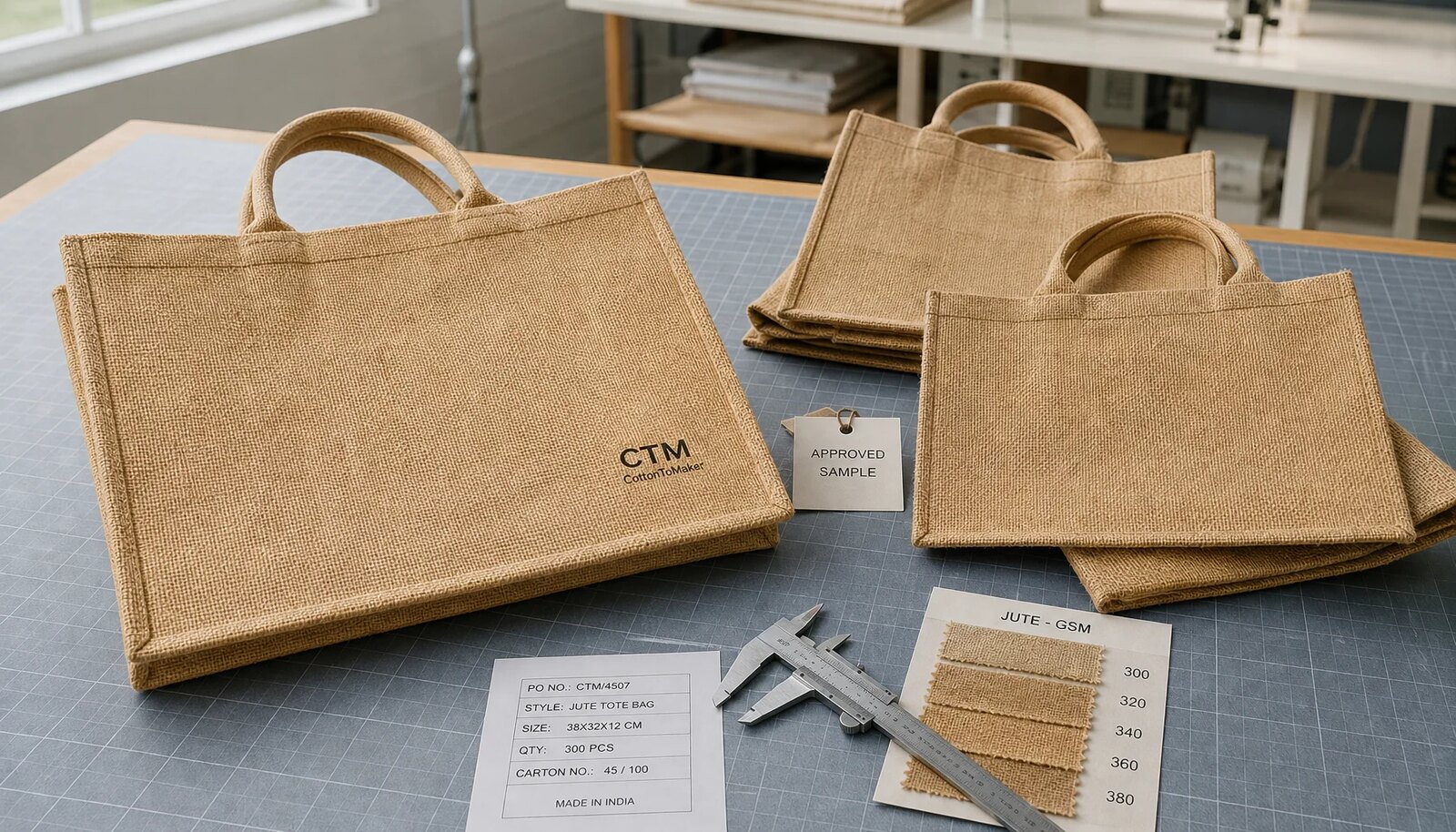
After approval, create a golden sample package. Keep the physical sample, artwork proof, material swatch, measurement record, load notes, packing reference if available, and dated approval comments. When possible, ask the supplier or inspector to keep a duplicate reference. The golden sample should answer later questions about shade, logo placement, handle length, seam finish, lining, and accepted natural texture.
- Measure the sample and record actual values before approving it.
- Load the sample with real event contents or a realistic substitute.
- Confirm the sample uses bulk-equivalent fabric, handles, lining, thread, and decoration.
- Treat substitute-method samples as visual prototypes, not final quality references.
- Keep a signed golden sample with clear approval notes.
Set Tolerances Before Production
Tolerances make inspection fair. Without them, one person may reject a small shift while another accepts a larger issue. Soft sewn bags will never have millimeter-level uniformity across every piece, especially when natural jute is involved. At the same time, loose standards create obvious problems for sponsor presentation, kit fit, and carton allocation.
Define tolerances for the details that matter. Finished width and height might be controlled within a written range such as +/- 1 cm, depending on size and supplier capability. Gusset depth, handle drop, handle spacing, and logo size also need limits. Logo placement is often more sensitive because the eye notices inconsistent branding quickly. For many event orders, print placement is controlled more tightly than body dimensions, often around +/- 0.5 cm to +/- 1 cm depending on the decoration method and artwork size. The exact number should be agreed before production starts.
Qualitative standards need the same clarity. Natural slubs can be acceptable if they are small, consistent with the sample, and not holes or weak areas. A few loose threads may be trim-and-pass issues. Skipped stitches at handle anchors, open seams, mildew odor, oil marks on the front panel, wrong logo version, and incorrect carton counts should be treated more seriously.
For larger orders, use a formal sampling plan or third-party inspection standard. For smaller or urgent event orders, inspect a targeted sample from multiple cartons and production batches. Pull from the beginning, middle, and end of production when possible. Do not base release on the cleanest carton presented first.
- Set measurable tolerances for size, handle drop, handle spacing, logo size, and logo placement.
- Use tighter controls where sponsor visibility or fit requirements are important.
- Classify natural jute slubs separately from holes, stains, and weak yarns.
- Inspect multiple cartons and production stages instead of one easy sample group.
Classify Defects Clearly
Defect classification prevents stressful arguments at the end of production. The buyer, supplier, and inspector should agree on critical, major, and minor defects before bulk work begins. Critical defects affect safety, contamination, or basic usability. Major defects affect brand presentation, strength, dimensions, order accuracy, or sellable appearance. Minor defects are small issues that do not affect use and can often be trimmed, cleaned, or accepted within the standard.
Critical or near-critical issues include broken handle anchors, open bottom seams, sharp objects in cartons, mold, strong mildew odor, contamination, or any construction failure that makes the bag unsafe to carry. Major defects include wrong fabric, GSM outside tolerance, severe shade mismatch, wrong logo color, wrong logo version, major print smear, poor ink adhesion, crooked handles, skipped stitches at load points, visible front-panel stains, finished size outside tolerance, short carton count, or mixed destination cartons.
Minor defects may include short loose threads, slight packing creases, small back-panel slubs within the approved standard, or trim issues that do not affect appearance after correction. Decide in advance whether minor defects may be trimmed and accepted, whether they count against the inspection result, and who handles sorting or rework.
Document accepted variance as carefully as rejected defects. If the buyer accepts a slightly darker natural shade during sample approval, record it. If a sponsor approves closest-match ink rather than strict Pantone matching, record that too. Written approvals keep the supplier, inspector, and receiving team from applying three different standards to the same order.
- Define critical, major, and minor defects before the purchase order is released.
- Treat handle failures, open seams, contamination, mildew odor, and sharp objects as serious defects.
- Treat wrong logo, poor print adhesion, carton miscounts, and mixed SKUs as major event risks.
- Record any approved variance so final inspection and receiving use the same standard.
Inspect Sewing and Load Points
Sewing quality is the functional core of a jute tote. Start with handle anchors, top hem, side seams, bottom seam, and gusset corners. These are the stress points when the bag is filled. Look for skipped stitches, broken thread, loose ends, uneven stitch density, puckering, open seams, fabric tearing near needle holes, and seam slippage. Because jute can fray, seam allowance and clean finishing matter.
Handle inspection should be measured, not guessed. Check that both handles are placed the same distance from the side edges and that handle drop matches the approved sample. Uneven handles make the tote hang crooked and look poorly made. If the bag is intended for shoulder carry, the drop must be long enough for practical use without causing the bag to drag or distort. Handle width matters too, especially when the contents are dense.
Reinforcement must match the sample. Some totes use box stitching, cross stitching, bar tacks, double rows, or reinforced top hems. The method can vary by design, but it should not change during bulk production without buyer approval. A bag can look similar from the front and still be weaker if the supplier simplifies reinforcement.
A practical load check is useful for event orders. Fill sampled bags with the intended contents or an agreed substitute weight and lift them repeatedly for a short handling test. Watch for thread stress, handle movement, seam opening, and panel distortion. If the bag must carry a specific kit weight, include that weight in the specification so the supplier knows the performance target before quoting.
- Inspect handle anchors, top hems, side seams, bottom seams, and gusset corners first.
- Measure handle spacing and handle drop across sampled pieces.
- Confirm reinforcement method is consistent with the golden sample.
- Run a practical lift check using event contents or an agreed substitute weight.
- Reject skipped stitches, fabric tearing, or open seams in load-bearing areas.
Control Logo and Decoration
Decoration is usually the first thing sponsors notice, so it deserves its own inspection routine. The decoration method should suit the artwork and the jute surface. Screen print can be efficient for bold one-color logos, but fine lines may break up on the weave. Heat transfer can handle more detail, but edge lifting and heat marks must be checked. Embroidery, patches, and woven labels can create a more premium effect, provided stitching, backing, and placement are controlled.
Start with artwork version control. Confirm the file name, logo version, sponsor order, colors, and final size before production. For events with multiple sponsors, one outdated logo can make otherwise well-made bags unusable. Inspection should compare bulk goods against the approved artwork proof and golden sample, not an informal image from an old email thread.
Measure logo placement from fixed reference points. A logo may look acceptable on one piece but create a messy registration desk when placement drifts across cartons. Check orientation, levelness, print size, distance from the top edge, and distance from side edges or centerline. For multi-color printing, check registration between colors. For screen print, inspect opacity, edge clarity, smearing, bleed into the weave, tackiness, and curing. For transfers, inspect edge adhesion, cracking, peeling, and gloss consistency. For embroidery or patches, inspect thread trimming, backing visibility, stitch security, and panel puckering.
Color expectations need to be realistic and documented. Pantone matching on natural jute is affected by base shade and texture. Ask whether the quote includes strict Pantone targeting, closest available ink, or visual matching to a reference. If sponsor rules are strict, approve a physical decorated sample before bulk release.
- Approve decoration on bulk-equivalent jute before full production.
- Confirm artwork version, logo size, sponsor order, and color expectation in writing.
- Measure logo placement from fixed bag edges or centerline.
- Check print opacity, curing, registration, smearing, rub resistance, and edge clarity.
- Test small type, thin lines, and QR codes at actual size.
Inspect Packing and Cartons
Packing is part of product quality for event orders. A well-made bag can still arrive unusable if it is crushed, damp, dusty, miscounted, or packed under the wrong venue label. Because event schedules are fixed, carton errors can be more disruptive than small sewing defects. Put packing requirements in the purchase order and final inspection checklist.
Choose the inner pack based on presentation and logistics. Flat packing usually protects shape and logo appearance, but it increases carton volume. Folding can reduce freight cost, but it may create creases across the print or body. Bundling can speed receiving and distribution, but bundle counts must be consistent. Individual polybags may protect premium totes, yet they add cost and packaging waste. Decide these tradeoffs before production, especially for sponsor kits or retail-style presentation.
Carton quantity must be verified physically. If the PO states 50 bags per carton, the inspector should open selected cartons and count the pieces or inner bundles. Short cartons create allocation problems at registration counters and multi-venue events. Mixed cartons are just as risky when an order includes different logo versions, colors, event dates, or destinations.
Carton condition matters because jute can absorb moisture and odor. Cartons should be clean, dry, strong enough for stacking, and securely closed. Outer marks should be clear and durable: PO number, item code, event name, logo version, color, quantity, gross weight, carton number, and destination where needed. For direct-to-venue delivery, request photos of opened carton layout, sealed carton marks, and pallet condition before shipment release.
- Define flat, folded, bundled, or individually packed presentation before production.
- Verify carton quantity and inner bundle count against the packing list.
- Use carton marks for PO, event, SKU, logo version, quantity, carton number, and destination.
- Check cartons for cleanliness, dryness, crushing, weak board, and unreadable marks.
- Request packed-carton photos for direct-to-venue or time-sensitive shipments.
Compare Quotes by Total Risk
Unit price means little until the specification is aligned. For custom jute tote bags, cost changes with GSM, finished size, gusset depth, handle material, reinforcement, lining, lamination, decoration method, color count, setup charges, sample rounds, inspection support, inner packing, carton strength, MOQ, freight terms, and delivery allocation. A cheaper quote may be a different bag.
Ask suppliers to show exactly what is included. The quote should state body GSM, dimensions, handle construction, decoration method, color count, setup fees, sample fee, sample lead time, production lead time, packing method, carton quantity, trade term, and validity date. It should also identify whether fabric, ink, lining, or handle material is subject to availability. For event buyers, landed cost and delivery reliability usually matter more than ex-factory unit price alone.
MOQ should be discussed with the production reason behind it. A factory may set minimums because of fabric roll usage, cutting efficiency, printing setup, or sewing-line scheduling. If the buyer needs a lower quantity, using a standard size, simpler decoration, or available material may help. If the buyer is near a price break, a small overage can reduce shortage risk and may cost less than a rush reorder.
Replacement and rework terms belong in the commercial comparison. Ask what happens if inspection finds too many major defects, if cartons are short, if the wrong logo is printed, or if packing misses the agreed standard. A supplier with clear QC ownership and remedy terms may be a stronger procurement choice than a lower quote with vague responsibility.
- Compare quotes only after GSM, size, handles, decoration, and packing are aligned.
- Ask suppliers to list setup charges, sample fees, packing, carton specification, and inspection support.
- Review realistic price breaks and overage needs before confirming MOQ.
- Check trade terms, freight assumptions, and delivery responsibility.
- Clarify rework, replacement, sorting, credit, and shipment-hold terms before PO release.
Specification comparison for buyers
| Procurement decision | Recommended control | When it fits | Buyer risk to check |
|---|---|---|---|
| Factory-direct jute tote sourcing | Confirm who controls material buying, cutting, sewing, decoration, in-line inspection, final inspection, packing, and shipment release. If any process is subcontracted, ask for the subcontracted step to be named in writing. | Repeat event programs, custom sizes, sponsor kits, multi-venue delivery, and orders where inspection responsibility must be clear. | Ask who signs the final inspection report, who can stop shipment, and who pays for sorting, rework, replacement, or extra freight if defects are found. |
| Trading company or sourcing agent | Use a technical specification and require factory-level sample records, production photos, inspection photos, and packed-carton confirmation. | Buyers sourcing jute, cotton, canvas, nonwoven bags, accessories, or mixed promotional items through one export channel. | Confirm whether the agent has authority to reject goods at factory level, and whether defect responsibility sits with the agent, factory, or buyer. |
| Importer stock with local decoration | Inspect blank bags before decoration, then approve the logo method on the same blank-bag lot that will be decorated. | Short timelines, small runs, simple one-color logos, and programs where a stock size is acceptable. | Check lot variation, handle strength, stains, storage odor, print adhesion on coarse jute, and whether blanks are clean enough for sponsor-facing use. |
| Full custom specification | Define body GSM, finished dimensions, gusset, handle drop, handle width, lining, lamination, print method, tolerances, packing, and carton marks in the RFQ. | Sponsor kits, retail gift sets, premium event giveaways, and annual programs needing repeatable quality. | An incomplete spec lets suppliers change fabric weight, lining, handle construction, print size, carton count, or finishing details without the buyer noticing until delivery. |
| Standard supplier size | Approve the existing pattern only after measuring a sample and loading it with the actual event contents. | Lower pattern risk, faster sampling, smaller order quantities, and events with flexible contents. | Verify that brochures, bottles, notebooks, samples, badges, or gift boxes fit without distorting the gusset or overloading handle anchors. |
| Natural unlaminated jute | Set acceptance standards for slubs, shade movement, fiber smell, and weave irregularity, while rejecting holes, stains, weak yarns, and mildew odor. | Rustic branding, sustainability-positioned events, lighter handouts, and simple bold decoration. | Natural texture is not poor quality. Train receiving teams to reject functional defects without rejecting normal jute character. |
| Laminated or lined jute | Check coating or lining adhesion, top-edge finish, corner pulling, cracking, odor, and inside cleanliness. | Bags needing more body, cleaner interiors, reduced fiber shedding, or premium gift-kit presentation. | Low-quality lamination can crack at folds, trap odor, or separate near seams. Lining can pull loose if seam allowance is too small. |
| Single-color screen print | Approve actual-size artwork on bulk-equivalent jute and set placement, opacity, curing, and rub-resistance requirements. | Bold logos, registration totes, sponsor marks, and high-volume giveaways. | Fine text can fill in or break up on the weave. Confirm opacity, smearing, curing, and print-location tolerance before bulk production. |
| Transfer, patch, embroidery, or woven label | Use when artwork has small text, multiple colors, gradients, tight brand marks, or a premium badge effect. | Executive gifts, retail resale, influencer kits, or events where logo clarity matters more than the lowest decoration cost. | Test edge lifting, stitch density, backing visibility, heat marks, bulkiness, and whether the finish distorts the jute panel. |
Buyer checklist before sampling
- Write the finished bag specification in measurable terms: width, height, gusset depth, handle drop, handle width, seam allowance, body fabric GSM, lining or lamination, and decoration size.
- State that dimensions are finished measurements after sewing, not cut-panel dimensions. Add tolerances such as +/- 1 cm for width or height and +/- 0.5 cm for logo placement when appropriate.
- Confirm the exact jute construction: natural unlaminated, laminated, lined, dyed, blended, coated, or jute-cotton combination. Request a labeled material swatch before sample approval.
- Give the supplier the intended event contents and approximate load, including notebooks, bottles, catalogs, boxed gifts, product samples, badge packs, or sponsor inserts.
- Specify decoration method, number of colors, Pantone or closest-match expectation, logo size, print placement from fixed edges, and whether small text or QR codes must remain readable.
- Request a pre-production sample made with bulk-equivalent jute, actual thread, handle material, lining or lamination, label, print process, and final packing method when presentation matters.
- Keep a signed golden sample with measured dimensions, print-location notes, fabric swatch reference, load comments, dated approval, and any accepted natural jute variation.
- Set defect limits for skipped stitches, open seams, loose threads, crooked handles, weak bar tacks, stains, holes, excessive slubs, odor, print smears, misregistration, and carton miscounts.
- Require first-article or first-production inspection after cutting, sewing setup, and print setup, especially for new sizes, new artwork, or a supplier's first order.
- Define carton quantity, inner packing, carton board strength, gross weight limits, carton markings, palletization, and direct-to-venue labels before bulk production starts.
Factory quote questions to send
- What exact body fabric GSM is included in the quote, and what bulk tolerance do you apply to fabric weight, such as +/- 5 percent or another written range?
- Is the quoted bag a stock style, modified standard pattern, or fully custom construction, and are the quoted dimensions finished bag measurements after sewing?
- What finished-size tolerances apply to width, height, gusset depth, handle drop, handle spacing, print placement, and logo size?
- Is the jute natural, laminated, lined, dyed, blended, coated, or treated, and can you provide a labeled swatch from the intended bulk material lot before sampling?
- What handle material and construction are included: jute tape, cotton webbing, padded handle, self-fabric handle, rope handle, box stitch, cross stitch, bar tack, or multiple stitch rows?
- What stitch density, thread type, thread color, seam allowance, top hem finish, and reinforcement method are included in your standard production?
- Which print or decoration method is included, how many colors are priced, and what screen, plate, transfer, patch, embroidery, digitizing, or setup charges are separate?
- Can you test the artwork at actual size on bulk-equivalent jute, especially for small type, thin lines, sponsor logos, QR codes, or multi-color registration?
- Will the approval sample use actual bulk materials and the final decoration method, or is it a visual prototype made with substitute fabric or decoration?
- How many sample rounds are included, what is the sample lead time, what courier method is used, and is the sample fee refundable against a bulk order?
Quality-control points to confirm
- Bulk jute body fabric matches the approved GSM and stated tolerance, with no unauthorized substitution to lighter fabric, different weave, different backing, or different lamination.
- Fabric shade, weave density, hand feel, and natural slub level remain consistent with the approved swatch and golden sample within the agreed acceptance standard.
- Jute panels have no open holes, oil marks, mildew marks, sharp chemical odor, brittle yarns, contamination, heavy stains, weak thin areas, or visible damage on presentation surfaces.
- Finished width, height, gusset depth, handle drop, handle spacing, and print location are measured against the purchase order, artwork proof, and golden sample tolerance notes.
- Side seams, bottom seams, top hems, gusset corners, and handle anchors are straight, secure, and free from skipped stitches, open seams, broken thread, puckering, or fabric tearing.
- Handles are aligned evenly as a pair, placed symmetrically from side edges, not twisted, and reinforced consistently with the approved sample.
- Thread color, stitch density, seam allowance, top hem finish, label placement, and reinforcement construction match the signed sample and approved specification.
- Lining or lamination, if used, sits flat and does not crack, delaminate, wrinkle heavily, trap odor, separate at corners, or pull away from the top edge.
- Logo size, placement, orientation, color expectation, print opacity, and artwork version match the approved proof, golden sample, and buyer's sponsor requirements.
- Ink, transfer, embroidery, woven label, or patch finish passes basic dry rub, edge adhesion, handling, stacking, and visual legibility checks for the intended event use.