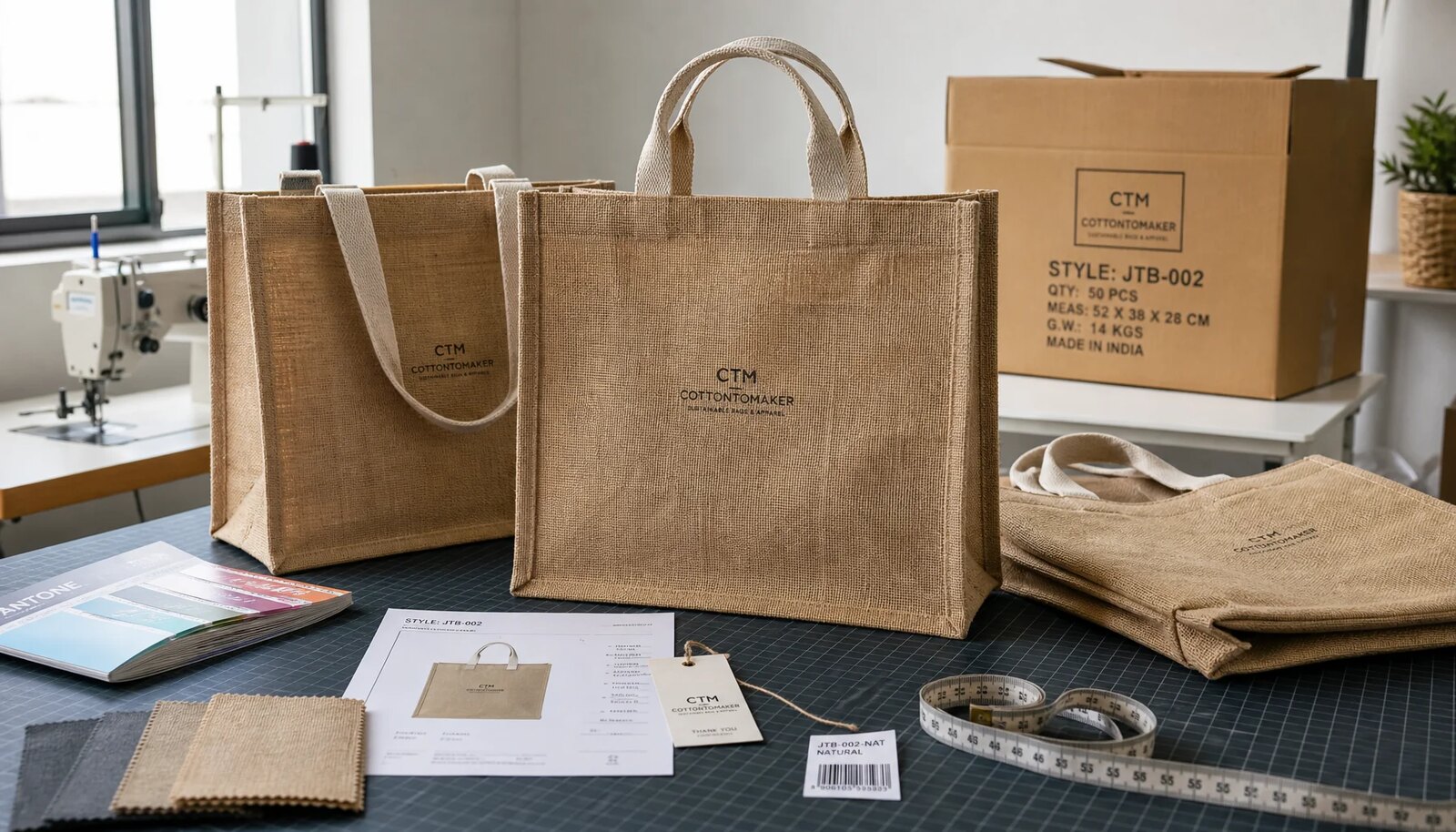
Why Hotel Retail Proofing Is Different
Custom jute tote bags for hotel retail are judged in a different setting from disposable event giveaways. They may sit beside candles, robes, towels, spa products, wine, books, resort apparel, and destination gifts. Guests read the tote as part of the property’s retail presentation, not as a throwaway carrier. A logo that looks polished in a PDF can look broken, dull, tilted, or too small once it is printed on coarse natural jute and sewn into a flexible bag.
Print proofing is the procurement control point that connects brand artwork with the real variables of production: fiber shade, weave openness, ink opacity, sewing pull, handle color, label placement, and carton pressure. The aim is not to erase every natural characteristic of jute. Those texture variations are often part of the appeal. The aim is to define what is acceptable and stop avoidable problems such as weak ink coverage, unreadable small text, crooked placement, odor, stains, or creases across the main logo.
For B2B buyers, proofing also protects schedule and margin. Hotel openings, resort seasons, conferences, holiday retail programs, and property refreshes often have fixed delivery windows. If the proof standard is vague, the buyer may face reprints, resampling, repacking, rejected cartons, or air freight. A practical custom jute tote bags print proofing checklist for hotel retail gives suppliers measurable instructions and gives procurement a fair basis for acceptance.
- Approve the full production combination: jute fabric, print, handle, stitching, labels, hangtags, and packing, not only the digital logo layout.
- Use physical proofing for small text, thin strokes, reverse print, borders, multi-color registration, pale ink, metallic ink, or large solid coverage.
- Treat natural jute variation as a controlled tolerance, not permission for random shade, staining, weak ink coverage, or distorted branding.
- Record the signed sample with measurements, photos, date, revision number, and buyer approval notes before bulk production starts.
Define the Hotel Retail Use Case First
Before choosing GSM, print method, or logo size, define what the hotel will actually put inside the tote and how guests will see it. A spa boutique tote carrying soap, a robe belt, and a brochure does not need the same structure as a resort beach tote carrying towels, sunscreen, and water bottles. A wine shop tote needs different bottom support and handle reinforcement than a small amenity retail bag. If the bag must stand upright on a shelf or hang neatly from a peg, gusset depth, handle drop, fabric weight, lamination, and carton packing all influence the proofing decision.
Hotel retail programs also vary by buying structure. A single resort boutique may want one natural jute bag with a large destination mark and soft cotton handles. A city hotel gift shop may need a cleaner laminated jute tote with barcode labeling and a compact shelf footprint. A hotel group or distributor may prefer one shared bag body with different property logos. That changes MOQ, screens, proof routing, carton marks, and warehouse sorting.
A useful RFQ starts with a short use-case brief. Include expected contents, estimated loaded weight, display method, retail price position, property count, quantity per design, delivery route, and packaging rules. This gives the supplier a chance to flag construction and print risks before sampling. It also prevents a generic promotional quote from winning on unit price while missing the retail standard.
- For spa retail, prioritize low odor, soft handles, clean stitching, calm one or two-color artwork, and packing that avoids front-panel creases.
- For beach and resort shops, specify stronger gussets, moisture-aware storage, larger shelf-facing artwork, and reinforced handles for towels or bottled items.
- For wine, gourmet, or gift-set retail, confirm load expectation, bottom structure, handle anchoring, and whether inserts or dividers are required.
- For multi-property groups, separate the shared bag specification from property-specific logos, barcodes, hangtags, and carton marks.
Lock Fabric and Construction Specs
Fabric choice controls both print result and retail structure. Many hotel retail jute totes use roughly 14 oz to 16 oz material, often described around 380-450 GSM depending on weave and measurement method. Lighter jute may reduce unit cost, carton weight, and freight, but the finished bag can wrinkle more easily, sag when filled, or show contents through the panel. Heavier jute can improve structure, though it may be bulkier to pack and may include stronger slubs that interrupt fine print details.
Buyers should ask for more than one GSM number. Jute varies by yarn thickness, weave tightness, finishing, lamination, and natural shade. A loose high-GSM jute may not print as sharply as a tighter lower-weight fabric. The supplier should provide a real swatch or sample bag in the proposed material, and the buyer should approve shade, handfeel, stiffness, odor level, and visible slub level before final artwork screens are made.
Construction needs to be approved before artwork is frozen. A boxed bottom, reinforced top hem, overlocked inner seams, and cotton webbing handles usually create a more retail-ready tote than a basic promotional seam. Construction also reduces and shapes the printable area. The logo should not sit across a bottom fold, crowd the top hem, or run too close to handle stitching. Final print position should be measured on the finished bag, not only on a flat cut panel.
- Specify fabric as supplier description plus target GSM or ounce range, weave character, shade expectation, and lamination choice.
- Confirm finished width, height, gusset depth, top hem width, handle drop, handle width, bottom structure, and stitch reinforcement.
- Keep important artwork away from side seams, bottom folds, gusset corners, handle stitching, top hem, and label placement areas.
- Request bulk-intended swatches when shade, slub level, stiffness, odor, or print clarity is critical to hotel retail acceptance.
Prepare Artwork for Coarse Jute
Artwork that works on coated paper, plastic, or smooth cotton canvas often needs adjustment for jute. Fine serif text, hairline borders, small stars, thin map lines, tight reverse text, tonal gradients, and halftones are common failure points. The weave can break lines, absorb ink unevenly, and make small negative spaces close up. Buyers should supply editable vector artwork, but they should also require the factory to review technical limits based on the actual fabric.
Direct screen printing is usually practical for custom jute tote bags when the design uses solid brand colors, destination icons, property names, or simple illustrations. It can provide strong coverage if the screen, ink viscosity, squeegee pressure, and drying or curing process are suited to the fabric. For better repeatability, artwork should use bolder strokes, simplified detail, adequate spacing around letters, and trapped edges for multi-color prints.
If the hotel brand requires photographs, gradients, tiny detail, or precise tonal artwork, a different decoration route may be needed. A heat transfer can offer smoother detail, but it may feel less natural and may create a visible film edge. A digitally printed cotton or canvas panel sewn onto jute can preserve complex artwork, but it changes the product style, cost, proofing route, and sewing process. The right method is the one the supplier can repeat against the approved sample.
- Send vector files with outlined fonts, Pantone targets, print size, safe area, and separate files for each hotel property or SKU.
- Ask the factory to confirm minimum stroke width, smallest text height, reverse-print limit, and multi-color registration tolerance before sampling.
- Use direct screen print for bold logos, solid colors, simple icons, and stable repeat programs.
- Use a transfer or sewn fabric panel only when the extra detail justifies the change in handfeel, appearance, cost, and proofing complexity.
Build a Production-Meaningful Proof
A useful proof usually has stages. The first stage can be a digital layout showing bag size, panel area, print dimensions, Pantone references, handle position, safe area, label placement, and carton mark notes. This step is valuable for alignment, but it should not be the final approval for hotel retail when color, texture, line clarity, or shelf appearance matters.
Commercial approval should come from a physical pre-production sample using the approved jute, final ink system, final handle material, final sewing method, final label, and representative packing method. If a component is substituted, it should be labeled clearly. A sample made with available jute can confirm size and construction, but it cannot fully approve ink color or line clarity. A sample with correct print but substitute handles cannot approve the full retail look.
Review the sample as a guest will see it. Fill it with realistic contents, place it on a shelf or counter, hang it by the handles, and view it under lighting similar to the store. A logo that looks centered when flat may look too low once the gusset opens. A large print may wave when the tote is filled. Approval notes should be measurable: print is 180 mm wide, 105 mm below top hem, centered within agreed tolerance, handle drop approved, hangtag on left handle, carton packed flat with front logo protected.
- Measure print width, print height, distance from top hem, distance from side seam, handle drop, gusset depth, and finished bag size on the sample.
- Review front, back, gusset, inside seams, handle stitching, bottom fold, labels, hangtags, barcodes, and packing fold before approval.
- Photograph the signed sample with ruler, color reference, revision number, date, and approval notes for factory and buyer records.
- Use clear sample status terms: layout proof, fabric reference, print strike-off, pre-production sample, and sealed production standard.
Set Color and Placement Tolerances
Natural jute is not a neutral white print base. Beige, tan, gray, or golden undertones change how ink appears, especially white, cream, olive, terracotta, navy, brown, black, and metallic tones. Buyers should avoid asking for an exact paper Pantone match on unbleached jute unless the artwork prints on a coated patch or smoother panel. A stronger standard is a Pantone target plus the approved physical printed result on the selected jute.
Color review must be controlled enough to be useful. Compare samples under consistent lighting, keep the approved swatch or bag available, and avoid deciding from phone photos alone. If remote approval is unavoidable, request photos under daylight and neutral indoor light with the sample beside the approved fabric swatch and a color card. Even then, the physical sample should remain the master standard.
Print position also needs realistic tolerance. Jute totes are flexible sewn items, not rigid printed cartons. Fabric cutting, panel movement, printing pressure, sewing pull, and gusset opening can all affect final placement. For many jute tote orders, plus or minus 5 mm from agreed measurement points is a practical commercial tolerance, but this must be confirmed with the factory. Designs with frames, borders, centered crests, or narrow safe areas may require tighter control, a changed layout, or acceptance of higher reject risk.
- Define color approval as Pantone target plus signed physical printed sample on the approved jute base.
- State print-position tolerance from fixed points such as top hem, side seam, bottom fold, or center line of finished bag.
- Classify critical print defects: wrong logo, wrong color family, missing artwork, severe bleeding, poor registration, tilted print, print crossing seam, or unreadable text.
- Use remote photo approval only as a support step when color consistency and retail shelf appearance matter.
Control Labels, Tags, and Retail Details
Hotel retail buyers often focus on the front print and miss the selling details that turn a tote into a retail-ready product. Hangtags, barcode stickers, price labels, woven labels, inner care labels, material labels, and property-specific SKUs should be part of proofing. A clean logo can still create receiving problems if the barcode is missing, placed on the wrong item, or mixed across property cartons.
The location and method of labels should be specified on the sample. A hangtag may go on the left handle, right handle, or top hem. A barcode sticker may belong on a removable hangtag rather than directly on jute because adhesive can mark fibers or pull loose surface yarns. A woven inner label should not create rough edges or visible exterior stitching unless that is part of the approved look.
If sustainability positioning matters, confirm whether the buyer wants minimal packaging, no individual polybags, recycled paper tags, cotton string, paper bundling, or plastic-free packing. These policies must be balanced against moisture protection and print-face protection during export shipping. For hotel groups, one shared bag body may need separate hangtags, barcode labels, or carton labels for each property, and that sorting labor should be included in the quote.
- Confirm hangtag material, string type, tag position, barcode data, price label policy, and whether labels are applied or supplied loose.
- Avoid direct adhesive labels on visible jute surfaces unless residue, fiber-pull, and removal risk have been approved.
- Specify inner label content, placement, stitching method, and any material or country-of-origin information needed for the sales channel.
- For multi-property orders, provide SKU-by-SKU label files, property names, carton marks, packing splits, and barcode data before final quote approval.
Compare Quotes on Real Cost Drivers
MOQ for custom jute tote bags is not only about total pieces. It is influenced by fabric sourcing, lamination, handle material, print screens, ink mixing, sewing setup, label application, packing style, and whether the order is split across several hotel properties. A supplier may accept a lower quantity for a standard natural jute tote with one-color print because components are common. The same total quantity split into six logos may require six screens, six proofs, separate production tracking, and property-level carton sorting.
Cost gaps between quotes often come from specification gaps. One quote may include 16 oz jute, cotton webbing handles, X-stitch reinforcement, inner lamination, two-color screen print, hangtag application, paper interleaving, and export cartons. Another may use lighter fabric, thinner handles, single stitching, no lamination, one-color print, and basic bulk packing. Both may be described as a custom jute tote bag, but they are not equivalent.
A procurement-ready quote separates the product unit price from setup and service items: screen charges, artwork cleanup, sample cost, courier cost, labels, hangtags, carton upgrades, inspection, inland freight, and delivery term. This makes it easier to decide whether to standardize one bag body across properties, reduce color count, increase quantity per design, or use one shared tag format.
- Product cost drivers include GSM, bag size, gusset depth, handle type, lamination, reinforcement, print colors, and total print area.
- Program cost drivers include sample rounds, screens, artwork revisions, multi-logo setups, label application, SKU sorting, and carton marking.
- Logistics cost drivers include pieces per carton, carton dimensions, gross weight, CBM, packing fold, and whether cartons arrive ready for property distribution.
- Compare supplier offers against the same written specification and require exceptions or substitutions to be listed clearly.
Prevent Packing and Distribution Problems
A good jute tote can be damaged after production if packing is treated as an afterthought. Dark prints may transfer or mark under pressure. Large printed areas can crease if folded through the logo. Laminated bags can show permanent fold lines or crushed corners. Natural fibers can hold odor or moisture if cartons are stored in poor conditions. For hotel retail, packing must protect the printed face, preserve a clean shape, and support efficient receiving.
Flat packing is common, but fold position matters. The main logo should not be sharply folded if the bag will go directly from carton to sales floor. For dark, heavy, or metallic prints, ask whether paper interleaving, tissue, or controlled stacking is recommended. For laminated jute, confirm carton quantity and compression so panels do not arrive with visible crease marks. If the buyer has a no-polybag policy, discuss alternatives such as inner carton liners, paper wrap, desiccants where appropriate, and storage controls.
Distribution requirements should be part of the RFQ, not a warehouse surprise. A central importer may only need SKU-level carton marks and a packing list. A hotel group shipping directly to properties may require property names, PO numbers, barcode ranges, inner bundles, mixed-SKU restrictions, or separate packing lists per location. These details affect factory labor, inspection, and quote accuracy.
- Set carton quantity based on print protection, bag size, carton strength, receiving weight limits, and risk of logo creasing.
- Use paper interleaving or controlled stacking when prints are dark, heavy, metallic, tacky, or likely to mark under pressure.
- Confirm carton dimensions, gross weight, CBM, carton marks, SKU labels, property labels, and packing-list format before packing begins.
- Inspect sealed cartons for piece count, moisture protection, odor, print-facing direction, crush damage, and correct property or SKU sorting.
Plan Lead Time and QC Gates
A reliable schedule separates inquiry, artwork review, digital layout, fabric approval, print strike-off, physical sample, courier transit, buyer review, correction round, bulk material preparation, printing, stitching, trimming, labeling, final inspection, and export packing. Production lead time should not be counted from the first inquiry when artwork, fabric shade, hangtag files, barcode data, or carton marks are still open.
The schedule becomes more sensitive when the order includes multiple colors, several property logos, dyed handles, custom labels, nonstandard size, lamination, or strict retail packing. Each variable may require approval. Buyers reduce risk by freezing the bag body first, confirming artwork and print method second, and releasing bulk production only after accessories and carton instructions are final. Late changes to logo size, property names, barcode data, or handle shade can force new screens, resampling, or repacking.
Quality control should be planned as gates rather than one final inspection. At fabric receiving, check GSM, shade, slub level, odor, and lamination. Before sewing, inspect printed panels for color, coverage, position, registration, and defects. During stitching, check dimensions, seam strength, handle attachment, and print alignment on the finished bag. At final packing, verify labels, carton marks, piece count, packing method, and appearance after compression.
- Reserve time for at least one physical pre-production sample round and one correction round when artwork or presentation is important.
- Freeze logo files, Pantone targets, construction, labels, carton marks, and packing method before bulk cutting or screen setup begins.
- Use QC gates at fabric receiving, print approval, sewing inspection, final appearance check, and export carton verification.
- Treat signed sample approval date, not inquiry date, as the practical start point for confirmed bulk production timing.
Specification comparison for buyers
| Spec decision | Recommended option | When it fits | Buyer risk to check |
|---|---|---|---|
| Jute fabric weight | 14 oz to 16 oz natural jute, commonly about 380-450 GSM depending on weave, finish, and supplier measurement method | Hotel gift shops, resort boutiques, spa retail, welcome stores, and amenity retail where the tote needs visible structure on shelf | Loose weave, heavy slubs, or batch shade variation can interrupt fine logo lines; approve a bulk-intended swatch before artwork is released |
| Print method | Spot-color screen print with artwork simplified for coarse jute; use transfers or sewn panels only when detail requires it | Hotel names, resort marks, destination icons, line art, simple slogans, and one to four-color retail graphics | CMYK photos, gradients, hairline borders, and small serif text can look muddy unless moved to a smoother print area |
| Artwork safe area | Keep main artwork at least 25 mm from side seams, bottom folds, gusset corners, top hem, handle stitching, and labels | Front-panel branding where the tote is displayed upright, folded, or hung on a retail peg | Artwork too close to construction points can distort, lose edge coverage, or appear off-center when the bag is filled |
| Print size control | Specify exact print width, print height, and print location measured from the finished bag, not only a scaled PDF | Shelf-facing destination logos, boutique marks, spa graphics, and property-specific designs | Oversized artwork may wrinkle across the gusset or crowd the top hem; undersized artwork may lack retail presence |
| Handle material | Cotton webbing, cotton rope, or approved jute handle with defined width, drop, shade, and reinforcement | Hotel retail buyers who want a cleaner handfeel and stronger perceived value than a basic promotional tote | Handle shade and texture change the perceived color balance of the bag; approve handle, jute, and print together |
| Lamination choice | Unlaminated for natural handfeel; light inner lamination only when shape retention or moisture resistance is needed | Beach resorts, wine shops, gift sets, heavier spa bundles, or totes that must stand more upright | Glossy or stiff lamination can reduce the natural look, add odor risk, and create crease marks if cartons are over-compressed |
| Sewing construction | Overlocked inner seams, reinforced top hem, boxed bottom or gusset, and handle X-stitch or bartack reinforcement | Retail loads such as towels, bottles, books, robes, candles, packaged foods, or multi-item hotel gift sets | Weak handle anchoring can cause returns even if the logo print passes; request load expectation and stitch method in writing |
| Proof sample type | Physical pre-production sample using bulk-intended jute, final ink, final handle, final size, label, and representative packing | Orders where shelf appearance, brand approval, repeatability, and property-level distribution matter | Digital mockups hide jute texture, ink absorption, seam pull, print tilt, odor, carton pressure, and label placement risk |
| Color standard | Pantone target plus signed physical printed sample as the commercial approval standard | Natural jute bases where beige, gray, golden, or darker undertones affect white, cream, green, navy, brown, and metallic inks | An exact paper Pantone match is usually unrealistic on unbleached jute; approve the actual printed effect under agreed lighting |
Buyer checklist before sampling
- Define the final bag size, finished panel size, gusset depth, handle drop, handle width, jute weight, lamination, expected load, display method, and target hotel retail use before artwork proofing starts.
- Send editable vector artwork with outlined fonts, Pantone references, exact print width and height, logo position, minimum stroke width, smallest text height, and safe area marked away from seams and handle stitching.
- Ask the factory to review artwork for jute suitability before screens are made, especially reverse text, small icons, thin borders, gradients, halftones, light ink, and large solid ink coverage.
- Request a physical printed pre-production sample when the order includes property-specific artwork, fine lines, multiple colors, pale ink, dark coverage, retail hangtags, or strict shelf presentation requirements.
- Approve fabric shade, weave character, handle shade, ink color, print size, seam alignment, label placement, hangtag placement, and packing method as one complete sample set.
- Set written tolerances for print position, color variation, bag dimensions, gusset width, handle drop, top hem, slub level, odor, loose threads, and visible print defects before mass production starts.
- Require bulk fabric, bulk ink, handles, labels, hangtags, barcode stickers, and carton marks to be checked against the signed pre-production sample and purchase order specification.
- Confirm whether screen charges, artwork cleanup, sample fees, courier fees, retail tags, barcode labels, inner labels, paper interleaving, tissue, individual bags, and export cartons are included in the unit price.
- Specify carton quantity, carton dimensions, target gross weight, estimated CBM, moisture protection, polybag policy, print-facing direction, fold line, and carton markings by SKU or hotel property.
- Do not count confirmed production lead time from inquiry date if artwork, fabric shade, proof sample approval, label artwork, barcode data, or carton marks are still open.
Factory quote questions to send
- What exact jute weight, weave density, shade range, and lamination option are included in the quoted price, and can you provide a bulk-intended swatch?
- Is the print quoted as direct screen print, heat transfer, printed fabric panel, laminated panel print, or another method, and how many spot colors are included?
- What minimum stroke width, smallest readable text height, minimum gap for reverse text, and registration tolerance do you recommend for this jute weave?
- Will the pre-production sample use actual bulk-intended jute, final ink, final handle material, final sewing construction, final label, and representative packing method?
- What color approval standard will control production: Pantone target, signed physical sample, printed strike-off, or another agreed reference?
- What print-position tolerance can you hold from the top hem and side seam, and does it change if printing is done before sewing versus after sewing?
- What are the finished-size tolerances for width, height, gusset depth, handle drop, handle width, top hem, and bottom construction?
- What is the MOQ for this size, fabric, and print method, and what changes if the same bag body is split across several hotel property logos?
- Are screen charges, artwork cleanup, sample fees, courier fees, hangtags, barcode labels, inner labels, tissue, paper interleaving, and export cartons included or charged separately?
- What are the normal lead times for artwork review, strike-off, physical sample, buyer approval, bulk fabric preparation, printing, stitching, inspection, and export packing?
Quality-control points to confirm
- Fabric weight should be checked against the approved GSM or ounce range using cut swatches from bulk fabric, not only a supplier catalog description.
- Bulk jute shade should be compared to the approved swatch because beige, gray, golden, or darker natural tones can change the apparent color of printed inks.
- Weave density, visible slub level, loose fibers, and surface cleanliness should be reviewed before printing because these directly affect logo clarity and retail appearance.
- Print color should be checked under consistent light against the signed sample, with special care for white, cream, beige, olive, green, navy, brown, terracotta, black, and metallic inks on natural jute.
- Print position should be measured from fixed points such as top hem and side seam with an agreed tolerance, often around plus or minus 5 mm for many jute tote orders unless tighter control is quoted and confirmed.
- Fine lines, small letters, reverse areas, ink coverage, and registration between colors should be inspected on actual printed panels before stitching when the production flow allows it.
- Finished bag size, gusset width, top hem width, handle drop, handle width, and bottom structure should match the signed sample within the agreed production tolerance.
- Handle stitching should show the approved reinforcement, such as X-stitch, bartack, or reinforced box stitch, for the intended retail load including towels, wine, books, candles, spa sets, or gift bundles.
- Seams should be checked for skipped stitches, loose threads, uneven overlock, exposed raw edges, weak corners, and distortion that makes the printed panel look tilted.
- Appearance defects for hotel retail should include oil marks, dirt marks, strong odor, uneven lamination, ink smudges, print set-off, crushed print surfaces, and heavy creases across the logo.