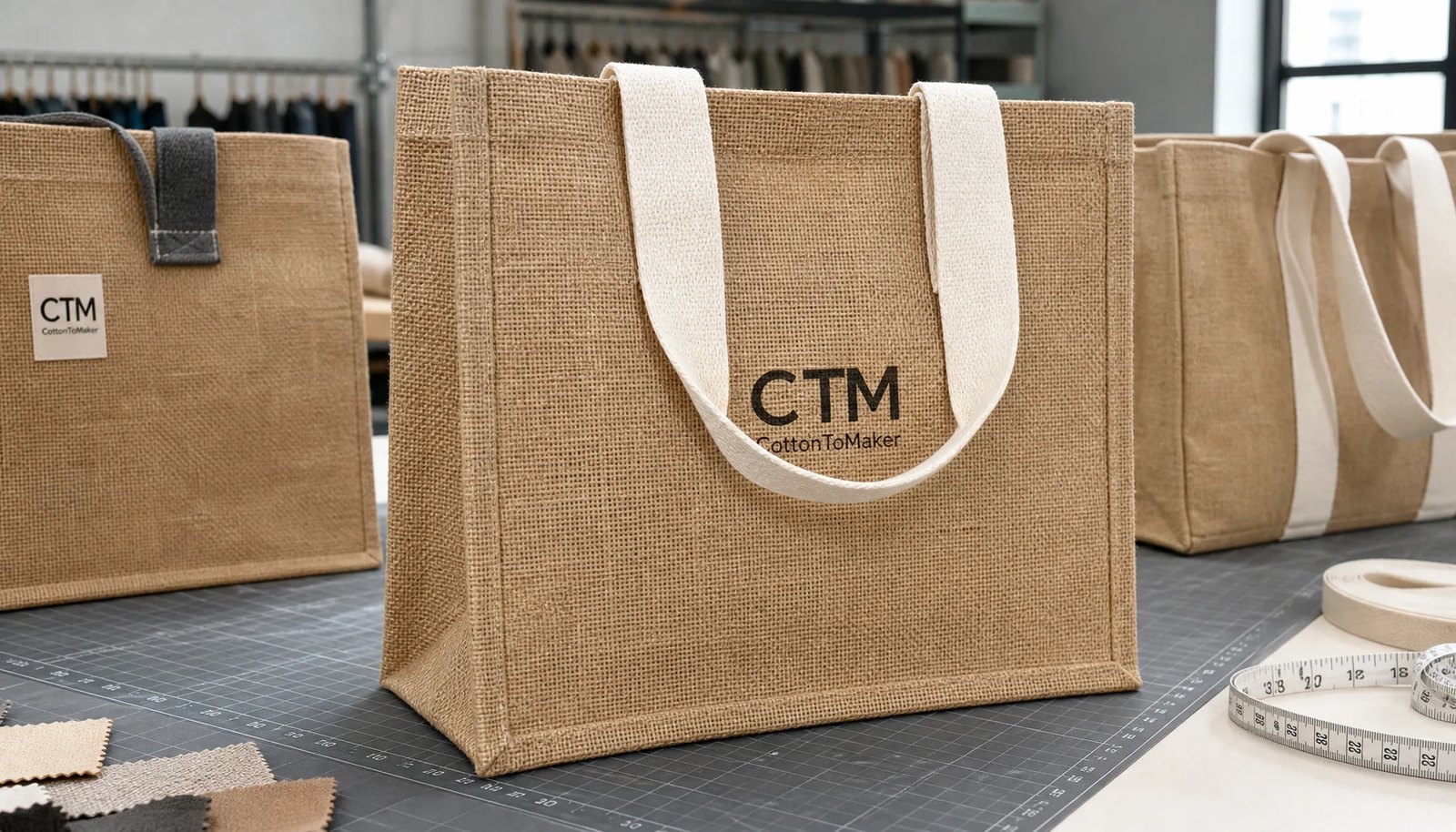
Why Trade Show Jute Totes Need Tighter Proofing
Custom jute tote bags can look easy on an RFQ. Pick a size, place a logo, approve the quote, and ship before the show. The risk is that jute is not a smooth promotional surface. It is a coarse natural fiber with slubs, shade movement, uneven yarn thickness, and a print face that changes from lot to lot. A clean PDF can turn soft at the edges once ink hits the weave. A QR code that scans on paper can fail when small modules land across raised yarns.
For trade show exhibitors, these problems are not abstract. Bags are carried under bright lighting, photographed in booths, handled by prospects, and judged next to printed brochures, signage, badges, and other branded materials. If the tote looks rough in the wrong way, the buyer has very little time to correct it. Event dates do not move because a sample was late or a print color looked different on natural jute.
A custom jute tote bags print proofing checklist for trade show exhibitors should connect the whole order: specification, artwork, sampling, inspection, packing, labeling, and delivery. It should also help teams make practical tradeoffs. Jute will never behave like coated paper, and that is part of its appeal. The job is to decide which natural variations are acceptable and which defects will hurt the brand, the show team, or the receiving process.
- Use a physical sample as the main approval standard for fabric, print, handles, and construction.
- Define acceptable jute character separately from rejectable defects such as stains, odor, holes, weak seams, or unreadable artwork.
- Keep marketing, procurement, the supplier, and the inspection team working from the same approved sample and written tolerances.
- Confirm carton marks and version names before bulk packing, especially for sponsor or regional programs.
- Treat the proofing record as part of the purchase order, not as a side email thread.
Lock The Bag Specification Before Artwork Approval
Artwork approval means very little until the bag specification is clear. A logo printed on a flat jute tote may sit differently from the same logo on a gusseted bag. A bag that folds through the print panel can crease ink. A narrow handle may look acceptable in photos but feel uncomfortable once the attendee adds brochures, samples, and a water bottle. Start with the product the event team will actually use.
The RFQ should list finished dimensions, not only catalog style names. Include width, height, bottom gusset, side gusset, handle width, and handle drop. Finished size affects the usable print area, carton count, and whether the bag can hold folders, notebooks, catalogs, boxed samples, or booth kits. If the bags will be pre-packed before the show, confirm whether they need to stand upright, open easily, or fit a kitting station workflow.
Jute weight also needs a written range. Many trade show jute totes sit around 13 oz to 15 oz, roughly 370-425 GSM depending on weave, finish, lamination, and supplier convention. Lighter jute can lower cost and freight weight, but it may have a looser weave and less stable print surface. Heavier jute can feel more substantial and hold shape better, but cartons become heavier and more expensive to move.
- Specify finished width, height, bottom gusset, side gusset, handle width, and handle drop in millimeters or inches.
- Confirm whether the quoted bag is plain jute, laminated jute, cotton-lined jute, dyed jute, bleached jute, or a mixed-material construction.
- Ask for a current production swatch, not only an old showroom sample.
- State the typical contents: catalogs, notebooks, bottles, boxed samples, chargers, folders, or sponsor inserts.
- Confirm whether the fabric weight includes lamination, backing, or lining when comparing GSM or ounce figures.
Build Artwork For The Surface You Are Printing On
The best jute artwork is usually bold, open, and forgiving. Large type, simple marks, strong contrast, and one to three spot colors tend to work better than fine serif text, thin outlines, halftones, gradients, or tiny reversed-out copy. Natural jute already has visual texture. If the design depends on delicate details, the fabric will compete with the artwork.
Before the factory makes a sample, ask for an artwork risk review at actual print size. This is especially important for QR codes, URLs, sponsor blocks, certification marks, legal copy, social icons, and small tagline text. If a QR code supports lead capture, it should be enlarged and tested on finished bags. If a small mark must stay sharp, a cotton patch, woven label, printed cotton pocket, or smoother front panel may be a better construction choice than direct print on coarse jute.
Pantone references help, but they do not guarantee the way color will look on jute. The tan or brown base changes ink perception. White can look warmer and less bright. Black can lose edge crispness. Red may deepen. Green can mute. Navy may read nearly black under show lighting. Approve color from the real sample, on the real material, under practical lighting.
- Provide vector artwork with fonts outlined and all linked assets supplied or embedded.
- Mark actual print width, print height, and placement from seams or panel edges.
- Keep important artwork away from seams, gussets, folds, handle stitching, and heavy texture zones unless the sample proves the placement works.
- Ask the supplier to flag minimum line thickness, minimum gap size, maximum ink coverage, and QR code risk before sampling.
- Name every artwork version clearly so sponsor, distributor, or regional designs do not blur together later.
Choose The Print Method Based On Artwork Risk
Screen printing is the practical default for many custom jute tote bags. It suits bold logos, simple typography, strong contrast, and repeat orders. The factory should still confirm ink type, mesh or screen setup, curing process, and minimum printable detail for the specific jute. More ink can improve coverage, but too much can fill small gaps, stiffen the panel, or crack when a printed area is folded tightly.
Transfers can be useful when artwork has more colors or smoother graphics, but they need proofing on the final material. Jute texture may telegraph through the transfer or make the edges less clean. Laminated jute may react differently to heat than plain jute. A transfer that works well on cotton canvas is not automatically safe on jute, so check adhesion, edge lift, fold behavior, and rub resistance before bulk production.
Embroidery, patches, and labels can solve some print problems, but they create their own tolerances. Embroidery can pucker coarse fabric and may be costly for large logos. Sewn patches and woven labels can give fine detail a cleaner base, but placement must be controlled and stitching must be neat. The best method is the one that fits the artwork, quantity, budget, and event standard, not simply the method used on last year's bag.
- Use screen print for bold brand marks, large sponsor logos, simple slogans, and one-to-three-color artwork.
- Use transfer printing only after checking adhesion, edge finish, rub behavior, and fold performance on final jute.
- Use cotton patches, printed cotton panels, or woven labels for fine text, small icons, and premium retail-style finishing.
- Confirm screen setup, ink matching, sample charges, and revised proof charges in the quote.
- Reject any print method recommendation that is not tied to the actual artwork and final bag construction.
Read Supplier Quotes Line By Line
Two quotes for the same tote size may describe very different products. One supplier may price a thin open-weave jute bag with narrow handles, one-color print, light cartons, and no sample freight. Another may include a heavier fabric, laminated backing, cotton webbing handles, PMS ink matching, reinforced stitching, better cartons, and separated version labels. Procurement needs to compare the assumptions, not only the unit price.
The quote should identify fabric weight, weave density or yarn character where available, finish, lining or lamination, handle material, handle width, print method, print size, color count, ink coverage assumptions, screen or setup costs, sample costs, sample freight, carton quantity, carton size, gross weight, and packing method. If the program includes multiple sponsors or regions, version-change charges should be visible before the order is awarded.
MOQ deserves careful attention. A 3,000-piece order may not behave like one 3,000-piece job if it is split into six artwork versions, three carton marks, and two packing formats. The supplier may need separate screens, setup time, labels, counting, and inspection sampling for each version. Sometimes the better decision is to reduce color count, combine sponsor logos into one approved layout, or use labels for lower-volume variations.
- Request itemized pricing for blank bag, print setup, print run charge, sample, sample freight, packing, carton marking, and inland freight.
- Ask for price breaks at practical volumes such as 500, 1,000, 3,000, and 5,000 pieces if final demand is still moving.
- Confirm MOQ by bag size, fabric color, print color, artwork version, and packing version.
- Compare carton gross weight and carton volume because they affect freight, warehouse handling, and event drayage.
- Ask whether PMS matching, revised samples, inspection support, and special carton labels are included or billed separately.
Approve Samples With A Useful Proof Record
A good sample process is quick, but it is not casual. For a trade show order, the normal path is fabric swatch, construction confirmation, digital layout, and then a physical pre-production sample. The final sample should show the actual jute, finished dimensions, handle material, handle drop, lining or lamination, print method, ink color, logo size, placement, and any folding method that could affect the printed panel.
Avoid approving samples with vague comments such as looks good or proceed. A better proof record says exactly what is approved and what remains open. Marketing may approve logo size while procurement still needs carton marks. Operations may care about handle drop and kitting fit. The supplier may read a short approval email as a production release even if the buyer still expects packaging changes.
Control reference samples carefully. Ideally, one marked sample stays with the buyer, one remains with the factory, and one is available for inspection. Photos are helpful for records, especially when they include a ruler beside the logo, gusset, handle, and label. Photos cannot replace a physical standard for handfeel, fabric shade, ink edge quality, odor, or handle comfort.
- Measure the sample flat and then review it filled with realistic trade show contents.
- Photograph the approved sample with a ruler beside the print, gusset, handle, label, and any patch or pocket.
- Record whether the sample is fully approved or approved with specific corrections before bulk production.
- Keep one signed or clearly marked reference sample for final inspection comparison.
- Do not release bulk printing until construction, fabric, artwork, ink color, placement, and print method are all approved.
Set QC Tolerances That Match Jute Reality
Jute is allowed to look like jute. Small slubs, shade movement, yarn-thickness variation, and mild texture irregularity are part of the material. That does not mean everything should pass inspection. Oil stains, mildew marks, damp odor, holes, severe panel mismatch, broken yarns across the logo, skipped handle reinforcement, unreadable artwork, wet cartons, and mixed versions are defects that can damage the event outcome.
Print placement should be measured from stable reference points. For a centered logo, use top seam and side seams or panel edges. For lower artwork, define whether the measurement comes from the bottom edge, gusset fold, or another fixed point. A tolerance such as +/-5 mm may work for a simple front logo, while framed designs, sponsor grids, and multi-logo layouts may need tighter review because small shifts are more visible.
Color tolerance should be tied to the signed physical sample. Phone photos and screens are not reliable because jute base shade and lighting shift the result. If production uses more than one fabric lot, ask to see the shade range before printing. If the bag carries a QR code, inspection should include scan testing on multiple finished bags under normal lighting and at a realistic distance.
- Define finished size tolerance for width, height, bottom gusset, side gusset, and handle drop.
- Define print-position tolerance and state exactly where measurements begin.
- State whether slubs inside the printed area are acceptable when readability and brand appearance remain intact.
- Include checks for odor, moisture, mildew, oil stains, holes, loose threads, skipped stitches, broken yarns, and weak handle seams.
- Require a practical handle load check based on expected booth contents rather than a generic durability claim.
- Use the approved physical sample as the color, construction, and print reference for final random inspection.
Make Packing Part Of The Product
Packing can make or break a trade show order. Bags may go to an advance warehouse, booth builder, distributor, sponsor office, exhibitor headquarters, or a kitting partner. The receiving team needs to identify event name, SKU, sponsor version, destination, carton quantity, and carton sequence fast. If cartons are vague or mixed, well-made bags can still become a show-floor problem.
Flat packing is common for jute totes, but the buyer should understand how the printed panels touch each other in the carton. Rough jute rubbing against ink can cause scuffing if bags are compressed tightly or shift during transit. Counted inner bundles make receiving easier and reduce handling time. Individual polybags may protect cleanliness for VIP or retail-style kits, but they add cost, material, packing time, and unpacking labor.
Moisture control matters because jute absorbs humidity. Bags should be packed dry, cartons should be export-grade, and storage should avoid damp floors or exposed loading areas. A musty smell on arrival is hard to fix before a show. Ask for carton dimensions and gross weight early so logistics can plan pallets, courier limits, warehouse space, and event handling costs.
- Confirm pieces per inner bundle, pieces per master carton, carton dimensions, gross weight, and pallet plan when applicable.
- Approve carton marks showing buyer code, event name, SKU, artwork version, quantity, carton number, and destination.
- Separate sponsor, regional, or distributor versions with carton marks and inner labels.
- Protect printed panels from heavy rubbing, dirty board, sharp folds, and excessive compression.
- Inspect cartons for dryness, sealing quality, odor, crushed corners, and clear labels before freight pickup.
Plan Backward From The Real Use Date
The useful deadline is not always the show opening morning. Many events have advance warehouse windows, decorator labels, booth builder schedules, kitting deadlines, and appointment-based deliveries. If jute totes are part of a booth kit with brochures, badges, samples, or sponsor inserts, late bags can hold the entire kit even when every other item is ready.
Build the schedule from the date the bags must be usable. Include artwork review, fabric confirmation, sample making, sample freight, buyer review, possible revisions, bulk material preparation, printing, sewing or final assembly, trimming, inspection, packing, documents, freight pickup, customs clearance, warehouse receiving, and final booth or kit delivery. The production lead time should start after complete sample approval, not after the first quote.
Approval delays are one of the easiest ways to lose control. If marketing needs three business days to review a sample, put that time in the timeline. If the artwork includes fine type, QR codes, large white ink areas, or exact brand color expectations, reserve time for one revised proof. A small buffer is usually cheaper than urgent freight on heavy cartons of jute bags.
- Confirm whether quoted lead time is in working days or calendar days and when the clock starts.
- Lock artwork, version names, and carton-mark logic before sample production whenever possible.
- Reserve extra proofing time for QR codes, fine text, large solids, white ink, or strict brand color requirements.
- Schedule final inspection before cartons are booked for pickup or sealed for export.
- Confirm receiving rules for the venue, advance warehouse, booth builder, or kitting partner early enough to print correct labels.
Compare Landed Cost, Yield, And Event Risk
The factory unit price is only one part of the buying decision. A reliable landed-cost view includes unit cost, setup charges, sample fees, sample freight, inspection, carton volume, gross weight, freight mode, duty assumptions, local delivery, warehouse handling, and event drayage. Heavy jute can look affordable at the factory and become expensive once air freight or venue handling enters the picture.
Usable yield matters more than ordered quantity. If cartons arrive damp, sponsor versions are mixed, QR codes do not scan, handles fail, or printed panels are badly scuffed, the event team may not have time to sort or replace them. A slightly higher unit price can be the better procurement decision when it buys clearer version control, stronger cartons, cleaner printing, or more dependable inspection.
Plan overage deliberately. Extra bags may be needed for sponsor samples, VIP visitors, internal sales teams, damaged cartons, late booth additions, or warehouse handling losses. For multi-version programs, assign overage by artwork. Extra bags in the wrong sponsor version do not solve a shortage in another version.
- Calculate landed cost using product price, setup, samples, inspection, carton volume, gross weight, freight, duty assumptions, and local handling.
- Compare usable yield rather than ordered quantity when cartons will be opened directly at the venue.
- Assign overage by artwork version for sponsor, regional, or distributor programs.
- Keep the proofing checklist with the purchase order so quoted details connect to inspection and receiving.
- Review whether better cartons, clearer labels, or stricter sample approval reduce enough event risk to justify the cost.
Specification comparison for buyers
| Spec decision | Recommended option | When it fits | Buyer risk to check |
|---|---|---|---|
| Jute fabric weight | 13 oz to 15 oz natural jute, roughly 370-425 GSM depending on weave, finish, and supplier convention | Trade show giveaways carrying catalogs, samples, notebooks, brochures, inserts, or sponsor literature | Open weave can break logo edges; heavier jute raises carton weight, freight cost, and storage volume |
| Construction | Plain jute for simple logo totes; laminated backing, cotton lining, or cotton front panel when print detail needs more stability | Exhibitors using large white ink, QR codes, sponsor blocks, retail-style finishing, or pre-packed kits | Lamination changes handfeel and sustainability wording; lining adds sewing time, unit weight, cost, and MOQ impact |
| Print method | Screen print for bold spot-color artwork; transfer, patch, or woven label only after proofing on final material | Most event bags with one to three brand colors, simple typography, and repeatable production | Ink can bridge uneven fibers; transfers may show edge lift; patches add sewing tolerance and placement variation |
| Artwork proof | Digital layout plus physical pre-production sample on final jute, final size, and final handle construction | Sponsor bags, lead-generation giveaways, VIP kits, retail add-ons, paid attendee bags, and color-critical logos | A PDF or paper proof cannot prove ink behavior, fabric shade, QR readability, or logo sharpness on jute |
| Handle specification | Cotton webbing or padded jute handle, commonly 25-35 mm wide, with agreed handle drop and box-X or reinforced stitching | Attendees carrying brochures, bottles, demo samples, catalogs, or multi-item booth kits for several hours | Narrow handles can feel sharp; weak stitch density or short handle drop can cause complaints or failure |
| MOQ logic | Confirm MOQ by bag size, fabric color, print color count, artwork version, packing version, and sample requirement | Importer, distributor, sponsor, and multi-region programs with several event designs | A 3,000-piece order split into six designs may price and schedule like six smaller jobs |
| Packing format | Flat packed in counted inner bundles, protected print panels, dry export cartons, and approved carton marks by version | Advance warehouse receiving, booth builder delivery, distributor drops, and event-site sorting | Moisture, scuffed print panels, unclear marks, or mixed versions can create show-floor shortages |
| Inspection threshold | Use written AQL plan plus specific tolerances for size, print position, color, stitching, odor, moisture, and carton condition | Bulk orders opened directly at venues, warehouses, sponsor offices, or fulfillment centers | Without acceptance criteria, normal jute character and true defects become arguments after shipment |
| Schedule control | Work backward from kitting, advance warehouse, or booth delivery date, not only show opening day | Orders tied to decorator deadlines, sponsor launches, warehouse appointment windows, or booth kits | Late proof approval can force air freight; late carton marks can block receiving or sorting |
Buyer checklist before sampling
- Define finished width, height, bottom gusset, side gusset, handle width, and handle drop in millimeters or inches; do not approve from a catalog photo alone.
- State the target jute weight or GSM range and whether the quoted fabric is plain natural jute, laminated jute, cotton-lined jute, dyed jute, bleached jute, or blended construction.
- Confirm whether the bag must stand upright when filled, fold flat for carton packing, fit a specific brochure size, or hold pre-packed booth materials.
- Provide vector artwork with fonts outlined, Pantone references, actual print size, placement from seams, and any minimum line thickness or QR code requirements.
- Mark which panels print, whether artwork crosses a fold or gusset, and whether sponsor, distributor, or regional versions require separate carton marks.
- Ask the supplier to review fine text, QR codes, reversed-out artwork, halftones, large solid ink areas, and white ink before the sample is made.
- Require a physical pre-production sample for major trade shows, sponsor bags, retail programs, paid attendee kits, and artwork with critical color or small detail.
- Approve print color on the real jute surface under practical lighting, not only from a screen, paper proof, or supplier photo taken in unknown light.
- Check handle material, handle width, handle drop, comfort, reinforcement stitching, and expected load based on the actual contents attendees will carry.
- Set tolerances for finished size, print position, color variation, fabric slubs, shade movement, odor, loose threads, broken yarns, stitch defects, and carton moisture condition.
Factory quote questions to send
- What jute weight, yarn thickness, weave density, and finish are included in the quote, and can you provide a current production swatch rather than an old showroom sample?
- Is the quoted bag plain, laminated, lined, dyed, bleached, or mixed-material, and how does that construction affect print sharpness, handfeel, unit weight, carton quantity, and lead time?
- Which print method are you quoting for this artwork, and what minimum line thickness, minimum gap, QR code size, and maximum ink coverage do you recommend on this jute?
- Does the quotation include screen setup, PMS ink matching, artwork checking, sample charge, sample freight, revised sample cost, and version-change charges?
- What is the MOQ per bag size, per fabric color, per print color, per artwork version, and per packing version if several trade show sponsors or regions are involved?
- What handle material, handle width, handle drop, reinforcement stitch pattern, stitch density, and expected load are included in the base price?
- What are your normal tolerances for finished size, print placement, print color, fabric shade, handle drop, stitching, and carton quantity?
- Can you provide a pre-production sample using the same jute lot, ink, handle, lining or lamination, and packing fold planned for bulk production?
- How many bags are packed per inner bundle and master carton, what are carton dimensions and gross weight, and can carton marks separate event name, booth kit, distributor SKU, or sponsor version?
- What production lead time starts after final sample approval, and what approval delay would push the ship date, change the freight mode, or require a revised delivery plan?
Quality-control points to confirm
- Finished bag size should be checked against written tolerance because jute can relax after cutting and sewing; measure width, height, gusset, and handle drop across a random sample.
- Print placement should be measured from stable seams or panel edges, with an agreed tolerance such as +/-5 mm for simple front logos and tighter review for framed or centered sponsor marks.
- Color approval should use a signed physical sample because natural jute changes the perceived brightness of white, black, red, green, navy, and metallic-look inks.
- Minimum print line thickness should be suitable for coarse jute; fine type, small QR codes, thin outlines, and reversed-out copy need sampling and readability checks.
- Ink adhesion should be checked with light rub, fold, and scratch review where appropriate, especially on laminated jute or transfer prints.
- Handle attachment should use reinforced stitching and pass a reasonable load test based on expected booth contents rather than a generic durability claim.
- Bulk goods should be checked for damp smell, mildew marks, oil stains, holes, loose threads, broken yarns, skipped stitches, weak handle seams, and sharp trimming residue.
- Cartons should be dry, export-grade, correctly sealed, clearly marked, and packed so printed panels do not rub heavily against rough jute, dirty board, or sharp folds.
- Artwork versions should be separated by carton mark, inner label, SKU code, or barcode to prevent sponsor, regional, or distributor designs from mixing at the show site.
- Final inspection should include carton count, inner bundle count, random sample review, approved-sample comparison, scan testing where relevant, and photo records before freight pickup.