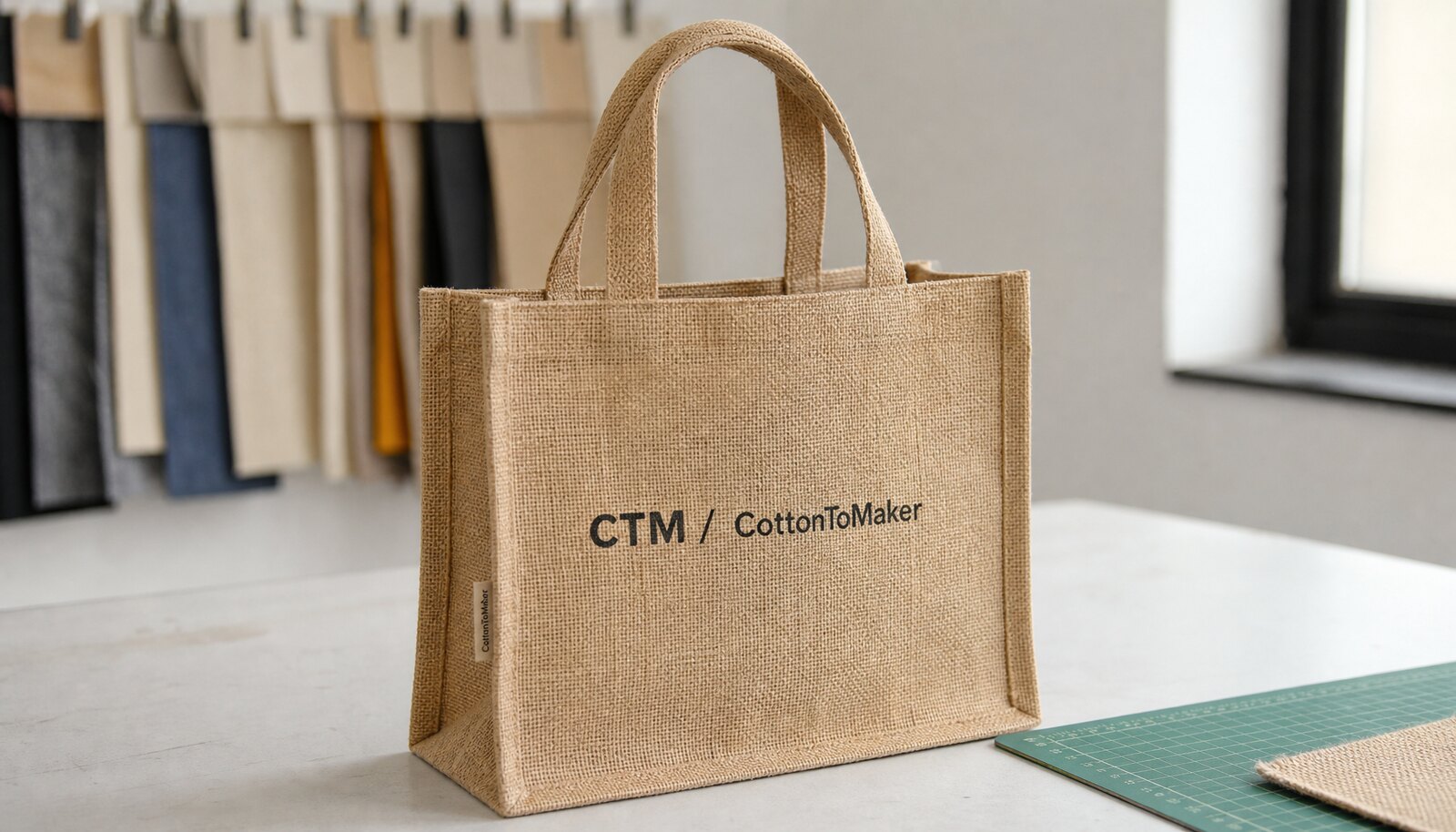
Why gift shop jute totes fail differently from promo bags
A gift shop tote has a different job from a trade-show giveaway. It sits on a shelf, competes with other retail items, and is often judged as part of the store's brand story. That means the bag is not only carrying a logo. It is carrying perceived quality, destination identity, and price justification. A tote that looks slightly crooked, smells too strong, or arrives with crushed print areas can hurt the store's margin even if the unit cost was attractive on paper.
That is why custom jute tote bags print proofing checklist for gift shops should start with the physical bag, not the artwork file alone. Jute weave, seam placement, gusset depth, and handle tension all affect where the print lands and how the bag presents on a shelf. A clean mockup can still produce a bad retail result if the supplier approves art before the build is locked.
Gift shop buyers also face more visible failure modes than general procurement teams. A tourist shop may sell the tote near postcards, ceramics, and apparel, so the bag has to look good from a distance and up close. If the print bleeds into the weave, the handles are uneven, or the bag collapses when set down, the customer sees the defect immediately. That is why the proofing process needs clear decisions, not general approval language.
- Treat the tote as a retail product, not just a printed carrier.
- Evaluate shelf appearance, not only logo accuracy.
- Lock the bag construction before you finalize the artwork approval.
Start with the bag body, because the print cannot rescue a weak build
For gift shop use, a practical starting point is 14–16 oz jute, or roughly 400–450 GSM, when the buyer wants a bag with a more premium hand feel and better shape retention. Lighter fabric can work for low-cost souvenir programs, but it usually shows more weave irregularity, creases sharply in packing, and gives the printer less room to hold clean edges. The first decision is not whether the bag is natural-looking. It is whether the fabric will present consistently enough to justify the retail price.
Finish matters as much as weight. Raw jute creates a natural, rustic look, but it can shed fibers and absorb ink unevenly from bag to bag. Laminated or lined bags usually hold shape better and look cleaner on shelf, but they also change the cost structure and can affect odor, folding behavior, and the way the print sits on the surface. Those tradeoffs are supplier-dependent, so the quote should state exactly what is being supplied rather than assuming all jute bags are comparable.
Gift shop buyers should use a simple threshold. If the tote must sit upright for display, ask for a reinforced base, lining, or lamination. If the bag will mostly be handed over at checkout and used immediately, an unlined build may be enough. If the supplier cannot explain why the proposed construction fits the channel, the spec is not tight enough yet.
- Use a heavier body when shelf presentation and shape retention matter.
- Do not compare lined and unlined bags as if they are the same spec.
- Ask whether the quote includes a reinforced base or bottom board if the bag needs to stand up.
Choose the print method by artwork, quantity, and retail expectation
Most gift shop runs do best with one-color screen print when the logo is bold, the artwork has enough open space, and the order is likely to repeat. Screen print is usually the most stable choice on coarse jute because it tolerates the surface texture better than very fine detail. It also keeps the commercial model easier to manage once the screens are made and the artwork is frozen.
Two-color screen print is still common for destination shops, museum stores, and seasonal retail, but it needs more discipline. Each extra color often adds setup time, and on smaller runs the added screen charge can have a larger impact than the ink itself. Heat transfer can handle more complex graphics or short runs, but it has to be tested on the actual jute weave. A design that looks crisp on paper can lift at the edges or lose contrast after pressing on a textured surface.
The right question is not which method the factory prefers. The right question is which method produces the cleanest retail result for the expected quantity. If the artwork includes thin text, tight spacing, or delicate lines, ask for a real bag proof under normal lighting before you approve the line. If the design is bold and the bag is a repeat seller, prioritize consistency and repeatability over decorative detail.
- Use screen print for bold logos and repeat orders.
- Use heat transfer only if the bag texture and artwork detail have been proven together.
- Reject paper-only proofs for textured jute.
Read the pre-production sample as a retail prototype, not a sample sheet
The pre-production sample is where the buyer learns whether the tote is actually ready for a gift shop shelf. It should be made from the final fabric, with the final print settings, final handles, and final packing method. A lookalike sample can hide the exact failures that matter most in production, such as print spread into the weave, handle imbalance, or the bag body twisting after stitching.
Measure the sample from reference points on the bag itself, not from the artwork file. The buyer should record height, width, gusset depth, handle drop, and the distance from the print to seams and folds. If the logo is centered in the digital proof but drifts once sewn, that is a construction problem, not just an artwork problem. The sample should also be checked in hand. Open the bag, set it down, and see whether it sits square or tips to one side.
For gift shop programs, the sample should answer one final question: will the customer believe this bag belongs on the shelf next to other paid merchandise? If the answer is no, keep adjusting the spec before bulk approval. Sample approval is cheaper than explaining a shelf of uneven bags after they arrive.
- Approve only a sample made with final materials and final construction.
- Measure from seam references and not from the raw edge alone.
- Check bag shape, panel flatness, and handle balance before sign-off.
Use the comparison table to separate cheap from commercially usable
The comparison table below is meant to help buyers judge commercial tradeoffs, not only unit price. A low quote can still be a poor fit if it comes with a weaker fabric weight, a higher setup burden, or a packing method that causes retail damage. The real question is what the supplier is leaving out. In jute tote sourcing, hidden costs often show up in the sample stage, in screen charges, or in the cost difference between low-MOQ and replenishment tiers.
For gift shops, the best value is usually a spec that looks consistent, survives unpacking, and can be reordered without a full reset every time. That often means choosing one stable fabric weight, one print method, and one packing format for the season, then comparing suppliers on whether they can hold that spec without adding avoidable fees.
- Compare like with like: same fabric, same print method, same packing, same MOQ tier.
- Ask where the supplier makes money: fabric upgrade, setup charge, or packing labor.
- Treat sample charges and repeat-order pricing as part of the real unit cost.
Quote questions that expose the hidden cost drivers
A useful quote conversation does not read like a generic RFQ template. It sounds like a buyer trying to confirm whether the supplier can actually deliver the same tote twice. Start with the material stack, because that is where suppliers often hide the biggest differences. A bag that is unlined, lightly stitched, and printed with a single color is not the same product as a lined bag with reinforced handles and a more controlled print surface, even if the front artwork looks identical.
Then ask about charges that often get buried in the first quote. Sample fees, screen charges, plate charges, revised artwork charges, and rush fees can turn a competitive quote into an expensive one after the proofing stage begins. If the supplier cannot state whether those charges are one-time, repeatable, or credited back against bulk, the buyer does not have a clear landed-cost picture yet.
Finally, ask for operational details that affect the order after it is approved. How many bags per carton? What is the gross weight? What is the exact lead time once the sample is signed off? Who signs the first-off photo? These are the questions that separate a bag vendor from a production partner.
- Ask for price breaks at 500, 1,000, and 3,000 units if those are realistic buying tiers.
- Confirm which charges repeat when the artwork changes.
- Make the supplier state who owns sample approval and who owns line release.
QC acceptance criteria should be measurable before production begins
Quality control is stronger when the buyer defines acceptance criteria up front. On jute, visual judgment alone is not enough because the weave changes how the print reads. A logo can look fine in a digital file and still fail once the ink lands on the fibers. That is why gift shop buyers should define what counts as acceptable placement, acceptable color, and acceptable finishing before the bulk line starts.
A practical approach is to give the factory a measurement frame. For example, keep the artwork centered within plus or minus 3 mm on the front panel, and keep finished dimensions within plus or minus 5 mm or 3%, whichever is larger. Agree the exact tolerance with the supplier if the bag uses a very soft body or a highly textured weave, but do not leave the tolerances undefined. Undefined tolerances become subjective disputes at receiving.
The same logic applies to seam strength, odor, and print cure. If the bag will be handed to customers in a store, it should not arrive with a strong chemical smell, open stitches, or visible ink transfer. If the supplier cannot agree to a testable standard, the buyer is not protecting the order tightly enough.
- Set numeric tolerances for size, placement, and handle drop.
- Test for rub resistance, seam integrity, and odor before the shipment leaves the factory.
- Reject recurring defects, not only obvious damage.
Packing and carton rules matter more than many buyers expect
Packing is where a good tote can become a receiving problem. Jute bags do not behave like flat synthetic pouches. They hold crease memory, and if they are compressed too hard, the front panel can wrinkle across the print area. That is a problem for gift shops because retail presentation starts the moment the buyer opens the carton. A bag that looks fine in production may still need rework if it arrives compressed, dusty, or packed in a way that hides print defects.
For most gift shop programs, flat pack in clearly labeled cartons is the safer option. It usually gives the receiving team better control and reduces the time spent sorting by SKU, color, or size. Bulk packing can work when the product is simple and the warehouse is set up for it, but it tends to create more handling inside the store or distribution center. If the quote includes inner polybags, confirm whether they are there for cleanliness or for moisture protection, because that choice can affect odor, condensation, and unpacking speed.
The carton spec should be part of the commercial decision, not an afterthought. Ask for carton count, carton dimensions, gross weight, and the labeling format before you approve the order. If the bags are being sent to a chain warehouse, distributor, or export consolidation point, the wrong carton cube can cost more in receiving friction than the whole print setup.
- Prefer flat pack when shelf presentation and receiving speed matter.
- Check whether inner polybags help cleanliness or create odor and condensation risk.
- Make carton labeling match the PO, SKU, and color code exactly.
Plan reorder logic around seasonality, not just the first order
Gift shop demand is often seasonal, event-driven, or tied to a location. That means the first order is rarely the only order that matters. A tote for a museum shop, holiday market, or destination store may need replenishment after a better-than-expected weekend or before a new tourist season starts. Buyers who only optimize the first run often end up paying more later because the second order has to be rushed, re-setup, or rebuilt from scratch.
This is where MOQ and setup charges should be viewed strategically. If a design is likely to repeat, it can make sense to choose a slightly higher initial volume if it unlocks a lower repeat cost and avoids a fresh setup later. If the tote is tied to one limited event, a smaller MOQ may be the better commercial choice even if the unit price is higher. The decision is not about cheapest headline cost. It is about how much flexibility the buyer needs after the first sell-through cycle.
A good supplier should be able to tell you whether the artwork, screen, and sample approvals can be reused on a reorder. If the answer is no, ask why. Sometimes the no is legitimate because the fabric or print method changes. Other times it only means the supplier has not organized the project well enough for a repeat retail program.
- Use the first order to learn whether the design can be replenished cleanly.
- Do not chase the lowest MOQ if a repeat program is likely.
- Ask whether the supplier can hold the approved artwork and setup for a reorder window.
Approve the order only when the spec packet is complete
The final approval should not be a vague email that says the sample looks fine. It should be a complete packet that can stand up in a dispute. At minimum, the packet should include the approved sample photo, finished dimensions, print placement reference, color reference, packing format, carton count, and delivery window. If there is more than one SKU or more than one print color, each version needs its own record so the factory and buyer are comparing the same thing later.
This packet matters because jute tote issues often show up at the margins. The print can be technically acceptable but still look wrong if it drifts too close to a seam. The bag can pass a visual check but still fail if it arrives with an odor or a packing problem that slows receiving. When the approval trail is tight, the procurement team has a clearer basis for rework, credit, or replacement if something goes off spec.
If the supplier pushes for immediate bulk release without a real pre-production sample, that is a red flag. It does not always mean the factory is unreliable, but it does mean the buyer is accepting avoidable risk. For gift shop programs, especially seasonal or branded retail, the better decision is usually to slow down at proofing and speed up only after the physical sample has been signed off.
- Keep one approval packet per SKU and colorway.
- Do not release bulk production until the sample, dimensions, and packing spec all match.
- Walk away or pause the order if the supplier will not commit to measurable proofing standards.
Specification comparison for buyers
| Spec decision | Recommended default for gift shops | Typical commercial tradeoff | What to confirm in the quote |
|---|---|---|---|
| Fabric weight | 14–16 oz / about 400–450 GSM jute for shelf-ready shape and fewer print distortions | 12–13 oz can be 10–20% cheaper on paper, but it usually looks softer, wrinkles more, and is less forgiving on coarse weave | Ask whether the quoted weight is raw, laminated, lined, or finished weight, and whether the same fabric will be used on the sample and bulk run |
| Print method | 1-color screen print for the most stable retail result; 2 colors only when the artwork needs it | Each extra color often adds a setup charge and can raise unit cost by 5–15% at mid volumes; on low MOQs the flat setup fee can matter more than the ink itself | Confirm color count, screen charge, cure method, and whether small text or fine lines will survive on the actual jute texture |
| MOQ tier | Use the lowest tier only for test launches, seasonal runs, or destination-store exclusives | A 500-unit order is often 20–40% more per bag than a 1,000–3,000 unit tier, depending on construction and print complexity | Ask for price breaks by tier and make sure the supplier states whether the MOQ is per design, per colorway, or per size |
| Sample and setup charges | Require a pre-production sample with final material, final print, final handle, and final packing method | Sample charges are often credited back on bulk orders, but screen or plate charges usually recur when the artwork changes | Confirm the sample fee, courier fee, and whether artwork revisions trigger new setup charges or a new sample run |
| Lining or lamination | Unlined for low-cost souvenir bags; lined or laminated when the tote needs a cleaner interior and stronger shelf presentation | Lining and lamination typically add labor and material cost, often raising the unit price by 8–20% depending on the build | Check whether lining affects odor, fold memory, recyclability language, or print adhesion |
| Handle construction | Cotton webbing or jute rope with bar-tack reinforcement for gift shop carry use | Better handle materials cost more than raw jute strips, but they reduce complaints about rough hand feel and weak attachment points | Ask for handle width, drop length, stitch count, and whether the load test is done at the handle top, seam, or gusset junction |
| Packing format | Flat pack with controlled carton counts for retail-ready receiving | Flat packing may use slightly more cube, but it usually cuts store-side sorting time and protects print areas better than over-compressed bulk packs | Confirm inner pack method, carton size, gross weight, moisture protection, and label format |
| Supplier route | Direct factory for repeat orders and clear spec control; trader only when the buyer needs multi-item consolidation | Direct factory usually gives better cost transparency, while a trader can add margin but may simplify mixed programs and small-order coordination | Ask who owns proof approval, who answers defects, and whether the quoted lead time includes internal handoffs |
Buyer checklist before sampling
- Write one spec sheet for the whole tote: finished size, gusset depth, fabric weight, lining or lamination, handle material, handle drop, and reinforcement method.
- Send vector artwork and state the minimum line thickness, smallest text size, and the safe zone from seams, gussets, and handle stitches.
- Request a pre-production sample made with the final fabric, final ink, final construction, and final carton pack method, not a lookalike substitute.
- Define pass/fail tolerances for print placement, finished dimensions, color match, and handle symmetry before the supplier starts the bulk line.
- Ask the factory to mark seam reference points on the sample so the team can measure artwork position from the same origin at approval and receiving.
- Confirm carton count, carton labeling, inner pack quantity, and whether the bags ship flat, folded, or nested.
- Require a first-off photo set from the line before the full run is released, especially if the order uses more than one print color or more than one SKU.
- Keep one approval record with the sample image, the signed dimension sheet, the agreed packing spec, and the production delivery window.
Factory quote questions to send
- What exact fabric weight, weave density, and surface finish are included in the quote, and are the sample and bulk bags built from the same material lot?
- Is the bag unlined, lined, or laminated, and does that construction change the quoted price or the appearance of the print area?
- Which print method is included, how many colors are covered, and what screen, plate, or setup charges apply per artwork version?
- What is the MOQ by design, colorway, and size, and how does the unit price change at 500, 1,000, and 3,000 units?
- What is the sample charge, courier charge, and revision charge, and is any of that credited back against the bulk order?
- Will the pre-production sample use the final handle material, final stitch pattern, and final packing format, or only a similar construction?
- What finished size tolerance does production use for height, width, gusset, and handle drop?
- What inspection method is used for print registration, odor, stains, loose threads, seam strength, and carton count?
- How are cartons packed, what is the gross weight per carton, and what pallet stack limit or warehouse labeling standard should the buyer expect?
- When does lead time start: at artwork approval, sample approval, deposit receipt, or purchase order acceptance?
Quality-control points to confirm
- Print registration should stay within plus or minus 3 mm of the approved sample on the front panel, with no part of the artwork crowding a seam, gusset fold, or handle stitch line.
- Finished dimensions should stay within plus or minus 5 mm or 3% of the approved spec, whichever is larger, for height, width, gusset, and handle drop.
- The print should show no obvious banding, pinholes, ink starvation, or visible smearing in the key logo area when viewed under normal retail lighting.
- Dry-rub testing should show no visible color transfer after 10 firm strokes with a clean white cloth, and the print should not feel tacky after curing.
- Handle attachments should have no skipped stitches, no loose bar-tacks, and no uneven tension between the left and right sides.
- A practical buyer load check is a static hold at the expected retail carry weight for 30 seconds to 60 seconds with no seam opening or handle pull-out; agree the exact threshold with the supplier before production.
- Odor should be limited to a mild natural jute smell on unpacking; any strong solvent, adhesive, or mildew odor should trigger rejection or rework if it does not air out quickly.
- Surface defects should be limited to minor natural fiber variation only; reject bags with oil marks, glue stains, broken threads crossing the print, or visible dirt inside the fold.
- Carton count should match the packing list exactly, and each carton should carry style, color, quantity, and carton number labels that match the PO.