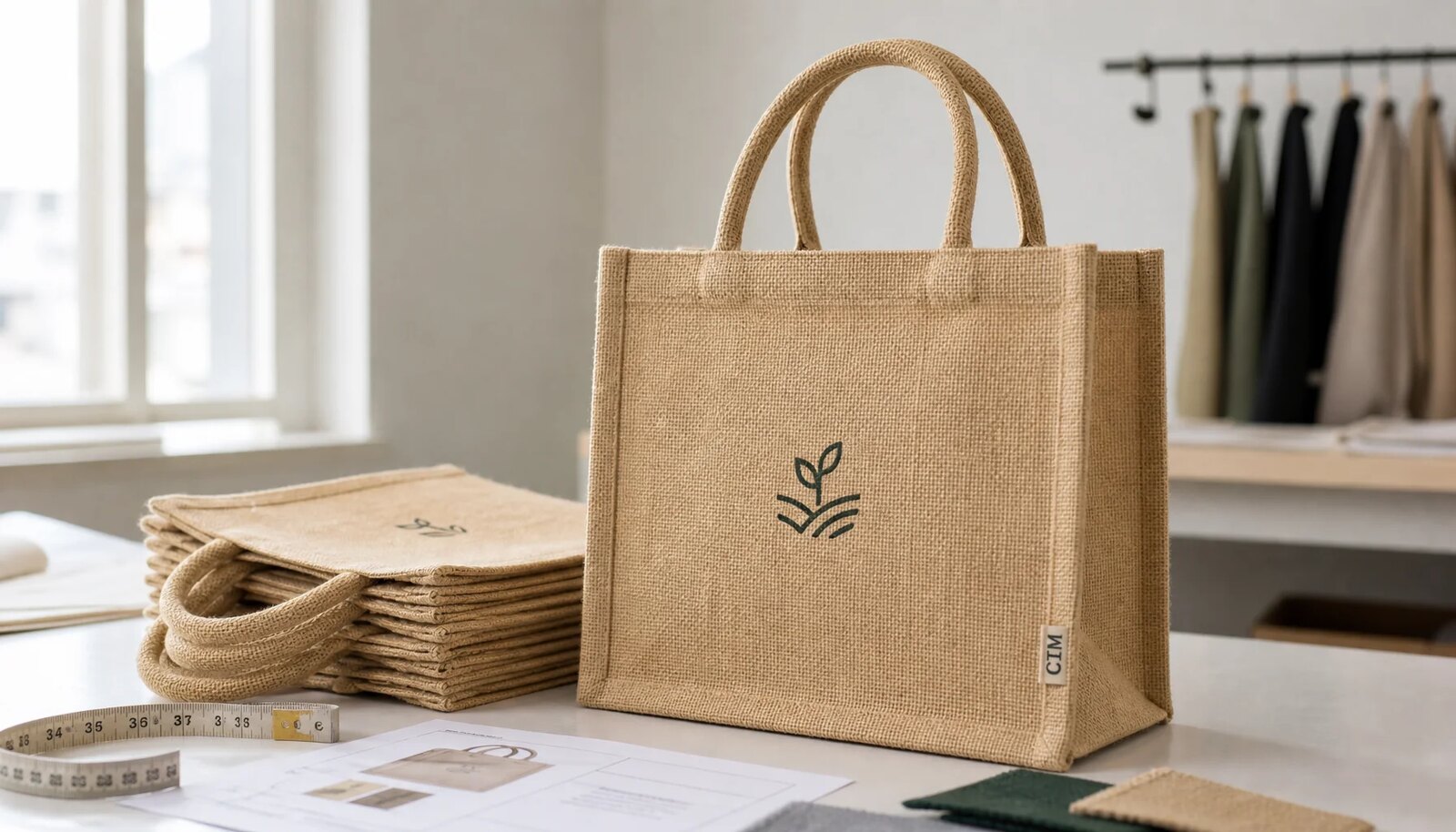
Why jute proofing needs its own checklist
A custom jute tote bag is not just a cotton tote in a different color. Jute has a coarse woven surface, visible slubs, natural shade variation, and more uneven absorption than smooth canvas. That texture is part of the appeal for eco apparel brands, but it also changes how artwork behaves. Thin rules can disappear into the weave, small reversed text can fill in, and a logo that looks crisp on a PDF can appear softer once ink crosses raised fibers and lower gaps.
For B2B procurement buyers, the risk is practical: a weak proof can create repeat sampling, missed campaign dates, warehouse delays, and stock that does not match brand expectations. Proofing should not be limited to a digital mockup or a front-panel photo. It should confirm the physical bag, the surface, the print method, the handle construction, the fold, the export packing, and the quality-control thresholds the inspector will actually use.
The best custom jute tote bags print proofing checklist for eco apparel brands starts before sampling. It turns the buyer's brand request into measurable production language. Instead of saying natural jute tote with logo, the RFQ should say the finished size, GSM, gusset, handle drop, print color, artwork dimensions, placement measurements, packing method, and sample approval requirement. That level of specificity makes quotes easier to compare and makes the approved sample more meaningful.
- Jute texture affects ink edge clarity, opacity, and small artwork details.
- A PDF proof confirms layout, but a physical sample confirms print behavior on the real substrate.
- Procurement should approve the product, print, construction, and packing as one connected specification.
- Every supplier should quote against the same measurable version of the bag spec.
Define the bag spec before discussing print
Print quality depends on the bag spec. If the fabric is too loose, the logo can look broken. If the front panel is narrow or heavily gusseted, a centered print may look off once the bag is filled. If the handle drop is too short, the tote may not function well for apparel shoppers carrying boxed items, folded garments, or catalog inserts. Before artwork approval, procurement should lock the physical structure enough for suppliers to price and sample accurately.
For many retail and promotional jute totes, 250-300 GSM is a workable range. It gives enough body for a clean printed mark while keeping the bag foldable and cost-conscious. Heavier jute, such as 320 GSM and above, can be appropriate for premium retail packaging, dense merchandise, or bags expected to be reused frequently. The tradeoff is higher material cost, greater sewing resistance, heavier cartons, and more freight volume if the bag becomes harder to compress.
Dimensions should be stated as finished measurements. A useful spec names width, height, gusset depth, handle drop, handle width, seam type, and whether the bottom needs reinforcement. If the order includes an inside pocket, closure, label, hangtag, barcode, or laminated interior, each element should be in the RFQ. Small add-ons can change cutting, sewing, inspection, and packing time, so they should not be left to sample-stage interpretation.
Natural shade is another detail buyers often under-specify. Jute is an agricultural fiber, so color can vary from warmer golden tones to duller brown-grey tones. The buyer does not need to demand artificial uniformity, but the supplier should show the expected shade range and confirm whether bulk will use one lot. This protects the brand from receiving cartons that look like separate programs when placed together in stores or event kits.
- State finished size as width x height x gusset, not only an approximate capacity.
- Specify GSM, natural shade expectation, lining or lamination, handle style, and reinforcement.
- Tie heavier fabric to a real load requirement instead of using it as a vague quality signal.
- Ask whether dimensions are measured before or after pressing and what tolerance applies.
Prepare artwork for a coarse natural surface
Artwork for jute should be designed for the material, not simply transferred from a hangtag, website header, or garment label file. Bold shapes, simple icons, and one- or two-color logos usually reproduce best. Hairline borders, delicate serif type, tight letter spacing, gradients, shadows, and small reversed copy are much more likely to soften or break. The proofing process should identify those risks before the factory makes screens or starts transfer setup.
The buyer should provide vector artwork with fonts outlined and colors clearly named. Pantone references help align expectations, but buyers should remember that ink on natural jute will not look exactly like ink on coated paper or a backlit screen. A physical swatch or printed sample is more reliable than digital color judgment. If the brand uses strict color standards, procurement should ask whether the supplier can provide a drawdown or print strike-off on the actual jute fabric.
Placement needs measurements, not visual guesses. A centered logo should have a defined print size, such as 180 mm wide, and a defined position from the top edge or bag center line. If the bag has a gusset, seam, or handle attachment near the print area, the supplier should confirm the safe printable zone. Artwork placed too close to seams may shift, distort, or become harder to print consistently in bulk.
Eco apparel brands often prefer subtle branding, but subtle should not mean illegible. If a logo depends on fine details, ask the supplier to flag minimum line thickness and minimum text height before sampling. Procurement can then decide whether to enlarge the logo, remove secondary copy, switch to a woven label, or simplify the art for the jute version. It is better to adapt the artwork early than to approve a technically weak print and fight defects later.
- Use vector files with outlined fonts, named colors, and final artwork dimensions.
- Avoid tiny text, thin borders, delicate icons, gradients, and low-contrast ink colors.
- Measure logo placement from top edge, side seams, or center line so inspection can repeat it.
- Ask the printer to confirm minimum line thickness and minimum readable text height on jute.
Choose screen print or transfer with full awareness
Screen printing is usually the default choice for custom jute tote bags with simple branding. It can deliver strong opacity, efficient repeat production, and predictable cost once screens are made. For one-color or two-color logos, it is often the most practical route. The screen must still be adjusted for the substrate. On jute, too little ink can look dry and broken, while too much ink can spread, fill small details, or crack when folded.
Heat transfer can be useful when the order is small, the artwork has multiple colors, or the brand needs detail that would be difficult to separate into screens. It should not be treated as automatically premium. On rough jute, a transfer may reveal film edges, sit stiffly on the surface, or fail if the temperature, pressure, dwell time, and fabric flatness are not controlled. A supplier quoting transfer should prove the result on the same jute construction intended for bulk.
Procurement should ask what ink or transfer material is being used and whether it is suitable for the bag's expected handling. A tote used for apparel packaging may not need the same wash durability as a garment, but it still needs to survive folding, carton compression, warehouse handling, and customer reuse. Rub resistance and adhesion matter, especially when printed faces touch each other in cartons.
A smart approval process compares print options against the brand's real requirement. If the artwork is a bold black logo on natural jute, screen print is likely the cleaner commercial decision. If the artwork is a multi-color campaign graphic and the quantity is low, transfer may be acceptable after physical proofing. If the brand requires a very fine mark, a sewn label or patch may be more reliable than forcing the art onto the jute surface.
- Screen print is usually best for bold, repeatable, one- or two-color jute tote logos.
- Transfer can work for complex art or lower quantities, but it must be sampled on final jute.
- Ask for ink opacity, rub resistance, transfer adhesion, and fold behavior to be checked.
- Consider a woven label or patch when the logo is too fine for direct print.
Build supplier quotes that procurement can compare
Many jute tote quotes appear comparable until the buyer asks what is actually included. One supplier may price 300 GSM jute, cotton webbing handles, one-color screen print, export cartons, and a true pre-production sample. Another may price lighter fabric, substitute handles, a visual sample, and basic bulk packing. The unit price alone will not reveal those differences. Procurement needs a quote format that separates the production decisions.
A useful RFQ asks each supplier to respond line by line: fabric GSM, finished dimensions, handle construction, print method, number of colors, maximum print size, sample charge, screen charge, MOQ, packing method, carton dimensions, gross weight, production lead time, and payment terms. This allows the buyer to compare total cost and risk. It also makes it harder for a supplier to win on a vague low price and then add charges after artwork review.
Supplier route should be visible. Some programs can work through a trading company, especially when the buyer needs broad sourcing or multiple product categories. But for print-sensitive custom jute tote bags, the buyer should know who controls fabric purchasing, printing, sewing, inspection, and packing. If those steps are outsourced, the quote should identify who owns proof approval and who is responsible if bulk does not match the approved sample.
The same quote sheet should capture alternatives. For example, request pricing at 500, 1,000, 2,500, and 5,000 pieces; ask for both 280 GSM and 320 GSM if load strength is undecided; compare cotton webbing handles against self-jute handles if the brand is balancing comfort and rustic appearance. Good procurement does not ask for endless options, but it does request the few alternatives that materially affect cost, performance, and launch risk.
- Compare quotes using one shared RFQ template and one spec version.
- Separate unit price from sample, screen, artwork, packing, and inland transport charges.
- Ask who performs printing and QC, not only who sends the quotation.
- Request tier pricing only for quantities the brand could realistically order.
Approve a physical pre-production sample
The physical pre-production sample is the most important proofing tool for custom jute tote bags. It should use the final fabric weight, final print method, final handle construction, final sewing approach, and intended finishing process. A sample made on smoother material, lighter fabric, or a different handle style may be helpful for concept review, but it should not be the approval basis for mass production.
When the sample arrives, review it with a ruler, the artwork file, and the written spec. Measure the bag width, height, gusset, handle drop, logo width, logo height, and logo position. Check whether the print is centered relative to the finished bag, not just relative to the cut fabric. Look at the front panel when the bag is flat and when it is opened, because gussets and seam tension can change the visual position of the logo.
The print itself should be reviewed under normal lighting at normal viewing distance, then closely for defects. The buyer should check edge clarity, ink coverage, filled areas, small text, pinholes, smudging, registration between colors, and any difference between left and right sides of the print. On jute, some texture will always show. The goal is not to erase the material character; it is to confirm that the logo is readable, brand-appropriate, and repeatable.
Sample comments should be written in one approval sheet. Avoid scattered email notes such as move logo slightly up or make it stronger. Instead, use exact corrections: increase logo width from 160 mm to 180 mm, move print center 25 mm higher, increase ink deposit for black logo, change handle drop to 260 mm. The factory should return a revised proof or confirm the correction in writing before bulk production begins.
- Approve a true pre-production sample, not only a mockup or photo.
- Measure logo size and placement against the spec instead of judging by eye.
- Record corrections in numbers, colors, and construction terms the factory can follow.
- Keep the signed sample approval attached to the purchase order and inspection file.
Set QC tolerances before bulk production
Quality control for jute must respect the material while protecting the brand. Natural slubs, small weave variations, and shade movement are normal within reason. Crooked logos, weak handles, heavy odor, large stains, poor stitching, and wrong carton counts are not. The buyer should define what is acceptable before production starts, because final inspection becomes much harder when standards are decided after defects appear.
Print tolerances should include placement, readability, and surface quality. For example, the approved proof can state the permitted placement shift from center or top edge, the minimum acceptable logo clarity, and whether small pinholes caused by jute texture are acceptable. If the artwork has two colors, registration tolerance should be agreed. If the logo uses a light color on natural jute, the sample should set the minimum opacity standard.
Construction QC should focus on stress points. Handles need secure reinforcement, consistent stitch density, and enough insertion or overlap to hold normal use. Side seams and bottom seams should be straight, with raw edges controlled according to the agreed construction. Loose threads should be trimmed. Dimensions should be measured after sewing and pressing, using a tolerance that reflects fabric behavior without excusing poor cutting.
Inspection should happen during production as well as at the end where possible. Early checks can catch screen alignment, ink density, handle placement, and fabric shade issues before the full order is packed. Final inspection should confirm random cartons against the approved sample, packing list, carton marks, and purchase order. If defects are found, carton numbers and defect types should be recorded so rework can be targeted.
- Define print shift, dimension tolerance, stitch defects, shade variation, and carton count rules in advance.
- Judge jute by approved sample standards, not by expectations from smooth cotton canvas.
- Check handles, seams, print opacity, odor, stains, loose threads, and packing consistency.
- Use carton-level records when defects need sorting, rework, or claim discussion.
Control packing, carton marks, and freight impact
Packing affects both product quality and landed cost. Jute bags are bulky compared with flat paper items, and small changes in folding or carton size can alter cubic volume. A quote with a lower unit price may become less competitive if it uses oversized cartons, low carton density, or retail polybags that are not required. Procurement should request packing details at quotation stage, not after production is complete.
The fold method matters for printed bags. Printed faces should not be packed in a way that causes abrasion, pressure marks, or ink transfer. If bags are packed before ink is fully cured, defects can spread across many units. If the brand requires individual polybags, hangtags, barcodes, or retail labels, those must be tested in the sample approval because they affect labor, carton count, scanning, and warehouse receiving.
Carton marks should be treated as part of the order specification. A useful carton mark includes buyer name or code, PO number, item number, color or artwork version, quantity per carton, carton number sequence, country of origin if required, and gross or net weight where applicable. Warehouse teams often reject or delay cartons when marks do not match the packing list or inbound routing instructions.
Freight math should be visible before supplier selection. Ask for units per carton, carton dimensions, gross weight, and estimated total cartons at the quoted quantity. This lets the buyer estimate cubic meters and compare landed cost more accurately. It also helps spot unrealistic packing promises. If a carton count looks unusually low, ask for packed carton photos or a packing trial before relying on the number.
- Request fold method, units per carton, carton dimensions, gross weight, and shipping mark content with the quote.
- Protect printed faces from abrasion, wet stacking, heavy compression, and ink transfer.
- Confirm barcode, hangtag, retail polybag, or inner pack requirements before sampling.
- Compare suppliers on estimated landed cost, not only unit price at factory gate.
Manage lead time and reproof risk
Lead time for custom jute tote bags is controlled by approvals. The schedule typically includes artwork review, sample making, buyer review, revisions if needed, material preparation, printing, sewing, trimming, packing, inspection, and shipment booking. If artwork changes after sample approval, the proofing process may need to restart. If the approved fabric lot is unavailable, the buyer may need to review shade and hand feel again.
A strong supplier quote separates sample lead time from bulk production lead time. It should state how many days are needed for first sample, how many days for a revised sample or print strike-off, and how many production days begin after written approval. A single promise such as delivery in 30 days is less useful than a schedule with gates, because it hides the points where delays usually occur.
Procurement can reduce schedule risk by freezing artwork before the sample is made, naming one buyer-side approval owner, and setting a response deadline for proof comments. Internal delay is common when marketing, retail, sustainability, and procurement teams all review the same bag without a clear sign-off path. The supplier cannot protect the ship date if comments arrive late or conflict with each other.
Inspection and logistics also need calendar space. Pre-shipment inspection, carton mark correction, export documentation, inland trucking, vessel booking, and customs paperwork can add days even after production is complete. If the tote bags support an apparel launch, event, store opening, or seasonal campaign, the order plan should include a buffer for at least one proof correction and one packing or labeling adjustment.
- Separate sample timing, revision timing, production timing, inspection timing, and shipping timing.
- Freeze artwork before sample approval and assign one buyer-side sign-off owner.
- Build schedule buffer for reproofing, carton labels, inspection, and freight booking.
- Do not accept a lead time that starts before final written sample approval.
Turn the checklist into a purchase order control
The final step is to convert the proofing checklist into purchase order control. A checklist is useful only if it becomes part of the supplier's working instructions. The PO or attached spec sheet should name the approved sample date, artwork file version, Pantone references, fabric GSM, finished dimensions, handle construction, print placement, packing method, carton marks, and inspection criteria. This reduces the chance that the factory follows an outdated email or earlier mockup.
Version control is especially important for repeat orders. Eco apparel brands may reorder the same jute tote for multiple stores, campaigns, or wholesale kits. If the first order required artwork adjustment, heavier handles, or a different carton count, those details should be captured as the new standard. Otherwise the second order can accidentally return to the original quote assumptions rather than the approved production reality.
Procurement should keep the signed digital proof, physical sample notes, supplier quote, PO, inspection checklist, and packing photos together. This record makes future quote comparison faster and gives the buyer leverage if bulk quality drifts. It also helps internal teams understand why a certain GSM, print size, or packing format was chosen, which prevents unnecessary redesign at the next reorder.
A strong proofing process does not make jute look like plastic-coated fabric. It protects the natural character of the material while making the commercial outcome predictable. For custom jute tote bags used by eco apparel brands, that means readable branding, fit-for-purpose construction, honest material expectations, controlled packing, and a supplier quote that can survive contact with real production.
- Attach the approved spec, proof, sample notes, and QC checklist to the purchase order.
- Use file names and version dates for artwork so the printer uses the correct logo.
- Keep sample approval records for repeat orders and supplier performance reviews.
- Treat natural jute variation as acceptable only within the limits approved in the physical sample.
Specification comparison for buyers
| Spec decision | Recommended option | When it fits | Buyer risk to check |
|---|---|---|---|
| Jute fabric weight | 250-300 GSM for standard retail totes; 320+ GSM for heavier merchandise or premium hand feel | Use 250-300 GSM for apparel giveaways, store packaging, event totes, and light retail sets; move heavier when the bag must carry bottles, folded denim, books, or dense kits | Too light can feel limp, distort at seams, and make the logo look uneven; too heavy increases cost, carton weight, sewing difficulty, and folded volume |
| Print method | 1-2 color screen print for bold brand marks; transfer only when artwork complexity or low volume requires it | Screen print fits most eco apparel logos, slogans, and simple icons on natural jute; heat transfer may fit short tests or multi-color artwork after sample validation | Fine lines can break on the weave; ink can look patchy if under-applied; transfer films may show edges, crack, or lift if heat and pressure are not controlled |
| Artwork coverage | Centered logo or message covering roughly the middle third of the front panel | Best for apparel brands that want a clean retail look, strong readability, and lower rejection risk on a coarse natural surface | Oversized or full-panel artwork increases misregistration, uneven ink coverage, print abrasion, and visual distortion near seams or folds |
| Logo file preparation | Vector artwork with Pantone references, minimum line thickness, approved logo size, and placement measurements | Use when brand consistency matters across stores, campaigns, or repeat purchase orders | Raster files, unconverted fonts, low-resolution art, or vague placement notes create avoidable reproof cycles and factory interpretation errors |
| Handle construction | Cotton webbing or reinforced self-jute handles with box-X or bar-tack reinforcement | Cotton webbing improves comfort for apparel retail use; self-jute keeps a rustic look and may reduce trim complexity | Weak tacks, short handle insertion, uneven stitch density, or narrow handles can fail under load even when the bag body is acceptable |
| Inner lamination or lining | Unlined for dry apparel and standard eco positioning; light lamination or lining only when function requires it | Unlined bags fit most clothing packaging and brand merchandise; lining may help with small accessories, moisture resistance, or cleaner interior finish | Lamination can change hand feel, recyclability messaging, odor, cost, lead time, and folding behavior; poorly bonded layers may bubble or delaminate |
| MOQ logic | 500-1,000 pcs per design/color for typical screen print; lower only with stock fabric, simple art, and accepted setup charges | Fits apparel launches, store packaging, trade shows, and private label programs that need predictable cost | Low MOQ quotes may hide screen charges, mixed fabric lots, slower production priority, limited color matching, or non-final sample materials |
| Supplier route | Factory or supplier that can identify fabric source, print process owner, sewing line, packing method, and QC responsibility | Best for repeat orders, multi-store distribution, and brands that need consistent proof-to-bulk control | Trading-only quotes can obscure who actually prints, who approves screens, which lot is used, and where responsibility sits if bulk differs from sample |
| Packing spec | Export bulk pack with defined fold, protective polybag if needed, fixed carton count, carton dimensions, gross weight, and shipping marks | Use for procurement teams comparing landed cost, warehouse receiving, and freight efficiency | Loose packing can abrade printed faces; over-packing can increase cubic volume; missing carton marks slow receiving and increase warehouse exceptions |
Buyer checklist before sampling
- Specify finished bag width, height, gusset, handle drop, handle width, seam allowance basis, and target load use before asking for price.
- State exact jute fabric weight in GSM, weave preference if known, natural shade expectation, and whether the order requires unlined, laminated, or lined construction.
- Send vector artwork with fonts outlined, Pantone references, maximum print size, placement from top edge and side seams, and a note on whether small text can be simplified.
- Ask the supplier to confirm print method, number of colors, screen or plate charges, minimum line thickness, maximum printable area, and whether white underbase or extra ink passes are needed.
- Require a physical pre-production sample made with final fabric weight, final print process, final handle construction, and the same intended finishing method as mass production.
- Approve the sample against measured checkpoints: logo width and height, logo position, print edge clarity, ink density, fabric shade, body dimensions, handle drop, stitch reinforcement, and overall hand feel.
- Define tolerances before bulk production, including acceptable print shift, dimension tolerance, shade variation, loose thread allowance, stitch defects, and carton count variation.
- Confirm packing format, fold direction, protection between printed faces if required, units per carton, carton dimensions, gross weight, barcode or hangtag needs, and shipping mark layout.
- Compare quotes on the same basis: fabric GSM, bag size, print method, number of colors, MOQ by artwork, sample charge, tooling charge, packing charge, lead time, and payment terms.
- Keep one approved spec version attached to the purchase order so sample comments, quotation details, and final inspection criteria do not drift across email threads.
Factory quote questions to send
- What exact jute GSM, weave style, and natural shade range are included in the quote, and will bulk production use one fabric lot or mixed lots?
- Are the quoted dimensions finished measurements after sewing and pressing, and what tolerance do you apply to width, height, gusset, and handle drop?
- Which print method is quoted, how many colors are included, what ink type is used, and what are your limits for line thickness, reversed text, and small logo details on jute?
- Does the price include screen setup, plate making, Pantone matching, artwork adjustment, sample making, and reproofing, or are those separate line items?
- Will the sample be a true pre-production sample using final fabric, final ink or transfer process, final handles, and final sewing method, or only a visual reference sample?
- What is the MOQ by bag size, fabric color, print color, artwork version, and handle style, and how does the unit price change at 500, 1,000, 2,500, and 5,000 pieces?
- Who controls each production step: fabric sourcing, cutting, printing, sewing, trimming, inspection, packing, and carton marking?
- What QC standard will be used for print placement, ink coverage, stitch strength, fabric shade variation, odor, loose threads, dimension tolerance, and acceptable natural weave irregularity?
- How are bags folded and packed, how many units go into each export carton, and what carton dimensions, net weight, gross weight, and cubic volume should we expect?
- Can you provide a carton mark template, packing list format, and photos of packed cartons before shipment for warehouse receiving review?
Quality-control points to confirm
- Fabric GSM, weave character, natural shade, odor, and hand feel should match the approved sample and written specification across the production lot.
- Finished dimensions should be measured after sewing and normal pressing, with agreed tolerances for body width, body height, gusset depth, handle drop, and handle width.
- Logo placement should match the signed proof, measured from top edge, side seams, and center line, with a defined maximum shift accepted in bulk.
- Ink density should be strong enough for the logo to read clearly across the jute texture without excessive bleeding, smudging, pinholes, or heavy buildup that cracks when folded.
- Fine details, small text, and reversed areas should be checked against the approved physical sample rather than judged only against the original vector artwork.
- Handle attachments should show consistent reinforcement, secure stitching, no loose ends at stress points, and no tearing around insertion areas after reasonable pull testing.
- Seams should be straight, stitch density should be consistent, raw edges should be controlled according to the construction spec, and loose threads should be trimmed before packing.
- Printed panels should not be stacked wet or abraded during folding, and any protective sheet or packing method approved at sample stage should be followed in bulk.
- Carton pack count, carton dimensions, gross weight, shipping marks, barcode placement, and packing list data should match the purchase order and warehouse requirements.
- Inspection records should connect defects to the approved spec version, sample approval date, production lot, and carton numbers so issues can be traced if rework is needed.