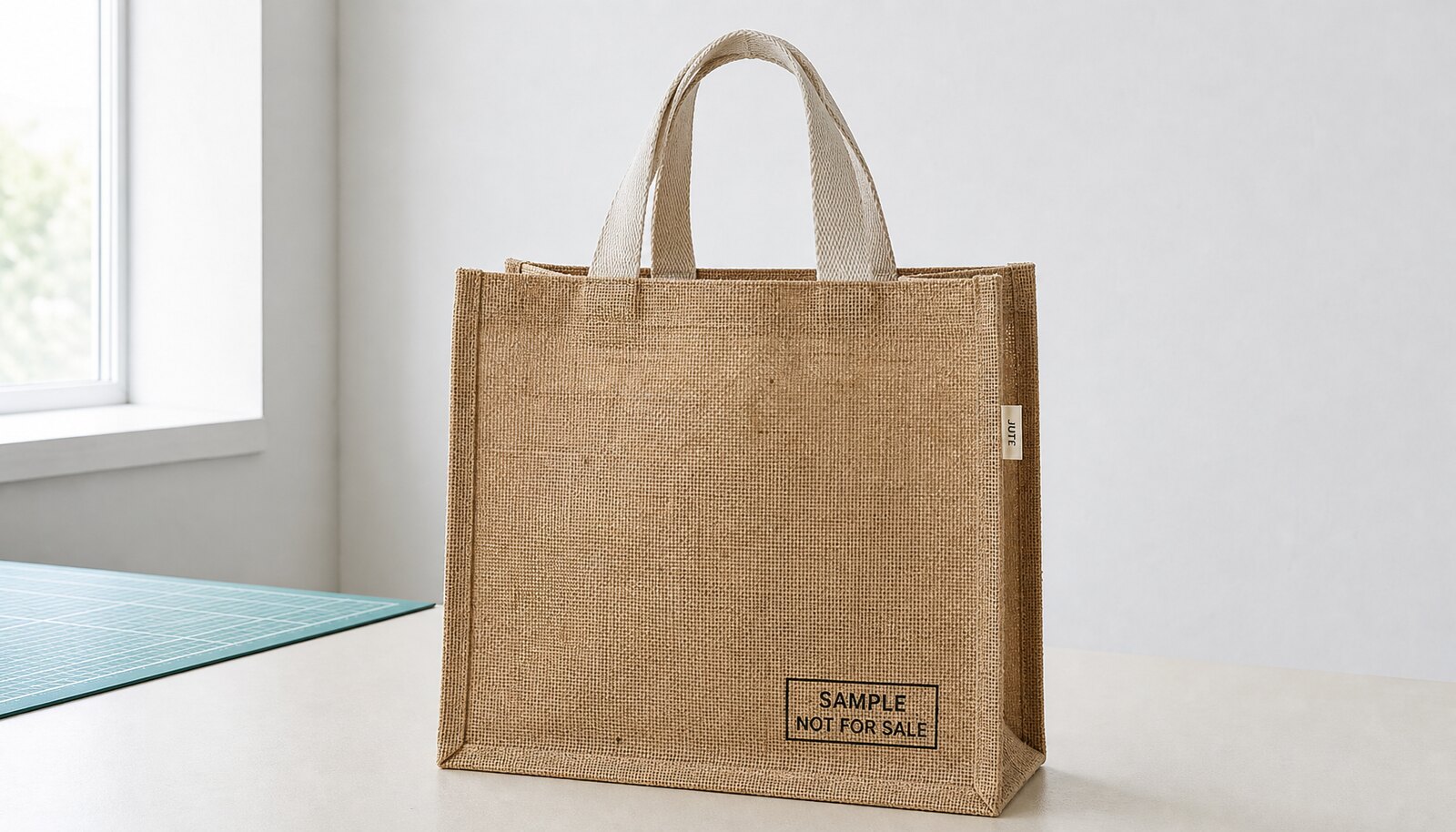
Why jute print proofing needs a procurement checklist
Most custom jute tote bag print failures start before bulk production. The buyer approves a clean PDF, a smooth paper printout, or a generic mockup, then expects the same sharpness on a coarse natural fiber. Jute, often described as burlap in some markets, has a visible weave, uneven fiber thickness, natural shade variation, and higher surface texture than coated paper, canvas, or synthetic non-woven fabric. Those characteristics are part of the product appeal, but they also change ink coverage, edge definition, small text, and perceived brand color.
Corporate gifting makes small defects more visible. The bag is often handed to clients, employees, speakers, dealers, or event guests on a fixed date. It may be photographed, placed on registration desks, shipped to branch offices, or combined with higher-value items. A logo that is 10 mm off center, a sponsor mark that fills in, or a crease across the printed panel can make the whole gift program look unmanaged even if the bag construction is otherwise acceptable.
The correct objective is commercial consistency, not a paper-perfect print. Natural jute will never behave like a coated retail carton. Procurement should define what variation is acceptable and what defect triggers correction, replacement, or rejection. A useful custom jute tote bags print proofing checklist for corporate gifting turns vague requirements such as good quality, centered logo, nice color, and strong handles into measurable specifications, approval samples, and inspection points.
- Approve print on the actual jute substrate because weave and absorbency change the result.
- Separate acceptable natural fiber variation from true defects such as smearing, mold, odor, misregistration, or wrong logo placement.
- Use fixed measurement points such as top seam, side seam, bottom fold, and gusset edge instead of subjective words like centered.
- Treat gift packing as part of the product because folding and carton pressure can damage the printed panel.
- Keep one signed golden sample as the standard for bulk production, inspection, and reorders.
Freeze the bag specification before artwork proofing
A print proof is only meaningful when the base bag is already defined. Finished width, height, gusset depth, fabric GSM, lamination, lining, baseboard, pocket, handle type, handle drop, and stitch construction all affect the printable area. A logo that looks balanced on a flat drawing can sit too close to handle bartacks, too low after the bag is filled, or too near a side gusset fold after sewing.
GSM should be treated as a construction detail, not a complete quality description. Many standard corporate jute totes are quoted around 280 to 350 gsm for the jute shell, but heavier, laminated, lined, or reinforced structures may be specified differently. Buyers should ask whether the GSM refers to raw jute fabric only, jute plus lamination, or a finished layered construction. Two bags with the same stated GSM can feel different if one has a tighter weave, lamination, cotton lining, or a reinforced base.
Finished dimensions matter more than broad capacity claims. A conference tote may need to hold A4 or letter-size folders without bending corners. A welcome-kit bag may need a gusset deep enough for a bottle, notebook, apparel item, and insert card. If the bag will be filled before gifting, test the logo position on a filled sample. The front panel can bow, the gusset can open, and the visual center can shift.
Typical starting tolerances should be discussed and confirmed with the factory before purchase order release. For sewn jute totes, buyers often set finished dimension tolerances in millimeters or as a percentage, such as plus or minus 10 mm for simple dimensions or a tighter value when the printable panel is critical. Print placement is commonly controlled from fixed seams within a written millimeter tolerance, often tighter than overall sewing tolerance. The exact number should match the style, construction, and factory capability.
- Specify finished width, height, gusset depth, handle drop, handle width, and acceptable tolerance.
- Confirm whether the bag is unlaminated, laminated, lined, reinforced, or supported by a baseboard.
- Lock handle material, color, width, drop length, stitch box, bartack, and reinforcement method.
- Request a dimensioned front-panel drawing showing seams, handle stitch zones, gusset folds, pocket, label, and no-print areas.
- Measure printable area on a sewn blank bag before approving final logo size.
- Check logo position on both an empty bag and a filled bag when presentation after filling matters.
Prepare artwork files that a factory can reproduce
Strong proofing starts with controlled artwork. Procurement teams should send vector files such as AI, EPS, or editable PDF whenever possible, with fonts outlined, linked images embedded, and logo proportions locked. Raster artwork may be suitable for some transfer methods, but it needs a defined resolution at final print size. A screenshot, low-resolution JPEG, or logo pulled from a website is not a dependable source file for a corporate gifting order.
The RFQ and purchase order should state final logo size in millimeters, not only show a visual mockup. For example, specify that the main mark is 180 mm wide and positioned 90 mm below the top seam, centered between side seams, with a no-print clearance from the gusset folds. If the design includes more than one logo, define the hierarchy and spacing. Sponsor stacks and co-branded lockups become difficult on jute when the smallest logo contains fine lines or small legal text.
Minimum line thickness, minimum gap, and minimum text height should be agreed after the supplier reviews the artwork. Jute texture can break thin strokes, close counters inside letters, soften serifs, and make trademark symbols unreadable. A practical approval process identifies details that may need enlargement, simplification, or conversion to a one-color mark before sampling.
Artwork control is especially important for reorders. The approved file name, version date, logo size, Pantone target, print method, placement dimensions, and sample reference should be recorded with the purchase order. Without this, a reorder can be made from a different sales mockup or rescaled PDF, causing visible brand drift across batches.
- Send vector artwork with fonts outlined and colors clearly named.
- Provide Pantone references, approved logo lockups, and brand rules for clear space and minimum size.
- Define final logo width, height, and placement in millimeters from fixed seams or panel edges.
- Identify small text, trademark symbols, URL lines, sponsor logos, and QR-like marks for special proof review.
- Ask the factory to confirm minimum printable line thickness, gap size, and text height for the selected method.
- Record artwork version, approval date, color target, and print method for reorder control.
Choose the print method around the logo and quantity
The lowest print quote is not always the safest choice. The right method depends on artwork detail, color count, jute surface, order size, expected finish, and schedule. Screen printing is often the practical option for bold one-color logos, simple icons, solid brand marks, and large type. Once the screen, ink, and placement are approved, it can be repeatable for bulk production. The limitation is that very fine lines, tight registration, small text, and gradients may not reproduce cleanly on coarse jute.
Multi-color screen printing needs additional control. Every color requires registration, and the rough surface plus sewn-panel movement can make paper-like precision unrealistic. If colors must meet edge-to-edge, ask for a physical strike-off and agree a registration tolerance. Where possible, add small gaps between colors, simplify the artwork, or enlarge the mark. If a brand guideline demands exact multi-color reproduction, the factory should prove it before bulk release.
Transfer printing can be useful for gradients, tonal artwork, small sponsor logos, and more detailed graphics. However, it creates different risks. Procurement should check transfer hand feel, gloss level, flexibility, edge lift, fold behavior, heat marks, and rub resistance. A transfer that looks sharp on a flat sample may look too glossy or plastic on natural jute, especially for premium corporate gifting.
Do not permit a print-method change after approval without a new proof. A supplier may suggest changing ink, screen mesh, transfer film, curing method, or subcontracted print line to improve cost or schedule. That may be acceptable, but it resets proofing risk. The approved strike-off and the bulk order must share the same substrate, ink or transfer, artwork size, and process.
- Use screen print for solid logos, simple icons, and larger type with spot colors.
- Use multi-color screen print only after confirming registration on actual jute.
- Consider transfer print for gradients, fine detail, multi-logo layouts, or tonal artwork.
- Check transfer edge lift, gloss, hand feel, flexibility, fold marks, and rub behavior.
- Require a new strike-off if ink, transfer material, screen setup, curing process, or print supplier changes.
- Avoid hairline traps and tiny reversed-out text on rough jute unless proven by sample.
Control Pantone color, opacity, and natural jute shade
Color proofing on jute is a physical matching exercise, not a monitor exercise. Natural jute has beige, brown, or golden undertones, and those undertones affect every printed color. The same Pantone target can look warmer, duller, or less saturated on jute than on coated paper. Buyers should approve color beside a physical Pantone reference or approved brand sample under neutral light, not from a phone photo or computer screen.
The purchase order should state whether color is approximate, commercial-match, or strict-match. Approximate color may be enough for low-risk giveaways. Commercial-match is more appropriate for most corporate gifting where the logo should be visibly close to brand standards on the actual material. Strict-match should be used carefully because jute shade, ink opacity, and weave texture limit precision. If strict color is required, allow time and budget for multiple strike-offs.
White ink, dark solids, and metallic effects need special review. White can appear weak or beige if opacity is insufficient. Dark navy, black, and deep green can show pinholes and fiber texture. Metallic effects may lose brightness on a rough natural surface. Approve these colors at normal viewing distance and close inspection. The recipient sees the bag in hand, while the brand team may examine the logo closely.
Bulk and reorder variation must be discussed before production. Jute shade can vary between fabric lots, and that can change the perceived color even if the ink formula is unchanged. For repeat orders, ask the factory to retain artwork files, ink references, screen details, and golden sample records. If the fabric shade, lamination, or ink system changes visibly, request a fresh strike-off rather than relying on the previous approval.
- Approve color on actual jute under neutral light against a physical reference.
- Define color expectation as approximate, commercial-match, or strict-match before sampling.
- Check white opacity, dark solid coverage, metallic appearance, and edge quality on the real substrate.
- Set an acceptance process for fabric shade variation because natural jute lots are not identical.
- Keep ink formula notes, artwork files, screen references, and signed samples for reorders.
- Request a new strike-off if jute shade, lamination, ink system, or print method changes.
Use a sample ladder instead of one loose approval
A single approval step is too weak for a B2B gifting order. A better workflow is a sample ladder: digital artwork proof, sewn blank approval, actual-material print strike-off, full pre-production sample, then controlled bulk production. Each step answers a different question. The digital proof confirms layout. The blank sample confirms construction. The strike-off confirms print behavior. The pre-production sample confirms the complete commercial item.
The digital proof should be treated as a layout check only. It can confirm spelling, logo size, placement dimensions, color names, and version control, but it cannot show ink absorption, weave breakup, actual handle position, or real bag proportions. Buyers should mark approval comments clearly, including whether approval is for layout only or for production release.
The sewn blank sample should be reviewed for finished size, gusset shape, handle drop, seam quality, panel flatness, and no-print zones. If the blank bag is wrong, a perfect print proof is not useful. On new constructions, approve the blank before spending time on print color and detail.
The strike-off must use final material, final artwork size, final ink or transfer, final color count, and final method. A strike-off on a scrap of similar jute can help early development, but final approval should be on the production substrate. Each proof should be labeled with date, artwork version, substrate reference, print method, ink color, and sample round.
The full pre-production sample is the commercial benchmark. It should include final stitching, handles, labels, hangtags, insert cards, fold method, individual packing, carton label style, and any barcode or SKU requirements. Keep one approved sample with the buyer and one with the factory. During inspection, compare bulk goods to that sample rather than to email descriptions.
- Use the PDF proof for layout, spelling, logo size, and placement confirmation only.
- Approve a sewn blank when the size, handle, gusset, lining, pocket, or baseboard is new.
- Require an actual-material strike-off before bulk printing.
- Label every sample round with date, artwork version, material, print method, and color target.
- Approve a full pre-production sample with final packing before mass production.
- Keep buyer and factory reference samples from the same approved round.
Read the quote beyond unit price, MOQ, and lead time
Jute tote quotes can look similar while hiding different assumptions. One supplier may include heavier jute, reinforced handles, screen setup, individual polybags, and export cartons. Another may quote a lighter blank bag with printing, sampling, and packing charged separately. Procurement should request a structured quote that breaks out bag cost, print cost, setup cost, sample cost, packing cost, testing cost, and freight terms.
MOQ is usually driven by setup, material batching, and packing complexity, not only by sewing capacity. A one-color screen print on one side may have a lower practical MOQ than a four-color design printed on two sides. Custom-dyed jute, custom handle color, special lining, retail packaging, hangtags, and multi-destination carton labels can also increase minimums. Ask MOQ by bag color, logo version, print side, print color count, handle color, and packing style.
Setup charges require careful review. Screen charges, plate charges, transfer film setup, artwork redrawing, Pantone matching, sample courier fees, and pre-production sample fees may be one-time charges or repeat charges. For repeat programs, ask which charges are waived when the same artwork, size, and print method are used again. A quote with a slightly higher unit price may be better if it includes the sampling and setup required to prevent defects.
Lead time should be measured from the right starting point. Suppliers may quote bulk production days from deposit, from artwork approval, or from signed sample approval. For corporate gifting, the reliable planning date is usually bulk lead time after final sample approval, plus inspection, packing, export handling, freight, customs, and local distribution. If the event date is fixed, build the approval timeline backward from the required delivery date.
Rejects, overruns, and shortages should be written into the commercial terms. Printing on natural material can produce rejects. Ask whether the factory produces a small overage, how shortages are handled, whether rejected pieces are replaced or credited, and who pays for rework when goods fall outside approved tolerance. This prevents a dispute after inspection.
- Request quantity tiers based on the same bag, artwork, print method, and packing assumptions.
- Separate blank bag, print, setup, sample, packing, testing, inspection, and freight costs.
- Ask MOQ by logo version, print color, print side, bag color, handle color, and packing format.
- Clarify which setup charges repeat on reorders and which are one-time.
- Confirm whether lead time starts after deposit, artwork approval, or signed pre-production sample approval.
- Define overrun, shortage, reject replacement, credit, and rework rules before PO release.
Set measurable QC thresholds before production starts
Quality control should be written into the purchase order before defects appear. For custom jute tote bags, the visible QC points are print position, ink coverage, color appearance, registration, seam alignment, handle stitching, cleanliness, odor, and packing condition. The buyer should set tolerances in measurable terms rather than relying on subjective approval language.
Common procurement starting points include finished dimension tolerances in millimeters, print placement tolerance from fixed reference points, and registration tolerance for multi-color artwork. For example, a buyer might require logo placement to remain within an agreed number of millimeters from the approved top and side measurements, while overall bag dimensions may have a separate sewing tolerance. The final tolerance must be agreed with the supplier based on style complexity and factory capability.
Defect classification helps factories and third-party inspectors make consistent decisions. Critical defects may include mold, strong chemical or musty odor, unsafe hardware, contamination, wrong logo, wrong product, or packaging that makes the goods unusable. Major defects may include visibly misplaced print, severe color mismatch, missing handles, weak stitching, unreadable logo details, wrong packing, or incorrect carton labels. Minor defects may include small loose threads or slight natural fiber variation that does not affect function or presentation.
For formal inspection, many buyers use an AQL framework such as ANSI/ASQ Z1.4 or ISO 2859-1, with acceptance levels agreed before inspection. The exact AQL should match brand risk and order value; common consumer-goods discussions often separate critical, major, and minor defects with different limits. Do not assume the factory knows your inspection level. State the inspection plan, sample size approach, defect list, and approval authority in the PO.
Functional checks should match the intended use. If the gift bag will carry catalogs, bottles, or apparel, define a reasonable load test and handle pull check. For example, the buyer may specify the expected gift weight and require the sample to carry that load without seam opening, handle tearing, or stitch failure. Avoid vague claims such as heavy duty unless the load, duration, and test method are written down.
- Define tolerances for dimensions, placement, color, registration, stitching, handle drop, and packing.
- Classify critical, major, and minor defects before inspection.
- Measure print placement from fixed seams, folds, gusset edges, pockets, or labels.
- Inspect each SKU, logo version, colorway, and packing version separately.
- Check odor, moisture, mold spots, dust transfer, oil marks, insect contamination, and carton condition.
- Define load expectations and handle strength checks based on the actual gift contents.
- State the inspection standard, sample size method, and approval authority in the PO.
Protect the print during folding, packing, and transit
Packing is part of the product experience in corporate gifting. A bag can leave the print room looking acceptable and arrive with scuffs, crease marks, ink offset, crushed handles, or distorted corners if folding and carton pressure are not controlled. The buyer should approve the fold method, which side faces inward, whether the printed panel contacts another rough surface, and whether tissue, paper dividers, or individual bags are required.
Different distribution channels need different packing. Event teams may want flat-packed bags that are quick to distribute at registration. Employee welcome kits may require individual bags with insert cards or items placed inside. Distributor gifts may need barcode labels, SKU labels, and carton marks that support warehouse receiving. Premium gifts may need cleaner presentation, lower compression, and less visible plastic. These requirements belong in the pre-production sample, not in a late email after printing.
Carton configuration affects both cost and quality. A high pack count can reduce handling cost but increase compression, print rubbing, and fold memory. A lower pack count may protect the bag better but increase freight volume. Ask for carton dimensions, gross weight, pack count, inner packing method, and pallet pattern when relevant. If the front logo is large, check whether the fold line crosses the artwork and whether repeated pressure could leave a permanent mark.
Labeling is a procurement control point. Carton marks should match PO number, SKU, logo version, quantity, destination, and warehouse requirements. Avoid mixed cartons unless the receiving process is designed for them. For multi-destination corporate gifting, unclear carton labels can cause the right bags to miss the right event even when the physical product is acceptable.
- Approve fold method, logo-face protection, individual packing, and carton pack count together.
- Use tissue, dividers, or polybags when the print face needs protection from rubbing.
- Confirm carton dimensions, gross weight, pack count, inner packing, and pallet pattern.
- Avoid fold lines through delicate artwork when possible.
- Check whether carton compression causes permanent creases or transfer marks.
- Make carton marks clear by PO, SKU, logo version, quantity, destination, and receiving requirement.
Build an RFQ packet suppliers can quote accurately
A complete RFQ packet saves time and improves quote accuracy. It should include finished bag size, gusset depth, target GSM, construction type, handle specification, lining or lamination, baseboard, print side, logo size, artwork file, Pantone references, quantity tiers, packing requirements, delivery destination, required ready date, and any testing or compliance requirements. When every supplier quotes the same assumptions, procurement can compare real options instead of chasing mismatched unit prices.
The RFQ should describe the use case. A one-day trade show tote does not need the same packing plan as a premium client gift shipped through a distributor network. A bag intended to carry heavy catalogs requires different handle and seam reinforcement from a lightweight welcome-kit bag. The factory can recommend better construction, print method, and packing if it understands load, recipient, presentation level, and distribution route.
Ask suppliers to respond in a structured format. Their quote should state what is included, what is excluded, sample timeline, bulk lead time after sample approval, setup charges, MOQ rules, tolerance assumptions, packing details, carton specifications, and validity period. Ask them to list missing information or production risks. A supplier that flags risks early is usually easier to manage than one that gives a fast unit price with every detail left open.
For repeat programs, include reorder expectations in the first RFQ. If the company may reorder quarterly, annually, or by regional team, ask how the factory controls artwork, screens, ink references, jute shade, packing records, and sample retention. Reorder consistency is much easier when the first order is documented as a controlled program rather than a one-off event purchase.
- Send one controlled RFQ packet to every supplier being compared.
- Include bag construction, artwork, Pantone target, packing, quantity, destination, and schedule details.
- Ask suppliers to separate included costs from optional costs and exclusions.
- Request sample timing, bulk timing, setup charges, MOQ, tolerances, carton specs, and inspection support.
- Ask the supplier to identify artwork, construction, color, packing, or schedule risks before quoting.
- Document reorder controls from the first order if the gift program may repeat.
Specification comparison for buyers
| Procurement decision | Recommended buyer action | When it fits | Proofing or QC risk to control |
|---|---|---|---|
| Supplier route | Use a direct factory or a supplier with disclosed sewing, printing, and packing controls when brand consistency matters | 500 units and up, repeat gifting programs, distributor kits, employee welcome packs, and executive gift runs | Confirm whether printing is in-house or subcontracted; require the approved strike-off and bulk order to use the same production route |
| Trader or sourcing agent | Use only with written factory disclosure, sample responsibility, and defect-resolution terms | Mixed product programs, multi-country sourcing, or buyers without factory-management bandwidth | Ask who signs the golden sample, who pays for rework, and whether the sample comes from the final production factory |
| Local printer on blank bags | Use for small urgent runs after locking the blank bag source, GSM, panel size, and construction | Regional events, last-mile personalization, low-volume staff gifts, or emergency replenishment | A proof on one batch of blanks does not validate a later blank batch; inspect blank-bag dimensions and panel flatness before printing |
| Blank bag approval | Approve a sewn blank before print proofing when construction is new or the printable panel is tight | New size, new gusset, lining, lamination, inserted baseboard, internal pocket, or unusual handle placement | Finished dimensions, seam position, handle bartacks, and gusset folds can reduce the usable logo area |
| Actual-material strike-off | Require a print strike-off on the exact jute or burlap substrate, final ink or transfer, and final artwork size | Any visible corporate logo, Pantone target, fine text, sponsor stack, or multi-color artwork | Paper proofs and screen mockups hide ink absorption, weave distortion, opacity problems, and placement limits |
| Full pre-production sample | Approve one complete bag with final print, handles, labels, hangtags, folding, inner packing, and carton mark sample | First orders, premium gifting campaigns, retail-ready presentation, or high-visibility event deadlines | The pre-production sample must represent bulk construction and packing, not a loose visual mockup |
| One-color screen print | Choose for bold logos, large type, simple icons, and solid corporate marks | Trade show bags, welcome kits, conference totes, and dealer gifts with simple branding | Check ink density, fiber show-through, pinholes, edge breakup, and whether small counters in letters remain open |
| Multi-color screen print | Use only when the factory proves registration on the actual jute surface | Two- or three-color spot logos with enough space between colors and no hairline traps | Set registration tolerance, usually in millimeters, because rough jute and sewn-panel movement make paper-like alignment unrealistic |
| Transfer print | Use for gradients, photographic detail, small sponsor logos, or artwork with more tone than screen print can hold | Campaign graphics, detailed event marks, multi-logo layouts, or artwork that needs sharper boundaries | Confirm edge lift, gloss level, hand feel, fold behavior, rub resistance, and whether the transfer looks too plastic on natural jute |
Buyer checklist before sampling
- Freeze finished bag width, height, gusset depth, handle drop, handle material, lining, lamination, baseboard, and target jute GSM before requesting a print proof.
- Clarify whether the quoted GSM refers to raw jute fabric only, jute plus lamination, or the finished multi-layer construction.
- Send editable vector artwork, approved logo lockups, Pantone references, fonts outlined, and brand rules for minimum clear space, scaling, and logo color use.
- Define final logo size and print position in millimeters from fixed references such as top seam, side seam, bottom fold, gusset edge, pocket, or label.
- Require a strike-off on the actual jute substrate using the final ink or transfer, final print method, final artwork size, and final color target.
- Agree minimum text height, minimum line thickness, and minimum gap size after reviewing what the rough jute weave can hold.
- State whether Pantone color is strict, commercial-match, or approximate, and define how it will be judged under neutral light against a physical reference.
- Approve a sewn blank bag before print approval when size, handle, gusset, lamination, lining, pocket, label, or baseboard is new.
- Approve a full pre-production sample that includes final stitching, label placement, print, hangtag, folding, inner packing, carton count, and carton marks.
- Set written tolerances for finished dimensions, print placement, color variation, registration, handle drop, stitching, packing, and acceptable natural jute shade variation.
Factory quote questions to send
- Is the bag cut, sewn, printed, finished, and packed in the same facility, or are any steps subcontracted?
- What exact jute GSM are you quoting, and does that number describe raw shell fabric, laminated fabric, or the full reinforced construction?
- What finished dimension tolerance can you hold for width, height, gusset depth, and handle drop on this style?
- Can you confirm finished dimensions, gusset depth, handle drop, handle width, stitch pattern, seam allowance, lining, lamination, pocket, and baseboard material?
- What MOQ applies per bag color, logo version, print color, print side, handle color, lining, and packing method?
- Which print method do you recommend for this artwork, and what minimum line thickness, text height, and color registration tolerance can you hold on this jute?
- What setup charges apply for screens, plates, transfer films, artwork adjustment, Pantone matching, sampling, courier, and reorders?
- Can you produce an actual-material strike-off before mass production, and will it use the final ink, fabric, artwork size, color count, and production method?
- How do you judge Pantone color on natural jute, and what shade variation should we expect between sample, bulk, and repeat orders?
- What print placement tolerance do you hold from the top seam, side seams, bottom fold, gusset edge, pocket, and label position?
Quality-control points to confirm
- Fabric GSM and construction match the approved sample, with no obvious thin panels, loose weave zones, delamination, lamination bubbles, or jute shade outside the agreed range.
- Finished bag width, height, gusset depth, handle drop, and base shape remain within written tolerance on a representative inspected sample size.
- Handles are aligned, evenly stitched, reinforced at stress points, and free from skipped stitches, loose threads, fraying, twisted webbing, or weak bartacks.
- Seams are straight enough for the approved appearance, with no open seams, broken stitches, sharp thread ends, or distorted gusset corners.
- Print placement stays within the approved millimeter tolerance from top seam, side seams, bottom fold, gusset, pocket, label, rivet, or handle stitch points.
- Ink or transfer coverage is even, with no unacceptable blotching, pinholes, excessive fiber show-through, edge cracking, smearing, ghosting, bleeding, or transfer-edge lift.
- Small text, trademark symbols, icons, URL lines, sponsor logos, and QR-like marks remain legible at the agreed viewing distance on the actual bag surface.
- Pantone or brand color is assessed on the actual jute under neutral light against the approved strike-off, not against a phone photo or monitor.
- Multi-color artwork maintains registration within the written tolerance, with no visible haloing or misalignment that changes the brand mark.
- Print withstands the agreed handling check, such as light dry rub, normal folding, and inner packing contact, without obvious transfer, flaking, or smearing.