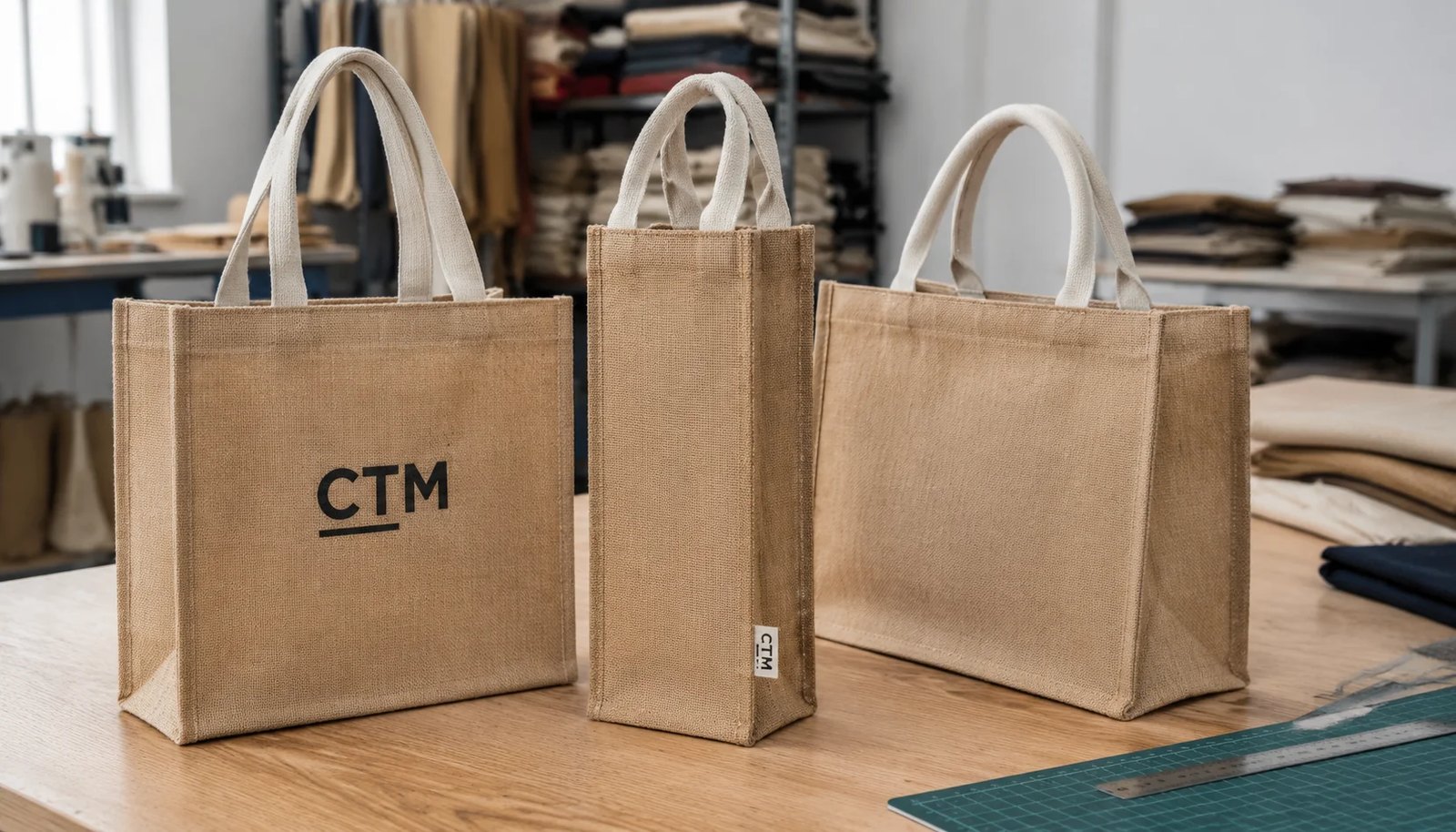
Why MOQ talks fail when buyers and factories mean different things
MOQ negotiation on custom jute tote bags often goes wrong before price is even discussed. A liquor retailer may think the project is a simple promotional tote. The factory may classify it as a bottle-carrying retail package with structural and appearance requirements. Those are not the same sourcing category. A low-cost event tote can sometimes be made from standard open-weave jute, basic rope handles, and a quick one-color print. A bottle tote for checkout or holiday gifting usually needs more control over size, gusset depth, handle strength, shape retention, and print legibility.
That mismatch creates bad quotes. Buyers ask for pricing at 500, 1,000, and 2,000 pieces without locking dimensions, bottle type, lamination, or handle build. Suppliers respond with a nominal starting price based on the easiest version they think they can sell. Later, when the buyer adds a wider gusset, cotton webbing, thicker body, divider, or more precise print placement, the price and MOQ both move. From the buyer side it looks like the factory changed terms. From the factory side, the spec changed into a different bag.
A stronger procurement approach is to separate three questions. First, what job does the bag have to do in store? Second, what construction is truly needed to do that job? Third, which of those features are custom enough to drive MOQ? Once those are clear, negotiation becomes practical instead of abstract. The aim is not to win the lowest possible minimum in conversation. The aim is to build a repeatable, quote-comparable specification that a supplier can run without hidden compromises.
- MOQ on jute bags is usually tied to material booking, print setup, and sewing efficiency, not just sales policy
- A one-bottle retail carry bag and a premium gift tote may look similar in photos but source very differently
- Early price comparisons are unreliable if the buyer has not frozen size, fabric, handle, and print assumptions
- The best MOQ outcome is usually the lowest-complexity build that still protects retail use, brand presentation, and shipment quality
Start with the liquor retail use case, not the target quantity
For liquor retailers, the first sourcing decision should be the store use case. Is the bag sold at checkout as an upsell, used for holiday gifting, offered for winery or tasting events, or distributed as reusable branded merchandise? Each use case changes the right specification. A checkout carry bag may only need safe bottle transport and acceptable branding. A holiday gift tote may need a cleaner silhouette, better top-line finishing, and a body that stands more neatly on display.
Bottle geometry matters more than many first RFQs show. A standard 750 ml wine bottle, a broader champagne bottle, and a square-shouldered spirit bottle do not occupy the same width or opening space. If the tote has to fit more than one bottle family, state that clearly. A few millimeters of extra gusset depth or opening width can change panel layout and cutting yield. That seems minor on paper, but factories calculate material usage from those dimensions. Unclear bottle fit is one of the easiest ways to end up approving a sample that works for one SKU and disappoints for another.
If the retailer is considering one-bottle, two-bottle, and gift-assortment versions, it is usually better to negotiate one core style first. A single-bottle format often gives the lowest-risk entry because sewing is simpler, cartons pack more efficiently, and mixed artwork is easier to manage. Once that style is stabilized, the buyer can ask whether a second format can share the same fabric booking, handle stock, or print color program. That creates leverage. Trying to negotiate three constructions at once often weakens it.
- Define whether the bag is for transport, gifting, display, or merchandise reuse before discussing MOQ
- Name the actual bottle family or maximum bottle dimensions that the bag must accommodate
- Treat one-bottle, two-bottle, and gift-set bags as separate sourcing builds unless proven otherwise
- Concentrating volume on one core format usually produces better MOQ flexibility than splitting a small budget across several styles
Specifications that really move MOQ: size, handle, divider, and finish
In custom jute tote bags, MOQ is often more sensitive to construction detail than buyers expect. A basic body with front and back panels, side gussets, bottom seam, and cotton webbing handles is a standard sewn item. The moment the buyer adds internal bottle dividers, stitched sleeves, piping, pockets, decorative closures, contrast trims, or bottom boards, the bag becomes slower to cut and sew. That raises labor content and defect risk, especially if the order is small. Factories usually protect themselves either with a higher MOQ or with a unit price jump that makes the lower quantity unattractive.
Handle choice deserves specific attention. Cotton webbing is usually the safest recommendation for liquor retail bags because it offers a more comfortable grip, cleaner edge appearance, and more consistent reinforcement than basic jute rope. In procurement terms, ask for actual width and handle drop rather than accepting 'standard webbing.' A 25 mm webbing handle will feel and perform differently from a 38 mm handle under bottle weight. Also confirm insertion depth and stitch pattern. A good-looking handle can still fail if it is inserted too shallowly or reinforced inconsistently.
Dividers are a classic MOQ trap. Buyers sometimes request a center divider because it sounds more premium or secure, but the retail need is not always real. If the bag is mainly carrying one bottle, or if wider gussets already stabilize the product, a divider adds labor and complexity with little commercial gain. If a divider is required, ask whether it is sewn into the body, attached at the top seam only, or added as a removable insert. Those are materially different constructions.
Finish expectations also need to be aligned with natural jute realities. Jute is not coated paperboard or smooth canvas. Variation in slub, shade, and surface texture is normal. If the buyer wants a cleaner premium look, specify that through measurable expectations such as better fabric selection, neater top hem, tighter print positioning, and lower tolerance for loose fibers. What should be avoided is vague wording like 'high quality' attached to a low-MOQ request. That invites interpretation, not control.
- Basic panel-and-gusset bodies are easier to source at lower MOQ than insert-heavy or trim-heavy constructions
- Specify handle width, handle drop, insertion depth, and reinforcement pattern instead of relying on 'standard'
- Only keep dividers if there is a real bottle-separation need; otherwise they often add cost and raise practical MOQ
- Natural-jute appearance variation should be acknowledged, but the acceptable level of finish still needs to be written down
Fabric and lamination: the specs most likely to hide cost or quality risk
Fabric language in jute sourcing is often imprecise, so buyers need enough specificity to compare quotes properly. For liquor retail tote programs, a useful working range is roughly 300-340 GSM for laminated jute if the bag needs a firmer body and better print support. Lighter options may still be usable for low-cost promotions, but they can sag under bottle load, distort around corners, and show more weave irregularity. Buyers should not rely on product photos alone because lighter open-weave fabrics can look acceptable in staged sample images.
Weave openness matters alongside nominal weight. Two fabrics described as similar GSM can behave quite differently if one has a looser weave and more visible gaps. A looser weave may reduce cost but gives a rougher print face and weaker shape consistency. That matters when the bag is sold in-store rather than simply given away. Ask for close-up photos or physical swatches of the actual body fabric. Better yet, request that the sample be made in the intended bulk material rather than a substitute cloth chosen only for showroom presentation.
Inside lamination is common for liquor retailer applications because it improves shape retention and offers some resistance to condensation or minor leakage. The practical issue is not whether lamination exists, but how it performs. Buyers should ask if the lamination is PE and request approximate thickness if available, often in a range such as 18-30 microns for standard builds. Thicker or thinner constructions can change feel, body, and crease behavior. Lamination can also contribute to odor complaints if material quality or curing control is poor.
Color strategy affects MOQ too. Natural jute is usually easier to source in smaller custom runs than dyed body fabric. If a buyer requests a tightly matched custom body color, the material minimum may move from the sewing floor back to the fabric source. In many liquor retail projects, keeping the body natural and carrying brand identity through print, labels, or handle color is the more practical way to stay near a lower MOQ target.
One final point: ask how the bag behaves after packing and transit. Laminated jute may arrive with stronger fold memory if cartons are compressed heavily. That is not necessarily a manufacturing defect, but it can become a merchandising problem if the bag must be display-ready on arrival.
- Approx. 300-340 GSM laminated jute is a common practical range for firmer liquor retail bag programs
- Open-weave fabric can lower cost but may weaken print crispness and shape consistency
- PE lamination can support moisture resistance and body retention, but odor and crease memory need to be checked
- Natural body color usually gives more MOQ flexibility than custom-dyed jute
Print planning that supports lower MOQ instead of fighting it
Jute does not reward overcomplicated artwork. For most liquor retailers, strong branding comes from simple, high-contrast graphics that respect the fabric surface. One-color or two-color screen print on the front panel is usually the most reliable and economical route. It keeps setup manageable, supports repeatability, and avoids unrealistic expectations for small detail on a coarse substrate.
Problems start when artwork prepared for labels, cartons, or glossy gift packaging is transferred directly to jute. Fine serif text, very thin lines, large reverse areas, and tight multi-color registration all carry more risk on a woven surface. Instead of asking whether the factory can 'match the file,' ask for minimum printable line width, minimum readable text size, and expected position tolerance on the exact fabric being quoted. These are better sourcing questions because they tie artwork to process limits.
Mixed artwork can be a legitimate MOQ negotiation lever if the buyer standardizes everything else. Many factories are more willing to split an order across several store names or regional logos when the bag dimensions, fabric, handle, print size, and ink colors all stay consistent. That is operationally different from asking for several completely different bags under one PO. To use this lever well, buyers should ask for the rules: How many artwork versions can share one MOQ? Does each version require its own screen charge? Can the pieces be packed by design code?
It is also smart to compare print-inclusive quotes carefully. One supplier may include a full-width front print; another may price a smaller logo area while using the same wording. Ask for actual print dimensions and print location in the quote. If the sample uses digital simulation instead of screen print, note that it is for layout only and not a final print standard.
If the retailer wants stronger branding without a second full print location, consider side labels or hangtags. These can increase perceived branding while keeping the main body print simple and easier to control.
- Front-panel 1-color screen print is usually the lowest-risk, best-value option on jute
- Always confirm minimum text size, line width, and print area instead of assuming paper-artwork standards apply
- Mixed logos under one MOQ are easier to negotiate when construction and ink colors stay constant
- Compare actual print size and process, not just the phrase 'logo included'
How factories calculate MOQ in practice
Understanding MOQ mechanics helps buyers negotiate intelligently. In jute programs, minimums often come from a combination of upstream material thresholds and factory-floor efficiency limits. Material thresholds can include custom-dyed jute, a special lamination run, non-standard webbing color, or a specific label component. Setup thresholds can include screen making, pattern preparation, and line changeover time. Production thresholds can include low cutting yield from custom dimensions or extra labor from heavy reinforcement and internal dividers.
That is why buyers should ask what is actually driving the MOQ. If a supplier says 1,000 pieces is the minimum, ask whether that number is tied to custom fabric color, print setup, or sewing complexity. The answer changes the negotiation path. If dyed body fabric is the blocker, natural jute may solve it. If multiple print versions are the blocker, standardizing print size and ink colors may help. If the bag shape is the issue, moving closer to a standard cutting layout may unlock a better number.
A useful quoting structure is to separate fixed charges from variable cost. Fixed charges may include sample fee, screens, or pattern cost. Variable cost covers the per-piece material, sewing, printing, and packing. Buyers sometimes push for a low unit price without seeing where the one-time setup cost sits. That can encourage hidden cost recovery later. Transparent quote structure makes it easier to compare suppliers and easier to decide whether a slightly lower MOQ is worth a higher setup fee.
Buyers should also distinguish between technical MOQ and economic MOQ. A factory may technically accept 500 pieces, but the unit economics may be poor because the setup cost is spread over too few bags. Another supplier may recommend 1,000 pieces because that is where the material and screen cost become more rational. For procurement, the right decision is usually the quantity where total landed cost, spec integrity, and schedule reliability all align.
- Material minimums, print setup, and sewing efficiency commonly combine to create the quoted MOQ
- Ask what is driving the minimum before trying to negotiate it down
- Request fixed charges separately from unit pricing to compare suppliers on a like-for-like basis
- Economic MOQ often matters more than the smallest quantity a factory says it can technically produce
MOQ negotiation tactics that work better than blunt price pressure
The strongest MOQ negotiations make the order easier to manufacture. Start by standardizing the elements that touch the most factory steps: finished size, gusset format, body material, lamination, handle spec, and print location. Then ask for flexibility in areas that are easier to vary, such as artwork version, carton split, or shipment staging. Factories prefer repetition on the production line. Buyers who structure requests around that reality usually get better cooperation.
Natural body color is one of the simplest and most effective levers. If the buyer can accept natural jute, the supplier may be able to use more readily available material and avoid a custom-dye threshold. That often matters more than a small debate over unit price. For first runs, test orders, or regional launches, a natural body plus one-color branding is often the smartest path to an acceptable MOQ without compromising the brand too heavily.
Artwork consolidation is another useful lever. If a retail chain needs different location names, ask whether one master logo format with limited text changes is easier than several unrelated designs. Keeping print size and ink colors consistent can reduce setup disruption. Likewise, if a buyer needs staggered delivery, ask whether the order can be produced in one batch and shipped in stages rather than split into separate small runs. That can help inventory management without multiplying setup cost.
Sample-charge handling can also be negotiated more effectively than many buyers realize. Rather than pushing for a free sample, ask whether the sample fee or screen charge can be credited back against the bulk order. That is often more realistic and leads to a more serious, production-relevant sample. Finally, if repeat orders are likely, say so. Suppliers are more open to helping on first-order MOQ when they see a stable specification with repeat potential rather than a one-off trial likely to disappear after one shipment.
- Keep body construction constant and negotiate variation mainly through artwork or carton allocation
- Use natural jute and straightforward branding to reduce material-driven MOQ pressure
- Ask about one-batch production with staged shipment if warehouse timing matters
- Negotiate sample fee credit-back instead of focusing only on obtaining a free sample
What to approve in the sample before you release the PO
For low- and mid-MOQ orders, sample approval is a financial control point. If the sample is vague, the bulk order risk is high because there are fewer units over which to absorb mistakes. The pre-production sample should use bulk-like jute, the intended lamination, final handle material, final reinforcement method, and the actual print process. If the supplier wants to send a layout sample in substitute fabric first, that can be useful, but it should not become the production approval standard by default.
For liquor retail bags, functional fit is essential. Insert the actual bottle type, or the widest and tallest bottle likely to be carried. Check whether the opening is comfortable for store staff, whether the bottle neck protrudes too much, whether the body collapses excessively when loaded, and whether the bag stands acceptably if standing is part of the design intent. If the product is likely to meet chilled bottles, assess whether the inside finish is appropriate and whether lamination odor is acceptable after unpacking.
Measurement should be formal, not visual. Record width, height, gusset depth, top opening, handle drop, and print position on the approved sample. Photograph front, back, side, top opening, bottom corners, and both handle attachment points. This creates a practical approval record for final inspection. It is also the right time to comment on details that often get lost later, such as top-edge straightness, acceptable slub variation, or the amount of loose interior fiber tolerated.
Buyers should also review sample packing logic before release. A tote that looks fine when shipped loose may show heavier fold marks when packed tightly in export cartons. If front-panel appearance matters at retail, ask the supplier to describe or demonstrate the proposed carton packing method. Specific comments beat generic ones. Instead of saying 'make the print better,' say 'increase opacity to match approved sample while keeping text edges clear on this fabric.' Clear comments become clear QC criteria.
- Approve only against a sample that reflects bulk-like material, handle, lamination, and print method
- Test with the real bottle type or an agreed load equivalent before confirming the construction
- Measure and record all key dimensions and print placement on the approved sample
- Review packing impact on creasing before bulk release if shelf presentation matters
QC standards that matter most for liquor retailer jute bags
Quality control for jute bottle totes should focus first on function, then on controlled natural-material appearance. Handle strength and handle symmetry matter because failure under bottle load creates immediate retail complaints. Buyers should require measurement of handle placement from side seams and confirmation that the reinforcement pattern matches the approved sample. If the factory has an internal pull or load test method, ask how it is applied. Even if no formal lab protocol is used, a practical agreed load test on random samples is better than relying on visual checks alone.
Dimension control also matters more than it appears. A bag that is slightly narrow or slightly shallow may still pass a casual visual review, but store staff will notice when bottles fit badly or the opening is awkward at checkout. State whether dimensions are measured empty and laid flat, and agree reasonable tolerances such as roughly ±10-15 mm on body dimensions unless the construction justifies something tighter or looser. Handle drop and print position should also have written tolerances so inspection does not become subjective.
Print QC on jute should define what is acceptable and what is rejectable. Normal texture variation is one thing. Unreadable text, obvious skew, major pinholes, missing ink areas, or severe flooding are another. If the logo contains small elements, mark them specifically in the approval comments. A supplier may otherwise classify them as non-critical because jute is a rough substrate. The approved sample and tolerance notes should settle that before shipping.
Lamination and odor deserve direct inspection. Check for delamination, bubbling, cracking at folds, and strong chemical smell after unpacking from cartons. If the bags are packed immediately after production, odor can concentrate in transit. Retail buyers often discover this only after arrival. Adding odor review to the pre-shipment checklist reduces dispute risk. Finally, verify packing accuracy. Wrong artwork in the wrong carton is a quality problem, not merely a logistics inconvenience.
- Measure body size, handle placement, and handle drop against written tolerances
- Use a practical load test or buyer-agreed strength check on random samples before shipment release
- Define print rejects clearly for unreadable detail, severe skew, missing ink, and flooding
- Treat odor, lamination condition, and carton assortment accuracy as formal QC points
Packing, logistics, and lead time: where a cheap quote can become expensive
Unit price alone does not show the real value of a jute tote quote. Two suppliers may offer similar pricing but pack very differently. One may compress cartons heavily to reduce freight volume. Another may use fewer pieces per carton to protect shape. Neither method is automatically right or wrong. The right choice depends on how the retailer will receive and use the bags. If they are a simple checkout item stored in the back room, some creasing may be acceptable. If they will be stacked for holiday display, excessive fold memory can reduce presentation quality and increase store labor.
Carton planning matters if the retailer uses a central warehouse or 3PL. Mixed-artwork programs should be packed and marked in a way that supports receiving accuracy. If bags are requested by store code or regional artwork, the carton mark, quantity per carton, and barcode label format should be frozen before production. Otherwise, any MOQ savings may be lost in relabeling, re-sorting, or inventory confusion after arrival.
Lead time should always be broken into stages. Ask for timing on material booking, sample revision, artwork approval, bulk cutting, printing, sewing, final inspection, and ex-factory or vessel-ready date. A low MOQ does not automatically mean a faster schedule. Small custom runs are often inserted around larger production blocks unless they use standard material and simple construction. Repeat orders on a stable specification are usually easier to schedule than first-time orders that still involve open technical questions.
Trade terms also affect quote comparability. EXW, FOB, and delivered prices can create very different landed outcomes, especially once carton dimensions and gross weight are known. For procurement teams importing regularly, FOB often makes comparisons easier because export handling assumptions are more standardized. Whatever basis is chosen, ask for carton dimensions and estimated gross weight before final decision-making. Freight can change the apparent value of a low-MOQ offer very quickly.
- Controlled carton compression can reduce freight, but over-compression can damage retail presentation on laminated jute
- Packing by artwork or store code should be treated as a specification item, not an afterthought
- Break lead time into approval and production stages so schedule risk is visible
- Compare trade terms, carton dimensions, and gross weight alongside unit price when choosing a supplier
Specification comparison for buyers
| Spec decision | Recommended option | When it fits | Buyer risk to check |
|---|---|---|---|
| Base fabric weight | Approx. 300-340 GSM laminated jute body for most liquor retail carry and gift use | Best for one-bottle retail totes, branded checkout upsell bags, and repeat programs needing a firmer silhouette | Some quotes use lighter open-weave fabric around 260-280 GSM or loosely woven constructions that photograph well but sag under bottle load |
| Lamination choice | Inside PE lamination, typically around 18-30 microns unless a different build is specified | Useful when bottles may sweat, minor leakage is possible, or the buyer wants better shape retention and a smoother print backing | Ask about odor, fold whitening, lamination adhesion, and whether heavy carton compression may create visible crease memory |
| Handle material | Cotton webbing, commonly 25-38 mm width, with box-X reinforcement | Recommended for better hand feel, cleaner finish, and more dependable bottle-carrying performance than low-cost rope options | Confirm actual webbing width, folded insertion depth, stitch count, and whether the quote includes reinforcement on both handle ends |
| Bag format | Single-bottle or general gift tote with standard side gussets; add divider only if there is a real bottle-separation requirement | Good for lower MOQ entry, easier approval, and better chance of mixed artwork under one production run | Internal dividers, bottle sleeves, or board-bottom inserts usually slow sewing and may trigger a higher practical MOQ |
| Print method | 1-color or 2-color screen print on front panel only | Most economical route for clear branding on coarse jute and easier setup for chain-store variants | Fine lines, small reverse text, halftones, and tight color registration can fail on jute; ask for minimum printable detail before approval |
| MOQ route | Keep size, fabric, lamination, and handle constant; negotiate mixed logos or regional artwork under one master construction | Best when a retailer needs store-group branding but does not want a separate MOQ per location | Get split ratios, screen charges, and packing-by-artwork rules in writing; mixed designs do not always mean mixed carton packs are included |
| Packing method | Flat packed in export cartons with controlled compression and clear carton marking by SKU or artwork code | Works for warehouse distribution and 3PL allocation if carton identity and counts are locked before bulk | Over-compression can set fold marks on laminated jute; confirm pieces per carton, carton dimensions, and whether bags are nested or bundled |
| Sampling approach | Physical pre-production sample made in bulk-like jute, with actual lamination and final print process | Critical when the order is near MOQ and there is limited room for claim disputes or rework | Display samples sometimes use substitute fabric, digital print, or a softer handle than bulk; do not approve production on appearance alone |
Buyer checklist before sampling
- Define the retail use case first: checkout carry bag, premium gift tote, winery event bag, or reusable merchandise item
- State the intended load clearly, such as one standard 750 ml wine bottle, one champagne bottle, or two spirit bottles, with approximate loaded weight
- Provide finished dimensions in millimeters or inches for width, height, and gusset, and specify whether tolerances are measured on a laid-flat empty bag
- Specify target fabric construction, such as laminated jute in the 300-340 GSM range, instead of requesting only 'natural jute'
- Confirm whether inside lamination is required and note if odor sensitivity, condensation, or minor liquid leakage resistance matters
- Lock handle material, width, handle drop, and reinforcement method early; do not leave 'standard handle' open to supplier interpretation
- Reduce artwork complexity before RFQ; bold 1-color or 2-color logos usually source more reliably on jute than fine-detail brand artwork
- Tell suppliers up front if you need mixed store names, mixed artwork, barcode labels, or regional carton splits under one PO
- Request a full quote breakdown covering sample fee, screen/setup charges, unit price, packing details, carton count, and trade term basis such as EXW or FOB
- Approve a physical pre-production sample made with bulk-like fabric, final print method, and the exact handle build intended for production
Factory quote questions to send
- What is the real MOQ by size, fabric color, artwork version, and packing split, and which part is driven by material minimums versus print setup versus sewing efficiency?
- What exact jute construction are you quoting: approximate GSM, weave type, laminated or unlaminated, and inside lamination thickness if applicable?
- What are the finished bag dimensions and tolerance standard you will work to for width, height, gusset, and top opening?
- What handle specification is included in the quote: material, width, handle drop, insertion depth, and reinforcement stitch pattern?
- What is the recommended safe working load for this construction, and what internal test or buyer witness test can you support for handle attachment strength?
- What print process is included, what maximum print area is realistic, and what minimum text size and minimum line width can remain legible on this jute surface?
- Can multiple logos share one MOQ if the bag body, print size, and ink colors remain the same, and what additional screen or handling charges would apply?
- Will the pre-production sample use the same jute, lamination, handle webbing, stitching method, and print process as bulk production?
- What are your standard tolerances for size, print position, handle placement symmetry, and natural material color variation?
- How many pieces per carton are planned, what are the carton dimensions and gross weight, and how much compression will be applied during packing?
Quality-control points to confirm
- Finished body dimensions should be checked against the approved spec, commonly within about ±10-15 mm for width and height and ±8-12 mm for gusset unless another tolerance is agreed in writing
- Handle drop and handle placement should be measured on both sides; asymmetry beyond the agreed tolerance can affect carry comfort and retail appearance
- Handle attachment should use the agreed reinforcement pattern, typically box-X or equivalent, with consistent stitch density and no obvious skipped or loose stitches
- Random load testing should be performed with the intended bottle configuration or equivalent weight before shipment release, especially for single-bottle gift formats
- Print position should stay within agreed tolerance, commonly around ±5-10 mm depending on print size and fabric variation, with no severe skew or unreadable detail
- Print quality should be checked for pinholes, flooding, excessive ink spread, poor opacity, and misregistration that exceeds the approved sample standard
- Lamination should be checked for adhesion, bubbling, delamination at folds, visible cracking, and objectionable chemical odor after bags are unpacked from cartons
- Side seams, bottom seams, and gusset corners should sit square enough for the bag to stand as specified when loaded, if standing performance is part of the approval criteria
- Trimming and finish should be reviewed for sharp protruding jute fibers, exposed raw edges where folded seams were specified, and excessive loose threads
- Carton assortment, inner bundling, carton marks, barcode labels, and SKU split should be verified against the packing list because mis-assorted goods create downstream warehouse cost