Define the MOQ Problem Before You Negotiate
MOQ negotiation is rarely about convincing a supplier to “go lower” in the abstract. For custom jute tote bags, the minimum is usually linked to fabric buying, cutting setup, print screens, sewing-line scheduling, trim purchasing, inspection, and packing labor. If the RFQ is vague, the supplier protects itself with a safer MOQ or a higher price.
Eco apparel brands often add complexity quickly: a special handle, a printed logo, a woven side label, a hangtag, cotton lining, individual packing, and more than one store version. Each choice may be reasonable, but together they turn a simple tote into a multi-SKU production program. A stronger first-order strategy is one hero bag that proves demand before variants are added.
Your target is the lowest practical entry quantity, not the lowest number at any cost. If the order is below the natural threshold for the chosen customization, the supplier may add setup fees, delay the order until it can be combined with other work, or accept the order but reduce attention to detail. A practical MOQ protects cash flow while still giving the factory a clean production run.
- Start with one hero size, one material base, one decoration position, and one packing method.
- Ask which specification choice is driving MOQ before asking for a discount.
- Separate pilot testing from long-term assortment planning.
- Use quantity tiers to identify real price breakpoints.
- Record any MOQ exception in the proforma invoice or purchase order, not only in email.
Choose a Jute Build That Matches the Use Case
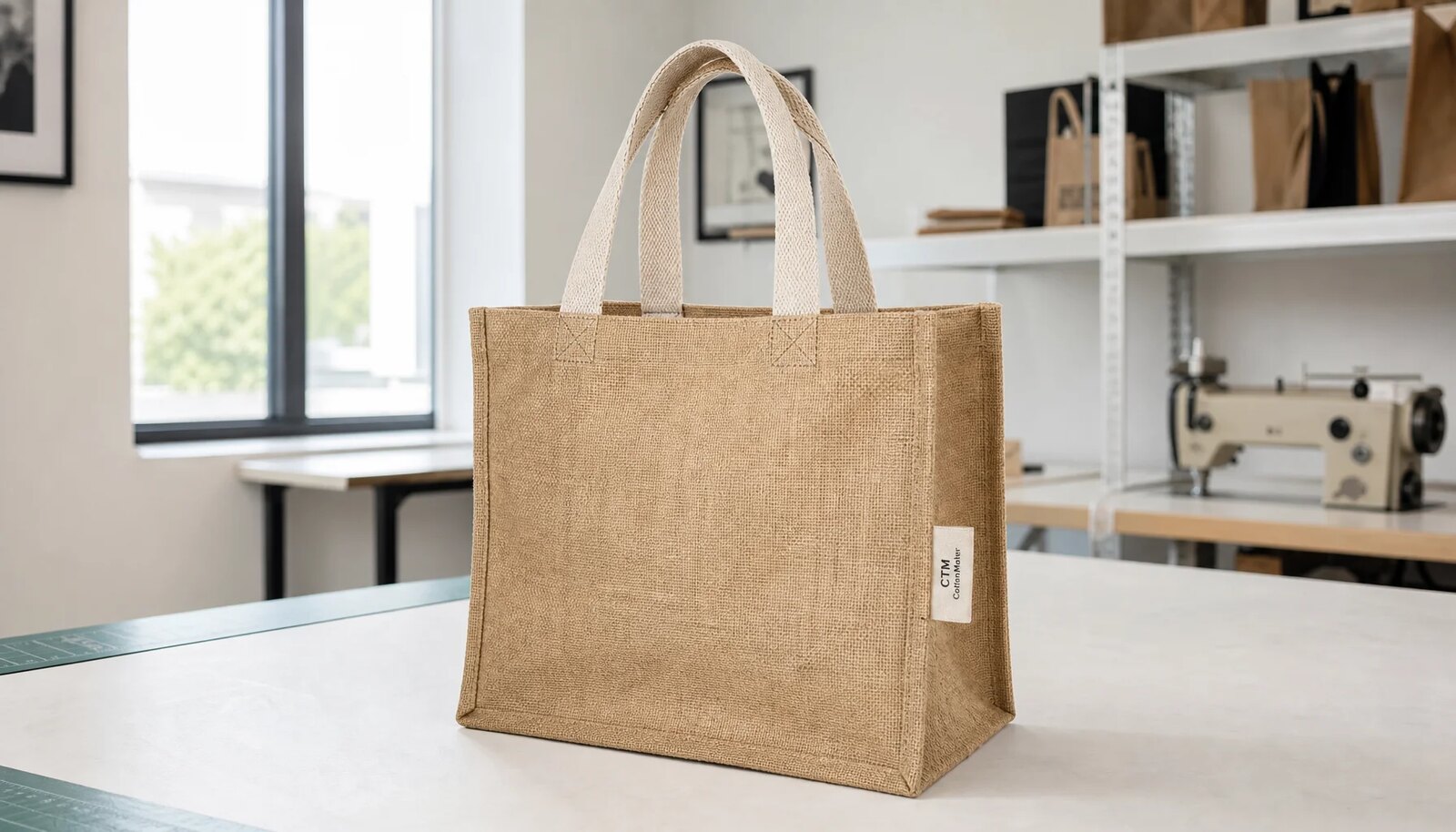
Jute tote bags are not a single fixed specification. Fabric weight, weave openness, lining, lamination, handle construction, and reinforcement all change cost and performance. For light retail, events, or promotional packaging, 280 to 320 gsm is often a practical starting point. For a more structured bag carrying folded garments, catalogs, or boxed accessories, 350 to 400 gsm may be more appropriate.
The lining decision has commercial consequences. Unlined natural jute is simpler to quote, easier to sew, and usually more MOQ-friendly. Cotton lining gives a cleaner interior and can protect apparel from rough fibers. Lamination can add structure or moisture resistance, but it may change hand feel, odor, sewing behavior, carton cube, and the sustainability language a brand can responsibly use.
Handle construction is a major quality point. Cotton webbing handles are usually comfortable and repeatable. Self-jute handles may look cohesive but can feel rougher unless they are well reinforced. Define handle width, handle drop, and root reinforcement rather than leaving them to factory habit. A boutique hand-carry bag, shoulder tote, and sample-kit carrier should not all use the same handle assumption.
- Use 280 to 320 gsm for light retail, launch events, and simple branded carriers.
- Use 350 to 400 gsm when structure and load performance matter more.
- Specify unlined, cotton-lined, or laminated construction before comparing quotes.
- Define handle material, width, drop, placement, and reinforcement stitch.
- Tell the factory what the bag must carry, not just what it should look like.
Know Which Specs Push MOQ and Cost Up
Factories raise MOQ when a specification adds setup time, special sourcing, scrap risk, or slow production. On jute totes, common MOQ drivers include nonstandard sizes, heavier GSM, lining, lamination, multicolor print, custom woven labels, retail inserts, and individual packing. A one-color print on a standard natural jute body is a very different order from a lined bag with two label positions and channel-specific cartons.
Artwork is a common hidden driver. Raw jute has texture, fibers, and natural shade variation. Fine type, thin lines, gradients, and tight multicolor registration are harder to control than bold single-color artwork. If the logo is detailed, a cotton patch, woven label, or simplified artwork may produce a better result at a lower risk than direct printing on the jute body.
Trims often create separate minimums. A woven label supplier may require 1,000 labels even if the bag run is 500 pieces. Hangtags, cords, zipper pulls, patches, and printed inserts can each carry their own MOQ. Ask for the minimum by component so you can see whether the bag MOQ is truly the obstacle or whether trim purchasing is driving the number.
- Multiple sizes increase pattern setup, cutting checks, measurement work, and carton complexity.
- Multiple artwork versions may require separate screens and approval steps.
- Custom labels, patches, and hangtags can trigger supplier MOQs outside the bag factory.
- Lining and lamination add sourcing, sewing, inspection, odor, and claim-control considerations.
- If MOQ is too high, ask which single change would reduce it most.
Use Quantity Scenarios to See the Real Breakpoint
A useful MOQ conversation compares tiers, not one number. Ask the supplier to quote the same specification at 300, 500, 1,000, 2,000, and 5,000 pieces. If the price drop from 300 to 500 is large, setup cost is probably being spread across too few units. If the price drop from 1,000 to 2,000 is modest, material and labor may be the main cost drivers.
For example, assume a one-color screen setup, artwork preparation, and sample-related fixed charges are spread across the run. At 300 pieces, each bag carries a larger share of those fixed costs. At 500 pieces, the burden is lower and the factory may run cutting and printing more efficiently. At 1,000 pieces, the order may justify cleaner material procurement, better line planning, and less manual exception handling.
SKU splitting can destroy these economics. A 1,000-piece order split into four artwork versions of 250 each may behave more like four small orders than one efficient order. The buyer sees 1,000 pieces; the factory sees four screens, four approvals, four carton markings, and four inventory risks. If you need variants, ask whether quantities can be aggregated for material buying while setup charges remain separate.
- Compare 300, 500, 1,000, 2,000, and 5,000 pieces using the same spec.
- Ask where setup amortization stops being the main cost issue.
- Avoid splitting the first run into too many artwork or size versions.
- If variants are required, keep body, handle, GSM, and packing identical.
- Request a pilot-and-reorder price: smaller first run, better repeat price for the same approved spec.
Compare Supplier Routes Commercially, Not Just by Unit Price
A direct factory, trading company, sourcing agent, and stock-program supplier can all quote custom jute totes, but they offer different control. A direct factory is often strongest when the buyer needs repeatability, transparent MOQ logic, and clear accountability for construction, samples, and packing. The tradeoff is that very small orders may not be attractive unless the spec is simple.
A trading company or sourcing agent can be useful if you are consolidating bags with apparel, trims, or packaging. The buyer may save management time, but MOQ transparency can be weaker. The quoted minimum may be the factory’s true MOQ, the trader’s preferred order size, or a blended risk number. Ask who controls sampling, bulk production, QC, and reorders.
Stock blanks are useful for urgent events or micro-tests. They can reduce MOQ because the bag body already exists, but exact GSM, shade, handle length, and carton spec may not be controllable. For a long-term retail packaging program, stock is only suitable if the available blank already meets your quality and brand standards.
- Use direct factories when repeatability and QC accountability matter most.
- Use trading partners when consolidation is more valuable than full MOQ transparency.
- Use stock blanks for speed or very small pilots, not for unverified long-term programs.
- Compare what is included: decoration, setup, sample, packing, documentation, and freight terms.
- Confirm whether the same production source will handle reorders.
Write an RFQ That Lets the Factory Quote Cleanly
A clear RFQ is the buyer’s strongest negotiation tool. It reduces guesswork and shows the supplier which parts are fixed and which can be standardized. Include finished dimensions, gusset depth, jute GSM, lining or lamination, handle material, handle drop, reinforcement stitch, artwork placement, packing method, destination, Incoterm, and quantity tiers.
Finished dimensions should be precise. Avoid terms such as “medium tote” unless you also provide width, height, gusset, and handle drop. State whether measurements are taken flat, open, pressed, or packed. If the bag must carry specific products, mention them: for example, two folded sweatshirts, a shoebox plus accessories, or a wholesale sample pack.
Artwork instructions should include vector files where possible, print size, print position, distance from edges or seams, ink reference, and acceptable decoration method. Invite the factory to flag risks before sampling. On textured jute, a cheap print method that cannot reproduce the logo is not a saving; it is a future rejection.
- List size, GSM, finish, handle build, artwork, packing, Incoterm, and destination in one RFQ.
- Request separate pricing for tooling, decoration, trims, packing, sample, and courier cost.
- State which features can change to reduce MOQ and which are non-negotiable.
- Ask for MOQ by variable, not only one total order minimum.
- Require carton dimensions, pieces per carton, and gross weight in the quote.
Control Branding on Textured Jute
Jute branding requires realistic expectations. The material’s coarse weave and natural shade variation are part of its appeal, but they reduce print sharpness compared with smooth cotton canvas. Bold logos, larger type, and one-color graphics usually perform better than tiny lettering, gradients, or tight multicolor registration.
Screen printing is often practical for low-to-mid MOQ programs, especially for one-color artwork. However, ink opacity and edge clarity must be checked on actual jute, not only on a digital mockup. Pale ink may lose contrast on a tan base, while heavy ink deposits can feel stiff or crack if not cured properly.
If brand detail matters, consider a woven label, cotton patch, or printed fabric patch. These options may add trim MOQ, but they can improve readability and reduce direct-print risk. The approved sample should record print size, position, distance from top edge, distance from side seam, label placement, color reference, and acceptable variation.
- Use bold artwork for direct jute printing.
- Move fine typography to a patch or woven label if readability is critical.
- Approve color and opacity on actual jute material.
- Measure artwork placement from seams or edges, not from a mockup only.
- Ask whether multi-pass printing changes cost, curing time, or hand feel.
Add Compliance, Sourcing, and Claim Checks Early
Eco apparel brands should treat sustainability language carefully. “Jute,” “natural,” “reusable,” or “eco” claims may still require limits depending on lining, lamination, inks, labels, and local marketing rules. Ask the supplier what documents can actually be provided and avoid writing unsupported claims into packaging or product pages.
Compliance checks should be practical and specific. If your customer or market requires it, ask about AZO-free inks, restricted substances, heavy-metal limits in pigments, and trim safety. For jute bags used near apparel, odor, moisture, mold prevention, and excessive fiber shedding are also important. A bag that smells musty or arrives damp can damage customer confidence even if its construction is acceptable.
Social compliance may matter if the tote is part of a branded retail program or wholesale account requirement. Do not assume every supplier can provide audit documents or certifications. Ask what is available before order placement, and state whether documentation is mandatory or preferred. If the documentation is not available, avoid making claims that depend on it.
- Confirm which sustainability claims are supportable for the actual finished bag.
- Ask for AZO-free or restricted-substance controls when required by your market or customer.
- Check odor, moisture, mold prevention, and storage controls before shipment.
- Clarify whether lamination or lining limits recyclability or claim language.
- Request social compliance documents only where needed, and verify what the supplier can provide.
Approve Samples With Measurable Criteria
A sample is the production reference, not a formality. For a first commercial run, approve a physical pre-production sample using the intended material, handle, artwork, label, and construction. Photo approval cannot confirm hand feel, odor, handle comfort, print texture, scale, or packing behavior.
Measure the sample the same way bulk goods will be inspected. Check body width, height, gusset depth, handle drop, handle width, print size, print placement, and label position. Record tolerances in writing. Jute can shift during cutting, sewing, pressing, and folding, so the goal is not impossible perfection; it is commercially acceptable consistency.
Test the sample under intended use. Fill it with the expected load, carry it by the handles, fold it as proposed for export packing, and reopen it. Look for seam strain, handle pullout, bottom distortion, print cracking, lint, odor, rough edges, stains, or moisture. If revisions are needed, write exact corrections such as “move print 2 cm upward” or “increase handle reinforcement,” not “make better.”
- Approve a physical pre-production sample before bulk production.
- Measure size, handle drop, print placement, and label placement.
- Test with the intended apparel or product load.
- Check odor, shedding, stains, slubs, skipped stitches, and print durability.
- Keep an approved reference sample for final inspection and reorders.
Plan QC, Packing, and Shipment Release Together
Quality control should start before sewing. Incoming jute should be checked for GSM, shade, weave consistency, odor, moisture, stains, holes, heavy slubs, mold marks, and broken yarns. Some natural variation is expected, but severe defects should not enter cutting because they are hard to correct later.
Inline checks prevent repeated defects. Ask the factory to confirm first pieces from cutting, sewing, printing, label attachment, and packing. If a handle jig is wrong or a screen is misaligned, hundreds of bags can be affected quickly. Final inspection should use the approved sample and written defect categories: critical, major, and minor.
Packing affects cost and product condition. Bulk-folded export packing is usually efficient for wholesale and warehouse use. Individual polybags, belly bands, inserts, or hangtags add labor and may trigger separate material MOQs. Always request pieces per carton, carton dimensions, gross weight, fold method, carton marks, and packing list format before booking freight.
Shipment release should include more than product photos. Confirm carton count, inner count, SKU labels, outer marks, gross weight, moisture protection, and rework evidence if defects were found. A low unit price is not a procurement win if cartons arrive short, mislabeled, damp, or repacked at destination.
- Check incoming jute for GSM, shade, odor, moisture, stains, holes, and severe slubs.
- Use first-piece checks for cutting, sewing, printing, label attachment, and packing.
- Define critical, major, and minor defects before inspection.
- Include handle strength, seam security, print placement, and carton count in QC.
- Confirm carton dimensions, pieces per carton, gross weight, fold method, and outer marks.
- Require rework photos or reinspection results before shipment release if issues are found.
Specification comparison for buyers
| Sourcing or spec route | Best fit | MOQ impact | Cost impact | Lead-time impact |
|---|---|---|---|---|
| Direct factory custom production | Repeat retail packaging, launch kits, wholesale programs, and brands needing consistent reorders | Usually clearer MOQ by size, fabric, artwork, and packing; lower negotiation risk if specs are standardized | May not be the cheapest first quote, but costs are easier to separate | Sampling and production schedule depend on factory capacity and material availability |
| Trading company or sourcing agent | Buyers combining bags with other apparel or packaging items in one shipment | MOQ may be blended or padded to cover supplier risk; ask for true MOQ by variable | Can include service margin but may reduce management time | Can be efficient if the agent already has qualified jute suppliers |
| Stock blank plus decoration | Urgent event orders, micro-tests, internal trials, or very low initial quantities | Lowest custom-entry route because the bag body is already made | Decoration cost may be reasonable, but bag spec control is limited | Often faster than full custom if stock is available |
| One hero custom SKU | First commercial run for an eco apparel brand testing demand | Best MOQ leverage because cutting, sewing, printing, and packing run as one batch | Setup is amortized across one version; fewer hidden trim and packing costs | Cleanest schedule with fewer approval loops |
| Multiple sizes or artwork versions | Established programs with known demand by channel or store type | Raises MOQ because each variable may create a separate production or print setup | Higher setup, inspection, labeling, and inventory cost | Longer approval and packing coordination |
| Unlined natural jute, one-color print | Cost-sensitive promotional or light retail use | Usually the most MOQ-friendly custom route | Lower material and sewing cost; simple setup | Shorter development path if artwork is bold |
| Cotton-lined or laminated jute | Premium gifting, resale totes, heavier apparel bundles, or cleaner interior presentation | Often increases MOQ because of extra material sourcing and sewing steps | Higher unit cost and carton cube; lamination can add odor and claim risk | May require additional sampling and drying/curing time |
| Retail-ready individual packing | Direct-to-store, ecommerce insert, or premium unboxing programs | Can trigger separate packing material MOQs | Adds labor, materials, carton volume, and receiving complexity | Longer packing and inspection time |
Buyer checklist before sampling
- Finished bag dimensions: body width, height, gusset depth, handle drop, and measurement method after pressing or folding
- Target jute GSM, weave appearance, color tone, and whether the bag is unlined, cotton-lined, laminated, or blended
- Handle material, width, length, placement, reinforcement stitch, and intended carrying load
- Artwork file, print size, position, ink reference, label artwork, and readability requirements for small text
- MOQ requested by finished size, artwork version, fabric weight, lining option, decoration method, trim, and packing style
- Quantity tiers such as 300, 500, 1,000, 2,000, and 5,000 pieces using the same specification
- Setup charges for screens, plates, woven labels, patches, hangtags, cutting tools, or special cartons
- Sample plan: development sample, strike-off if needed, pre-production sample, approval method, and measurable tolerances
- Compliance checks: AZO-free or restricted-substance ink requirements, odor and moisture control, social compliance expectations, and documentation needed to support any sustainability claims
- Packing spec: fold method, inner pack count, master carton count, carton dimensions, gross weight, outer marks, SKU labels, and packing list format
Factory quote questions to send
- What is your MOQ per finished size, artwork version, fabric GSM, lining option, decoration method, label, and packing style?
- Can you quote the same specification at 300, 500, 1,000, 2,000, and 5,000 pieces so we can see setup amortization and price breakpoints?
- If our target is 300 pieces but your standard MOQ is 500 or 1,000, which specification change would reduce risk the most?
- What exact jute GSM, weave, finish, and color tone will be used, and will bulk material match the approved physical sample?
- Is the quoted price for blank bags, decorated bags, or finished export-packed bags with labels, marks, inserts, and cartons?
- What setup charges apply for screens, plates, woven labels, cotton patches, hangtags, cutting dies, or special packing materials?
- What sample cost, sample lead time, courier cost, and approval stage do you require before bulk production starts?
- What handle material, handle width, reinforcement stitch, and load recommendation do you suggest for folded apparel or retail use?
- How do you control print clarity and ink curing on raw jute, especially for fine lines, small text, light ink, or multiple colors?
- Can you confirm AZO-free or restricted-substance controls for inks and trims if required by our market or customer policy?
Quality-control points to confirm
- Finished width, height, gusset depth, and handle drop should stay within written tolerances after pressing, folding, and packing
- Measurements should be taken from the same points used on the approved sample and inspection checklist
- Handle length, placement, left-right symmetry, and reinforcement stitching should match the pre-production sample
- Stitching should be straight, secure, evenly tensioned, and reinforced at stress points with no skipped stitches, loose threads, or open seams
- Print should match approved placement, opacity, registration, edge clarity, ink curing, and color reference within agreed limits
- Labels, patches, hangtags, and trims should match approved artwork, spelling, orientation, placement, and attachment method
- Fabric should be free from holes, oil stains, mold marks, severe shade variation, uneven lamination, broken yarns, and excessive shedding
- Bulk bags should pass the agreed carrying-load check without seam opening, handle pullout, or unacceptable shape collapse
- Odor and moisture should be acceptable for retail handling, warehouse storage, and carton opening at destination
- AZO-free or restricted-substance requirements should be verified when required by buyer policy, market regulation, or customer program