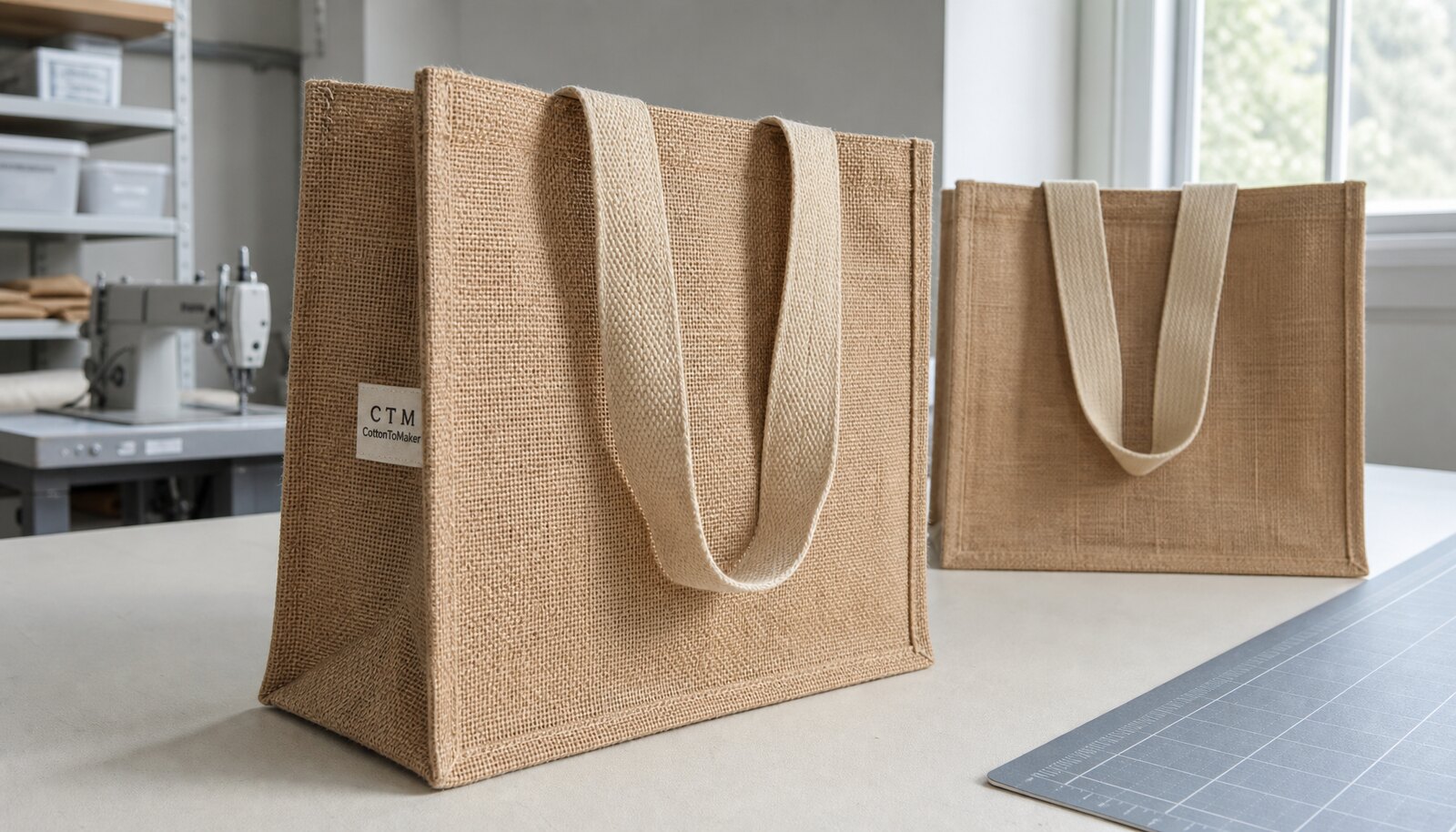
1. Start With The Retail Job, Not The Fabric
Most jute tote mistakes start with buyers choosing the material before they define the bag's job. A gift shop tote is not the same as a supermarket carry bag or a promotional giveaway. It needs to look clean on a shelf, hold a sensible retail margin, and survive repeated customer handling without going limp or shedding too much fiber. If the bag is for souvenirs, museum stores, holiday gifting, or branded merchandise, the build has to support a stronger perceived value than a plain utility tote.
Before you discuss weave or GSM, lock the use case. If the bag will carry small boxed gifts, you need a flatter front panel, enough gusset depth for structure, and a handle that feels comfortable in the hand. If it is meant as a premium retail item, a lined or laminated build may justify the higher cost. If it is for a low-price promotional shelf, you may need a lighter fabric and a simpler print method to keep the landed cost in range.
- Define where the bag will sit in the store: checkout impulse, premium gift wall, or bundled gift packaging.
- Define what it must carry: lightweight souvenirs, books, cosmetics, bottles, or boxed sets.
- Define the target price tier before asking for samples, because that controls the fabric and finishing choices.
2. Choose The Right Jute Build For The Shelf And The Load
For gift-shop totes, the practical fabric range is usually around 200 to 380 gsm depending on the target price and how structured the bag must feel. On the lighter end, roughly 200 to 240 gsm works for simple branded totes that do not need heavy load-bearing strength. In the middle, 250 to 300 gsm gives a more retail-ready body and is often the safest starting point for everyday gift-shop use. Above 320 gsm, the bag starts to feel more substantial, but the cost, stiffness, and handling complexity rise with it.
The fabric weight is only part of the decision. A rough natural jute surface can look premium, but it also limits fine-detail printing and can show slubs, fiber variation, and slight shade differences between lots. If the bag must look cleaner and protect the contents, consider an inner lining or lamination. If the retailer wants a softer handfeel and more consistent shelf appearance, a cotton-webbing handle and a sewn label often create better perceived value than trying to overprint the jute surface itself.
- 200 to 240 gsm: lighter retail tote, lower price point, simpler structure.
- 250 to 300 gsm: balanced choice for most gift shops, better shape retention.
- 320 gsm and above: premium feel, higher cost, better body, but more weight in freight.
- Lamination improves stiffness and moisture resistance but may reduce natural texture appeal.
3. Size, Gusset, And Handle Choices Drive The Real User Experience
The wrong dimensions make a tote feel cheap even when the material is acceptable. Gift shops usually need sizes that look proportional on a shelf and are easy for customers to reuse. Small totes can work well for postcards, candles, or jewelry boxes, while mid-size totes suit tourist goods and apparel. The gusset depth matters because a narrow flat bag may look neat but fails as soon as the customer loads a box or bottle. A good buyer spec should say not just width and height, but the intended contents and the minimum internal depth needed for those contents.
Handle design is a major cost and comfort driver. Cotton webbing handles usually give a cleaner grip and better perceived quality than rough jute rope, while self-fabric handles can reduce cost but may feel less premium. Handle drop must match the item size and shelf use. Short handles are fine for carry-out use, while longer handles are better if the bag will be worn on the shoulder. Reinforcement at the handle attachment points is worth paying for because that is where most customer complaints start.
- Set size around the intended contents, not around a standard catalog dimension.
- Use gusset depth to protect boxed gifts and to keep the bag standing upright.
- Specify handle length and handle drop in the RFQ so the sample does not arrive with a wrong carrying feel.
- Ask for reinforced stitching or bar-tacks at the handle attachment points.
4. Printing On Jute Needs A Different Standard Than Cotton
Jute is not a smooth canvas. Its surface texture can make small text, thin lines, and gradients look rough or broken unless the print method is chosen carefully. For most gift-shop totes, screen printing is still the most reliable option for one to two spot colors because it gives good opacity and predictable repeatability. If the design depends on soft color transitions or photographic detail, you may need a different route, but that usually raises cost and approval risk. Buyers should decide early whether they want the logo to look handcrafted and rustic or sharp and retail-clean, because those are not the same print goals.
For brand marks, keep the artwork honest to the material. Large simple logos work better than dense type, and darker inks usually read better than delicate pastel shades. If the design needs more polish, use a woven label, sewn patch, or side label instead of forcing the entire identity into the print. That approach often improves shelf appearance and reduces the chance of visible print defects. The factory should show the exact print area, registration tolerance, and curing method in the sample phase, because print failures usually come from assumptions, not from the press itself.
- Screen print: best for 1-2 colors and repeat orders with simple logo shapes.
- Heat transfer or similar methods: better for complex graphics, but more sensitive to texture and adhesion.
- Use a woven side label or sewn patch when the logo must stay clean and premium.
- Specify acceptable ink coverage, opacity, and edge sharpness on the approved sample.
5. MOQ Logic And Quote Data: Read The Cost Structure, Not Just The Unit Price
A useful quote for custom jute tote bags should break out the real cost drivers. If the supplier only gives a single unit price, you cannot see whether the price is being held down by lighter fabric, cheaper handles, thinner stitching, or a hidden setup charge. A proper quote should show fabric grade, handle type, print colors, lining or lamination, packing format, and the trade term. That is the only way to compare suppliers on equal terms.
MOQ is usually not one number. It changes with fabric selection, number of print colors, bag size, and whether the supplier can run the production on existing cutting patterns. A simple one-color natural tote may have a reasonable MOQ, but once you add lining, a sewn label, special handle color, or multiple print positions, the MOQ usually rises. Buyers should treat low MOQ claims carefully because they often come with batch mixing, longer lead time, or a higher unit price that disappears only after the first quote revision.
- Ask for unit price, setup fee, sample fee, carton fee, and shipping term separately.
- Request MOQ by size and by print version, not just one headline MOQ.
- Confirm whether the supplier can mix colors or artwork variants within one production run.
- Compare quotes only after matching fabric GSM, handle type, and pack method.
6. Compare Supplier Routes Before You Compare Prices
For gift-shop programs, the supplier route matters as much as the tote specification. A direct factory with in-house sewing and printing usually gives the best control over seams, print registration, and repeatability. A trading company can help when you are buying mixed items or need one contact for several product lines, but the quote may include an extra margin layer and a slower sampling loop. A local decorator using imported blanks can be useful for urgent promotional drops, but it usually gives up control over the base bag quality.
The buyer's job is to decide which risk matters most. If the assortment is stable and you plan to reorder, direct factory sourcing is usually the cleaner path. If the program is broad and the order is small, a trade route may reduce coordination effort. If the launch is early and you only need a pilot run, an MOQ-friendly supplier is acceptable as long as the sample approval and packing specs are written tightly enough to prevent drift later.
- Ask whether sewing, printing, and packing are done in one facility or split across subcontractors.
- Request production photos of the actual jute line, not only showroom samples.
- Check whether the factory has repeat production records for the same construction.
- If the bag is part of a wider gift program, decide whether one supplier or multiple suppliers reduces more risk.
7. Sample Approval Should Catch Construction Problems, Not Just Logo Color
A sample that looks good in a photo can still fail in bulk if the construction is weak. The pre-production sample should be treated as a signed reference for fabric, handle, print placement, lining, labels, and carton format. The sample review should include how the bag stands, how the handles pull under load, and whether the print sits flat on the weave. If the sample is only checked for color, you are leaving the most expensive defects for the bulk stage.
Sample approval should be a decision gate, not a courtesy. Measure the bag dimensions, inspect the seam allowance, check the attachment points, and verify that all accessories are exactly what the PO says. If a detail is uncertain, like whether the customer-facing label is woven or printed, settle it before bulk starts. Every unresolved sample question becomes a production dispute later, and on a natural fiber product those disputes usually cost time rather than money.
- Approve a golden sample with final fabric, final print, final label, and final packing.
- Measure width, height, gusset, and handle drop against the drawing, not against memory.
- Load-test the sample with a practical retail weight, not only by hand feel.
- Sign off on carton marks and packing count before bulk cutting begins.
8. QC Thresholds For Jute Bags Need To Be Practical And Visible
Jute naturally has fiber variation, so QC should focus on functional consistency rather than impossible cosmetic perfection. The bag must still meet a clear standard for seam quality, handle strength, print alignment, and overall appearance. Loose threads, open corners, and crooked handles are not acceptable because they are visible at shelf level and usually get worse after use. The buyer should define what level of natural variation is acceptable in the weave and what defects trigger rejection. Without that line, every lot becomes a subjective discussion.
Moisture control deserves more attention than many buyers give it. Jute absorbs humidity, and a poorly packed carton can lead to smell, waviness, or mold risk in transit. If the route is long or humid, ask for moisture protection in the carton and clean storage before shipment. A strong QC plan also checks random cartons from the top, middle, and bottom of the stack because jute bags can look fine on the surface while the inner cartons carry compression or humidity damage.
- Reject bags with open seams, broken handle stitching, or offset print registration outside tolerance.
- Set an acceptable range for minor fiber slubs and shade variation if the material is natural and unbleached.
- Check odor, dampness, and carton integrity during pre-shipment inspection.
- Verify that carton counts match the packing list and that mixed styles are not packed together.
9. Packing And Lead Time Affect The Landed Cost More Than Buyers Expect
Packing choice changes freight cost, damage rate, and warehouse handling time. Flat packing may lower volume, but the bag can crease or lose shape if the press and packing process are poor. A retail-ready pack with a polybag or inner wrap may protect the product better, but it adds material and labor. Carton count matters as well: a carton that is too heavy slows handling and raises damage risk, while one that is too loose wastes cubic space. The right answer depends on whether the product ships to a distribution center, a store network, or a fulfillment partner.
Lead time should be planned in layers. Sample making, sample approval, raw material booking, bulk sewing, printing, packing, inspection, and export booking each add their own risk. A quote that says only '30 days' is not actionable. Buyers need a schedule that shows the critical path, because a late fabric booking or a rework on print registration can easily move the ship date. For seasonal gift-shop programs, the safest approach is to lock the approved spec early and leave room for one round of sample adjustment before the full order starts.
- Ask for carton dimensions, gross weight, and pallet plan before approving the PO.
- Compare FOB, CIF, and DDP only after the packing format is fixed.
- Plan extra time if the order includes lining, lamination, or multiple print colors.
- Treat sample approval delays as a real risk to the shipping window, not as a minor admin step.
10. A Clean RFQ Gives You A Better Bag, Not Just A Faster Quote
The best RFQs for custom jute tote bags are short on marketing language and long on production detail. They describe the bag size, fabric weight, handle construction, print method, label type, packing requirement, and delivery term in a way that the factory can quote without guessing. That reduces the back-and-forth that usually hides cost changes. It also makes supplier comparisons cleaner because the same spec is being priced by everyone.
If you want a bag that fits gift-shop retail, keep the spec tied to one decision: material selection. Do not let the quote drift into unnecessary extras unless the retail margin can support them. A simple natural jute tote with a clean logo, reinforced handles, and controlled packing often sells better than a overbuilt version that costs too much to replenish. When the bag is intended for repeat ordering, reliability in construction and quoting is usually more valuable than a flashy first sample.
- Lock the bag dimensions, fabric GSM, print method, and handle type before requesting final pricing.
- Use one golden sample as the reference for all reorders.
- Keep one clear replacement rule for defects, carton damage, or print misalignment.
- Requote only when the spec changes, not when the supplier is trying to substitute materials quietly.
Specification comparison for buyers
| Spec decision | Recommended option | When it fits | Buyer risk to check |
|---|---|---|---|
| Direct jute bag factory with in-house printing | Best for standard tote specs, 1-2 color branding, and repeat orders | You want cleaner pricing, tighter control of construction, and fewer handoffs | Confirm the factory actually runs jute sewing and printing in-house, not through subcontractors |
| Trading company with multi-factory sourcing | Useful when you need mixed materials, packaging, or consolidation | You buy tote bags alongside pouches, backpacks, or other gift items | Check whether the quote includes one margin layer and whether sample changes are slow |
| Local decorator using imported blanks | Good for very small runs or late promotional deadlines | You need fast branding on a common blank bag | Risk is inconsistent blank supply, weaker seam control, and less leverage on material grade |
| Factory with in-house screen print and sewing | Best balance for gift-shop totes with a simple logo and repeatability | You need consistent print placement and stable lead times | Verify print registration tolerance, curing process, and wash/rub performance |
| Factory offering lamination plus lining | Choose for premium retail bags that must hold shape and protect contents | You need a better handfeel and cleaner interior for boutique pricing | Watch for added odor, delamination, and higher minimum order quantity |
| Supplier with low MOQ and shared production slots | Works for pilot launches or seasonal testing | You are validating a design before full rollout | The risk is schedule slip, variable batch shading, and fewer packing options |
| Supplier with carton optimization and export documents | Best when freight cost matters and cartons must survive long routes | You ship by ocean and want fewer damaged cartons and less cubic waste | Confirm master carton size, pack count, moisture control, and pallet plan before approval |
| Dual-source route: sample factory plus production factory | Use only for large programs with strict timing control | You need an early sample while protecting volume capacity | Transfer risk is high if the production factory does not match the approved sample exactly |
Buyer checklist before sampling
- State the exact bag size, gusset depth, handle length, and whether the bag must stand upright on a shelf.
- Specify jute fabric GSM or ounce weight, plus whether you want natural, laminated, or lined construction.
- Define the print method, number of colors, print area, and whether the logo must stay off the seam line.
- Ask for the factory's MOQ by colorway and by print color, not just one headline MOQ number.
- Require a pre-production sample or golden sample with sewn label, carton marks, and final packing format.
- Confirm seam allowance, handle reinforcement, and acceptable tolerances for size and print placement.
- Request carton dimensions, carton count, gross weight, and moisture protection for sea shipment.
- Get lead time split into sample, bulk production, inspection, and dispatch so delays are visible early.
Factory quote questions to send
- What jute fabric GSM, weave density, and finishing are you quoting, and what tolerance do you hold between lots?
- Is the handle cotton webbing, jute rope, or self-fabric, and what is the handle attachment method?
- How many print colors are included, what setup fee applies, and what is the repeat order cost?
- Does your quote include lining, lamination, bottom board, woven label, or only the outer shell?
- What is the MOQ by size and by print version, and can you mix colors within one production run?
- What is the sample fee, sample lead time, and can the sample be made with final materials?
- What is the packing method per carton, carton test standard, and whether polybags or moisture liners are included?
- Please split the quote by unit price, setup cost, sample cost, carton cost, and shipping term such as FOB or CIF.
Quality-control points to confirm
- Fabric weight matches the approved spec and does not vary enough to change the bag's body or collapse resistance.
- Handle stitching is reinforced with no skipped stitches, loose ends, or narrow bite into the fabric edge.
- Print position stays within the approved tolerance and does not drift across left and right panel pairs.
- Seams are straight, dense enough for the bag load, and free from open holes at the bottom corners.
- Bag dimensions, gusset depth, and handle drop stay within the agreed tolerance after pressing and packing.
- Natural fiber odor, oily stains, or visible mold are absent, especially if the bags are stored in humid conditions.
- Carton count, carton marks, and inner packing match the approved packing list without mixed variants.
- Random samples from the bulk lot match the signed golden sample in fabric shade, construction, and logo placement.