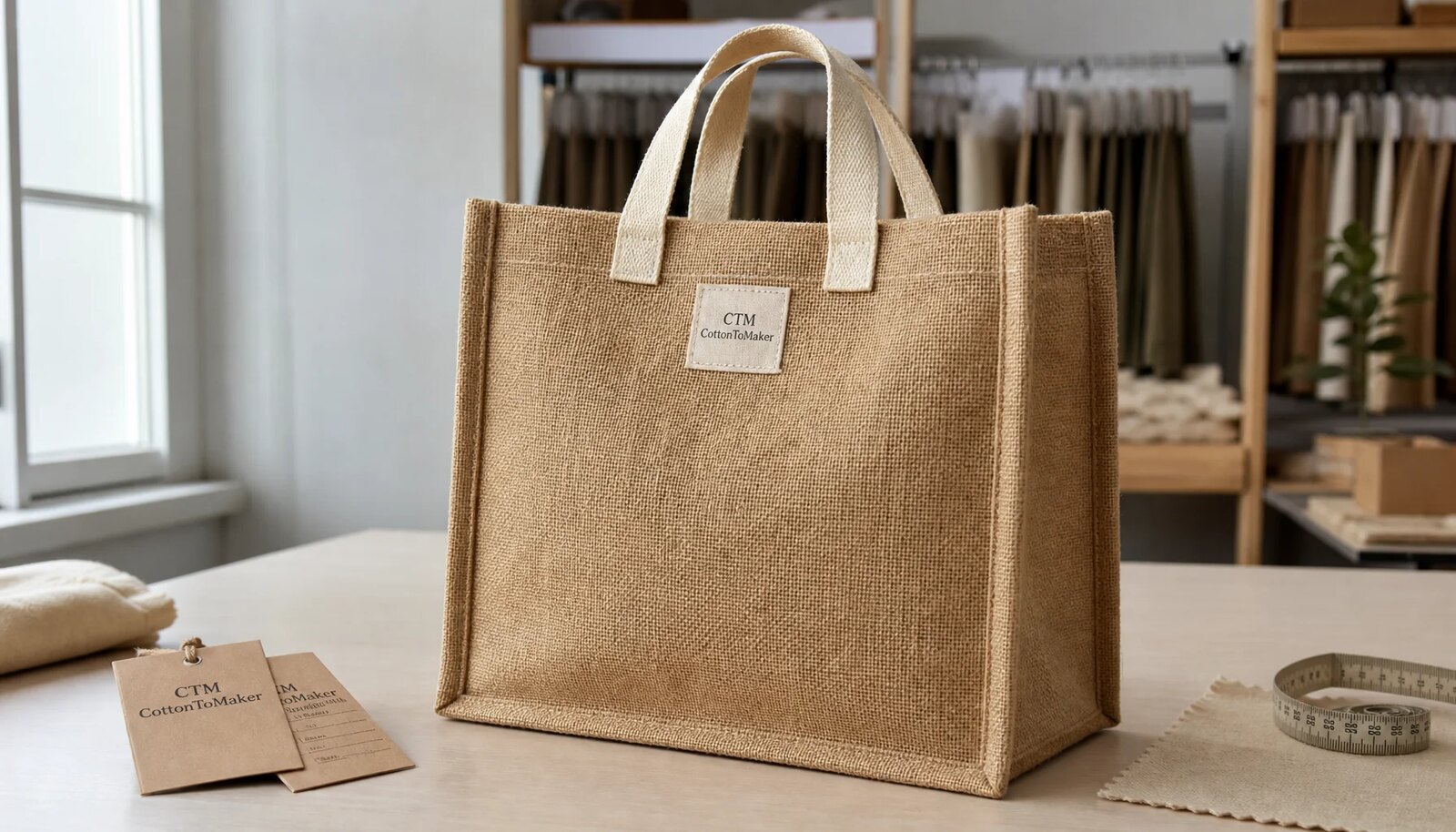
Start With the Event Job, Not a Bag Photo
A custom jute tote should be specified around the job it has to do on event day. Procurement teams are often given a product image, a logo file, a quantity, and a deadline. That is enough to collect prices, but not enough to compare like for like. A registration-desk tote carrying an agenda, pen, and badge insert is a very different product from a hotel-room gift bag holding a bottle, boxed snack, notebook, and sponsor literature. Both can be called natural jute tote bags. The correct GSM, gusset, handle, reinforcement, decoration method, and packing plan may be completely different.
Build the brief from the contents and the workflow. Identify the largest item, thickest item, heaviest item, most fragile item, and the item that controls the bag shape. A catalog may decide the height. A rigid box may decide the bottom gusset. A bottle may require a more stable base and stronger handle anchors. If bags are pre-filled before shipment, stacking pressure and carton compression matter. If they are filled at the venue, carton labels, bundle counts, and unpacking speed may matter more than individual wrapping.
Brand words also need to be translated into production terms. Premium, rustic, natural, reusable, giftable, and sustainable are useful direction, but they are not specifications. For one program, premium may mean 350-400 GSM jute, cotton webbing handles, a clean laminated interior, a sewn woven label, and tighter sorting for stains. For another, it may mean 300-320 GSM natural jute with a bold one-color print. The supplier can quote either version only when the buyer names what must be protected.
- List every item going into the bag, with dimensions and estimated filled weight.
- Define whether bags are handed out empty, pre-filled at a kitting center, packed at the venue, or delivered to hotel rooms.
- State the carry route: registration desk, trade show floor, campus event, outdoor venue, retail activation, or airport transfer.
- Separate visual requirements from functional requirements so suppliers can price both clearly.
- Do not approve size from a photo until real contents have been tested against finished dimensions.
Turn Contents Into Size, Gusset, and Load
Bag size is not just height and width. For event planners, side gusset, bottom gusset, and handle drop often decide whether the tote feels useful or awkward. A flat jute tote may work for brochures. Add boxed gifts, water bottles, folded apparel, or rigid samples, and the same bag can bulge, tip, or strain at the lower corners. A bottom gusset helps the bag sit upright during staging. A side gusset increases capacity, though it can also curve the front panel and change how the logo looks after the bag is filled.
Ask for finished dimensions, not only cut-panel dimensions. Sewing, turning, lamination thickness, seam allowance, and the top hem can reduce usable space. A bag described as 35 x 40 cm may not comfortably accept a 35 cm document if the opening is narrowed by seams. A clear RFQ should name finished height, finished width, side gusset, bottom gusset, and acceptable tolerance. For many sewn bags, plus or minus 0.5-1.0 cm on body dimensions and plus or minus 1.0 cm on handle drop are reasonable points to discuss, but the agreed tolerance should match the specific construction.
Write the expected load into the RFQ in kilograms or pounds. This does not make the tote a certified lifting device, but it tells the factory whether the order is a light handout or a load-bearing welcome kit. A bag carrying 0.8 kg of paper can be built differently from one carrying 3-4 kg of books, bottles, and boxes. Load affects fabric weight, handle width, reinforcement, stitch density, base construction, and inspection focus. The sample should be reviewed while filled, because an empty tote can look square even when the filled bag twists or pulls at the handles.
- Use finished dimensions when comparing supplier drawings, quotations, and samples.
- Match gusset depth to the thickest item and to how contents will be stacked.
- Specify handle drop and width, especially if attendees may carry the bag over the shoulder.
- Give the supplier a target filled weight and ask whether the quoted build is suitable.
- Request a filled-sample check for bottles, books, rigid boxes, dense catalogs, or pre-packed kits.
Choose Jute GSM, Weave, and Lamination Deliberately
Natural jute is not one uniform material. GSM, weave density, lamination, finishing, and sorting all affect appearance, print behavior, durability, odor, packing volume, and cost. For many light event kits, approximately 300-320 GSM jute is a practical starting point. It gives more structure than very light promotional cloth while keeping sewing and freight manageable. For heavier contents, premium sponsor gifts, or bags expected to stand upright, approximately 350-400 GSM is often worth quoting. Heavier fabric can improve shape and perceived value, but it also increases carton CBM, sewing resistance, and sometimes sample confirmation time.
Do not rely on GSM alone. A heavier but loose weave may print worse than a slightly lighter, more consistent weave. Coarse yarns create the natural texture buyers often want, yet they also create uneven ink edges, fiber hairs, and visible slubs. Ask the supplier to describe the weave character and provide a real material swatch or sample photo from current stock. If the front logo panel must look especially clean, the order may need tighter panel sorting, a cotton patch, or a woven label instead of direct print.
Lamination should be stated clearly. Inner lamination can improve shape, reduce fiber shedding, create a cleaner inside surface, and offer limited protection during ordinary storage and handling. It does not make the bag waterproof. Poor lamination can add strong odor, excessive stiffness, shine, bubbling, delamination, or cracking at folds. Unlaminated jute has a softer, more natural hand and may suit simple rustic programs, but it can shed more and look rougher inside. For events where guests repeatedly open the bag or insert loose papers, the interior is part of the experience.
- Use 300-320 GSM as a starting point for light agendas, flyers, pens, and small giveaways.
- Discuss 350-400 GSM for heavier welcome kits, boxed gifts, catalogs, bottles, or premium presentation.
- Ask for weave character, normal shade range, and slub expectations before approving price.
- Specify laminated or unlaminated construction and define odor, stiffness, and inside appearance expectations.
- Treat oil stains, mold, holes, severe discoloration, and hard lumps as defects, not natural variation.
Engineer Handles Before Artwork Is Final
The body fabric gets most of the attention, but handle construction often decides whether an event tote survives real use. Staff lift loaded bags during receiving, kitting, staging, and distribution. Attendees carry them through halls, hotels, transit points, outdoor routes, and sometimes home after the event. A strong-looking jute panel can still fail if the handle ends are narrow, poorly folded, or held by a weak single stitch near the top hem. For procurement buyers, handle material, width, drop, stitch pattern, and reinforcement method deserve written approval.
Cotton webbing handles are common for event jute totes because they feel smoother than jute handles, accept consistent stitching, and can be dyed or matched more predictably. A 25-30 mm width is often practical for comfort and strength on standard event bags, with wider or stronger options considered for heavier kits. Jute self-fabric handles support a fully natural look, but they can feel rougher and need careful sewing. Rope handles create a different presentation, though they require secure attachment points and may not suit flat-packed conference handouts.
Reinforcement should follow the load. Bartacks, box-X stitching, or an approved equivalent help spread stress at the handle anchors. Confirm whether handle ends are folded under, whether stitching is single-row or multi-row, and whether reinforcement will be visible on the front panel. Stitch color matters too. Tonal stitching hides small variations, while contrast stitching makes uneven work more visible. For pre-filled kits, lift the sample repeatedly with actual or equivalent contents. Empty-table approval is too easy to pass.
- Specify handle material, width, drop length, color, stitch color, and reinforcement method.
- Use cotton webbing handles for most event programs where comfort and repeat carrying matter.
- Require bartacks, box-X stitching, or equivalent reinforcement for medium and heavy loads.
- Check whether handle ends are folded and securely captured inside the top hem or stitched to the panel.
- Review the filled sample for pulling, puckering, twisting, and uneven handle placement.
Match Decoration to a Coarse Surface
Decoration is where many jute tote projects become difficult to fix. Jute is coarse, textured, and absorbent compared with cotton canvas, nonwoven fabric, or paper. Screen printing can work well for bold one- or two-color logos, especially at volume, but artwork must be adapted to the surface. Thin strokes, tiny legal text, detailed sponsor grids, QR codes, gradients, and reversed type may break, fill in, blur, or lose contrast on the weave. A clean PDF proof does not prove clean production on jute.
The safest decoration route depends on artwork complexity, quantity, timeline, and brand requirements. Direct screen print is usually right for simple logos with enough open space. A printed cotton patch gives fine detail a smoother surface and can be sewn onto the jute panel, but it adds patch cutting, print registration, sewing alignment, edge finish, and placement tolerances. A woven label can look durable and premium for smaller branding, though small text and color matching still need review. Heat transfer may carry detail, but the finish should be tested on actual jute for cracking, lifting, and whether it looks too plastic for the brand.
Make artwork approval measurable. Include vector artwork, Pantone or brand color references, target imprint size, print position measured from fixed bag features, and minimum legibility requirements. If a QR code must scan, test it on the physical sample after printing and after folding. If sponsor marks must be readable, define the smallest acceptable text height. Natural jute changes the way ink color is perceived, so color expectations should be checked on material, not only on screen. The goal is not to force jute to behave like coated paper. The goal is to pick a decoration method that respects the material.
- Use direct screen print for bold one- or two-color logos with simple shapes.
- Move fine detail, sponsor grids, small text, or QR codes to a patch or label when clarity matters.
- Confirm minimum line width and text height with the supplier before final artwork release.
- Measure logo placement from top edge, side seam, handle line, base, or patch edge.
- Approve decoration on a physical pre-production sample, not from digital mockup alone.
Write an RFQ Suppliers Can Price Accurately
A strong RFQ reduces re-quotes because it removes production guesswork. Instead of asking for a custom jute tote with logo, send a production brief: quantity by version, finished size, gusset, GSM, lamination, handle construction, decoration method, artwork file, print size, packing format, delivery term, destination, and required in-hand date. If there are sponsor versions, regional versions, attendee-tier versions, or different packing plans, separate them clearly. Factories price setup, cutting, printing, label production, sorting, and packing differently when versions multiply.
Ask for cost components as well as the total. At minimum, separate the blank bag, decoration, setup charges, patch or label, special packing, master carton, and logistics assumption. This is not about breaking the quote into pieces just to negotiate each line down. It helps procurement see why one offer is cheaper. A lower unit price may rely on lighter GSM, narrower handles, no lamination, fewer stitches, looser QC, different packing, or a different trade term. Without line-level clarity, the buyer may be comparing different products.
MOQ should reflect production reality. A supplier may have one MOQ for natural stock jute, another for dyed fabric, another for custom handles, and another for printed patches or woven labels. MOQ can change by size, fabric color, handle color, print color count, artwork version, label version, and carton mark requirement. An 800-piece event order split across four sponsor logos is not the same as one 800-piece print run. Sometimes one shared bag body with different sewn labels is more efficient than four large print versions.
- Send one complete spec sheet instead of scattered partial emails.
- Request itemized pricing for bag body, handles, lamination, decoration, setup, packing, carton, and logistics assumptions.
- Ask MOQ by size, fabric color, handle color, print version, patch or label version, and packing version.
- Require suppliers to state what is included, excluded, and assumed in the quote.
- Compare quotes only after GSM, lamination, handles, decoration, packing, and trade term are aligned.
Check Capability, Schedule, and Subcontracting
Supplier type changes the risk profile. A direct factory with fabric sourcing, cutting, sewing, decoration coordination, QC, and packing under one management system may give better visibility for repeat programs and fixed event dates. A trading company or promotional seller can still be useful, especially when communication is strong, but buyers need to know which steps are controlled directly and which are subcontracted. If printing is outsourced, who checks placement before bulk packing? If labels are made elsewhere, who controls color and size? If packing happens after decoration at a third party, who owns final defects?
For event planners, schedule control can matter as much as unit price. The event date usually will not move because a sample was late. Ask for a realistic timeline broken into artwork proofing, sample production, sample transit, buyer approval, material booking, bulk cutting, sewing, decoration, inspection, packing, export processing, and destination delivery. Also ask which steps can run in parallel and which must happen in sequence. A supplier who explains the critical path clearly is easier to manage than one who gives a neat but unsupported ship date.
Capability evidence should be practical. Ask for photos or samples using similar GSM, handle style, lamination, print method, patch method, and packing. Ask whether the factory can keep a gold sample at the production line. Ask who signs final QC and whether inspection happens during production or only after all cartons are packed. Ask how defects are handled if found before shipment. These questions are not meant to create friction. They connect the quote to a production system that can repeat the approved bag.
- Confirm who controls fabric sourcing, cutting, sewing, printing, labels, QC, and packing.
- Ask for examples matching the quoted construction, not unrelated promotional bag photos.
- Require a named contact for samples, production updates, inspection response, and shipment release.
- Treat unclear subcontracting as a risk to manage through samples, photos, and inspection.
- Build the timeline from the required in-hand date backward, including approval and transit buffers.
Approve Samples With Production Discipline
A pre-production sample is the most important control point in a custom jute tote order. It should use the same jute GSM, weave, lamination, handle, stitch method, decoration process, patch or label, and approximate packing approach intended for bulk production. A showroom sample or digital mockup can show direction. It cannot confirm stiffness, odor, handle comfort, seam strength, print edge quality, logo placement on texture, or how the bag behaves when it is filled.
Review the sample methodically. Measure finished height, width, side gusset, bottom gusset, handle width, and handle drop. Fill the bag with representative event contents and lift it repeatedly. Check whether the handles twist, the top edge collapses, the base sits flat, the corners strain, and the logo still looks level when filled. Inspect inside lamination, loose fibers, sharp edges, skipped stitches, unfinished seams, and odor after the bag has been closed in packaging. Look at color and print under normal event lighting as well as bright desk light.
Once approved, the sample should become the gold sample. Label it, date it, photograph it, and reference it in the purchase order or approval record. If the buyer approves the material but changes logo placement, that change needs an updated spec, not a casual email note that gets lost. If the sample fails, feedback should be specific: increase GSM, change handle width, add bartacks, revise gusset, move to patch, adjust ink, enlarge text, or remake the sample. Vague feedback usually creates vague production.
- Approve a physical sample for first orders, revised specs, new artwork, or higher-risk event kits.
- Measure every critical dimension and compare against the written specification.
- Load-test the sample with real or equivalent event contents.
- Document all approved changes before bulk production begins.
- Keep a gold sample with the factory and, when practical, with the buyer or inspection team.
Set QC Rules and Tolerances Early
Quality control works best when the factory knows the rules before production starts. For jute bags, buyers need to separate natural-fiber character from rejectable defects. Slubs, fiber hairs, and slight shade movement are expected. Oil stains, mold, holes, broken yarns on visible panels, severe discoloration, crooked labels, loose handles, open seams, and unreadable logos are defects. The inspection checklist should classify critical, major, and minor issues in plain language. A missing handle reinforcement may be critical on a heavy welcome kit. A small slub away from the logo area may be minor if it matches the approved sample range.
Inspection should cover material, construction, decoration, and packing. Material checks confirm GSM range, weave character, lamination, odor, shade, and surface cleanliness. Construction checks confirm finished size, gusset, handle drop, stitch security, seam alignment, base shape, and loose threads. Decoration checks confirm color, placement, legibility, curing, patch stitching, registration, and QR code function if applicable. Packing checks confirm carton count, version separation, inner bundles, carton marks, PO references, destination marks, and carton condition.
Tolerances protect both buyer and supplier. Jute is a sewn natural-fiber product, so it should not be judged like molded plastic. Still, written tolerances prevent disputes. Buyers can agree practical ranges for finished dimensions, handle drop, logo placement, shade comparison, and acceptable defect levels before production. For example, logo position may be measured from the top edge and side seam, while finished size may allow a defined centimeter variance. Define the remedy as well: sorting, rework, remake, discount, shipment hold, or buyer approval for release.
- Define acceptable natural jute character separately from rejectable defects.
- Inspect fabric, lamination, stitching, handles, decoration, odor, and packing against the gold sample.
- Agree tolerances for finished size, handle drop, logo position, shade range, and carton quantity before production.
- Use in-line or mid-production checks for large, complex, or time-sensitive event orders.
- Confirm carton marks, version separation, and packing list accuracy before goods leave the factory.
Make Packing and Logistics Part of the Spec
Packing is not a small shipping detail. It affects freight cost, carton volume, warehouse receiving, venue setup speed, and the condition of the bags when attendees see them. Jute totes are often nested in bulk to control volume, but pieces per carton should match the people and equipment handling the order. A carton that is efficient for export may be too heavy for one-person venue handling. A carton that mixes sponsor versions, sizes, or destinations can slow setup and create allocation errors.
The right packing method depends on the workflow. If bags ship to a kitting center, fixed-count inner bundles may help staff count and fill quickly. If bags go directly to a convention venue, clear carton marks, manageable weights, appointment delivery details, and carton sequence matter. If goods will be stored before the event, moisture protection and clean cartons become more important. Individual polybags can protect surfaces but add labor and waste. Bulk nesting is faster and uses less packing material, though it may allow rubbing, dust transfer, or compression marks. Choose based on the receiving plan, not habit.
Carton data also affects landed cost. Jute bags can be bulky relative to unit price, so carton dimensions, gross weight, net weight, total carton count, and CBM are essential for freight comparison. A supplier with a slightly higher unit price may still deliver a better total cost if packing is efficient and cartons are easier to handle. State the trade term clearly. EXW, FOB, CIF, DDP, and local delivery are not interchangeable. Event buyers need delivered cost, receiving-window confidence, and packing that supports the team on the ground.
- Specify pieces per inner bundle and master carton instead of leaving carton count open.
- Keep carton weight practical for warehouse and venue teams that may move goods manually.
- Use outer marks with PO number, item name, version, quantity, destination, and carton sequence.
- Request carton dimensions, gross weight, net weight, total cartons, and CBM with every serious quote.
- Align packing with the workflow: bulk handout, pre-event kitting, hotel-room drop, or multi-location delivery.
Specification comparison for buyers
| Spec decision | Recommended option | When it fits | Buyer risk to check |
|---|---|---|---|
| Sourcing route | Direct factory or seller with disclosed control of fabric sourcing, cutting, sewing, decoration, QC, and packing | Repeat event programs, custom sizing, sponsor versions, tight in-hand dates, and buyers who need one accountable production owner | Undisclosed subcontracting can weaken schedule control, print placement accountability, and defect resolution |
| Standard bag body | Approx. 300-320 GSM natural jute, with finished dimensions and tolerance stated | Light conference kits, agendas, flyers, pens, badge inserts, and retail handouts under moderate load | Too-light or loosely woven jute may sag, distort at seams, and print unevenly on coarse yarns |
| Heavier or premium build | Approx. 350-400 GSM jute, reinforced handles, and base support if contents are dense | Welcome kits, catalogs, boxed gifts, bottles, premium sponsor packs, and bags staged upright | Higher GSM increases bulk, sew resistance, carton CBM, freight cost, and sample confirmation time |
| Lamination | Inner lamination specified by presence, finish, approximate thickness expectation, odor limit, and fold performance | Programs needing better shape, cleaner inside surface, reduced fiber shedding, or short-term storage protection | Unspecified lamination may be too stiff, shiny, odorous, poorly bonded, or cracked at folds |
| Handle construction | 25-30 mm cotton webbing handles with bartacks or box-X reinforcement for most event loads | Long carry routes, hotel drops, campus events, trade shows, and reusable attendee bags | Weak handle anchors usually fail before the jute body; unclear handle drop can make the bag uncomfortable |
| Base and gusset | Defined side and bottom gusset, with base reinforcement when contents are rigid or heavy | Books, bottles, folded apparel, food packs, stacked samples, and pre-filled kits | A shallow gusset or soft base may tip during staging and strain lower seams |
| Direct print | 1-2 color screen print with artwork adjusted for jute texture and minimum line size confirmed | Bold logos, simple sponsor marks, matte natural branding, and larger runs | Fine lines, small reversed type, QR codes, gradients, and dense coverage may fill in, break, or scan poorly |
| Patch or label decoration | Printed cotton patch, sewn woven label, or simplified artwork version approved by the brand owner | Detailed logos, sponsor grids, small text, premium programs, and artwork needing cleaner edges | Patch size, stitch margin, label color, placement tolerance, and edge finish must be approved before bulk |
| Packing method | Nested bulk pack or inner-bundled pack with carton quantity, carton weight, marks, and version separation defined | Direct-to-venue delivery, warehouse kitting, multi-location distribution, and fast registration setup | Overweight cartons, mixed versions, unclear labels, or high compression can slow receiving and damage presentation |
Buyer checklist before sampling
- Define the event use case: conference welcome kit, sponsor gift, retail activation, trade show handout, hotel-room drop, VIP pack, or multi-location program.
- List every item going into the tote with length, width, depth, approximate weight, fragility, and whether it is inserted before shipment or at the venue.
- Confirm finished bag height, width, side gusset, bottom gusset, and handle drop against the largest and thickest contents, not against a generic tote size.
- State the expected filled load in kilograms or pounds and ask the supplier to confirm whether the quoted GSM, handle, seam, and base construction are suitable.
- Specify jute GSM range, weave expectation, lamination status, inside finish, shade range, odor expectation, and whether the bag should stand upright when empty or filled.
- Choose handle material, width, drop length, color, stitch color, folded-end treatment, and reinforcement method before requesting final pricing.
- Define decoration method, artwork size, print position, ink references, label or patch dimensions, file format, and minimum acceptable line width or text height.
- Ask whether QR codes, sponsor logos, fine legal text, gradients, or small reversed type require a patch, woven label, or simplified artwork version.
- Request MOQ by size, fabric color, handle color, print color count, decoration version, patch or label version, and packing version.
- Name the sample approval owner, sample due date, approval criteria, gold sample process, and whether a revised sample is required after any spec change.
Factory quote questions to send
- What exact GSM range, weave character, lamination status, and inside finish are included in this quote?
- Is the quoted jute from current stock, or must it be woven, dyed, laminated, printed, or specially purchased for this order?
- What finished size tolerance do you hold for height, width, side gusset, bottom gusset, and handle drop on bulk production?
- What handle material, width, drop length, stitch pattern, folded-end treatment, and reinforcement method are included in the unit price?
- What target load do you recommend for this quoted construction, and do you suggest reinforcement if the filled kit reaches that weight?
- Is printing, patch production, woven label production, cutting, sewing, QC, and packing done in-house? If not, which steps are subcontracted?
- What is the MOQ per size, fabric color, handle color, print version, patch or label version, and packing version?
- What setup charges apply for screens, plates, woven labels, cutting dies, artwork adjustment, sample making, or revised samples?
- Can you quote blank bag, handle upgrade, lamination, print, patch or label, individual packing, master carton, export packing, and logistics assumptions as separate lines?
- What artwork file format do you require, and what minimum line width, text height, and QR code size do you recommend on this jute surface?
Quality-control points to confirm
- Fabric weight is checked against the agreed GSM range using a defined sampling method, and the weave matches the approved sample closely enough for presentation use.
- Outer panels are free from major oil stains, glue marks, holes, torn yarns, mold, heavy discoloration, hard lumps, and defects that affect the visible logo area.
- Natural slubs, fiber hairs, and shade movement remain within the approved gold sample range instead of becoming uncontrolled lot variation.
- Lamination, if specified, is even, bonded, and free from strong odor, bubbling, delamination, cracking at folds, sharp inner edges, or excessive shine if a matte look was approved.
- Finished height, width, side gusset, bottom gusset, and handle drop are measured against written tolerances, commonly agreed before production rather than negotiated after inspection.
- Handle anchors are symmetrical, firmly stitched, reinforced with bartacks, box-X stitching, or the approved equivalent, and free from skipped stitches or loose ends.
- Base corners, side seams, top hem, and inside seams are secure, especially on bags intended for boxed gifts, bottles, books, catalogs, or pre-filled kits.
- Logo placement matches the approved reference, including distance from top edge, side seam, base line, handle line, or patch edge as applicable.
- Print is legible, cured, and not blurred, tacky, cracked, peeling, heavily clogged, misregistered, or visibly shifted beyond the approved placement tolerance.
- Patch or woven label, if used, is straight, securely stitched, correctly colored, centered to the approved reference, and free from frayed edges unless intentionally specified.