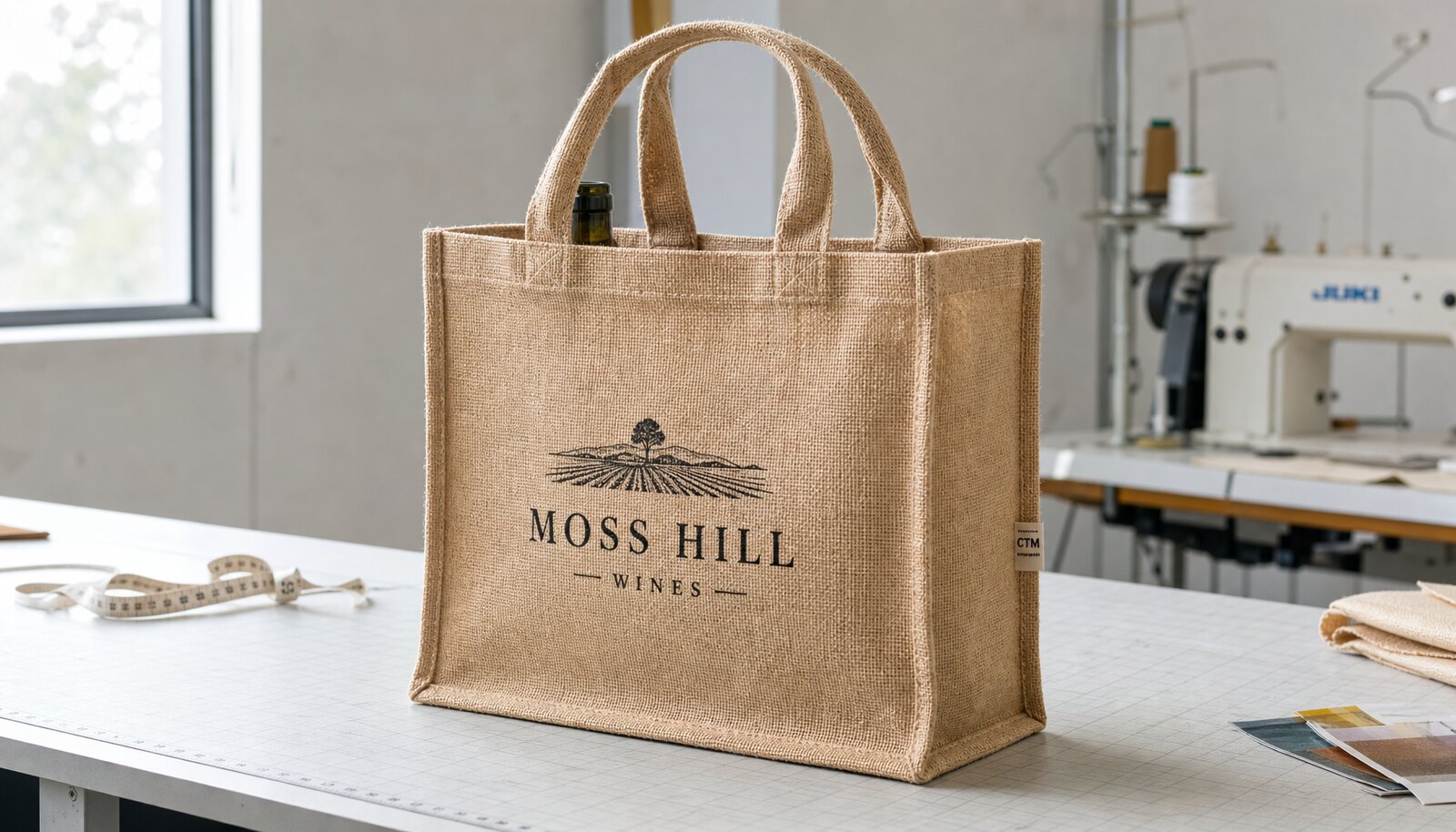
Start with the wine program, not the bag
For boutique wineries, the right jute tote is determined by how it will be used in the commercial program, not by the fabric name alone. A tasting-room retail bag that carries one bottle home has different requirements from a holiday gift bag for two bottles or a branded carrier meant for repeated use by customers. Buyers often approve a visually appealing sample first, then discover the opening is too narrow for a Burgundy bottle, the handle is too short for a comfortable grip, or the bag body collapses once the bottle is inside. Those failures are not design defects in the abstract; they are mismatches between use case and material selection.
A useful RFQ starts with bottle count, bottle dimensions, filled weight, carry distance, and whether the bag is for one-time gifting or repeat retail use. A winery bag should be specified like a packaging component, not like a generic souvenir tote. That means the procurement team should define the actual bottle family, the presentation standard, and the handling expectation before discussing print or embellishment. Once those use conditions are clear, the material choice becomes a series of practical tradeoffs rather than an aesthetic guess.
There is also a brand-positioning angle. Rustic natural jute can support an earthy, heritage look, but the same texture can work against a luxury label if the interior is rough, the stitching is uneven, or the bag sheds too much fiber. For a tasting-room program, the bag is often a final touchpoint that customers carry into their car, home, or social media feed. If the bag feels unstable or unfinished, it subtly lowers the perceived value of the wine itself. The right material spec protects both logistics and brand equity.
- Single-bottle carry: prioritize handle strength, bottle neck clearance, and a stable base.
- Two-bottle gift set: prioritize width, gusset depth, and separation or reinforcement logic.
- Retail resale: prioritize shape retention, neat edges, and repeatable branding.
- Seasonal giveaway: prioritize MOQ flexibility, simple print layout, and fast replenishment.
- Premium gifting: prioritize cleaner interior finish, better lining, and a more polished label or print method.
Choose jute weight and construction for the load
Jute is not a single build standard, and procurement buyers should avoid treating all jute totes as interchangeable. The practical choice is a combination of fabric weight, weave tightness, yarn quality, and whether the bag is left natural or backed with a lining or lamination. Lighter constructions in the 280 to 320 gsm range can work for lower-cost promotional use, but they should be treated as light-duty carriers rather than premium retail bags. A tote in that range can be perfectly acceptable for a single bottle if the handle and base are reinforced, but it should not be assumed to behave like a heavier, structured gift bag.
Once the construction moves into the 350 to 450 gsm range, the tote usually gains enough body for better shelf presentation and more confidence around bottle weight. That extra density helps the bag hold its shape, reduces visible sagging, and makes the printed surface feel more substantial. However, heavier fabric also increases sewing load, carton bulk, and unit cost. If the factory is not used to thicker jute, stitch quality can drop at the handle anchor points or at the corners where the fabric layers stack up. In other words, more weight is not automatically better if the factory’s workmanship is not adapted to it.
A lining can change the way the bag performs as much as the outer jute itself. Cotton lining generally offers a cleaner touch and better bottle protection, while nonwoven lining can help with cost and shape retention. Laminated jute can support a more structured retail presentation and is often chosen when the buyer wants the bag to stand upright, but it also introduces stiffness and possible odor or delamination concerns. The right specification depends on whether the buyer values softness, shape, or presentation more than the lowest possible cost.
For boutique wineries, the selection should be tied to the customer moment. If the bag will be handed over at a tasting counter and carried directly to the car, a moderate unlined or lightly lined tote may be enough. If the bag will stay on a retail shelf, be photographed, or be reused as a gift bag, the extra cost of lining or lamination may be worthwhile. Buyers should resist overspecifying a heavy build just because it feels premium in hand; sometimes a moderate fabric weight with excellent stitching gives a better total result than a thick body with weak finishing.
- 280 to 320 gsm: light-duty, promotional, or budget-conscious single-bottle use.
- 350 to 450 gsm: better for retail resale, gifting, and repeat handling.
- 500 gsm and above: reserve for premium presentation or heavy-load programs where stiffness is acceptable.
- Unlined: lowest cost, but rougher interior and more variability.
- Lined or laminated: better presentation and bottle protection, but higher cost and tighter process control required.
Set dimensions, gusset depth, and handle build before pricing the print
The most common failure in winery tote sourcing is not the logo; it is the geometry. A good-looking sample can still perform badly if the opening is too tight, the gusset is shallow, or the handle placement makes the bag feel awkward when full. Standard sizing should be driven by the actual bottle family you plan to use, including taller Bordeaux bottles and wider Burgundy-style bottles if your assortment includes both. Buyers should measure bottle height, shoulder width, and neck clearance, then translate those dimensions into usable internal space rather than simply copying a catalog size.
Handle design deserves the same attention as the body. For bottle bags, handles should be long enough for comfortable hand carry, but not so long that the bag swings awkwardly or causes the bottle to tilt. The handle width matters too, because narrow handles can dig into the hand when the bag is loaded. Reinforced handles with sewn-through anchors are usually more reliable than decorative-only attachment. For heavier retail programs, box-X or bar-tack reinforcement at the stress points is worth specifying. If the bag is meant for premium presentation, a bottom board can help the bag sit squarely; if the bag is purely functional, the budget may be better spent on stitch quality and a stronger base panel.
Gusset depth is especially important for wine bags because glass bottles are tall and relatively rigid. A shallow gusset may look fine on a sample table but create friction once the bottle is inserted, especially if the bag has a lining. A practical spec should state the minimum internal width, the finished gusset depth, and whether the bag is expected to stand upright. This avoids the all-too-common problem where the supplier meets the outer measurement while the actual usable cavity is too tight for the bottle profile. In procurement terms, geometry is not an afterthought; it is the core of the product spec.
- Confirm bottle clearance at the opening, not only the outside bag width.
- Match gusset depth to the actual bottle body and base dimensions.
- Specify whether the bag must stand upright when loaded.
- Use reinforced handle anchors for any bag intended for repeated carry or retail resale.
- Add a bottom board only when shelf presentation or premium gifting justifies the extra cost.
Choose a branding method that works on coarse jute
Jute is a rough and visually irregular substrate, so print and decoration methods must be matched to the surface rather than to the artwork alone. Screen printing remains the most common choice for bold logos and simple graphics because it is cost-effective, durable, and generally visible on coarse fiber. It is less suitable for fine lines, small typography, gradients, or logos that rely on crisp micro-detail. On a winery tote, a simple but well-spaced mark usually performs better than a crowded design that loses readability when the ink lands across uneven fibers.
Woven labels and stitched labels are often the most premium-looking options when the brand wants a refined finish without relying on direct print coverage. They work well for smaller logos, side placement, or tasteful branding that complements the rustic material instead of fighting it. They also help when the buyer wants a more repeatable look across multiple fabric lots, since the label remains visually consistent even if the jute surface varies slightly. Heat transfer can be useful for more detailed artwork, but it should be treated cautiously on rough jute because adhesion, edge lift, and gloss mismatch can become visible fast, especially after handling or storage.
For boutique wineries, the safest route is usually a one- or two-color logo with clear breathing room around it. If the design must include fine text, the buyer should ask the supplier to prove the result on the actual jute construction, not on a smoother substitute. A good procurement practice is to ask for a print strike-off or decorated sample and inspect it under daylight and indoor light. What looks acceptable on a screen or in a proof image may become muddy once printed on coarse weave. Buyers should treat artwork simplification as a quality decision, not a compromise.
A final consideration is brand tone. A winery that sells premium reserve bottles may prefer a smaller woven label or discreet stitched mark, while a tasting-room program for everyday wines may benefit from a stronger front-panel print. The correct method depends on the role of the bag in the sales experience. If the tote is expected to be reused often, the decoration should age gracefully rather than flake, crack, or look dated after a few carries.
- Screen print: best for simple logos, controlled cost, and medium-volume programs.
- Woven or stitched label: best for premium presentation and small logo detail.
- Heat transfer: only use when the supplier proves adhesion and edge stability on the actual jute.
- Avoid tiny text, thin linework, and complex gradients unless the supplier has already demonstrated success on the same material.
Compare sourcing routes, MOQ logic, and supplier control
A useful quote is only as good as the manufacturing chain behind it. Direct factory sourcing gives the strongest control over weave, cutting, stitching, and print placement, which matters when a winery wants repeatable bags across several seasonal orders. Trading companies can be useful if the buyer needs to bundle multiple packaging categories into one purchase, but the procurement team must still identify where the actual production happens. Domestic decorators are worth considering when speed is the priority, especially for event programs or short replenishment runs. Regional converters can also be practical when freight time matters more than a marginal unit-cost advantage.
MOQ is driven by setup loss, fabric lot planning, screen preparation, and whether the supplier needs to buy or reserve special materials. When buyers ask for low MOQs, the per-unit cost usually rises because the supplier has to absorb the same setup across fewer pieces. The commercial trick is to keep the base bag construction consistent and vary only the decoration or label where possible. That lets the winery refresh artwork seasonally without re-developing the entire bag every time. If the supplier insists on a different minimum for each color or size, ask whether the material lot or print setup is the real constraint.
Buyers should also watch for hidden control issues. If the quote comes from a trading company but the factory is separate, approvals can be slower, revisions can be diluted, and sample fidelity can drift. If the quote comes from a domestic decorator using imported blanks, the buyer may gain speed but lose visibility into weave consistency. None of these routes is inherently wrong; the key is matching the route to the business objective. For boutique wineries, the most practical supplier is often the one that can hold the same material and print quality through repeated seasonal replenishment without re-litigating the whole spec every time.
- Direct factory: best for control and repeatable quality.
- Trading company: useful for bundled sourcing, but confirm factory identity and process ownership.
- Domestic decorator: useful for fast starts and short runs.
- Regional converter: useful when freight time is more important than the absolute lowest unit price.
- Lower MOQ usually means fewer construction choices and a higher per-unit setup burden.
Build the RFQ so quotes are truly comparable
A good RFQ for custom jute tote bags should read like a production instruction sheet, not a marketing brief. It should include exact bag dimensions, target bottle count, fabric weight, lining or lamination choice, handle length, handle width, logo placement, and number of print colors. Add the intended carry load, carton count, packaging preference, and whether polybags, paper wrap, or breathable inner packing are acceptable. If the bag is for a winery gift set, specify whether the product must accommodate tissue, a brochure, or a second bottle. Without this information, suppliers will quote different assumptions and the buyer will spend time comparing items that are not actually the same.
The quote should also be structured to reveal the cost drivers. Ask for the unit price at the target MOQ and the next volume break so you can see whether setup is being amortized efficiently. If the supplier can separate material cost, print setup, packaging, sample charge, and carton cost, procurement can identify where the margin sits and where a future redesign might save money. That level of transparency is especially useful for wineries that expect recurring orders around holiday seasons or harvest promotions. It helps the buyer decide whether to invest in a more durable base spec now or to keep the first order lighter for testing.
Commercial terms matter just as much as the physical spec. A quote that appears attractive on ex-works terms may become less competitive once freight, duty, inland trucking, and destination handling are added. Buyers should compare all quotes on the same Incoterm and the same quantity tier. If the supplier is vague about what is included, ask for explicit exclusions. The goal is not to create a difficult supplier relationship; it is to ensure the winery buys the same item from every bidder so the price comparison is meaningful.
- Specify size, GSM, lining, handle build, print method, and artwork count.
- State the bottle use case and the expected load so suppliers do not guess.
- Request separate pricing for sample, setup, bulk unit price, and packing.
- Compare all offers on the same Incoterm and quantity tier.
- Ask whether carton spec, barcode labels, and master marks are included or extra.
Treat sample approval as a production gate, not a formality
The sample is where the supplier proves control over the rough jute surface, the stitch sequence, and the print process. A good sample should demonstrate the same fabric tone, handle finish, seam alignment, and print sharpness you expect in bulk. Buyers should evaluate it under the same lighting that will be used for approval and with the intended bottle inserted, not just when the bag is empty. An empty tote can hide geometry problems. Once a bottle is inside, the opening may flare, the base may twist, or the handle may pull the top edge out of alignment. Those issues are practical, not cosmetic.
A pre-production sample or signed golden sample should be locked after artwork, dimensions, and construction are finalized. That sample should be retained by the buyer and referenced during bulk inspection. If the supplier changes fabric lot, lining, handle tape, thread type, or print process, the approval should be reopened. That is not over-management; it is basic control. Jute varies naturally, and the production team may also introduce small process substitutions if they are trying to keep the order moving. The signed sample is what keeps the order anchored to the agreed standard.
Procurement teams should also ask for proof of similar output. Not a fake case study, but actual production photos or a short video of a comparable tote with the same or similar build. The purpose is to see whether the factory can stitch the handle anchors cleanly, whether the print sits well on the weave, and whether the interior finish is consistent. A supplier who only shows polished catalog shots may still produce acceptable bags, but a supplier who can show close-ups of the actual build usually gives the buyer more confidence. Sample approval is the place to separate sales promises from manufacturing reality.
- Check fit with the intended bottle, not only the empty bag.
- Inspect seam alignment, stitch density, and handle reinforcement.
- Review print opacity and edge sharpness in daylight.
- Keep one signed golden sample and reference it in bulk QC.
- Reopen approval if fabric lot, lining, handle tape, or print method changes.
Define QC checkpoints, test thresholds, and documentation before bulk release
A buyer-focused jute tote QC plan should do more than say “check quality.” It should tell the factory what to measure, what to document, and what failures are not acceptable. At minimum, the buyer should ask for fabric weight confirmation, finished dimension checks, stitch inspection, print inspection, carton verification, and a photo record of the finished goods before shipment. The point is to catch problems while they are still cheap to correct. If your winery program will be used at retail, the QC standard should reflect shelf presentation as well as physical durability.
For load-bearing bags, handle attachment deserves special scrutiny. A practical buyer test is to load the bag with the intended bottle weight or a verified equivalent and check whether the handle anchors deform, stitches open, or the top edge stretches excessively. The exact threshold can be written into the spec as a target load test rather than a vague “strong enough” instruction. Likewise, dimension checks should be based on the golden sample with a realistic tolerance range agreed in advance. A bag can be technically “within spec” and still look wrong if the opening, gusset, or handle spacing drifts too far from the approved sample.
Documentation should be part of the order, not an afterthought. Ask for fabric lot traceability where possible, print proof approval records, carton counts, SKU labels, and a final inspection report before shipment release. If the winery buys through a trading company or a multi-step supply chain, the buyer should also request confirmation of who performed each step. That matters when a defect appears after delivery and the root cause has to be assigned quickly. Suppliers do not always volunteer this level of detail, but serious procurement programs should require it.
There are also practical rejection criteria that matter for consumer-facing wine packaging. Bags with damp odor, mold risk, contamination, visible glue spots, loose fiber shedding beyond normal jute behavior, or poor edge finishing should be rejected or reworked before shipment. If the bag is intended for retail resale, inspect a few units after simulated unpacking and restacking to see whether they hold shape or become visibly creased. That small extra step often reveals whether the build is genuinely ready for a shelf or just acceptable in a photo.
- Check fabric weight, dimensions, stitch quality, print quality, and carton marks before shipment.
- Use a realistic load test based on the intended bottle weight.
- Require box-X, bar tack, or equivalent reinforcement at key stress points.
- Request pre-shipment photos and a final inspection report.
- Reject damp, mold-risk, contaminated, or badly finished units before dispatch.
Plan packing, storage, and inbound handling around jute’s weaknesses
Packing matters more for jute than many first-time buyers expect. The material can absorb moisture and odor if it is stored poorly, and a heavy plastic seal can trap moisture and create a musty smell during transit. On the other hand, an overly open pack can let dust and dirt settle into the weave. The best approach is to specify an inner pack that protects the bags while still allowing them to breathe enough to stay fresh. Buyers should also decide whether the bags will be folded, stacked flat, or nested, because that choice affects crease marks and presentation on arrival.
Carton marking is another practical control point. Every master carton should show the PO, item code, size, color, pack count, and any barcode or retail identifiers the warehouse needs. This is especially important when multiple winery SKUs are being shipped together, or when the bag will be stored before seasonal release. Clear marks reduce receiving time and prevent miscounts. If cartons are going to be palletized, confirm carton strength and stacking limits first so the bottom cartons do not crush during transit.
Inbound handling should also be considered in the quote review. A low-cost bag that arrives with dirty faces, bent handles, or moisture odor can become expensive once the receiving team sorts, repacks, or rejects part of the lot. Boutique wineries often have limited backroom space, so a bag that is easy to receive and store can save real labor. Good procurement is not only about the unit price. It is about receiving a product that is ready to move into saleable inventory without extra touch labor or avoidable damage risk.
- Use breathable but protective inner packing where possible.
- Avoid moisture-trapping packs that can create odor issues.
- Mark cartons clearly by SKU, size, color, and pack count.
- Confirm carton strength and stacking limits before palletizing.
- Ask for a packing sample photo before bulk shipment if the program is shelf-facing.
Read lead time and landed cost as a risk map, not just a number
Lead time for custom jute totes is driven by material availability, print setup, sample approval speed, and the factory’s current capacity. If the supplier already has suitable jute in stock and the logo is simple, the order can move relatively quickly. If the bag needs a custom width, a lining change, a new handle build, or a multi-color print that requires several proof rounds, the schedule expands quickly. Boutique wineries should plan backward from launch date, not from purchase order date. Seasonal demand around harvest, holiday gifting, and tasting-room events can compress timelines more than expected.
Landed cost needs the same discipline. A low ex-works quote can become less attractive once freight, duty, inland trucking, destination handling, and receiving labor are added. A more expensive unit price may still win if the supplier has better consistency, lower defect risk, or shorter replenishment time. That matters in winery programs because under-delivery during peak season can cost more than the difference between two quotes. The cheapest bag is not always the best bag if it arrives late or requires heavy inspection and repacking.
A practical buyer approach is to compare three scenarios: the lowest unit price, the best-balanced quality/value option, and the fastest replenishment option. That comparison often clarifies whether the company should commit to a heavier bag body, a simpler print method, or a more local sourcing route. The point is to choose the material and supplier combination that matches the winery’s commercial calendar and customer expectation, not the one that simply produces the lowest quote line.
- Work backward from retail launch date or event date.
- Build time for sample sign-off, print proofing, and possible rework.
- Compare ex-works, FOB, and DDP pricing on the same basis.
- Include freight, duty, inland move, receiving labor, and rework risk in the decision.
- Balance cost against repeatability and seasonal supply reliability.
Specification comparison for buyers
| Spec decision | Recommended option | When it fits | Buyer risk to check |
|---|---|---|---|
| Sourcing route: direct jute factory with in-house printing | Use when you need control over weave, size, handle build, and repeatability | Best for ongoing winery programs, private label retail, and seasonal replenishment | Confirm the factory owns or tightly controls weaving, cutting, stitching, and printing rather than subcontracting each step |
| Sourcing route: trading company bundling multiple bag types | Use when you want one PO to cover tote bags, wine bags, and gift pouches | Best for buyers consolidating packaging SKUs or testing a new supplier relationship | Ask for factory identity, process photos, and a clear map of which steps are in-house |
| Sourcing route: domestic decorator using imported blanks | Use when you need a faster start and lower development risk | Best for short runs, event programs, and urgent retail replenishment | Blank quality may vary by lot and the landed cost is usually higher than factory direct |
| Sourcing route: regional converter near your warehouse or port | Use when freight time matters more than the absolute lowest unit cost | Best for replenishment programs where inventory holding is expensive | Check whether raw jute is imported, who owns the inventory, and whether carton packing is included |
| Fabric weight: 280 to 320 gsm | Choose a lighter jute body with basic reinforcement | Fits entry-level tasting-room giveaways or short-carry promotional use | The bag may sag with heavier glass unless the base and handles are reinforced |
| Fabric weight: 350 to 450 gsm | Choose a denser body with better shape retention | Fits retail resale, gift packaging, and regular winery merchandising | Higher weight improves structure but also increases cost, stitching load, and carton bulk |
| Fabric weight: 500 gsm or above | Choose only when the bag is intended to feel premium and remain upright | Fits premium gift sets, reuse-oriented retail programs, or heavy bottles | Watch for stiffness, larger freight volume, and higher sewing failure risk if the factory is inexperienced |
| Structure: unlined natural jute | Choose when you want low cost and a rustic finish | Fits lower price points and simple branding | Raw fibers can shed, interior finish is rougher, and bottle abrasion risk is higher |
| Structure: cotton-lined or nonwoven-lined jute | Choose when presentation, cleanliness, and bottle protection matter | Fits retail resale, gift sets, and premium tasting-room programs | Confirm lining color, attachment method, and whether the lining affects opening width |
Buyer checklist before sampling
- Define the use case first: single bottle, two-bottle carry, gift set, event giveaway, or retail resale.
- Document the bottle profile, including height, diameter, and whether the range includes Bordeaux, Burgundy, or sparkling bottles.
- Select the fabric weight, structure, and lining before requesting artwork quotes.
- Specify handle width, handle length, and the intended load per bag in kilograms.
- State whether the bag must stand upright on shelf or only carry safely to the car.
- Provide final artwork in vector format and define the number of print colors, finish, and placement.
- Request close-up photos of weave, stitching, handle anchoring, and edge finishing from a real production lot.
- Ask for a pre-production sample and keep one signed golden sample for bulk comparison.
- Confirm pack count, carton dimensions, barcode needs, and pallet requirements in the RFQ.
- Compare all quotes on the same Incoterm so freight, duty, and inland charges do not hide the real price.
Factory quote questions to send
- What exact jute construction will you use, including GSM, weave style, and whether the bag is lined, laminated, or unlined?
- What is the intended bottle load and carry test for this bag, and how did you calculate it?
- Is printing done in-house, and which method will you use for this artwork on coarse jute?
- What is the MOQ by size, color, and print version, and what happens if we split the order across variants?
- Can you share photos or video of a previous similar tote with the same or close construction and handle build?
- What are the exact bag dimensions, gusset depth, handle length, and reinforcement points?
- What thread type, stitch density, and reinforcement pattern will you use at the handle anchors and base?
- What packing method, carton quantity, and master carton size do you propose, and can you confirm carton drop strength?
- What is your standard lead time after sample approval, and what part of that time is material sourcing versus production?
- Which Incoterm is quoted, and which charges are excluded from the price?
Quality-control points to confirm
- Verify fabric GSM against the signed sample and agreed spec, not only the supplier sheet.
- Measure finished bag dimensions against the agreed tolerance; a practical buyer target is usually within plus or minus 5 mm on samples and plus or minus 10 mm in bulk unless your program needs tighter control.
- Check bottle fit with the intended bottle type, including neck clearance and side clearance, before approving bulk.
- Inspect handle attachment with a load test using the intended bottle weight or an equivalent verified test weight.
- Ask for stitch reinforcement at stress points such as box-X, bar tack, or equivalent reinforced construction.
- Check for skipped stitches, loose thread tails, frayed edges, and uneven seam allowance.
- Inspect print opacity, registration, edge sharpness, and color consistency in daylight and under warehouse lighting.
- Review odor, dampness, mold risk, and contamination risk before shipment release, especially after humid transit.
- Confirm lining attachment, if used, does not reduce opening width or create puckering at the seam.
- Verify carton counts, barcode labels, outer marks, and SKU identification against the PO before shipment release.