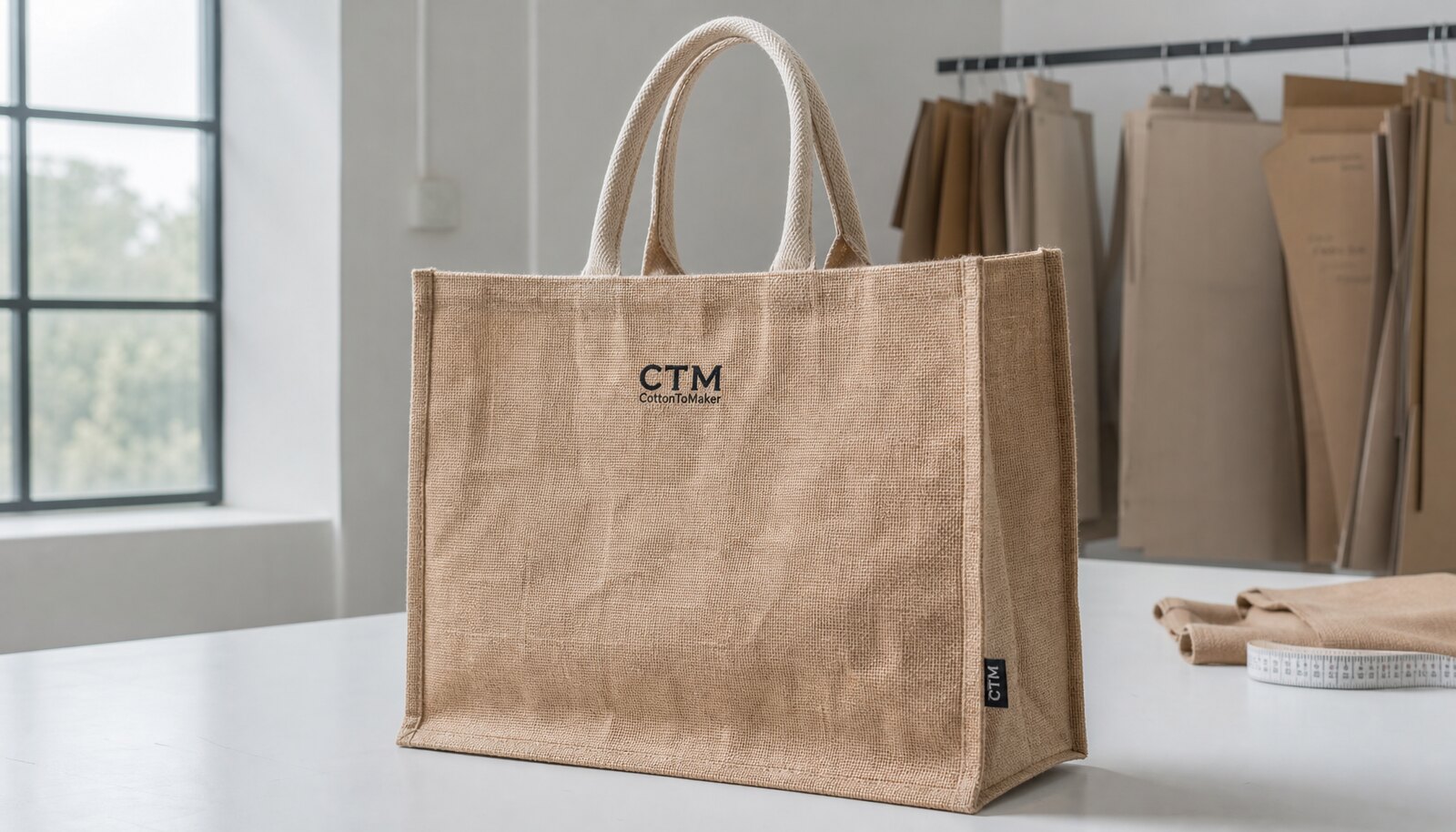
Begin with the logo moment
A corporate gift tote is seen in motion, on tables, in photos, in offices, and sometimes in unboxing or kitting workflows. Logo placement needs to work in those real moments, not only on a flat proof. A mark that looks centered on a PDF can sit too low once boxed snacks, notebooks, bottles, apparel, or documents push the bottom of the jute tote outward.
For many programs, front upper-center placement is the safest starting point. It keeps the logo visible when the recipient carries the tote by the handles, when bags sit on chairs, and when event staff stack them on registration tables. Lower-corner branding can look refined, but it is easier to hide behind table edges, gift contents, and bottom creases. Side gusset branding is useful as a secondary cue, not as the only logo position when sponsor or employer visibility matters.
Jute adds production reality to the design choice. The surface is coarse, naturally varied, and less even than cotton canvas or polyester. Small type can break across yarns, pale ink can lose contrast, and fine edges can soften. That does not make jute a weak branding surface. It means the logo zone, artwork, and inspection method should be controlled before bulk production.
- Decide where the logo must read: shoulder carry, event table, kit packing, recipient photo, or daily reuse.
- Check the placement on a physical sample while flat, lightly filled, hanging by the handles, and folded for packing.
- Use front upper-center as the default primary placement unless the brand brief has a clear reason to do otherwise.
- Keep secondary placements such as gusset, back print, label, or hangtag in their proper role.
Lock the tote specification first
Logo placement is only meaningful after the bag construction is settled. A 35 x 40 cm flat tote, a 35 x 40 x 12 cm gusseted tote, and a 38 x 42 x 15 cm shopping tote do not have the same visible logo area. Gusset depth, handle stitching, pocket construction, lining, lamination, and top-edge finish all affect where a mark can sit cleanly.
For many premium corporate gift bags, buyers often start by reviewing jute around 260-300 GSM because it can provide useful body and a more substantial hand feel than very light material. That range is only a practical starting point, not a universal rule. Lighter jute may be acceptable for budget handouts with light contents. Heavier jute may improve structure but can add carton volume, stiffness, sewing strain, and freight cost.
Construction choices also change the print zone. Unlined jute gives a simple natural look. Laminated jute can add stiffness and some moisture resistance, while changing odor profile, fold behavior, surface feel, and recycling claims. Cotton lining creates a cleaner interior for higher-value kits, but adds sewing steps and can affect how the front panel lies during decoration. A pocket creates a smaller brand area with its own stitch boundaries.
- Confirm finished width, height, gusset, GSM, fabric shade, lining or lamination, pocket details, handle drop, and reinforcement.
- Use finished dimensions in quotes and inspection because those are the measurements delivered to the buyer.
- State the expected contents, such as documents, bottles, books, food gifts, apparel, or electronics accessories.
- Ask the supplier for the usable logo area on the chosen construction, not only the catalog bag size.
Define the logo zone in millimeters
A useful logo placement guide has measurements. The drawing should show logo width, logo height, finished bag size, and distance from fixed reference points. Common references include the top finished edge, side seam, visible front panel edge, pocket edge, gusset fold, handle stitch line, and bottom fold. If the tote has a pocket, specify whether the mark is centered on the pocket or centered on the full bag face.
As a common starting point, many front-panel jute tote designs keep artwork at least 25 mm to 40 mm away from seams, gusset folds, handle stitching, pocket stitching, and bottom creases. Larger bags, heavy ink coverage, looser weave, or multi-color artwork may need more space. Printing closer to a seam may be possible, but it should be proven by sample because stitched areas often do not lie perfectly flat under a screen or transfer.
Placement tolerance also belongs in the specification. For a straightforward front-center screen print on a stable tote, buyers often discuss plus or minus 5 mm to 8 mm from the approved drawing. Pocket prints, gusset prints, laminated bags that resist flattening, and prints near seams may require a wider tolerance. The supplier should confirm what it can hold consistently, and that number should appear in the PO and inspection checklist.
- Show X and Y measurements from agreed reference points.
- Define whether the logo is centered on the visible panel, flat panel, pocket face, or total bag width.
- Keep a practical safe zone around seams, handle stitching, pockets, gusset folds, and bottom folds.
- Use one agreed tolerance for sample approval, bulk production, and receiving inspection.
Prepare artwork for jute texture
Many logo problems begin with artwork designed for smooth paper, web, or coated packaging. Jute is friendlier to bold icons, open wordmarks, simple spot colors, and strong negative space. It is less forgiving with tiny legal copy, hairline outlines, thin serif strokes, tight multi-color registration, gradients, photographs, and subtle tonal shifts.
Procurement should request production-ready vector artwork, such as AI, EPS, or editable PDF, with fonts outlined or supplied. The file package should include target print size, brand color references, clear-space rules, and notes on what cannot be modified. If the master logo includes a tagline, sponsor names, or detailed symbols, ask the supplier to confirm minimum readable text height and line thickness on the selected jute, not on a different fabric.
Color expectations should be practical. Natural jute is beige, tan, or golden-brown, and shade can vary by lot. It is not a white print base. Black, navy, dark green, deep red, dark brown, and other strong spot colors usually read better than pale yellow, light gray, thin white, or low-contrast tones. A digital proof can confirm layout, but the printed sample on approved jute is the color and readability control.
- Send vector artwork instead of low-resolution PNG or JPG files.
- Ask the supplier to flag small type, thin lines, gradients, halftones, metallic effects, pale inks, and tight registration before sampling.
- Approve small text at arm's length under normal indoor lighting.
- Use the printed sample, not the screen proof, as the practical color standard.
Choose the branding method deliberately
Screen printing is the practical default for many custom jute tote bags used in corporate gifting. It suits one-color or two-color spot logos, repeat orders, and controlled budgets. It also gives QC teams a clear standard for position, color, ink coverage, readability, smudging, and edge quality. It is less suitable for photographic art, soft gradients, very small copy, or designs that need extremely sharp edges on a coarse weave.
A woven label, cotton patch, canvas patch, leather-look patch, or embroidered patch may be better when the logo is detailed or the brand wants a more finished presentation. A patch gives the mark a smoother surface and separates it from the irregular jute texture. The tradeoff is more components, more sewing, more approval steps, and more QC points. Patch size, color, stitch position, alignment, and puckering all need inspection.
Heat transfer and digital transfer are sometimes offered for shorter runs or multi-color artwork. On jute, they should be approved carefully. The uneven surface can affect adhesion and edge appearance, and some transfers look glossy against a natural bag. If a supplier recommends transfer printing, inspect a sample after bending it, rubbing it by hand, and folding it in the intended packing format.
- Use screen print for bold spot-color logos and practical repeatability.
- Use a sewn patch or woven label for detailed, small, or premium-feeling marks.
- Treat direct embroidery on loose jute cautiously; a patch is often more stable.
- Use transfer only after checking adhesion, edge quality, gloss, hand feel, rub resistance, and folding behavior.
Match placement to the gifting use case
The best placement depends on how the tote will be used. For event welcome bags, front upper-center branding usually gives the cleanest visibility across tables, queues, and photos. For executive client gifts, a smaller upper-center print, woven label, or patch may feel more restrained. For sponsor-heavy events, a back print can carry secondary names while preserving a cleaner front logo.
If the tote will be filled before presentation, approve placement while filled with representative contents. A large front visual-center logo can look balanced when flat but too low when the bottom bulges. Bottles and books may pull the side seams forward, reducing the visible front face. Apparel and soft items may wrinkle the panel differently. Procurement should test the intended load before final approval.
Inside labels, hangtags, and woven tabs can support brand ownership, material notes, or presentation. They are not substitutes for exterior branding when the buyer needs exposure in event photos or daily reuse. Side gusset logos can feel subtle and retail-like, but they disappear easily when bags are lined up, stacked, or carried close to the body.
- Event registration: front upper-center logo with good contrast and simple packing.
- Client gift kit: smaller front print, patch, or woven label with cleaner finishing.
- Sponsor program: primary front logo plus back print for secondary names or event details.
- Retail-style giveaway: front label or pocket print, with side gusset branding as a supporting detail.
- Shipment or kitted pack: confirm logo visibility after fold, wrap, carton compression, and unpacking.
Compare quotes on the same basis
A factory, sourcing partner, trading company, local decorator, and promotional products distributor can all quote jute totes. The right route depends on order size, customization level, timing, and how much control the buyer needs. For custom construction, one party should own sewing coordination, decoration approval, retained samples, packing, and final QC. Otherwise, logo drift or construction variation can become a handoff dispute.
MOQ is rarely driven by only one item. Finished size, jute GSM, dyed versus natural fabric, lamination, lining, handle type, pocket construction, print colors, placement count, patch components, and packing method can all change the minimum. A supplier may quote a low MOQ for a stock blank with one-color print, then require higher quantities for custom GSM, non-standard handles, two placements, individual barcodes, or multiple ship-to cartons.
Good quote comparison normalizes the specification. Every supplier should price the same finished dimensions, GSM, construction, handle drop, artwork size, placement, decoration method, color count, sample path, packing, carton marks, delivery term, and inspection requirement. When one quote is much lower, ask what is excluded.
- Separate unit price, setup cost, sample cost, packing adders, freight assumptions, inspection support, and duties or taxes where relevant.
- Confirm whether printing, patches, labels, and packing are in-house or outsourced.
- Ask who pays for rework if bulk logo placement misses the approved tolerance.
- List screen setup, pre-production sample, artwork adjustment, individual packing, desiccants, carton marks, and freight as separate line items where possible.
Use samples as control documents
Sampling turns assumptions into visible decisions. A blank sample helps buyers confirm size, GSM, handle drop, pocket position, lining, lamination, fold behavior, odor, and printable area before final decoration. If the blank tote feels too soft, collapses around the front panel, or offers less safe logo space than expected, changing the artwork alone will not fix the order.
The printed pre-production sample is the main approval standard. It should use the intended decoration method, artwork size, color, placement, bag construction, and packing fold. Review it flat, hanging, lightly filled, and folded as it will ship. This often reveals issues supplier photos miss, such as weak contrast, a logo sitting too low, text breaking across the weave, or a fold line crossing important letters.
Any change after sample review should be documented. If the brand team moves the logo 10 mm higher, reduces print width, removes a tagline, or darkens the ink, the supplier should issue a revised drawing or written sample note before bulk production. One retained sample should stay with the factory, and one should stay with the buyer or inspector.
- Approve the blank construction sample for custom builds or higher-value gift loads.
- Approve the printed sample in normal indoor lighting, not only from close-up photos.
- Measure the accepted logo position and record final values in millimeters.
- Reference the approved sample date or number in the PO.
- Keep retained samples available for production and pre-shipment inspection.
Inspect jute with realistic QC criteria
Jute QC should separate natural fiber character from true defects. Slight shade movement, yarn slubs, and minor weave irregularities are normal on natural jute. They do not excuse poor placement, unreadable print, skipped stitches, weak handles, incorrect fabric weight, moisture damage, or construction that differs from the quote. The approved sample sets the acceptable visual range.
Print inspection should cover position, size, color, coverage, registration, and readability. Inspectors should measure from the agreed reference points and compare bulk goods to the retained sample. Solid areas should have enough coverage without heavy bleeding or caked ink. Small type should be readable at arm's length. On multi-color artwork, check registration at the tightest overlap, not only from a distance.
Construction inspection matters because recipients judge the whole gift. Check seam straightness, stitch density, top-edge folding, loose thread trimming, handle alignment, handle reinforcement, lining finish, lamination condition, and pocket attachment. If the tote will carry bottles, books, or heavier kits, request a practical load check based on the expected contents.
- Measure finished size, gusset depth, handle drop, logo size, and logo position against the approved specification.
- Reject clear off-center placement, unreadable text, heavy smearing, severe pinholes, incorrect color, open seams, weak handles, and moisture problems.
- For patches, inspect size, color, stitch alignment, straightness, puckering, and frayed edges.
- Check first articles early and random bulk pieces before shipment.
- Use carton-level traceability for multiple artwork versions, destinations, or mixed packing plans.
Plan packing and receiving before production
Packing can protect the logo or damage it. Bulk folding is efficient, but the fold line should not run through the main logo unless the buyer has accepted that result. Individual packing, paper wrap, tissue, hangtags, inserts, or barcode labels may be needed for event handout, employee kits, or client shipments. Each choice affects unit cost, labor time, carton dimensions, freight volume, and receiving speed.
Moisture control matters because jute is a natural fiber. Bags should be dry before packing, cartons should suit export or warehouse handling, and long storage or humid shipping lanes may justify desiccants or added inner protection. If the brand wants to avoid plastic, that requirement belongs in the RFQ so the supplier can quote paper-based alternatives or bulk packing correctly.
Carton marking is part of the B2B specification. Receiving teams may need to route cartons by event, office, warehouse, kit version, or recipient group. Cartons should identify PO, SKU, bag size, print version, color, quantity, destination, and barcode requirement if used. Packed-carton photos before shipment help confirm fold direction, logo protection, quantity per carton, and label accuracy.
- Approve fold direction and confirm the logo face is protected from scuffing and crease marks.
- Define bulk pack, individual pack, paper wrap, tissue, insert card, hangtag, barcode label, and retail presentation needs.
- Specify master carton quantity, carton marks, mixed-carton rules, destination labels, and pallet requirements.
- Ask about dry storage, odor control, moisture protection, and desiccant use where shipping conditions justify it.
- Align packing materials with the company's sustainability brief before final price approval.
Specification comparison for buyers
| Logo option | Best fit | Placement notes | Buyer risk to check |
|---|---|---|---|
| Front upper-center screen print | Most corporate gifting, event bags, client kits, employee welcome packs | Usually the strongest primary logo position because it stays visible when carried, photographed, or lightly filled | Confirm clearance from handle stitching, top edge, side seams, and bottom fold; approve on a filled sample, not only a flat mockup |
| Front visual-center large print | Campaign graphics, sponsor marks, larger brand statements | Center on the visible front face after gusset folds are considered, not only total fabric width | Large ink areas can look uneven on coarse jute; check coverage, pinholes, and whether the logo drops too low when filled |
| Pocket print | Bags with a deliberate front pocket design | Center within the pocket stitching and keep the mark smaller than the pocket safe area | Pocket stitch lines reduce usable print space; tolerance may need to be wider than a plain front panel |
| Side gusset logo | Subtle secondary branding or retail-style detail | Works best as an additional placement, not the only logo when visibility matters | Gusset folds can distort print and hide the mark on tables or when the bag is full |
| Back print | Sponsor lists, event details, campaign message, QR or reorder information | Quote and inspect as a separate placement with its own size and reference points | Back prints add setup, handling, alignment, and inspection time; confirm whether MOQ or lead time changes |
| Sewn patch or woven label | Detailed logos, small marks, premium presentation, repeat gifting programs | Patch creates a smoother branding surface than direct print on jute | Check patch size, stitch position, straightness, puckering, frayed edges, and color match |
| Heat or digital transfer | Shorter runs or multi-color artwork when supplier has proven jute capability | Use only after sampling on the exact bag construction | Uneven jute can affect adhesion, gloss, edge quality, and folding behavior |
| Inside label, hangtag, or woven tab | Material notes, ownership branding, presentation detail, sustainability messaging | Useful supporting brand touchpoint with low exterior visibility | Do not rely on it as the primary corporate logo if exposure in photos or daily reuse matters |
Buyer checklist before sampling
- Send editable vector artwork, brand color references, target logo size, required clear space, and notes on any logo elements that cannot be simplified.
- Lock finished tote width, height, gusset, target GSM, fabric shade, lining or lamination, pocket details, handle material, handle drop, reinforcement, and expected carry load before final artwork approval.
- Provide a dimensioned placement drawing with logo width, logo height, distance from top finished edge, side or visible-panel reference point, pocket edge if relevant, and bottom fold clearance.
- State whether the logo should be centered on the visible front panel, flat front panel, pocket, side gusset, or aligned to a handle midpoint or label.
- Name the decoration method to be quoted, including color count, number of placements, ink type if specified, patch or label construction, setup charges, and sample charges.
- Ask the supplier to flag small type, thin lines, gradients, halftones, pale inks, metallic effects, and tight registration before screens, patches, or labels are made.
- Request a blank construction sample for custom bags and a printed pre-production sample using the intended artwork, placement, material, and packing fold.
- Define inspection tolerances for logo shift, print size, print coverage, color, fabric shade, finished size, handle drop, seam quality, carton count, and permitted overrun or underrun.
- Specify packing format, carton marks, fold direction, logo protection, individual or bulk packing, barcode labels, desiccant use, pallet needs, and mixed-SKU rules.
- Tie the RFQ to the in-hands date, sample approval deadline, inspection point, freight term, rework responsibility, and replacement or credit process if bulk goods miss the approved standard.
Factory quote questions to send
- What is the exact finished bag size, gusset depth, jute GSM, fabric shade, lining or lamination, handle material, handle drop, and measurement tolerance?
- What usable front-panel print area do you recommend for this construction after allowing for seams, gusset folds, handle stitching, pockets, and bottom creases?
- Which decoration method will you use for this logo, and what limitations apply on this jute weave for small type, thin lines, pale colors, gradients, and registration?
- What placement tolerance can you hold in bulk production for front print, pocket print, gusset print, back print, patch, or label application?
- Can you provide a blank sample, a printed pre-production sample, and production reference photos showing logo measurements from the agreed top and side reference points?
- What is the MOQ by bag size, fabric weight, handle type, lining or lamination, print color count, placement count, patch or label component, and packing method?
- Are printing, patch sewing, labels, and packing handled in-house or outsourced, and who approves first articles before bulk production continues?
- What packing is included in the unit price, and what costs extra, such as paper wrap, individual polybags, inserts, hangtags, barcode labels, desiccants, cartons, or palletization?
- How do you control moisture, odor, carton compression, and logo scuffing during packing, storage, and shipment?
- What inspection steps do you perform before shipment for logo position, ink coverage, color, fabric defects, stitch quality, handle strength, carton count, carton marks, and moisture condition?
Quality-control points to confirm
- Logo position should match the approved placement drawing and retained sample, with measurements taken from the same top, side, pocket, or gusset reference points on every inspected bag.
- For straightforward front-panel screen print, many buyers use a starting tolerance around plus or minus 5 mm to 8 mm, but the agreed value should reflect the supplier's confirmed capability for the chosen bag and method.
- Logo should appear visually centered on the usable front face, not merely centered on total fabric width if gusset folds, side seams, pockets, or handle positions change the visible panel.
- Ink coverage should be even across the woven surface, with no excessive pinholes, smearing, heavy strike-through, scuffed edges, filled counters, or broken lettering beyond the approved sample standard.
- Small text, icons, registration points, and thin strokes should remain readable at arm's length under normal indoor lighting, not only in close-up factory photos.
- Print color should be compared against the approved printed sample on the same jute shade; natural fiber variation is acceptable, but clear batch-to-batch mismatch should be flagged.
- Finished size, gusset depth, handle drop, pocket position, print dimensions, and patch dimensions should be checked against the approved spec, not only against catalog descriptions.
- Seams should be straight and stable, with no skipped stitches, loose thread tails, puckering, open seams, distorted top edges, or print-area distortion caused by sewing tension.
- Handle attachment should use the approved reinforcement and be pull-tested against the expected gift load, especially when bags will carry bottles, books, food kits, apparel, or electronics accessories.
- Fabric weight, weave density, lamination, lining, and hand feel should match the approved sample; substitution with thinner, looser, or differently treated jute should be treated as a specification failure.