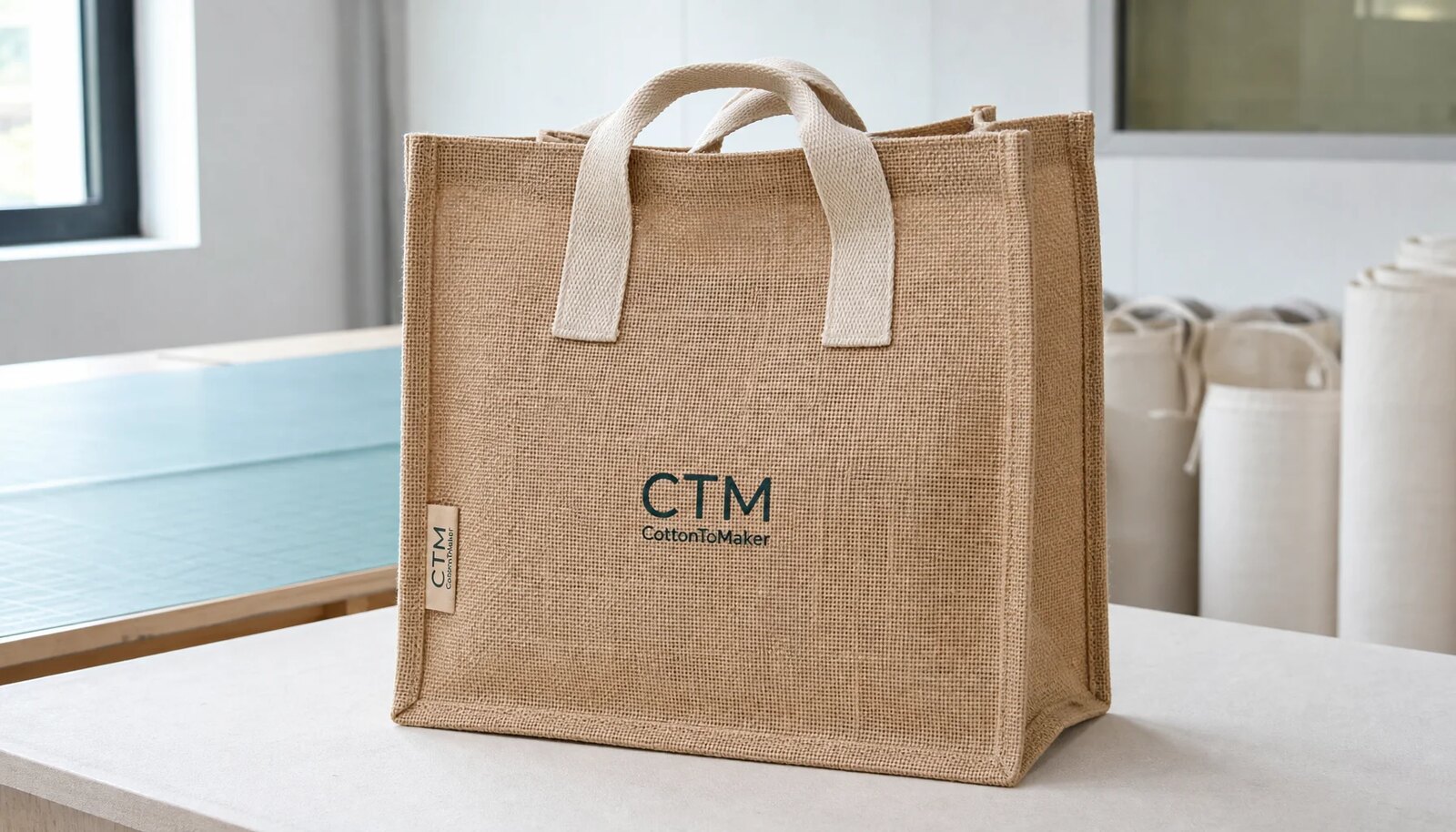
Lead Time Starts With the Bag Spec, Not the Order Date
Most schedule problems on custom jute tote bags begin before production starts. Buyers often send a logo first and a size later, then expect the factory to quote a reliable delivery date. For jute, that does not work well. The finished dimensions, fabric weight, handle type, lining, and print coverage all affect cutting yield, sewing time, and the chance of rework. If any of those items move after the quote, the lead time moves too.
For event orders, a simple unlaminated tote in a standard size can move faster than a structured retail-style bag with reinforced handles, inner lining, or a second decoration method. As a planning baseline, a stock-style custom print order may fit in roughly 3 to 5 weeks from artwork freeze to ex-factory, while a new spec with lamination, extra stitching, or complex packing usually needs more room. The useful question is not whether the order is fast or slow. The useful question is which part of the spec is driving the calendar.
- Lock the finished size before requesting quotes so different factories price the same product.
- Treat lamination, lining, and extra pockets as schedule items, not as small add-ons.
- Use the event date as the final delivery requirement, then work backward through production and freight.
Choose the Right Jute Construction Before You Compare Quotes
Jute tote bags are not all built the same way, and the price difference usually traces back to construction rather than to the logo. A light giveaway tote may use about 300 to 340 GSM fabric with a simple self-fabric handle, while a heavier retail or gift version often moves toward 350 to 450 GSM with reinforced handles or a laminated inner layer. The higher the weight and structure, the more cutting pressure, stitching time, and freight volume you buy.
The other issue is load profile. A bag that carries paper brochures can tolerate a lighter body and simpler handle attachment. A bag meant for wine bottles, sample kits, or boxed gifts needs stronger seams, a firmer bottom, and a handle spec that survives real carrying. If your brief does not define the contents, the factory will guess, and the quote will not protect you from failure at the event.
- 300 to 340 GSM works for lightweight inserts, catalogs, apparel, and flat giveaways.
- 350 to 450 GSM is safer when the bag must stand upright or carry heavier contents.
- Use reinforced X-box or bar-tack stitching when the handle will see repeated lifting.
- Avoid fine typography on coarse jute weave unless you approve a strike-off first.
Compare Supplier Routes Before You Judge Unit Price
A low unit price only means something if the supplier route matches the schedule and the order complexity. A direct factory with in-house cutting, printing, and packing gives the best control for an event buyer because one team owns the full workflow. A trading company can help when the tote is only one item in a mixed program, but the extra handoff can stretch the calendar if the spec is still changing. A stock bag converter can be the fastest route when the shape is standard and only the logo needs to change.
When comparing routes, look for proof of actual production control. Ask for line photos, sample-room images, carton photos, and a recent packing record for a similar jute item. If the supplier cannot show who prints, who sews, and who packs, the quote is not as comparable as it looks. For event programs, schedule certainty is often worth more than the cheapest headline number.
- Direct factory: strongest on schedule control and repeatability.
- Trading company: useful for mixed baskets of products, weaker on production visibility.
- Stock converter: fastest when the bag shape is fixed and artwork is simple.
- Always confirm whether labels, hangtags, and carton marks are handled at the same site.
Build the Schedule Backward From the Event Date
A workable jute tote timeline should start from the hand-in date at the venue, not from the purchase order date. Subtract freight transit, customs clearance, local delivery, production time, material booking, and sample approval. If the order is going by ocean, the ship window alone can absorb a large part of your calendar. If the order is air freight, the production risk does not disappear, it just shifts into a smaller transit window with less cushion for rework.
The safest planning method is to freeze the artwork early, approve the sample before mass production, and reserve time for inspection and packing. Even a simple tote can lose several days if the logo size needs adjustment or the handle length is changed after sampling. For a fixed event date, the schedule buffer should be built into the procurement plan, not treated as optional slack.
- T minus 8 to 10 weeks: finalize spec, quantity, and artwork for first-time orders.
- T minus 6 to 8 weeks: approve sample or strike-off and release production.
- T minus 2 to 4 weeks: plan production completion, inspection, and freight booking.
- Keep an extra buffer if the order falls near peak season or a factory holiday period.
MOQ Is Usually a Cost Formula, Not a Random Factory Rule
MOQ on custom jute tote bags is usually tied to material efficiency, print setup, and sewing flow. A factory does not set minimums just to sound difficult. It needs enough pieces to cover fabric cutting waste, screen setup, color matching, and packing labor. If your bag is a standard size with one-color print, the MOQ can be reasonable. If the bag needs a new size, a custom lining, multiple print colors, and special packing, the minimum rises because the factory has more setup cost per piece.
The real quote problem is not the MOQ itself. It is the hidden assumption behind the MOQ. Two suppliers can quote the same tote but include different scopes: one may price the base bag only, while the other includes printing, labels, and carton packing. A useful quote breaks out the base construction, decoration method, packing requirement, and any special inserts. That is the only way to compare route by route without being misled by a low unit number.
- Compare base bag, print setup, labels, and packing as separate quote lines if possible.
- Expect MOQ to rise when you change size, material weight, print colors, or handle style.
- If a quote is unusually low, check whether carton marks, sample charges, or packing are excluded.
- Ask whether the MOQ applies per artwork, per color, or per total order.
Sample Approval Should Prove the Hard Parts, Not Just the Logo
A jute tote sample is useful only if it proves the risk points. The bag should be checked for finished size, handle comfort, seam alignment, print placement, and the way the ink sits on the weave. A digital mockup can approve the artwork layout, but it cannot prove registration, coverage, or how the natural fiber surface will behave in production. For first orders, a sewn sample or pre-production sample is far more valuable than a polished file on a screen.
The approval standard should be practical. If the bag is meant for a 5 kg event kit, load test it to that level. If the logo is placed near a seam or gusset, inspect distortion after stitching. Small shifts are normal on jute, but large print drift, loose threads, and handle asymmetry are not. Approval should be based on what the buyer will accept in bulk, not on what looks perfect in one hand-made sample.
- Confirm size, seam position, handle length, and logo placement on the sample.
- Review print opacity and edge sharpness under daylight, not only indoor lighting.
- Check for smell, stains, and moisture because natural fibers can trap storage issues.
- Approve a production sample only after the factory confirms the same fabric and printing method will be used in bulk.
Packing Choices Can Quietly Add Days and Freight Cost
Packing is often treated as a warehouse detail, but it affects both lead time and landed cost. A bulk-packed jute tote in a master carton is usually the simplest option for importers and distributors. It reduces handling time and keeps the factory focused on count accuracy. Individual polybags can help with retail presentation, but they add labor, material cost, and more packing steps. If the order is for event handouts, retail presentation may not be worth the added delay.
Carton planning also matters because jute is bulky. Too many pieces per carton can create compression marks and raise handling damage. Too few pieces can increase freight cost per unit. The right carton count depends on the bag size and whether the bag is flat, gusseted, or lined. Ask for the carton dimensions early, then compare them with your warehouse and freight plan. A unit price without carton data is incomplete.
- Use carton counts that protect shape, not just the maximum number that fits.
- Keep clear carton marks for PO, style, size, quantity, and country of origin.
- Avoid over-compression on laminated or structured bags.
- Decide early whether retail-ready packaging is necessary or just expensive.
Inspect the Weak Points Before You Release the Bulk Order
The most common jute tote failures are not dramatic. They are small, repeatable defects that show up across a lot. Uneven seams, weak handle attachment, print misregistration, and size drift cause the most trouble because they are hard to fix after shipping. If the order is for a branded event, even a minor defect rate can become visible fast because the bags are distributed all at once. That makes the inspection standard more important than the factory sales pitch.
A workable quality plan starts with a clear tolerance band. Many buyers use an AQL-style inspection approach and then sharpen the critical points for their own brand risk. For example, a small variation in natural fiber shade may be acceptable, but a crooked logo, a broken seam, or a handle that fails under the intended load is not. The goal is to define what is rework, what is acceptable, and what is a reject before production starts.
- Set a size tolerance that the brand can live with, not one chosen after the first defect appears.
- Treat print shift, broken stitches, and handle failure as major defects.
- Use a load test that matches the actual event contents.
- Verify carton counts by style and artwork before the shipment leaves the factory.
Compare Landed Cost, Not Just Factory Price
A cheap factory quote can still produce a high landed cost if the order is late, overpacked, or inconsistent. Buyers should compare ex-works or FOB value against the cost of freight, duty, inland delivery, rework risk, and the time value of missing an event date. For a fixed-date program, a slightly higher unit price from a supplier with tighter control is often cheaper than a lower price that creates emergency freight or replacement cost later.
The cleanest way to judge the offer is to compare two full scenarios. One is the lowest factory price. The other is the most reliable total path to your warehouse or venue. If the event cannot move, the schedule is part of the cost. That does not mean you always choose the most expensive option. It means you choose the option with the least hidden risk after the whole chain is priced.
- Compare unit price, freight, duty, and local delivery together.
- Include sample and rework risk in the decision, especially for first-time artwork.
- Add a contingency for weather delays, inspection holds, or packing corrections.
- For urgent events, pay for schedule control before you pay for cosmetic extras.
Specification comparison for buyers
| Spec decision | Recommended option | When it fits | Buyer risk to check |
|---|---|---|---|
| Supplier route | Direct factory with in-house cutting, sewing, and printing | Best when you need schedule control and one accountable plant for the full order | Confirm the factory actually handles printing and packing in-house, not through an unseen subcontractor |
| Supplier route | Trading company or sourcing agent | Useful when you are buying mixed items, but the tote is only one line in a larger event program | Lead time can slip between handoffs, so get the real production site and status update cadence in writing |
| Supplier route | Stock bag plus decoration converter | Fits shorter schedules when the bag shape is standard and only the logo changes | Stock color, handle spec, and carton count may not match the brand brief exactly |
| Fabric weight | 300 to 340 GSM unlaminated jute | Works for light event inserts, brochures, apparel, and giveaway kits | Bag body can sag if the load includes bottles, hard boxes, or thick catalogs |
| Fabric weight | 350 to 450 GSM reinforced or laminated jute | Better for premium gifting, heavier contents, and a more structured retail look | Higher weight usually means longer sewing time and higher freight cost |
| Print method | 1 to 2 color screen print | Most practical for event logos, sponsor marks, and repeat logos on coarse jute weave | Fine detail and tight registration can fail if artwork is too small or too thin |
| Branding route | Woven label, side label, or small sewn patch | Works for buyers who want a cleaner premium finish with less ink coverage | Adds a sewing step and needs label approval before bulk production |
| Packing route | Bulk carton with clear carton marks | Best for importers optimizing freight and warehouse handling | Count accuracy and compression damage must be controlled before shipment |
| Sample route | Pre-production sample after material confirmation | Needed for first orders, new artwork, or any change to size, handle, or print | Sample approval can add a week or more if the supplier has not frozen the spec |
Buyer checklist before sampling
- Fix the finished size, gusset, handle length, and target fabric weight before requesting pricing
- State the print method, number of colors, print placement, and artwork safe margin
- Specify whether the bag needs lamination, lining, a pocket, a closure, or reinforced handles
- Ask for the MOQ by size and by artwork, not just a single headline minimum
- Request a pre-production sample or strike-off for any first-time design
- Confirm carton count, carton dimensions, and whether individual polybags are required
- Build a schedule buffer for sample approval, production, and freight, not only sewing time
- Collect photos or video of the actual line, packing area, and finished goods before final PO release
Factory quote questions to send
- What exact jute fabric weight and construction are you quoting, and is it laminated or unlaminated?
- How does MOQ change if I change the size, print colors, or handle style?
- Is the quote based on a pre-production sample, and what is the sample approval timeline?
- What is included in the unit price: sewing, printing, label insertion, packing, and carton marks?
- What print method will you use for this artwork, and what line thickness is safe on jute weave?
- What size tolerance do you allow on the finished bag, and what stitch standard do you follow?
- How many pieces per carton, and what carton size will you use for freight planning?
- What is the rework policy if print placement or sewing fails inspection?
- Can you share a recent export packing photo or redacted packing list for a similar order?
Quality-control points to confirm
- Finished size should stay within an agreed tolerance, usually tighter on width and handle length than on body depth
- Handle attachment must use reinforced stitching, with no skipped stitches, loose thread, or uneven bar tacks
- Print should be opaque enough to read cleanly on the jute texture, with no major smearing or double images
- Seams should remain straight, secure, and free from puckering at the gusset and top hem
- Fabric should be clean, dry, and free from mildew smell, oil marks, or heavy color variation outside the approved shade range
- Sample load testing should reflect the real use case, such as brochures, bottles, or gift boxes, not just an empty bag test
- Carton count should be verified by size and artwork variant, with outer marks matching the PO
- Final packed goods should be checked for compression damage, handle creasing, and damage from moisture during storage