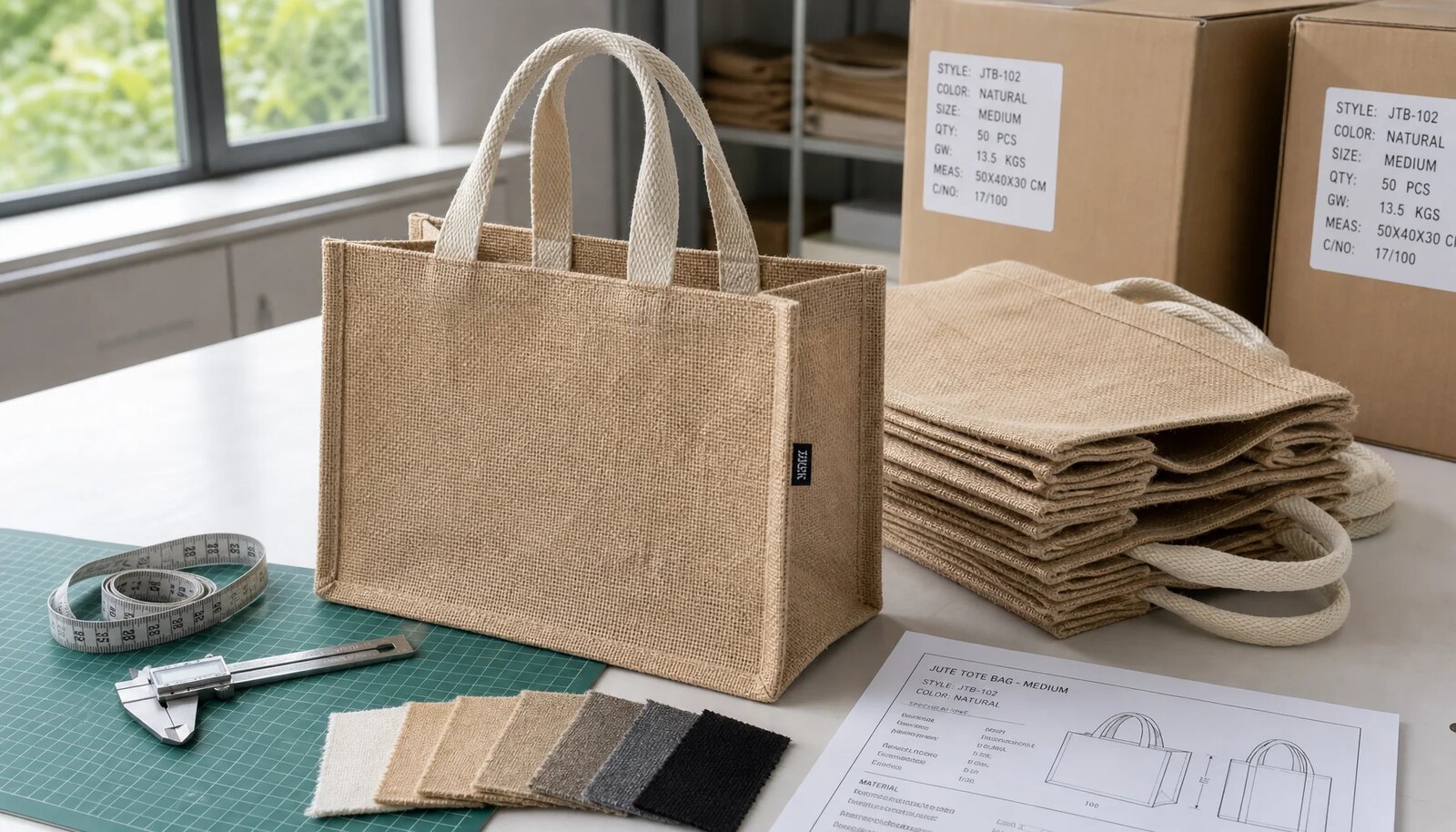
Lead time starts with locked inputs, not the first quote
For B2B procurement teams, custom jute tote bags lead time becomes dependable only after the product, artwork, approvals, packing plan, and freight route are defined. A supplier's first estimate is useful for early planning, but it is not a production calendar. The order clock may start after deposit, after final artwork, after material approval, after a print strike-off, after pre-production sample approval, or only after every one of those items is complete. Ask the factory to name that start event in writing before the launch schedule is built around it.
Jute adds a few planning wrinkles that are easy to miss on a clean product mockup. It is natural, coarse, and visibly variable. Shade can move between lots. Slubs and weave texture can interrupt small type or thin logo lines. A heavier body fabric may sew more slowly and pack with more bulk. Lamination, lining, side gussets, custom handles, and woven labels each create separate sourcing, sampling, or inspection points. The sketch may look simple; the factory route is usually more layered.
A controlled schedule separates buyer gates from supplier gates. Buyer gates include RFQ clarity, artwork release, sample comments, approval authority, payment timing, and freight decisions. Supplier gates include material sourcing, cutting, printing, drying or curing, sewing, trimming, inline checking, packing, and cargo handover. When these are bundled into one vague lead time, delays become hard to identify and even harder to recover.
- Ask the supplier to state which approval starts production lead time.
- Track sample lead time, bulk production, inspection, packing, and transit as separate calendar lines.
- Assign one internal approval owner for artwork, material, construction, and packing comments.
- Build a buffer for one sample revision when size, fabric, artwork, or packing is new.
- Confirm the latest approval date that still protects the required ship date.
Write the RFQ like a manufacturing document
A strong RFQ prevents weak comparisons. Phrases like eco tote, premium burlap, thick fabric, long handles, and standard packing leave too much room for interpretation. One supplier may quote 10 oz natural jute with basic cotton handles and bulk flat packing. Another may include 14 oz laminated jute, lining, reinforced stitching, individual barcode labels, and stricter carton marks. Those are not the same bag, even if both replies sound reasonable in an email.
Use finished dimensions in millimeters and state how they are measured. Include width, height, bottom gusset, side gusset if any, top hem width, handle length, and handle drop. For sewn bags, many buyers work around practical tolerances such as +/-5 mm on smaller elements and +/-10 mm on larger finished panels, but the final tolerance must be agreed with the supplier before bulk cutting. If the tote must hold folded T-shirts, denim, boxed accessories, or footwear, include the fill dimensions or send a reference packing photo.
Fabric should be specified by measurable target and finish. For many apparel retail totes, 10-12 oz natural jute is a common starting range because it balances structure, cost, and packability. For heavier contents, a stiffer retail presentation, or a premium resale tote, 14 oz or heavier may make sense. Heavier is not automatically better. It can affect cutting, sewing, carton volume, freight cost, and how the bag feels when folded or carried.
- Specify finished size, gusset style, handle drop, handle length, and tolerances in millimeters.
- State fabric weight by the supplier's measurement basis, such as oz or GSM.
- Identify finish clearly: natural, bleached, dyed, washed, laminated, unlaminated, lined, or unlined.
- Provide the intended apparel fill or carton size when fit matters.
- Ask whether the quoted fabric is in stock, routinely replenished, or made to order.
Choose construction from the use case backward
The best construction choice depends on what the bag must do after it leaves the factory. A tote for an event T-shirt giveaway can be simpler than a retail resale bag expected to carry denim, knitwear, or boxed accessories. Overbuilding adds cost, weight, and lead time without always adding value. Underbuilding creates more expensive problems: stretched seams, failed handles, distorted bases, poor shelf presentation, and complaints after the shipment is already in market.
Handles deserve extra attention because they take the load and shape the user's first impression. Cotton webbing handles are often more comfortable than self-jute handles and can be controlled by width, color, finished length, and drop. Self-jute handles can match the body, but they may feel rougher and create bulk where they fold into the top hem. Avoid short handle or long handle as the only instruction. Say whether the bag is for hand carry, forearm carry, or shoulder carry, then specify the numbers.
Gussets change both function and schedule. A flat tote is efficient to cut, sew, and pack. A bottom gusset gives more capacity for folded apparel and gift sets. Side plus bottom gussets create a boxier retail shape, but they add more alignment points and more inspection work. If the tote must stand upright for merchandising or showroom presentation, put that requirement in the RFQ. The factory may need heavier fabric, lamination, a wider base, or a different seam setup.
- Define expected load: T-shirts, denim, outerwear, shoes, accessories, or mixed retail items.
- Specify handle material, width, color, drop, finished length, and reinforcement pattern.
- Use box stitch, cross stitch, or bar tack language where relevant, and confirm the factory's normal method.
- Decide early whether the bag must fold flat, stand upright, or keep a boxy profile.
- Add zipper, snap, pocket, lining, or hardware only when the sales channel justifies the extra sourcing and inspection.
Treat MOQ as a sourcing signal
MOQ is not just a price negotiation point. For custom jute tote bags, it may be driven by fabric purchase quantity, dye lot, lamination setup, printing screens, woven label production, cutting efficiency, special cartons, or total order value. A low MOQ is usually easier when the buyer uses stock materials and standard construction. Change the body color, jute weight, handle color, print count, lining, or packing format, and the order may move onto a different production route.
For eco apparel brands testing a new packaging program, the fastest first order is often a factory standard size with stock natural jute, standard cotton webbing handles, and one-color screen print. That route can still feel branded if logo placement, woven side label, hangtag, and carton labeling are controlled. A fully custom pattern makes more sense when the tote has recurring volume, retail resale value, or a brand reason strong enough to justify the extra setup.
Repeatability matters as much as the first MOQ. A supplier may offer a small run from available material, but the same shade, weight, handle webbing, or label stock may not be available later. For a one-time event, that may be acceptable. For seasonal replenishment, wholesale packaging, or retail programs, ask what can be repeated: pattern, screens, label artwork, fabric specification, packing method, and carton marks.
- Ask which item drives MOQ: fabric, dyeing, print setup, labels, sewing, packing, or order value.
- Compare standard-size and custom-size routes before approving a new pattern.
- Limit the first order to one construction and one or two artwork versions when timing is tight.
- Confirm which materials, screens, labels, or tools can be reused on reorders.
- Do not assume a low MOQ quote is repeatable unless the stock and reorder conditions are stated.
Compare production routes before comparing unit price
Two suppliers can quote the same drawing and still be pricing different bags. One quote may be based on stock 10 oz natural jute, a standard bottom-gusset pattern, one-color screen print, and bulk flat packing. Another may include 12 oz fabric, custom webbing, woven labels, individual bags, barcode stickers, and stricter carton marks. The second quote may look more expensive and slower, but it may simply include more of the actual work.
A procurement-ready quote should be detailed enough that another supplier could price the same specification. It should show fabric weight, finish, dimensions, handle material, print method, color count, sample route, production start condition, packing method, and inspection assumption. Once the packing plan is known, logistics teams also need estimated carton dimensions, units per carton, gross weight, and total cubic volume. Jute can be bulky, so volume is often as important as weight.
A useful comparison grid marks each element as stock, standard production, custom sourcing, or buyer approval pending. This makes the lead time risk visible. A supplier with a longer quoted production time may be the safer option if materials, sampling, packing, and carton labels are all defined. A faster quote can still be useful, but only if the buyer accepts the limits of stock fabric, standard construction, and simpler branding.
- Require all suppliers to quote against the same spec sheet and artwork version.
- Separate material sourcing, sampling, bulk production, packing, inspection, and transit.
- Ask what is excluded from the unit price, including hangtags, barcode stickers, inspections, and special cartons.
- Compare freight impact using carton volume as well as unit price.
- Treat undefined terms such as standard fabric, normal packing, and usual tolerance as open quote risks.
Use samples to make decisions, not just to check a box
Sampling is the strongest control point in a custom jute tote bag program. A digital proof can confirm logo size and placement, but it cannot prove print opacity on coarse fiber, handle comfort, seam strength, lining behavior, odor, or the way a gusset sits when filled. For retail, wholesale, or launch-critical orders, approve a physical pre-production sample before bulk cutting. That sample becomes the reference for both production and inspection.
The best PP sample uses actual bulk fabric, actual handles, actual branding method, and intended construction. If the supplier substitutes a close fabric or temporary handle to save time, the sample can still help review shape and measurements. It should not be treated as final approval for shade, texture, thickness, hand feel, print behavior, or packing bulk. Record every substitution clearly so unresolved items do not disappear inside a general approval email.
Review the sample like a buyer and an inspector. Measure width, height, gusset, handle drop, handle length, print location, label placement, and top hem. Place the intended apparel bundle inside and check whether the tote distorts. Fold it the way the warehouse will pack it. Look at the print under ordinary light, not only supplier photo lighting. For laminated or lined bags, check inside seams, stiffness, smell, and carton bulk.
- Approve artwork proof first, then approve a physical PP sample before bulk cutting.
- Require the supplier to identify any material or method substitution.
- Record actual sample measurements beside the approved target measurements.
- Test the sample with the intended apparel fill and packing fold.
- Send one consolidated revision list with a final approval owner.
- Keep the signed sample, photos, artwork, and spec sheet under the same version number.
Design artwork for the reality of jute
Artwork can shorten the schedule or quietly consume it. Jute is not coated paper and it is not tightly woven canvas. Its open weave, fiber ridges, and slubs can break fine lines, soften edges, and mute color. A logo that looks sharp in a PDF may need adjustment before it works on natural jute. Bring design into the process early enough to simplify the artwork before the strike-off, not after a failed sample.
Screen print is often practical for bold one- or two-color logos on jute tote bags. It can give strong contrast and repeatable placement, but it needs screen setup, drying or curing time, and artwork that respects the surface. Fine serif type, hairline rules, dense halftones, gradients, and tight multi-color registration are higher risk. Ask the supplier for minimum stroke width and minimum readable text height based on their equipment and the jute quality being quoted.
Pantone references are still useful, but they are not a guarantee that ink on natural brown jute will match ink on white paper. White ink may need more opacity. Light colors can look muted. Dark colors often read more clearly, although edges will still follow the weave. If fine brand details, QR codes, care text, or premium trim language are important, use a woven side label, patch, interior label, or hangtag rather than forcing every detail into the main print.
- Use vector artwork for logos, typography, icons, and repeatable brand marks.
- Specify print size, Pantone target, color count, and position from fixed edges in millimeters.
- Ask for minimum stroke width, minimum text height, and registration tolerance.
- Avoid gradients, tiny disclaimers, dense textures, and hairline details unless tested on actual jute.
- Use woven labels or hangtags for small text, QR codes, and premium brand details.
- Confirm whether printed panels are inspected after drying or curing and before sewing.
Set QC standards before bulk starts
Quality control for jute totes begins by separating natural character from defects. Slubs, mild shade movement, and irregular fiber texture are normal in natural jute. Oil marks, mildew, strong odor, water stains, foreign fibers, broken stitches, unreadable print, crooked handles, and wrong carton labels are defects. If that line is not defined before production, the argument often happens after the shipment is late.
Measurement tolerances should be written into the spec sheet. Finished sewn goods will vary, but the allowed range must be practical, measurable, and agreed. Define tolerances for width, height, gusset depth, handle drop, handle length, label placement, and print placement. For print, the reference point should be exact: distance from top edge, side seam, center line, or bottom edge. For gusseted bags, inspectors should also check base alignment and whether the bag folds or stands as intended.
Handle inspection deserves special focus. Check reinforcement pattern, stitch density, skipped stitches, thread tension, loose ends, seam allowance, and left-right symmetry. If the tote will carry heavier apparel, ask about the factory's internal pull test or load check. The test does not need to be complex for every order, but it should match the expected use and be agreed before production begins.
- Define acceptable jute variation using the approved swatch or PP sample.
- Set reject rules for stains, odor, mildew, severe shade mismatch, broken stitches, and unreadable branding.
- Measure early bulk pieces before the full order is sewn and packed.
- Inspect print after drying or curing, not only when ink is freshly applied.
- Treat handle reinforcement and gusset alignment as high-priority functional checks.
- Use AQL or another agreed inspection plan when order size, channel risk, or retail value justifies it.
Pack for freight, receiving, and presentation
Packing is often discussed late, but it affects cost, timeline, and landed quality. Bulk flat packing in master cartons is usually efficient for freight and simple for wholesale movement. It may be enough for event totes, showroom bags, or internal distribution. Heavier jute, laminated bodies, and structured gussets can crease or distort if cartons are overfilled, so ask for a packing trial or carton photos when appearance after transit matters.
Retail-ready packing adds real work. Individual polybags, hangtags, barcode stickers, retail sleeves, country-of-origin labels, size labels, and special carton marks all require materials and labor. They may be necessary for resale, marketplace routing, or distribution center compliance, but they belong in the first RFQ. A factory that priced bulk packing may need extra time and a revised cost if these items are added after sample approval.
Translate warehouse rules into supplier instructions. State units per inner pack, units per master carton, maximum carton gross weight, carton dimensions if constrained, SKU mix rules, barcode format, label placement, PO number, carton numbering, and shipping marks. Freight teams need carton count, gross weight, and cubic meters. Because jute bags are bulky, air freight decisions should be based on dimensional weight as well as actual weight.
- Confirm whether the quote includes bulk packing, individual packing, hangtags, barcode labels, or retail sleeves.
- Set units per carton, maximum gross weight, carton dimensions, and SKU mixing rules.
- Ask for carton packing photos before shipment release.
- Check barcode readability and label placement against warehouse receiving needs.
- Avoid individual polybags unless moisture protection, retail handling, or channel rules require them.
- Use estimated carton CBM when comparing ocean, air, courier, or consolidated freight.
Work backward from the in-hands date
A useful custom jute tote bags lead time planning guide for eco apparel brands starts with the required in-hands date. Identify when bags must be available for kitting, retail distribution, wholesale shipment, launch photography, or event setup. Then work backward through domestic delivery, import clearance or receiving, international transit, cargo handover, final inspection, packing, sewing, printing, cutting, material readiness, sample approval, and internal artwork approval.
The buyer-side calendar is often the hidden risk. Brand review, legal copy checks, payment processing, sample courier time, stakeholder meetings, and freight booking all consume days. If the design team may revise the logo after seeing the first real print, build one revision loop into the calendar. If the launch date cannot move, unresolved artwork, material, or packing decisions should be treated as schedule risks, not small admin items.
Choose the transit mode early. Ocean freight may suit larger programs when the calendar allows. Air freight can protect a fixed event date, but jute totes are bulky and dimensional weight can push landed cost up quickly. Courier may work for samples and very small urgent quantities, but it is not a default solution for full programs. Confirm carton volume before committing to the freight plan, especially when the bag is gusseted, lined, or laminated.
- Set the required in-hands date and latest ship date before approving the order.
- Build separate deadlines for artwork approval, sample comments, PP sample approval, bulk start, inspection, and cargo handover.
- Ask the factory for the latest sample approval date that still protects the required ship date.
- Hold a buffer for sample courier time and internal decision time.
- Choose transit mode using carton dimensions, gross weight, and launch risk.
- Do not announce a fixed retail or event date internally until approval status and freight route are realistic.
Specification comparison for buyers
| Planning decision | Practical specification target | Lead time impact | QC or quote detail to confirm |
|---|---|---|---|
| Jute fabric weight | 10-12 oz natural jute for most apparel retail totes; 14 oz or heavier when the bag needs more structure, carries heavier fill, or is intended as a premium resale item | Stock 10-12 oz natural jute is usually easier to schedule; heavier, dyed, bleached, or laminated materials may need fresh sourcing and swatch approval | Confirm actual GSM or oz basis used by the mill, allowed weight tolerance, approved swatch reference, and whether the quoted fabric is currently in stock |
| Finished size and tolerance | Specify finished W x H x D in mm; common buying tolerance is often around +/-5 mm for small dimensions and +/-10 mm for larger panels, subject to buyer and supplier agreement | Custom dimensions require pattern confirmation and can slow cutting approval compared with factory standard sizes | Ask if dimensions are measured flat, finished, and empty; include handle drop, handle length, top hem, and gusset depth in the spec sheet |
| Jute finish | Natural unbleached jute for a raw eco presentation; dyed or bleached jute only after lab dip or swatch approval | Natural jute is faster when available; dyed, bleached, washed, or shade-controlled lots add approval steps and material risk | Set shade band expectations because natural jute has fiber variation, slubs, and batch-to-batch movement |
| Lamination or lining | Unlaminated and unlined for faster, softer, lower-bulk totes; light inner lamination or lining only when the channel requires structure, moisture resistance, or a more finished interior | Lamination adds material handling and odor checks; lining adds sourcing, cutting, turning, sewing, and inspection steps | Confirm lamination side, lining fabric composition, seam finishing, odor limit, carton compression risk, and whether the bag must fold flat |
| Branding method | 1-2 color screen print for bold logos; woven label or side label for small text; transfer only after adhesion and hand-feel testing | More colors, fine registration, strike-offs, and label weaving extend approval time; simple one-color print is usually the fastest custom route | Confirm print size, location tolerance, minimum stroke width, Pantone target, opacity expectation, and drying or curing time |
| Handle construction | Cotton webbing handles, self-jute handles, or padded handles with box stitch, cross stitch, or bar tack reinforcement | Custom webbing color, width, or handle length can affect material availability; reinforcement increases sewing control time but reduces failure risk | Specify finished handle length, handle drop, width, stitch pattern, seam allowance, thread color, and any pull or load test requirement |
| Gusset and structure | Bottom gusset for apparel bundles; side plus bottom gusset for boxier retail capacity; flat tote for low bulk and event use | More gussets increase cutting, alignment, sewing, and inspection time; structured bags also increase carton volume | Define whether the bag must stand upright, fold flat, or hold a specified folded garment bundle |
| MOQ route | Use factory standard size, stock jute, standard handles, and one print color for the most predictable first order | Custom fabric, dyed lots, woven labels, multiple artwork versions, and retail unit packing can raise MOQ and add days | Ask which MOQ driver applies: fabric purchase, printing setup, label weaving, sewing line efficiency, packing materials, or total order value |
| Sampling gate | Artwork proof, material swatch, print strike-off if needed, then pre-production sample before bulk cutting | Skipping physical approval can save calendar days but increases rework risk on print opacity, handle length, shade, and packing fit | State whether the PP sample uses actual bulk fabric and actual print method; document any substitution in the approval record |
Buyer checklist before sampling
- Issue one version-controlled spec sheet with finished width, height, bottom gusset, side gusset if any, handle drop, handle length, and measurement tolerance in millimeters.
- State the fabric target using the supplier's measurable basis: oz, GSM, weave type if known, natural or dyed finish, laminated or unlaminated, lined or unlined, and approved swatch reference.
- Define the performance use: folded T-shirts, denim, shoes, boxed accessories, gift-with-purchase, retail resale, event giveaway, or wholesale showroom sample bag.
- Confirm whether the bag must stand upright, fold flat, fit inside an existing carton, hang on a retail fixture, or meet a maximum carton gross weight.
- Provide vector artwork with Pantone references, print size in millimeters, print position from top and side edges, color count, minimum stroke width, and placement tolerance.
- Specify branding method by location: front print, back print, woven side label, interior label, patch, hangtag, barcode sticker, or mixed branding package.
- Lock handle material, color, width, finished length, handle drop, attachment stitch pattern, seam allowance, thread color, and pull-strength or load-test expectation if required.
- Define seam expectations: stitch density, top hem width, inside seam finish, loose-thread limit, raw-edge acceptance, lining capture, and reject rules for skipped or broken stitches.
- List sampling gates: swatch, artwork proof, print strike-off, pre-production sample, approval photos, courier sample, revision deadline, and who has final approval authority.
- State QC criteria before bulk starts: measurement tolerance, fabric shade range, stain limits, odor review, print defects, handle alignment, seam defects, carton labeling errors, and AQL level if used.
Factory quote questions to send
- What exact event starts the quoted lead time: deposit receipt, final artwork approval, material approval, print strike-off approval, pre-production sample approval, or all approvals together?
- Is the quoted fabric stock natural jute, routine replenishment fabric, dyed-to-order jute, bleached jute, laminated jute, or a special weight that requires new sourcing?
- What actual fabric weight is included in the price, and how do you measure it: oz per square yard, GSM, or another mill standard? What tolerance do you allow?
- Which finished dimensions, handle material, handle width, handle drop, gusset style, stitch pattern, thread color, and packing method are included in the quoted unit price?
- What MOQ changes if we revise size, gusset, fabric weight, handle color, lining, lamination, print color count, woven label size, or carton packing?
- How many calendar days do you need for material swatch, artwork proof, print strike-off, and full pre-production sample, and what is included in the sample fee?
- Will the pre-production sample be made with actual bulk fabric, actual handles, actual branding method, and intended packing fold, or will any part be substituted for speed?
- What artwork limits should we apply on jute: minimum stroke width, minimum readable text height, maximum printable area, registration tolerance, ink opacity, and color limitations on natural brown fabric?
- What QC standard do you use for finished dimensions, print placement, stains, odor, shedding, stitching defects, handle reinforcement, carton labels, and count accuracy?
- Can you provide first-bulk photos or an inline inspection before full production is completed, especially for print placement, handle stitching, and gusset alignment?
Quality-control points to confirm
- Fabric weight is checked against the approved specification using the agreed measurement basis, with a documented tolerance and comparison to the approved swatch or pre-production sample.
- Natural jute shade, slubs, fiber thickness, and weave texture are reviewed against an approved batch standard so normal natural variation is separated from stains, mildew, oil marks, or contamination.
- Finished width, height, gusset depth, handle drop, handle length, handle symmetry, and pocket or label placement are measured on randomly selected pieces against the signed spec sheet.
- Print placement is measured from fixed reference points such as top edge and side seam, with tolerance stated in millimeters rather than described as centered or normal.
- Print registration, opacity, edge sharpness, color contrast, curing, cracking, lifting, and ink transfer are checked on actual jute texture after drying, not only on artwork proofs.
- Small text, fine lines, logo edges, and negative spaces are inspected for filling, broken edges, unreadable details, and inconsistent ink coverage across slubs.
- Handle attachment is checked for correct reinforcement pattern, stitch density, skipped stitches, thread tension, loose ends, seam allowance, and alignment between left and right handles.
- Side seams, bottom seams, gussets, top hems, lining seams, and label seams are inspected for twisting, puckering, broken stitches, exposed raw edges beyond tolerance, and uneven folding.
- Odor, dust, loose fiber shedding, moisture marks, foreign fibers, and surface debris are reviewed before packing because jute totes are often used next to apparel inventory.
- Unit count, inner pack count, carton count, SKU labels, barcode readability, PO references, carton numbers, and shipping marks are verified against the purchase order and routing guide.