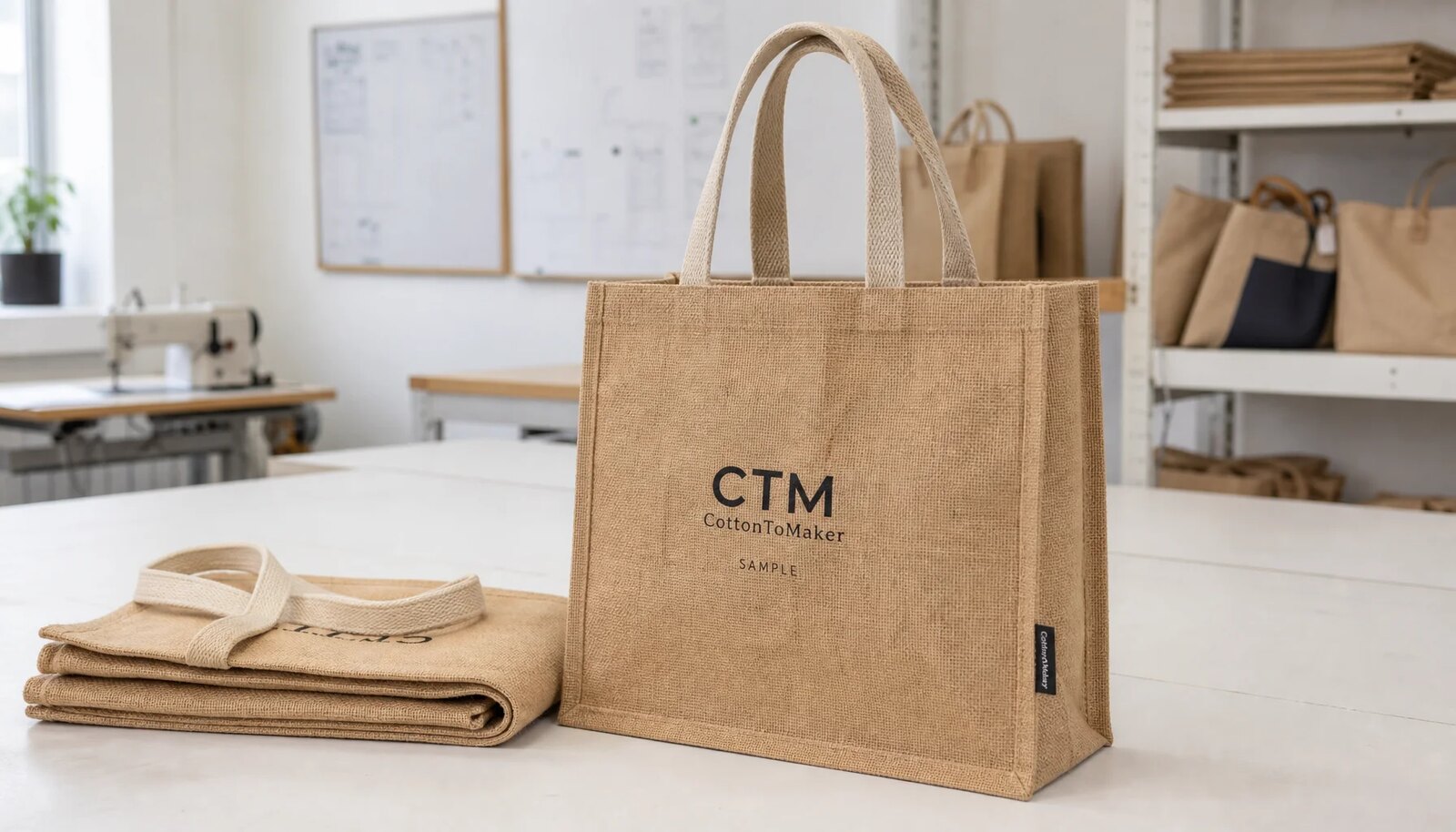
Plan From the Warehouse Deadline
For custom jute tote bags used at craft fairs, the real deadline is usually not the public opening morning. Bags may need to arrive days or weeks earlier for vendor welcome kits, sponsor packs, presale merchandise, retail display cartons, or multi-location redistribution. If procurement starts with the factory’s stated production time, the plan will look cleaner than reality. Sewing is only one piece of the timeline; artwork approval, sampling, inspection, export booking, customs clearance, receiving, and booth allocation all need space on the calendar.
A stronger B2B schedule starts from the warehouse receipt date or booth-kit packing date and works backward. For a new imported program moving by ocean freight, begin RFQ and artwork work about 10 to 14 weeks before the required in-hand date when possible. A repeat order with the same supplier, same construction, and simple one-color artwork can move faster. That shortcut does not apply when the size, lining, handle, logo set, or packing plan changes.
The pre-production sample is the gate that protects the rest of the order. For ocean freight programs, approving the PPS about 8 to 10 weeks before the in-hand date gives the buyer a safer buffer for bulk production, final inspection, vessel booking, customs, and domestic movement. Air freight can save a late program, but jute totes are bulky relative to unit value. Treat air as a named contingency with a budget owner, not as the default rescue plan.
Craft fair projects often have several approval groups: event managers, sponsors, local vendors, merchandisers, and sometimes a distributor. Procurement should assign dates and owners for buyer-side tasks, not only supplier tasks. If a sponsor logo arrives late or copy changes after screens are made, the supplier may be blamed for a delay that started before production could safely begin.
- Use warehouse receipt or booth-kit packing date as the buying deadline.
- Set separate deadlines for artwork freeze, sample comments, deposit release, PPS approval, inspection, freight booking, and local delivery.
- Identify the last safe ocean freight date and the date when air freight becomes the only viable recovery option.
- Treat multiple logos, lining changes, special carton labels, and destination splits as schedule-risk factors.
- Assign one buyer-side approver for final construction, artwork, and packing instructions.
Specify Jute Construction Precisely
A jute tote specification should describe the physical bag, not just the marketing idea. At a craft fair, one tote might carry candles, jam jars, ceramics, books, boxed soap, folded textiles, packaged foods, and catalogs in the same afternoon. That mixed load makes fabric weight, gusset shape, handle reinforcement, and interior finish more important than they appear in a flat mockup. A bag can look right on screen and still collapse on a vendor table or feel uncomfortable when full.
For many event and retail craft fair programs, natural jute in the 13 to 15 oz/yd² range, roughly 440 to 510 GSM depending on supplier conversion and finish, is a practical starting point. It provides more structure than lightweight promotional jute without pushing carton weight and freight volume too far. Ask the supplier to state how weight is calculated because oz/yd² and GSM are not always quoted consistently, and lamination can change perceived stiffness.
Interior finish changes both user experience and production timing. Laminated jute is common for structured event totes because it helps reduce shedding and gives the panel enough body to stand upright. Cotton lining creates a more premium presentation and can protect contents better, but it adds sewing cost, bulk, and measurement variability. Raw unlined jute can suit a rustic look, yet it is less forgiving when fiber shedding, odor, or cleanliness matters for food-adjacent products, apparel, paper goods, or gift sets.
Handle construction deserves the same level of detail as the body fabric. Cotton webbing handles in the 2.5 to 3.8 cm width range are commonly used for repeat-use totes. Shoulder-carry drops often sit around 22 to 28 cm, while shorter hand-carry handles set a different comfort expectation. Reinforcement should be named in the spec, such as box stitch, cross stitch, or bar tack, rather than hidden behind a general request for strong handles.
- Specify finished dimensions, gusset depth, fabric weight, lamination or lining, handle width, handle drop, and reinforcement method.
- Define the expected load: paper goods, apparel, jars, candles, ceramics, booth kits, or mixed retail purchases.
- Ask whether quoted jute weight includes lamination or refers only to base fabric.
- Use paid retail tote standards for stitching, panel shape, and cleanliness when the bag will be resold.
- Request a finished sample weight when comparing suppliers with similar-looking but differently built bags.
Match Size to Fair Use
Bag size should follow actual use, carton efficiency, and booth handling. A medium shopper around 35 x 40 x 15 cm works for many mixed craft fair programs because it can hold boxed goods, folded apparel, catalogs, candles, or several small purchases without feeling oversized. Smaller flat totes can work better for prints, greeting cards, documents, or low-cost sponsor giveaways. Larger gusseted shoppers create stronger retail presence, but they also increase fabric consumption, carton CBM, and the chance that users overload the handles.
The gusset is a functional choice, not just a style line. A flat bag is economical and easier to pack, but it does not support jars, boxed sets, ceramics, or thick textiles as well as a side-and-bottom gusset. A deep gusset improves capacity, yet it can distort the front print panel if artwork sits too close to seams or if the bag is filled unevenly. Confirm the print-safe area after the supplier drafts the pattern, not only after the marketing team approves a flat mockup.
Think through how the tote will be handled on site. Vendors may need bags standing on a table, stacked behind a booth, hung from hooks, or presorted into booth cartons. Laminated gusseted totes may stand better, but they can crease if compressed too tightly. Lined bags can look more premium and use more carton space at the same time. These choices affect landed cost and warehouse labor as much as visual presentation.
Size tolerances should be realistic because jute is cut, sewn, opened, and packed through hand-operated processes. For many sewn totes, ±1 cm on body width and height is a reasonable working tolerance, but buyers should confirm the supplier’s exact standard and measurement method. A flat empty tote measures differently from a filled open tote, especially around gussets and seams.
- Choose flat tote, side-gusset tote, or bottom-gusset shopper based on the products being carried.
- Keep artwork away from seams, gusset folds, and handle attachment zones.
- Ask for print-safe area, finished measurement points, and tolerance before sample production.
- Check carton volume impact before approving a larger size or deeper gusset.
- Use the sample to test table display, hanging display, stacking, and vendor allocation handling.
Design Artwork for Jute Limits
Jute is coarse, uneven, and naturally variable. That texture gives craft fair totes their natural look, but it also limits print precision. Artwork that looks crisp on paper packaging, cotton canvas, or a digital mockup may lose detail on jute. Fine lines can break, small counters in letters can fill, and large solid areas can look uneven because ink sits over a textured weave.
Screen printing is often the most practical method for one- or two-color craft fair tote artwork. It performs best with bold marks, simple icons, strong contrast, and enough spacing between text elements. Heat transfer may support sharper detail on some laminated surfaces, but buyers should confirm adhesion, hand feel, edge durability, and cost before choosing it. Embroidery can look premium, though it adds time and may distort lighter jute panels if backing and stitch density are not controlled.
Sponsor artwork is where many projects get messy. Event totes may need an event logo, local sponsor marks, vendor names, dates, slogans, website URLs, or social handles. Tiny sponsor names, QR codes, thin script fonts, gradients, and reversed text should not be approved from a screen proof alone. If sponsor visibility is part of the commercial agreement, require a printed sample or strike-off on the actual jute surface.
Supply artwork in AI, EPS, or print-ready PDF with fonts outlined and Pantone targets listed. Pantone should be treated as a target, not a guaranteed visual match, because natural jute shade varies by batch and can shift perceived ink color. Before making the physical sample, the supplier should comment on minimum text height, minimum line width, color count, screen charge, print position, and any artwork elements that may fail on jute.
- Use bold artwork, high contrast, and limited color count for the cleanest jute print result.
- Confirm minimum line width and text height with the printer before sampling.
- Avoid QR codes, gradients, fine reversed text, and very small sponsor marks unless tested on actual jute.
- State print size, location, color count, and Pantone targets in the RFQ.
- Inspect rub resistance and curing on the physical sample and during bulk inspection.
Separate MOQ From Artwork Splits
MOQ is not only a total quantity question. It is shaped by fabric procurement, cutting efficiency, lamination availability, print setup, sewing changeover, inspection, and packing segregation. A buyer may request 3,000 totes split across ten vendors at 300 pieces each and expect one bulk price. The factory sees one base bag, but it also sees ten artwork approvals, ten screen setups, ten print runs, ten packed allocations, and a higher risk of mixed cartons.
The cleanest procurement strategy is to standardize the base bag first. Keep one size, one jute weight, one handle, one finish, one packing method, and one carton standard, then vary the front logo if the program requires it. This lets the supplier cut and sew efficiently while pricing artwork versions separately. It also makes quote comparison easier because base bag cost, print setup, split packing, and carton labeling are visible line items.
Ask for two MOQ figures: the MOQ for the base bag and the minimum quantity per artwork. Also ask whether overrun or underrun tolerance applies, especially on small artwork lots. If one vendor needs only a very small quantity, a shared event logo, hangtag, sticker, or insert card may be more economical than a dedicated print run.
Packing instructions must connect to MOQ planning. Separate cartons by logo, vendor, booth number, or destination can reduce warehouse sorting time, but they require accurate labeling and packing control. Mixed-logo cartons may reduce factory labor and still create expensive mistakes when booth kits are assembled. Decide the rule before the PO is issued, not during final packing.
- Quote total order quantity and quantity per artwork version in the first RFQ.
- Ask for base bag MOQ, artwork MOQ, screen charge, and split-packing charge separately.
- Consolidate size, color count, lining, and handles before adding vendor-specific logos.
- Specify whether mixed-logo cartons are allowed or prohibited.
- Define overrun and underrun tolerance by total order and by artwork version.
Build a Comparable RFQ
A strong RFQ for custom jute tote bags should generate comparable data, not just a low unit price. Include finished dimensions, gusset depth, jute weight, lamination or lining, handle material, handle width, handle drop, print method, number of colors, print positions, artwork versions, MOQ, sample cost, screen charges, packing format, pieces per carton, carton dimensions, gross weight, CBM, Incoterm, payment terms, lead time, and quote validity.
When the RFQ is vague, suppliers may quote different products under the same product name. One quote may include 15 oz laminated jute and wide cotton handles. Another may use lighter raw jute and narrow handles. One may include screen charges and carton labels; another may exclude them. Procurement should not compare price until construction, print scope, packing, and excluded costs are normalized.
Quantity tiers help because craft fair demand can shift after vendor signups or sponsor commitments. Ask for realistic tiers such as 500, 1,000, 3,000, and 5,000 pieces, plus the cost per additional artwork version. This makes it easier to compare the cost of ordering a buffer against the cost and risk of a late repeat run.
The RFQ should also make production assumptions visible. Ask what must be confirmed before the supplier reserves material or production capacity: deposit, signed PO, final artwork, approved sample, PPS approval, or all of these. If the supplier’s lead time starts only after all approvals are complete, early email discussions should not be counted as production time.
- Request tiered pricing and per-artwork pricing rather than one blended price.
- Separate product cost, sample cost, screen cost, packing extras, courier, labels, and split-packing fees.
- Require carton data before supplier selection so freight estimates are not guesswork.
- State Incoterm, quote validity, payment schedule, and lead-time start point.
- Compare suppliers only after confirming equal material, construction, print, and packing standards.
Use Sampling to Test Performance
Sampling should test the complete tote, not only the front logo. A digital proof cannot show stiffness, fiber shedding, odor, handle comfort, gusset shape, print readability, or whether the tote stands upright on a table. For craft fairs involving handmade foods, soaps, apparel, stationery, or premium gift sets, physical sampling is the buyer’s best chance to catch a bulk problem while it is still inexpensive to fix.
A practical sample route has three stages. The digital artwork proof confirms print size, placement, spelling, Pantone targets, and logo version. The physical sample confirms material, construction, print method, hand feel, smell, handle comfort, and overall presentation. The pre-production sample freezes the approved standard for bulk cutting, printing, sewing, and inspection. If the order repeats a known approved bag with only a logo change, the route can be shortened, but new construction should not skip the physical check.
Use the sample like the real product. Load it with expected contents such as jars, candles, books, boxed goods, ceramics, or vendor materials and let it hang for several hours. Check the handle attachment afterward. Open the gusset, stand the bag on a table, stack several samples, and see whether the print distorts when filled. Rub the print with a dry cloth and, if relevant, a slightly damp cloth to evaluate ink transfer.
Document the sample standard clearly. Label the approved sample with date, PO number, artwork version, fabric weight, finish, handle construction, print method, and approved tolerances. Keep one approved sample with the buyer and one sealed reference sample at the factory. If third-party inspection is used, give the inspector the same standard instead of a broad instruction to check quality.
- Approve digital proof before physical sampling to avoid avoidable courier delays.
- Measure body width, height, gusset, handle drop, print size, and print placement on the sample.
- Load-test with realistic craft fair products and inspect seams and handles afterward.
- Check odor, shedding, lamination, lining, ink adhesion, panel shape, and packing recovery.
- Retain labeled approved samples for bulk production and final inspection reference.
Set QC Tolerances Before Production
Jute is a natural material, so some slub, shade variation, and weave irregularity are normal. The important question is whether the buyer and supplier define the acceptable range before bulk production. A rustic promotional tote and a clean retail resale tote may use similar language but very different standards. The PO should name unacceptable defects such as mildew odor, oil stains, damp marks, broken yarn holes, excessive shedding, unreadable print, wrong artwork, weak handles, and severe panel distortion.
Measurement tolerance should be written into the order. For many sewn jute totes, body width and height are commonly controlled around ±1 cm, while print placement may be around ±5 to 8 mm depending on panel size and screen setup. Handle drop should also be measured because a short or uneven handle changes comfort and appearance. Tolerances need to be realistic, but they should not be decided subjectively after production is finished.
Inspection should separate fabric, measurement, workmanship, print, odor, packing, carton marks, and quantity. A carton with the right count can still fail because the logo is unreadable, handles are weak, bags smell damp, or artwork versions are mixed. Multiple-logo craft fair orders need version-by-version inspection against the PO, packing list, and carton marks.
Agree AQL before production. For event-driven orders, the buyer should define critical defects that cannot be accepted, major defects that require rework or rejection above the agreed limit, and minor defects that are monitored. Final inspection should happen before balance payment and shipment release when timing allows. Reinspection cost responsibility should also be agreed so the supplier has a clear incentive to correct issues before calling inspection.
- Define critical defects such as wrong logo, mildew odor, unsafe handle failure, and severe contamination.
- Set measurable tolerances for size, gusset, handle drop, print placement, and shipment quantity.
- Inspect fabric, stitching, print clarity, ink rub, odor, lamination, lining, packing, and carton labels separately.
- Check every artwork version against the PO, packing list, and carton marks.
- Agree AQL level, defect classification, rework process, reinspection cost, and shipment-release rule before bulk production.
Control Packing and Carton Data
Packing is a cost and operations decision, not a final detail. Jute totes are bulky compared with thin cotton or polyester bags, and the packing method affects carton volume, crease risk, warehouse counting, and booth distribution. Flat packing is efficient for many event programs, but excessive compression can crease laminated panels or deform gussets. The supplier should quote a packing method that protects presentation while keeping CBM realistic.
Individual polybags keep each tote cleaner and may be useful for retail resale, long storage, or strict channel requirements. They also add material cost, plastic use, unpacking labor, and carton volume. For many craft fair programs, inner bundles of 10, 20, or 25 pieces inside an export carton provide a better balance. Bundles help warehouse teams count and allocate quickly without forcing every bag into individual packaging.
Carton data should be requested before PO approval. Pieces per carton, carton dimensions, net weight, gross weight, and total CBM allow freight forwarders to estimate ocean, air, courier, or consolidated shipping costs. Typical carton counts may fall around 25 to 50 pieces depending on bag size, lining, handles, and compression limits, but the exact figure must come from the supplier’s construction and packing test.
Carton labeling matters even more when several vendors, sponsors, or destinations are involved. Labels should show PO number, item code, logo version, quantity, destination, and carton sequence. If a craft fair distributor is assembling booth kits, mixed cartons can cause manual sorting and wrong-booth shipments. Packing instructions belong in the purchase order and inspection checklist.
- Choose flat pack, inner bundle, or individual polybag based on distribution needs and retail presentation.
- Request pieces per carton, carton dimensions, gross weight, net weight, and CBM before supplier selection.
- Avoid over-compressed cartons that permanently crease laminated panels or deform gussets.
- Require carton marks for PO, item, logo version, quantity, destination, and carton number.
- Inspect carton contents by artwork version when split packing is required.
Protect the Schedule From Common Delays
The most painful delays often happen before bulk production starts. Missing vector artwork, late sponsor approval, unclear Pantone decisions, delayed deposit, unresolved sample comments, and last-minute packing changes can stop the supplier while the buyer believes production is underway. Lead time should begin only when the supplier has the final specification, approved artwork, payment requirement, and sample approval needed to proceed safely.
Artwork freeze is one of the simplest and most useful controls. After the freeze date, changes to sponsor lists, taglines, logo colors, URLs, QR codes, and print placement should trigger a schedule review. If one sponsor is late, procurement should decide whether to release approved versions first or hold the entire order. Make that decision before the calendar becomes critical.
Material and capacity risks deserve early questions. Jute availability can vary by shade, weight, lamination, and season. Printing capacity may become the bottleneck when many small artwork versions are scheduled together. Sewing capacity can tighten during seasonal peaks for promotional totes, gift packaging, and retail bags. Ask the supplier what action actually reserves capacity: deposit, PO, fabric booking, PPS approval, or all of these.
Freight risk belongs in the same timeline. Ocean shipment depends on booking windows, sailing schedules, port conditions, customs clearance, and domestic trucking. Air freight can shorten transit, but it may be expensive because jute totes occupy significant volume. Procurement should show internal teams the cost and deadline impact of late approvals so air freight is not treated as a supplier problem after buyer-side decisions slip.
- Set an artwork freeze date and require schedule review for changes after that date.
- Confirm when supplier lead time officially starts and what approvals are required.
- Track each logo version separately for proof, screen, print, packing, and carton label status.
- Reserve inspection time before balance payment, shipment release, and freight pickup.
- Maintain an ocean-versus-air decision date with cost responsibility assigned.
Specification comparison for buyers
| Planning item | Recommended B2B control | Typical figure or tolerance | Procurement risk to verify |
|---|---|---|---|
| Reverse calendar | Work backward from warehouse receipt, booth-kit packing, or distributor allocation date | New imported program: start RFQ 10-14 weeks before required in-hand date; repeat simple orders may need less | Factory production time alone excludes artwork approval, sampling, inspection, export booking, customs, receiving, and redistribution |
| Pre-production approval | Freeze construction, artwork, and packing before bulk cutting and printing | PPS approved about 8-10 weeks before in-hand date for ocean freight programs | Bulk cutting before PPS approval can lock in wrong size, wrong logo placement, weak handles, or unsuitable print detail |
| Jute body fabric | Quote weight by oz/yd² or GSM and require approved sample match | Common event tote range: about 13-15 oz/yd², roughly 440-510 GSM depending on supplier conversion | Low quotes may use lighter jute, softer panels, raw interior, or thinner lamination unless specified |
| Size tolerance | Define measurement points for width, height, gusset, handle drop, and print placement | Body width/height often ±1 cm; print placement often ±5-8 mm; handle drop often ±1 cm | Unwritten tolerances cause disputes over panel skew, short handles, uneven gussets, and off-center logos |
| Handle construction | Use cotton webbing handles with reinforcement at attachment points | Handle width commonly 2.5-3.8 cm; shoulder drop often 22-28 cm depending on bag style | Narrow handles or weak stitching can fail with jars, candles, books, ceramics, or heavy booth-kit contents |
| Printing method | Use simple screen print for most one- or two-color craft fair artwork on laminated jute | Minimum text height and line width should be confirmed by supplier before sampling | Fine sponsor names, QR codes, reversed text, gradients, and large flood prints may break or bleed on coarse jute |
| Interior finish | Specify laminated jute, cotton lining, or raw interior by use case | Lamination improves structure and reduces shedding; lining improves premium presentation | Raw jute may shed fibers or retain odor; lining adds cost, sewing time, and measurement variability |
| MOQ structure | Separate base bag MOQ from MOQ per artwork version | Quote total quantity plus quantity per logo, destination, or vendor allocation | Ten small artwork lots can create ten screens, ten approvals, ten print runs, and packing-segregation risk |
| Packing data | Require carton quantity, dimensions, gross/net weight, CBM, and carton marks before PO approval | Flat pack often 25-50 pcs/carton, depending on size, lining, and compression limits | Over-packed cartons crease laminated panels; missing carton data prevents accurate freight and warehouse planning |
Buyer checklist before sampling
- Confirm the craft fair opening date, booth-kit packing date, warehouse delivery deadline, and latest acceptable in-hand date before requesting quotes.
- Build a reverse calendar for artwork freeze, proof approval, sample production, sample courier time, PPS approval, deposit, material booking, bulk production, inspection, freight pickup, customs clearance, and domestic delivery.
- Define finished size, gusset depth, jute weight in oz/yd² or GSM, lamination or lining, handle material, handle width, handle drop, print method, color count, print position, and packing method in the RFQ.
- State whether the order is one logo, multiple vendor logos, sponsor artwork, destination-specific cartons, or a shared base bag with separate artwork allocations.
- Send vector artwork in AI, EPS, or PDF with outlined fonts, Pantone targets, logo size, print placement, minimum text size, and the person responsible for final approval.
- Ask suppliers to identify risky artwork elements such as QR codes, gradients, small sponsor names, reversed text, thin lines, and large solid ink areas on natural jute.
- Request unit pricing by quantity tier plus separate costs for samples, screens, artwork revisions, courier, individual polybags, inner bundles, carton labels, hangtags, and split packing.
- Ask for pieces per carton, carton dimensions, gross weight, net weight, total CBM, carton marks, pallet requirements, and whether cartons are segregated by logo or destination.
- Require a sample route that includes digital proof, physical sample, revision window, pre-production sample, buyer signoff date, and earliest safe date for bulk cutting.
- Set measurable QC criteria for fabric weight, size tolerance, gusset shape, handle drop, print placement, color shade, ink adhesion, stitch reinforcement, odor, stains, loose fibers, lamination, packing, and carton marks.
Factory quote questions to send
- What exact jute weight in oz/yd² or GSM, lamination thickness or lining type, body construction, handle material, handle width, handle drop, and reinforcement stitching are included in the quoted unit price?
- What finished-size tolerance, gusset tolerance, handle-drop tolerance, print-position tolerance, and shipment-quantity tolerance do you apply for this construction?
- What is the MOQ for the base bag, and what is the minimum quantity per artwork version if the order is split by craft fair vendor, sponsor logo, destination, or PO line?
- Which print method are you quoting, how many colors and positions are included, and what minimum line width or text height do you recommend for natural jute?
- What artwork file format do you require, will fonts need to be outlined, how do you handle Pantone targets on natural jute, and will you issue a digital proof before the physical sample?
- How many calendar days are required for artwork proof, physical sample production, sample courier dispatch, revision, pre-production sample approval, bulk production, packing, and final inspection?
- Which charges are excluded from the unit price, including sample fees, screens, courier, artwork revision, hangtag, individual polybag, inner bundle, carton label, split-packing, export documentation, or palletizing?
- What are the estimated pieces per carton, carton dimensions, net weight, gross weight, total CBM, and recommended pallet or loading plan for each quoted quantity tier?
- Can you pack by logo version, vendor name, booth number, city, destination, or PO line, and what process prevents mixed cartons when several artwork versions are produced?
- Can you provide pre-production photos or short videos of fabric cutting, printing, print curing, handle reinforcement, inline inspection, final inspection, and packed export cartons?
Quality-control points to confirm
- Fabric weight should match the quotation and approved sample. Inspectors should verify hand feel, structure, lamination, and any available weight documentation rather than accepting a generic natural jute description.
- Finished body width and height should normally stay within the agreed tolerance, commonly around ±1 cm for sewn totes; gusset depth should be consistent enough for the bag to stand and pack evenly.
- Handle drop should be measured on both handles. Uneven handle length, twisting, narrow attachment, skipped stitches, weak reinforcement, or loose thread ends beyond the agreed limit should be recorded as defects.
- Print placement should follow the approved proof and sample. A common working range is ±5-8 mm, but the buyer should confirm the tolerance before production because panel shape and jute weave affect setup accuracy.
- Logo edges and text should be readable at normal viewing distance. Broken letters, filled counters, heavy ink bleed, missing fine lines, wrong logo version, or unreadable sponsor names should be treated as print defects.
- Ink adhesion should be checked with a controlled dry rub and, where relevant, a damp rub. Ink should not smear, flake, powder, or transfer under normal packing and event handling.
- Natural jute variation is acceptable within the approved range, but bags should be rejected for strong chemical odor, mildew smell, damp storage odor, visible oil stains, water marks, heavy dirt, broken yarn holes, or excessive shedding inside the usable area.
- Lamination or lining should not bubble, peel, crack, separate at seams, or create sharp internal edges. Lined bags should be checked for puckering, trapped threads, and loose lining panels.
- Stitching should be consistent at side seams, bottom seams, gusset corners, and handle attachment points. Skipped stitches, open seams, fraying seam allowance, or weak bar tacks should be separated from cosmetic thread-trimming issues.
- Cartons should match approved count, packing layout, carton marks, logo segregation, and destination labels. Severe compression that permanently creases laminated panels should be recorded, not dismissed as normal transit pressure.