Start With the Hotel Retail Job
The right fabric weight for custom jute tote bags starts with the bag’s job inside the hotel. GSM matters, but it only describes fabric weight in grams per square meter. It does not prove handle strength, print clarity, odor control, shelf presentation, or how the tote looks after export cartons are opened.
A resort boutique tote carries different expectations from a conference giveaway. It may sit near apparel, spa products, local food items, books, or branded amenities, and it must support a retail price. A welcome amenity tote has a different brief: clean packing, consistent appearance, easy room placement, and low receiving friction. A beach tote may need longer handles, a wider gusset, and better recovery after guest handling.
Write the RFQ in operational language before debating GSM. Where will the bag be sold or placed? What will it carry? Will it hang on a rack, sit folded on a shelf, or be packed with products before delivery? What is the required in-hand date at the property, not just the factory ship date? These answers prevent suppliers from quoting a generic promotional tote when the buyer needs a retail-ready product.
- Define the use case: boutique resale, amenity, spa gift, beach tote, event merchandise, or destination souvenir.
- Connect GSM to target price point and expected carry load instead of treating it as a stand-alone cost lever.
- For shelf display, review samples after carton-style folding and reopening, not only fresh sample-room photos.
- For multi-property programs, state whether artwork, carton marks, or routing will vary by hotel.
Choose a Practical GSM Range
Suppliers often quote jute tote fabric in broad GSM ranges. Around 250 to 280 gsm is the lighter end for tote production. It can work for seasonal, promotional, or low-price retail programs, but buyers should expect more risk of creasing, soft structure, open weave, fiber shedding, and uneven print. If lining, lamination, or a bottom board is later added to improve presentation, the initial saving may shrink.
The 300 to 350 gsm range is a useful starting point for many hotel retail jute totes. It usually gives the front panel enough stability for display, a better in-hand feel, and reasonable structure for normal guest use without making the finished unit unnecessarily heavy. It also tends to support simple screen printing better than loose, lightweight jute because the surface shifts less during handling.
At 400 gsm and above, the tote can feel more substantial. This may suit resort gift bundles, wider-gusset silhouettes, or premium retail positioning. Heavier fabric is not automatic value. It raises material cost, can increase sewing stress, adds finished unit weight, and may affect freight. It also makes poor construction easier to notice because handles, corners, and seams carry more force.
- 250 to 280 gsm: light-duty or low-price programs; check crease recovery and print quality carefully.
- 300 to 350 gsm: common hotel retail range for balanced cost, structure, and presentation.
- 400 gsm and above: premium hand feel; pair with stronger stitching and careful packing.
- Ask whether GSM is measured on base jute, treated fabric, laminated fabric, or cut panel.
- Compare finished unit weight as well as GSM because trims, lining, boards, and packaging affect freight.
Specify Weave, Treatment, and Feel
Two totes described as 350 gsm can feel different if the weave, yarn, finishing, or backing is different. A tighter weave usually improves stability and print legibility. A more open weave can look rustic but may shed more fiber, distort more easily, and make logo edges less sharp. Natural slubs are part of jute, but the approved swatch should show what level of variation is acceptable.
Finishing also changes buyer experience. Sizing, coating, lamination, washing, or pressing can alter stiffness, odor, touch, and recovery after packing. Laminated backing can reduce fiber release and improve structure, but it changes material composition and may affect sustainability language. Cotton lining creates a cleaner interior, but it adds sewing labor, weight, and another material to inspect.
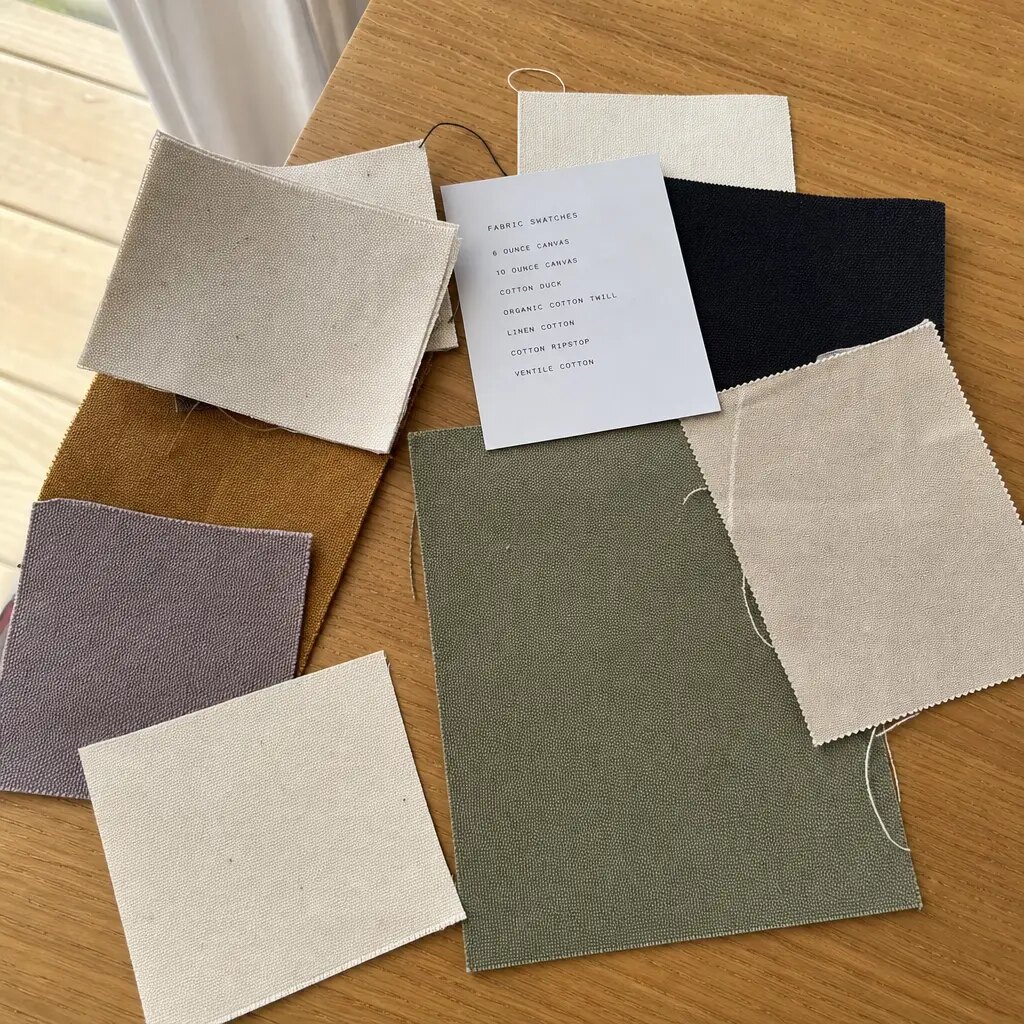
Ask suppliers to label swatches with fabric reference, GSM basis, treatment, and whether the material is stock or made to order. Swatches without production references are useful for mood boards, but weak for procurement control. For repeat hotel retail programs, the swatch becomes part of the specification.
- Approve natural tone, weave openness, stiffness, slub level, odor, and shedding before artwork approval.
- Ask whether fabric is stock, seasonal, or made to order; this affects repeat consistency and lead time.
- If lamination or coating is used, request material composition and odor review on a physical sample.
- Keep one approved swatch with the buyer and one with the supplier for bulk comparison.
Build Strength Into Construction
A finished jute tote is a construction package, not just a fabric panel. Body GSM, gusset depth, base shape, lining, handle material, stitch pattern, reinforcement, closure, label, and packing all work together. A well-built 320 gsm tote with reinforced handles can outperform a poorly sewn 400 gsm tote.
The gusset is a retail decision. A flat tote packs efficiently but will not hold boxed spa products, folded apparel, books, or multiple purchases as neatly as a gusseted bag. A wider gusset improves capacity and helps the bag sit upright, but it increases fabric use and adds seams that require inspection. If shelf standing matters, quote a bottom board or structured base separately.
Handles deserve special control because they are both a comfort feature and a failure point. Cotton webbing often feels softer. Jute webbing gives a consistent natural look. Wider handles can improve comfort for heavier purchases. Specify handle width, drop, attachment method, reinforcement patch, thread color, seam allowance, and load test. Do not let the factory choose by default.
- Specify finished width, height, gusset, top-mouth opening, base style, and whether the bag should stand, hang, or fold flat.
- Quote no lining, cotton lining, laminated backing, zipper, snap, pocket, and bottom board as separate options.
- Use stronger reinforcement and stitching before simply increasing GSM for heavier use.
- State handle-drop tolerance and check both sides for symmetry.
- Inspect recovery after the final carton packing method, not only open-table appearance.
Approve Decoration on Real Jute
Jute is coarse, uneven, and absorbent compared with cotton canvas or polyester. A logo that looks clean in a digital mockup can lose detail on natural fiber. Fine lines fill in, small letters close, and ink can look uneven where the weave has slubs or gaps. For hotel retail, decoration approval should happen on the final jute fabric.
One- or two-color screen print is often the best-value option for bold hotel logos, destination names, and simple high-contrast artwork. Specify print size, location, direction, Pantone or brand reference, and placement tolerance. A realistic placement tolerance may vary by bag size and process, so agree it before production.
For detailed marks, a woven label, cotton patch, leather-look patch, or sewn side label may look cleaner than direct print. The control point then becomes placement: label dimensions, stitch color, edge finish, and acceptable tolerance. Crooked labels are very visible on plain natural jute.
Heat transfer, embroidery, and multi-color print require extra testing. Transfers may not bond evenly on rough jute. Embroidery can distort lighter fabric if backing and tension are not controlled. Multi-color screen print can work, but registration is less forgiving on textured surfaces.
- Use screen print for bold one- or two-color artwork with adequate line thickness.
- Use labels or patches for small hotel marks, crests, or premium boutique positioning.
- Ask the printer for minimum line thickness and minimum readable text size.
- Approve a physical strike-off on the final GSM and treatment.
- Inspect print for position, density, sharpness, registration, rubbing, strike-through, and legibility.
Make Quotes Comparable
MOQ for custom jute tote bags is rarely one number. It can change by fabric GSM, finished size, body color, lining, handle material, decoration method, print color count, label type, packing format, and artwork version. A supplier may accept a low total quantity but require a minimum per design or per print color.
A strong RFQ gives each supplier the same product to price. Include finished dimensions, GSM range, GSM basis, natural or dyed jute, weave target, lining, handle drop, handle material, reinforcement, decoration method, artwork size, number of colors, labels, closures, bottom board, packing method, carton requirements, incoterm, destination, first order quantity, and forecast range if known.
Separate setup costs from unit costs. Screen charges, artwork setup, label tooling, sample fees, courier charges, barcode setup, and packaging development may be shown separately or absorbed into unit price. Either can work, but hidden costs make comparison unreliable. For repeat hotel retail programs, a higher setup cost may be acceptable if repeat consistency improves.
Carton data belongs in the first quote, not after supplier selection. Units per carton, carton dimensions, CBM, net weight, gross weight, inner packing, and outer marks all affect landed cost and receiving work.
- Request MOQ by size, GSM, color, artwork, print color count, label, lining, and packing method.
- Ask for separate lines for unit cost, sample cost, screens, labels, packing, inspection, and freight-related carton data.
- Use the same incoterm and destination when comparing suppliers.
- Reject quotes that omit GSM basis, handle construction, print method, carton quantity, or lead time assumptions.
Match Supplier Route to Buyer Need
The best supplier route depends on order profile. A direct factory in a jute-producing region can fit repeat programs, stable artwork, standard sizes, and quantities that meet MOQ. This route may give clearer visibility into fabric stock, sewing capacity, and repeat consistency. It may be less flexible for late artwork changes, small runs, or unusual trims.
A trading company or sourcing agent can help when a hotel group needs several retail products, multiple materials, or coordinated packaging across suppliers. The risk is unclear responsibility if fabric, printing, sewing, and packing are handled by different subcontractors. Ask who performs QC, who issues inspection reports, and who has authority to stop shipment or require rework.
A local converter or finisher may suit smaller launches, late decoration approval, or programs where local barcode and retail pack control matters. The buyer may get faster communication and easier sample review, but the true timeline may still depend on imported fabric or blanks. Extra handling can also create wrinkles, size variation, or repacking defects.
When two quotes differ sharply, map the process. One supplier may include inspection, retail packing, barcode application, and property-specific carton marks. Another may quote only basic production in bulk cartons. The lower unit price is not necessarily lower landed cost.
- Direct factory: best for repeat, standard, higher-volume programs with stable artwork.
- Agent or trading company: useful for multi-product coordination; verify QC authority and subcontractor control.
- Local converter: useful for decoration control or smaller launches; confirm raw material source and true timeline.
- Ask who owns corrective action for print, odor, size, stitching, packing, or carton failures.
- Include rework, replacement, delay, and reinspection responsibility in the purchase agreement.
Control Sampling Before Bulk
A sample should prove repeatability, not just show one attractive unit. For jute totes, review fabric tone, GSM, weave, stiffness, lining, handles, stitch quality, decoration, labels, folding, packing, and retail presentation. Photo samples can help early screening, but physical approval is important when the bag will be sold in a hotel shop.
Use staged approval. First approve fabric swatches for tone, weave, treatment, stiffness, odor, and GSM basis. Second, approve a decoration strike-off or label sample on the actual material. Third, approve a full pre-production sample made with final fabric, final handles, final lining, final decoration, final label, and final packing method.
Sample comments must be exact. “Approved with changes” is too vague for production. Use marked photos, measurement notes, and written approval conditions. If handle drop must increase by 2 cm, state it. If the logo needs to move 10 mm upward, state it. If the label is approved but stitch color is not, list the replacement thread color.
For larger or time-sensitive hotel programs, request in-line photos or an early production inspection after first units are made. This can catch print placement, handle reinforcement, or label alignment issues before the full order is sewn and packed.
- Approve swatch, print strike-off or label sample, pre-production sample, and packing method separately where practical.
- Use final materials for the pre-production sample; substitute fabric reduces approval value.
- Document revisions with measurements, marked photos, dates, and supplier confirmation.
- Keep sealed approved samples for final inspection and repeat orders.
Write QC and Packing Requirements
Quality control should be written before production begins. Jute has natural variation, but hotel retail buyers still need acceptance criteria. Define dimensional tolerances, GSM tolerance, print placement tolerance, label placement tolerance, stitch requirements, odor limits, and packing requirements. If using ANSI/ASQ Z1.4 or another inspection plan, agree on sampling level and AQL limits in the purchase order.
Dimension checks should include width, height, gusset depth, base, top-mouth opening, handle drop, handle width, and label position. For many sewn bags, around ±1 cm may be workable for major dimensions and handle drop, but the correct tolerance depends on bag size, construction, and factory capability. The key is written agreement before bulk starts.
Functional checks are essential because GSM alone does not prove strength. Define a practical load test based on intended use: static hanging, repeated lifting, or a buyer-defined fill test. After the test, inspect for handle pullout, seam opening, stitch breakage, fabric tearing, and permanent distortion.
Packing has a direct effect on retail condition. A hard fold across the printed front panel can leave a visible crease. Over-compressed cartons can flatten the base and distort the top mouth. Decide packing before quote comparison because it changes labor, carton quantity, CBM, gross weight, receiving work, and sustainability messaging.
- Define critical defects: mold, severe contamination, wrong logo, wrong material, unsafe hardware, or unusable construction.
- Define major defects: loose handles, open seams, out-of-tolerance dimensions, unreadable print, severe odor, major stains, or missing labels.
- Check units from multiple cartons and carton levels, not only factory-selected samples.
- Choose bulk pack, individual sleeve, tissue separation, hangtag, barcode, insert card, and carton marks before production.
- Inspect carton sealing, count accuracy, packing direction, carton damage, and recovery after unpacking.
Calculate Landed Cost and Claims Carefully
Lead time for custom jute tote bags is driven by more than sewing. Fabric availability, natural tone, GSM, lining, coating, printing, label production, sample approval, inspection, packing, export booking, freight, and local delivery can all affect the schedule. A standard natural jute tote with one-color print is simpler to plan than dyed jute with lining, zipper, custom label, multi-color decoration, and property-specific pack-outs.
Hotel retail launches often have fixed dates: property openings, seasonal shop resets, holiday programs, group arrivals, or conference events. Work backward from the required in-hand date at the hotel or distribution center. Include sample courier time, internal approval, bulk production, inspection, export clearance, freight, receiving, unpacking, tagging, and merchandising.
Landed cost should be calculated with equal assumptions for every supplier. Compare unit price, setup fees, sample fees, packing cost, carton count, CBM, gross weight, incoterm, freight mode, duty assumptions, inspection cost, and domestic delivery. A lighter tote may need lining to look retail-ready. A heavier tote may raise freight. Individual packaging may reduce dust and simplify barcode handling, but adds material and volume.
Sustainability claims should match the actual construction. Jute is a natural fiber, but the finished tote may include cotton lining, polyester thread, laminated backing, synthetic labels, plastic polybags, metal closures, or coated prints. Avoid broad claims that are not supported by material composition and documentation.
- Separate sample lead time, revision time, production time, inspection time, shipping time, and receiving time.
- Treat artwork, handle, lining, and packing changes as cost and schedule changes.
- Compare landed cost using equal incoterms, carton data, setup charges, and packing assumptions.
- Do not market the tote as fully natural or plastic-free unless every material and package supports that claim.
- Ask which specification choices shorten lead time and which create bottlenecks before committing to a launch calendar.
Specification comparison for buyers
| Spec decision | Recommended option | When it fits | Buyer risk to check |
|---|---|---|---|
| Body fabric weight | 300 to 350 gsm natural jute | Most hotel retail totes needing stable hand feel, credible shelf presence, and normal guest use without excessive weight | Confirm whether GSM is measured on base jute, treated jute, laminated fabric, or cut panel; request the supplier’s production tolerance |
| Premium body fabric weight | 400 gsm and above | Higher-ticket resort shop bags, structured silhouettes, wider gussets, or gift bundles with heavier contents | Higher GSM raises material and freight weight but does not fix weak handle stitching, poor panel squareness, or crushed packing |
| Economy body fabric weight | 250 to 280 gsm | Seasonal promotions, conference resale, light souvenir programs, or low-price retail items | Open weave can crease, shed, distort, and print unevenly; quote lining, lamination, or bottom board before assuming savings |
| Weave and surface | Medium-tight weave with controlled slubs | Hotel logos, destination artwork, and front-panel display where print clarity matters | Very open weave reduces print sharpness and can increase fiber release; approve a swatch and strike-off from production fabric |
| Lining or inner treatment | No lining, cotton lining, laminated backing, or coated inner layer | No lining for rustic value; cotton lining for cleaner interior; lamination or coating for structure and reduced fiber release | Lining changes unit weight, sewing time, odor risk, recycling story, carton volume, and landed cost |
| Handle construction | Cotton webbing, jute webbing, or reinforced self-fabric with box-and-cross or bar-tack stitching | Hotel shop, beach, spa, amenity, and boutique retail programs where comfort and failure prevention matter | Specify drop, width, reinforcement patch, stitch pattern, seam allowance, and load test instead of leaving handles to factory default |
| Handle drop | Hand carry: about 12 to 18 cm; shoulder carry: about 22 to 28 cm | Short drop for gift/shopper style; longer drop for resort, beach, or guest carry | State handle-drop tolerance, commonly around ±1 cm if suitable, and check symmetry on both sides |
| Decoration method | 1 to 2 color screen print on final jute | Bold hotel logos, destination names, and simple high-contrast artwork at volume | Fine lines can fill in and small text can disappear; approve minimum line weight and physical strike-off |
| Premium branding option | Woven label, cotton patch, leather-look patch, or sewn side label | Small detailed logos, boutique presentation, or artwork unsuitable for coarse jute printing | Control label placement, stitch color, edge finish, and placement tolerance because crooked labels are highly visible |
Buyer checklist before sampling
- Define the bag role: hotel shop retail, resort boutique resale, welcome amenity, spa gift, conference merchandise, beach service, minibar/local product bundle, or destination souvenir.
- Set the target retail price or perceived-value tier before choosing GSM; a low-price promotional tote and a boutique resort tote need different construction standards.
- Lock finished dimensions: width, height, gusset depth, top-mouth opening, base style, handle drop, handle width, handle material, and whether the bag must stand upright or fold flat.
- Specify body fabric GSM range and measurement basis: base jute, treated jute, coated jute, laminated fabric, or cut panel. Ask for the supplier’s normal tolerance.
- Request fabric swatches showing natural tone, weave openness, stiffness, coating or lamination if any, and acceptable slub level before approving artwork.
- State construction options clearly: no lining, cotton lining, laminated backing, zipper, snap, magnetic closure, inside pocket, bottom board, stiffener, hangtag, barcode label, or insert card.
- Give an intended load target in practical terms, such as apparel only, books and souvenirs, spa bottles, beach items, or retail purchases up to a stated kilogram or pound load.
- Specify handle attachment: box stitch, cross stitch, bar-tack, reinforcement patch, seam allowance, thread color, and whether reinforcement is visible or hidden.
- Send artwork in vector format and define Pantone or brand color reference, print size, print location, print direction, number of colors, and minimum readable text size.
- Require a print strike-off or label sample on the final jute weight when artwork contains thin lines, small text, halftones, multiple colors, or low-contrast ink.
Factory quote questions to send
- What body fabric GSM do you recommend for this finished size, gusset, handle type, and hotel retail use case, and what GSM tolerance do you normally control in bulk?
- Is the quoted GSM measured on base jute, treated fabric, coated fabric, laminated fabric, or cut panel? Can you provide a swatch marked with the exact production reference?
- What is the expected finished unit weight for each option, including handles, lining, label, closure, bottom board, and packaging?
- What carton quantity, carton dimensions, net weight, gross weight, and estimated CBM will apply to each packing method?
- What weave density, yarn style, coating, lamination, sizing, or finishing do you use for standard hotel retail totes, and are these materials from current stock or made to order?
- Can you quote the same bag in 280 gsm, 320 gsm, 350 gsm, and 400 gsm, with the same handle, print, and packing, so we can compare real tradeoffs?
- Can you quote no lining, cotton lining, laminated backing, zipper, snap, inside pocket, and bottom board as separate add-on lines rather than blending them into one price?
- What are the MOQ and price breaks per size, per colorway, per artwork version, per print color count, per label type, and per packing format?
- What handle materials are available, what are the standard widths and drop lengths, and what reinforcement method do you use at the attachment point?
- What load test do you recommend for the intended use, and how do you test it: static hanging, repeated lifting, or buyer-defined practical loading?
Quality-control points to confirm
- Verify fabric GSM using the agreed method, sample size, and tolerance. Record whether the tested material is base fabric, coated fabric, laminated fabric, or cut panel.
- Compare jute tone, weave openness, stiffness, visible slubs, coating feel, lamination uniformity, odor, and shedding against the approved swatch under consistent lighting.
- Measure finished width, height, gusset, base, top-mouth opening, handle drop, handle width, and label placement across units from multiple cartons, not only the top carton.
- Use written dimensional tolerances, such as ±1 cm for major bag dimensions and handle drop where suitable, or the supplier’s agreed production tolerance if different.
- Check panel squareness by laying the bag flat and confirming side seams, top edge, base corners, and gusset folds align without twisting or excessive asymmetry.
- Inspect seam allowance, stitch density, skipped stitches, broken stitches, loose threads, thread tension, exposed raw edges, and whether the top hem is secure and even.
- Review handle symmetry, reinforcement patches, box stitching, cross stitching, bar-tacks, and any puckering or fabric tearing around attachment points.
- Perform the agreed load check using the buyer’s intended load; inspect for handle pullout, seam opening, fabric tearing, stitch breakage, and permanent distortion after loading.
- Inspect print position, print size, color density, edge sharpness, registration, ink coverage, bleeding, cracking, strike-through, and small-text legibility against the approved strike-off.
- Rub the printed area with a dry white cloth and, if relevant, a lightly damp cloth to check for excessive ink transfer, dust, or fiber release that could affect retail presentation.