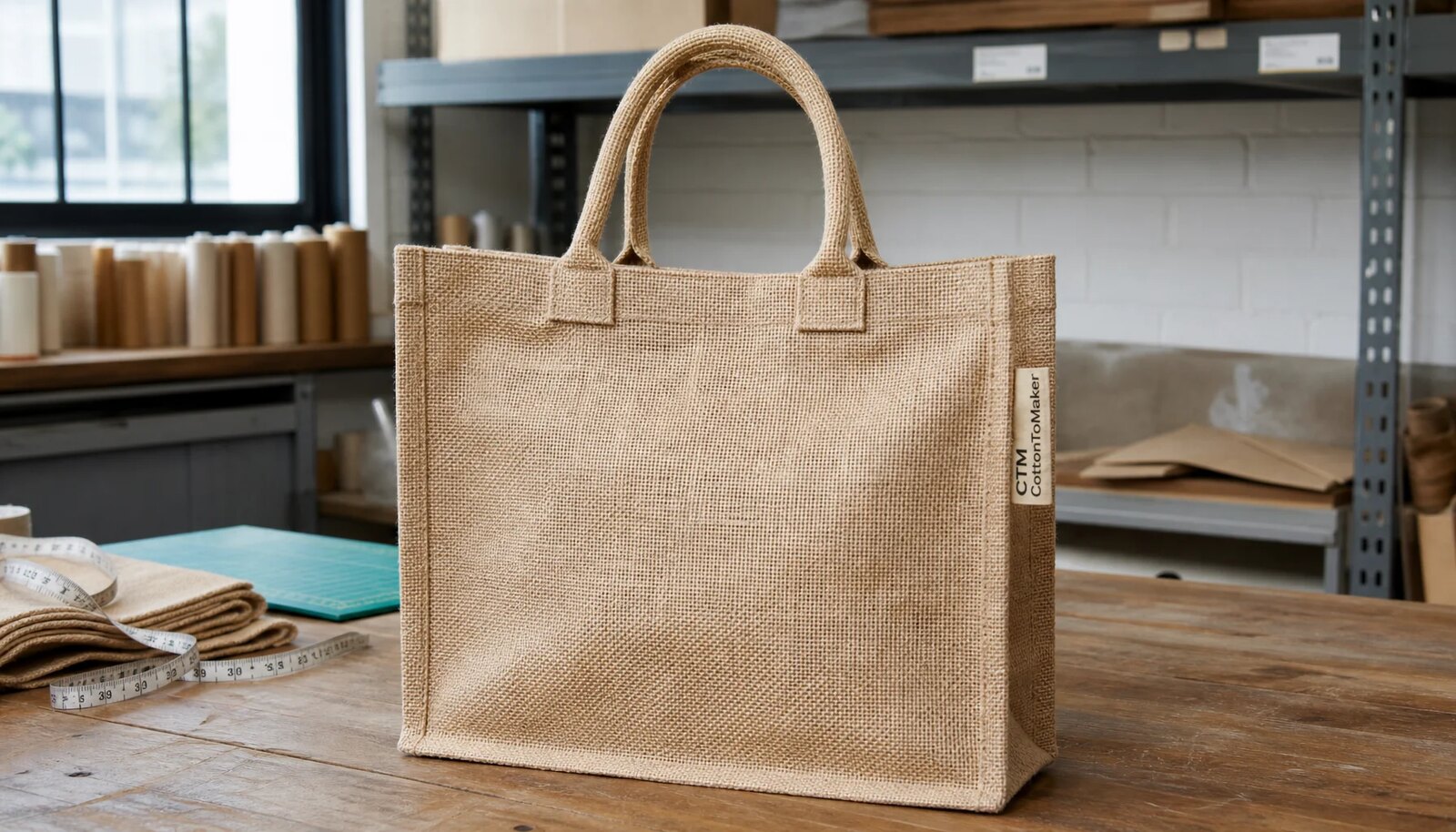
1. Start With the Bag’s Job, Not the Ounce Number
A custom jute tote bag is not just a fabric swatch with handles. For an eco apparel brand, it may be retail packaging, a reusable shopper, a gift-set component, a launch-event giveaway, or a sellable accessory. Each role changes the right fabric weight. A tote holding one folded tee and an insert card does not need the same body, gusset, or handle reinforcement as a bag carrying denim, boxed accessories, catalogs, or footwear add-ons.
The common shortcut is to send an RFQ that says, “14 oz jute tote with logo.” It feels precise, but it leaves too much open. Finished size, gusset depth, weave density, handle material, top hem, bottom seam, logo method, packing fold, and even the meaning of “14 oz” can vary from supplier to supplier. Two factories can quote the same ounce weight and still deliver bags that look, fold, print, and carry differently.
Start by translating the merchandising plan into measurable requirements. What goes inside the tote? How much will it weigh when filled? Will the bag sit upright on a retail shelf, hang from a display peg, ship flat in a carton, or be packed together with garments? Should the consumer reuse it often, or is it meant for a short campaign? Once those answers are clear, fabric weight becomes one decision inside a complete construction spec—not the whole spec itself.
- Define the bag role: promotional giveaway, retail packaging, sellable accessory, gift set, or reusable shopper.
- List expected contents and estimated fill weight, such as one tee and insert card versus denim plus boxed accessory.
- State the display requirement: stand upright, hang from peg, fold flat, fit a shipper carton, or arrive pre-packed with apparel.
- Clarify whether the bag is consumer-facing packaging, a product SKU, or both.
2. Jute Weight Terms: Oz, GSM, Raw Cloth, and Finished Construction
Jute fabric weight is usually quoted in ounces or GSM. In textile sourcing, ounces normally means ounces per square yard, while GSM means grams per square meter. The approximate conversion is 1 oz/yd² = 33.9 GSM. On that basis, 12 oz is about 407 GSM, 14 oz is about 475 GSM, and 16 oz is about 542 GSM. These numbers help you compare options quickly, but they are not a substitute for a supplier’s test basis.
The important procurement question is simple: what exactly is being weighed? The number may refer to raw jute cloth, laminated jute cloth, the outer body fabric only, or a supplier’s shorthand for the finished bag. Lamination, lining, coating, patches, and heavy handles can all change the finished feel and total bag weight without making the jute fabric itself heavier. If a lined tote is quoted as “16 oz,” ask whether that means the outer jute is 16 oz or the supplier is describing the overall construction.
Also look beyond the number. Weave density, yarn consistency, surface cleanliness, odor, and fiber shedding influence how the bag performs in retail. A tighter 13 oz jute can feel more stable than a loosely woven 15 oz material. Natural jute will show slubs, hairiness, color variation, and uneven yarns. Those traits are part of the material, but they still need an approved standard so bulk production does not look dirty, weak, or mixed-grade.
- Require both oz/yd² and GSM on the spec sheet, with the measurement basis clearly stated.
- Ask whether the weight excludes or includes lamination, lining, coating, or backing.
- Do not compare quotes unless fabric finish, weave grade, and construction are the same.
- Use a sealed physical swatch or sample because jute handfeel cannot be approved from a conversion table alone.
3. Practical Fabric Weight Bands for Apparel Tote Programs
For eco apparel brands, many commercial jute tote programs sit somewhere between 11 oz and 16 oz. Lighter weights can work for short-use promotions, but they may feel too soft for premium retail packaging. Heavier weights can improve structure and perceived durability, yet they also increase material cost, carton weight, stiffness, and freight cube. The right choice is not automatically the heaviest fabric. It is the lightest construction that meets your load, display, reuse, and complaint-risk requirements.
An 11-12 oz plain jute tote can be suitable for small formats, lightweight garments, tee packaging, or cost-controlled retail inserts. It needs careful checking if the bag has a wide gusset, a large panel, or a heavier fill. A 13-14 oz tote is often the most practical first sample for branded apparel retail bags because it usually gives a useful balance of cost, structure, and print surface. It is a good baseline before moving up to heavier fabric.
Use 15-18 oz when the tote is larger, the contents are heavier, or the brand wants a more structured premium presentation. But heavier jute is not a cure-all. A stiff body with narrow, uncomfortable handles may still disappoint consumers. On larger totes, reinforcement, handle width, seam allowance, bottom construction, and stitch pattern may improve performance more effectively than adding one more ounce to the body fabric.
- Use 8-10 oz only for light promotional use or short-distance carry, not premium retail positioning.
- Use 11-12 oz for small, cost-sensitive apparel bags with modest fill weight.
- Use 13-14 oz as the first commercial sample range for many eco apparel retail totes.
- Use 15-16 oz for premium structure, larger gussets, gift sets, or higher perceived value.
- Use 17-18 oz only when rugged structure is required and the team accepts extra stiffness and freight impact.
4. Construction Details That Can Matter More Than Fabric Weight
A jute tote usually fails at a sewn stress point, not in the middle of the fabric panel. Handles, bottom seams, side seams, gusset corners, and top hems carry most of the risk. A 16 oz bag with poor handle stitching can fail sooner than a 13 oz bag with better reinforcement. That is why procurement teams should specify the full construction instead of letting the factory choose the lowest-cost sewing method around a requested fabric weight.
Handle design deserves special attention. Options include self-jute handles, cotton webbing, rope, folded jute, padded handles, and inside reinforcement patches. Cotton webbing often feels softer in the hand; self-jute gives a more natural, uniform look. Neither is automatically better. Match the handle to the target fill weight, carry style, and brand presentation. State the handle width, handle drop, attachment area, stitch pattern, thread type, and reinforcement detail in the RFQ.
Bottom and gusset construction are just as important. A wider gusset helps the tote hold folded garments or gift boxes, but it puts more stress on bottom corners. A clean top hem improves opening shape and controls fraying. Binding can sharpen the look, though it adds more sewing points. Lining can make the inside cleaner for apparel contact, but it can also twist, bunch, trap debris, or reduce usable capacity if the factory does not control it well.
- Specify handle material, width, drop, stitch pattern, reinforcement patch, and thread color.
- Ask whether handle attachment will use box stitch, cross stitch, bartack, double row, or another defined pattern.
- Define side seam, bottom seam, gusset corner, top hem, binding, and lining construction in the PO.
- Require close-up sample photos of the inside and outside construction before bulk approval.
5. Print and Branding Limits on Coarse Jute
Jute has a coarse, open, irregular surface. It will not print like cotton canvas, polyester, or paperboard. Fine type may break. Small reversed letters may fill in. Gradients can look uneven. Dense solid ink areas may appear patchy because the ink sits on natural fibers with texture and height variation. A heavier jute can make the bag feel more stable, but it does not turn jute into a smooth print substrate.
Screen printing is usually the safer route for bold logos, simple artwork, and limited colors. Ask the supplier for the minimum line thickness, minimum text height, and recommended maximum print area for the actual jute being used. These limits vary by weave and finish, so approve them through a strike-off rather than a digital mockup. Heat transfer can sometimes hold finer detail, but adhesion, handfeel, cracking, and edge lift must be tested on the selected fabric. Embroidery can look premium, yet it may distort an open weave or feel too heavy for small marks.
For small brand details, consider woven labels, cotton patches, leatherette patches, or hangtags instead of direct print. This is especially relevant for QR codes, care instructions, sustainability messages, and small product text. If the information must remain readable after folding, packing, and shipping, inspect it after carton compression—not only when a fresh sample is laid flat on a table.
- Use bold logos, open spacing, and limited color counts for direct print on natural jute.
- Avoid thin outlines, small reversed text, gradients, detailed illustrations, and large untested ink blocks.
- Request a strike-off or pre-production print on the actual jute before approving bulk.
- Inspect print after folding and carton compression, not only when the sample is flat.
6. Lamination, Lining, Dyeing, and Sustainability Messaging
Jute is often chosen because it looks natural and supports a reusable packaging story. Extra finishes can help the bag perform, but they can also change that story. Lamination may add body, reduce fraying, stabilize the print surface, and provide light moisture resistance. It may also change the handfeel, create odor or blocking risk if poorly controlled, and make sustainability claims more complicated. If the bag is sold or described as a natural jute tote, the buyer should know whether a coating or backing is present.
Lining is a common upgrade for fashion retail, accessories, and gift sets. Cotton or canvas lining can make the inside feel cleaner and reduce direct contact between garments and loose jute fibers. Still, lining adds a second material with its own GSM, color, shrinkage behavior, and seam requirements. The spec should name the lining fabric, color, weight, seam method, and inspection tolerance. A lined tote that twists or bunches will not feel premium, even if the outer jute is correct.
Dyeing and colored trims need realistic expectations. Natural jute has inherent shade variation, so dyed jute may not match a brand standard as tightly as synthetic fabric, coated paper, or plastic trim. Request lab dips or color strike-offs before bulk. For handles, labels, and printed logos, review color under consistent lighting on the actual material. A digital file can guide the target, but it cannot prove how the color will appear on coarse jute.
- Ask whether lamination is present and which side is coated or backed.
- Specify lining fabric composition, GSM, color, seam method, and inspection tolerance.
- Request lab dips for dyed jute or colored trims before committing to bulk.
- Review sustainability claims carefully if the bag includes lamination, coatings, synthetic labels, or mixed-material trims.
7. RFQ Format: Make Supplier Quotes Comparable
A strong RFQ removes guesswork. Instead of asking for one broad price, request controlled alternatives. For example, ask for the same finished size, handle, print, packing method, and order quantity in 12 oz, 14 oz, and 16 oz plain jute. Then ask for separate adders for lamination, lining, woven labels, reinforced handles, individual packing, barcodes, and hangtags. This format shows where cost changes and prevents a false comparison between different bags.
Use volume breaks that match the real buying plan. If the program may be 1,000, 3,000, or 5,000 pieces, ask for those price levels. If there are multiple bag sizes, artwork versions, handle colors, or trims, ask how MOQ is applied. Is the minimum per size, per print design, per color, per label, or per total order? A quote may look attractive at total order level but become less practical once each SKU has its own minimum.
Ask for landed-cost inputs in the first round, not after sampling. Fabric weight, gusset depth, handle style, lining, and packing method all affect carton cube and gross weight. Heavier or loosely folded bags can raise freight and warehouse handling costs. A useful B2B quote includes unit price, setup charges, sample cost, tooling or screen charges, lead time, pieces per carton, carton dimensions, net weight, gross weight, Incoterms, and any assumptions the supplier used.
- Ask for the same construction quoted in multiple fabric weights so the price delta is clear.
- Separate base price from adders for lining, lamination, reinforcement, labels, hangtags, barcodes, and packing.
- Request MOQ by each variable: size, color, print, trim, lining, and packing method.
- Require carton dimensions and gross weight before sample approval so landed cost can be estimated.
8. Sampling Plan and Approval Tolerances
Sampling should be treated as a technical approval gate, not a quick logo check. A front-view photo does not prove that the tote is ready for production. Measure it, fill it, carry it, fold it, unpack it, and inspect the inside. Record finished width, height, gusset, handle drop, handle width, print placement, label placement, seam type, stitch pattern, and packing fold. If anything changes after sample approval, update the final spec sheet before bulk cutting.
Set tolerances before production begins. For many sewn tote programs, practical finished-dimension tolerances may be around +/-5 mm to +/-10 mm on smaller measurements and +/-10 mm to +/-15 mm on larger panels, depending on bag size and factory capability. Print and label placement may need tighter control when a logo must align with a seam, center panel, or pocket. Fabric weight tolerance is often discussed as a percentage, commonly around +/-5% when agreed by lot, but the final standard must be written into the PO and accepted by the supplier.
Keep sealed reference materials. Ideally, the buyer and factory each retain an approved pre-production sample. Keep approved swatches for jute shade, lining, trim, label, and printed color as well. With natural jute, a reasonable shade band may be necessary. The goal is not to reject every slub or natural fiber variation. The goal is to prevent uncontrolled variation that makes a shipment look mixed, dusty, stained, or lower grade than the approved sample.
- Measure and record dimensions, handle drop, print placement, label placement, seam type, and packing fold during sample review.
- Agree tolerances for fabric weight, finished size, placement, shade, and construction before cutting bulk fabric.
- Approve actual print strike-off, not only digital artwork.
- Keep sealed reference samples for final inspection and dispute resolution.
9. Bulk QC: What to Inspect Before Shipment
Final inspection for custom jute tote bags should combine measurement checks, appearance checks, functional checks, branding checks, and packing checks. The inspection plan should reflect order size, buyer risk, and retailer requirements. Many buyers use a recognized sampling plan such as ANSI/ASQ Z1.4 or ISO 2859-1, with acceptance levels agreed in advance. Even when a formal AQL plan is not required, define critical, major, and minor defects before inspection starts.
Functional checks should focus on likely failure points. Inspect handle attachment under tension, bottom seam strength, gusset corners, side seam security, top hem, lining attachment, and stitch consistency. Load testing should reflect the intended contents plus a sensible safety margin. If a tote is expected to carry 3 kg, lifting an empty sample tells you very little. Agree on the test load, hold time, lifting method, and number of pieces tested before production.
Appearance matters because the tote may touch finished apparel. Inspect for oil stains, mildew marks, excessive dust, loose fibers, strong odor, moisture, broken yarns, sharp creases, scuffs, shade mismatch, and dirty interiors. For printed or branded bags, check registration, placement, color consistency, ink coverage, pinholes, cracking, transfer lift, embroidery distortion, label alignment, and label stitch security. For lined bags, turn the bag inside enough to inspect loose threads, trapped debris, seam puckering, and lining twist.
- Use an agreed sampling plan or inspection quantity; do not rely only on supplier self-declaration.
- Classify defects before inspection: critical safety/contamination issues, major functional or branding issues, and minor appearance issues.
- Perform load checks using a defined weight, hold time, and sample quantity.
- Inspect inside surfaces because apparel may contact the bag during packing or consumer use.
- Compare bulk goods against the sealed sample, approved swatches, and signed spec sheet.
10. Packing, Moisture Control, Lead Time, and PO Readiness
Packing affects both presentation and landed cost. A tight fold saves carton space but can leave hard creases. A loose fold protects shape but increases freight volume. Handles may be folded inside, laid flat, banded, or protected depending on the retail presentation. Approve the packing method during sample review, not after production is finished. For retail-ready goods, request a packed sample or detailed photos showing fold method, bundle count, carton liner, and carton marks.
Moisture control matters with jute because it is a natural fiber. Bags stored or packed in damp conditions can develop odor, staining, or mildew risk. Depending on route, season, and warehouse conditions, buyers may request moisture-conscious storage, carton liners, desiccants, or pre-shipment moisture checks. Packaging choices should still fit the brand’s sustainability goals. Individual polybags can reduce dust and scuffing, but they may conflict with reduced-plastic expectations. Paper bands, bulk packing, or recycled-content packaging may be workable alternatives if they protect the goods well enough.
Plan lead time by milestone. Plain natural jute with a simple one-color logo may move faster than dyed, laminated, lined, reinforced, multi-label constructions. Custom woven labels, dyed handles, exclusive lining colors, special cartons, and retailer-specific barcode labels can each add setup time or separate MOQ. Do not release the purchase order until sample approval, final spec sheet, tolerance agreement, packing method, carton data, compliance requirements, inspection plan, and ship-ready date are aligned.
- Approve fold method, carton count, carton liner, bundle method, and handle position before bulk packing.
- Specify carton marks: PO, SKU, style, color, size, quantity, net weight, gross weight, carton number, and destination if required.
- Ask for sample, material sourcing, printing, sewing, inspection, packing, and ship-ready milestones.
- Confirm compliance documents, country of origin marking, fiber content description, and retailer receiving requirements before production.
- Evaluate landed cost using unit price plus setup, packing, freight cube, gross weight, duties, brokerage, warehousing, and rework risk.
Specification comparison for buyers
| Fabric / construction choice | Typical sourcing range | Best-fit use case | Quote and QC detail to verify |
|---|---|---|---|
| 8-10 oz plain jute | Approx. 270-340 GSM if converted by fabric weight; supplier must confirm basis | Light giveaways, event inserts, short carry distance, low-fill apparel promotions | Use only when low price is the priority. Check open weave, shedding, weak body structure, seam slippage, and whether the filled bag collapses on display. |
| 11-12 oz plain jute | Approx. 370-410 GSM; common entry retail range | Small to medium apparel totes, tee or accessory packaging, cost-controlled eco retail bags | Confirm finished dimensions, weave density, handle attachment, bottom seam strength, and load expectation. Do not approve from weight number alone. |
| 13-14 oz plain jute | Approx. 440-475 GSM; balanced commercial range | General eco apparel retail tote, boutique shopping bag, branded packaging with moderate reuse | Good first sample range for many brands. Verify print edge quality, color tone consistency, top hem, side seam, and carton compression marks. |
| 15-16 oz plain jute | Approx. 510-540 GSM; heavier structure | Premium retail bag, gift set, larger gusset, heavier folded garments, stronger shelf presence | Check stiffness, folding bulk, freight cube, handle comfort, needle holes, and whether reinforcement is upgraded with the heavier body. |
| 17-18 oz heavy jute | Approx. 575-610 GSM; rugged or structured build | Reusable shopper positioning, large tote sizes, boxed sets, higher target load | Require load testing by agreed method. Inspect handle fold-back, bartack/box stitching, bottom corner stress, and user comfort. |
| 14-16 oz laminated jute | Body cloth plus laminated backing; total measured weight may include coating | Cleaner shape, more stable print surface, light moisture resistance, retail display bags | Ask lamination type, coating side, odor control, blocking/sticking risk, fold-crack risk, and whether sustainability claims need qualification. |
| 14-16 oz jute with cotton/canvas lining | Outer jute plus separate lining cloth; weight must be specified by layer | Fashion retail, gift sets, accessories, products that should not contact loose jute fibers | Specify lining GSM, color, shrinkage expectation, seam method, inside cleanliness, needle holes, and lining twist/bunching tolerance. |
| 13-16 oz jute with reinforced handles | Body weight plus cotton webbing, self-jute handles, rope, or patch reinforcement | Heavier apparel, repeated carry use, retail complaints prevention | Define handle width, drop, attachment area, stitch pattern, stitch density, thread type, and target load test. Fabric weight cannot compensate for weak handles. |
| 13-16 oz jute with woven label or patch | Direct print reduced or replaced by sewn branding element | Fine logos, small text, boutique branding, QR code alternatives, private label packaging | Approve placement tolerance, label size, color, fray control, seam allowance, and whether label is sewn before or after bag assembly. |
Buyer checklist before sampling
- Define the commercial role first: giveaway, retail packaging, sellable tote, gift set, reusable shopper, or warehouse pick-pack component.
- State finished bag width, height, gusset depth, handle drop, handle width, expected contents, estimated fill weight, and whether the tote must stand upright.
- Specify whether fabric weight is raw cloth weight, laminated cloth weight, outer body layer weight, or finished construction shorthand.
- Use both oz/yd² and GSM where possible. 1 oz/yd² is approximately 33.9 GSM, but the supplier must confirm actual test basis.
- Request the same bag pattern quoted in at least three weight bands, such as 12 oz, 14 oz, and 16 oz, with all other variables held constant.
- Lock construction details before final price comparison: top hem, side seam, bottom seam, gusset, lining, lamination, binding, handle type, reinforcement, and label position.
- Define realistic tolerances before sampling: finished dimensions, handle drop, print placement, label placement, fabric weight, and carton quantity.
- Require the supplier to identify which processes are in-house and which are subcontracted: cloth sourcing, dyeing, lamination, printing, sewing, inspection, and packing.
- Ask for minimum line thickness, minimum text height, maximum print area, ink type, and sample print method for direct printing on jute.
- Approve a pre-production sample with close-up photos of handle attachment, bottom corners, inside seams, print edges, top hem, label, and packing fold.
Factory quote questions to send
- Is the quoted fabric weight measured as raw jute cloth, laminated jute, outer body layer only, or finished bag construction?
- Please state the fabric weight in oz/yd² and GSM, the conversion basis, and the bulk tolerance you can hold by lot.
- What is the acceptable tolerance for finished width, height, gusset, handle drop, print placement, and label placement?
- What weave count, yarn count, or internal cloth grade is included in this quote, and can it remain consistent across the full order?
- Will the jute be natural, bleached, dyed, laminated, washed, calendared, or otherwise finished before cutting?
- What handle style do you recommend for the bag size and target fill weight: self-jute, cotton webbing, rope, folded jute, padded, or reinforced patch?
- What stitch pattern will be used at the handle attachment: box stitch, cross stitch, bartack, double row, or another method?
- What stitch density, thread type, and seam allowance do you normally use for this construction?
- What target load test can you perform on the approved sample and on bulk goods, and how many pieces per lot will be checked?
- Which print method do you recommend for this artwork on the specified jute: screen print, transfer, embroidery, woven label, leatherette patch, cotton patch, or hangtag?
Quality-control points to confirm
- Verify fabric weight by lot using an agreed test method. For many programs, buyers request a tolerance such as +/-5% on fabric weight, but the exact tolerance must be agreed in writing with the supplier.
- Measure finished bag width, height, gusset, handle drop, handle width, and top opening against the sealed sample and purchase-order spec.
- Use practical finished-size tolerances. Common tote tolerances may be around +/-5 mm to +/-10 mm for small dimensions and +/-10 mm to +/-15 mm for larger panels, but the PO should define the accepted range.
- Check fabric appearance across the lot: weave density, slub level, shade band, oil spots, stains, mildew marks, dust, loose fibers, broken yarns, and color difference between panels.
- Inspect top hem, side seams, bottom seam, gusset corners, lining attachment, binding, and raw-edge control for fraying or seam slippage.
- Inspect handle attachment under tension. Confirm stitch pattern, thread quality, stitch density, reinforcement patch size, and that needle holes do not tear the jute fibers.
- Perform an agreed load test on samples and in-line/bulk inspection. The test load should reflect the buyer’s intended fill weight plus a safety margin, not an arbitrary promotional-bag claim.
- Check print or branding for registration, placement, edge spread, pinholes, ink coverage, color consistency, transfer adhesion, embroidery distortion, label alignment, and stitch security.
- For small text, QR codes, sustainability messages, and care marks, inspect readability on the actual jute surface after folding and carton compression.
- Check laminated jute for bubbling, delamination, odor, blocking, cracked fold lines, and uneven coating.