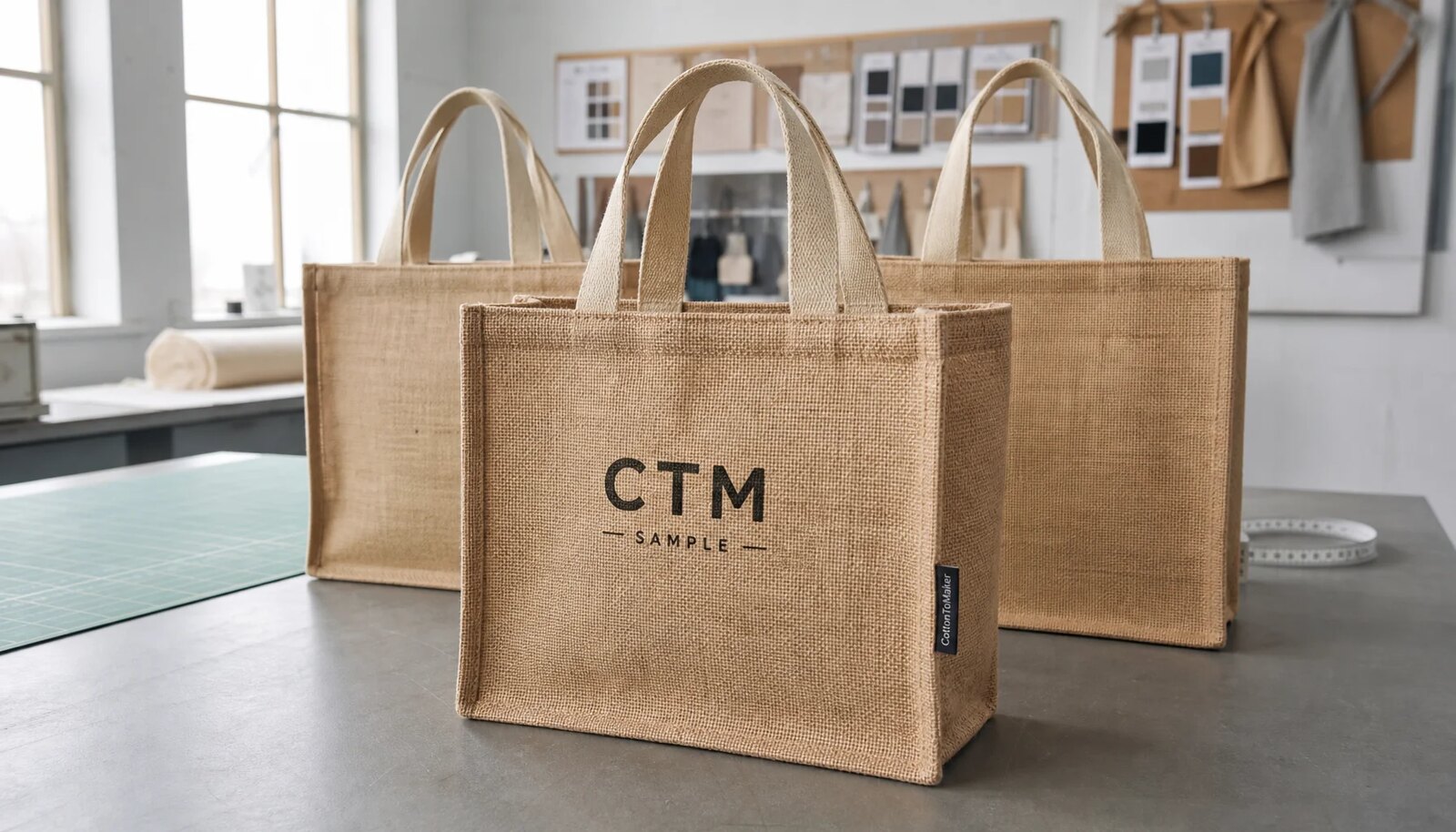
Why Craft Fair Use Changes the Durability Standard
A craft fair tote is handled harder than a normal giveaway bag. It sits on a booth hook, gets folded under tables, carries heavy small products, and may be reused across a weekend. The failure points are usually not the front panel first. They are the handle seam, bottom gusset, top hem, and print surface after repeated rubbing.
For procurement teams, the buying problem is simple: the bag must look handmade-friendly without behaving like a fragile decorative sack. A custom jute tote bags durability testing checklist for craft fairs should therefore test the same stresses the buyer's customer will create at the event: loaded lifting, repeated opening, abrasion against packaged goods, short drops, and carton recovery after shipment.
- Set a target load such as 5 kg for light craft goods or 8 kg for heavier mixed items.
- Treat handle attachment as a structural decision, not only a style detail.
- Judge jute texture honestly; natural slubs are acceptable, weak seams are not.
- Inspect the bag after packing and unpacking because creasing can change shelf presentation.
Choose Jute GSM Before Comparing Prices
Jute tote quotes can look close on paper while the real fabric is very different. A low-weight open-weave jute may be fine for a simple gift sleeve, but it is risky for craft fairs where the bag is expected to carry jars, pottery, candles, or books. For most reusable craft fair totes, buyers should start around 260-320 GSM for laminated jute or 300-360 GSM for unlaminated jute, then adjust for size and load.
Lamination changes the buying decision. Laminated jute holds shape better, protects the back side of printing, and helps the bag stand upright at a booth. Unlaminated jute has a softer natural feel but can stretch more and may shed fibers. Neither option is automatically better; the right choice depends on product weight, event positioning, and how sharply the logo must print.
- Use higher GSM when the tote has a wide gusset or long handles.
- Use laminated jute when upright display and cleaner internal finish matter.
- Use unlaminated jute when a softer, more natural hand feel is more important than stiffness.
- Request fabric swatches with the quote, not only after the price is accepted.
Handle Construction Is the Main Failure Point
Most jute tote failures during real use happen where the handle joins the bag. Coarse jute fabric does not hold stitch tension the same way dense cotton canvas does. A narrow handle stitched directly onto a low GSM panel may look acceptable in a photo but start tearing when the user swings the bag with heavy goods inside.
For craft fair procurement, specify handle width, handle drop, material, and stitch pattern. Cotton webbing handles are often more comfortable and stable than twisted jute rope for reusable totes. A box stitch with cross tack and an inner reinforcement patch gives the factory a clear construction target and gives the inspector a visible acceptance standard.
- Common handle width range: 2.5-3.8 cm depending on bag size and load.
- Common hand-carry drop: around 18-22 cm; shoulder-carry drop usually needs more testing.
- Reinforcement patches reduce tearing on coarse or open-weave jute.
- Reject skipped stitches, loose thread nests, or handle ends that are not fully secured.
Printing on Jute Needs Different Artwork Rules
Jute is not a smooth advertising panel. The weave is uneven, the yarn color varies, and the surface absorbs ink differently from cotton canvas. Screen printing works well for many craft fair designs when the artwork uses solid shapes, clear text, and limited colors. Very fine lines, small reversed text, and large flooded backgrounds can produce inconsistent edges.
If the brand requires gradients, small multi-color artwork, or photographic detail, a transfer or sewn label may be more controllable. That does not mean it is always better. Transfers can feel less natural on jute, and labels add sewing steps and placement tolerance. The RFQ should define print method, print size, color count, artwork margin from seams, and acceptable texture variation.
- Keep small text large enough to stay readable over the jute weave.
- Avoid critical logo details too close to side seams or the bottom gusset.
- Use Pantone references for ink, but allow realistic variation on natural jute.
- Approve a printed sample under normal daylight and indoor booth lighting.
Build a Practical Durability Test Plan
A useful test plan does not need to be complicated, but it must be repeatable. The buyer should define the load, number of lifting cycles, drop height, and pass-fail condition before production starts. If the factory only tests one perfect sample at the sewing line, the result does not protect a full shipment. Random finished goods must also be tested.
For craft fair use, the test should simulate a customer buying multiple small heavy items, carrying the tote between booths, and setting it down repeatedly. The pass condition should include no handle tearing, no seam opening, no major bottom distortion, and no print transfer after normal handling. The test load should match the buyer's product category instead of using a generic number.
- Loaded lift test: fill to target weight and lift repeatedly by both handles.
- Short drop test: drop the loaded bag from hand height onto a clean flat surface.
- Swing test: gently swing loaded bags to stress handle seams and side panels.
- Abrasion check: rub printed area against carton board or packaged goods to see if ink transfers.
- Post-test review: inspect handle seams, bottom gusset, side seams, top hem, and logo.
MOQ Logic and Cost Drivers
MOQ for custom jute tote bags is driven by fabric purchasing, handle tape, print setup, labor efficiency, and packing. A very low quantity may be possible, but the unit price often includes setup waste, sample handling, and lower cutting efficiency. A higher MOQ can reduce unit cost if the same fabric, same handle, and same artwork are used across the order.
Buyers should not treat every quote difference as supplier margin. A bag with 320 GSM laminated jute, cotton webbing handles, reinforcement patches, and two-color screen print should cost more than a thin unreinforced tote with one-color print. The important comparison is whether each supplier quoted the same construction and whether the durability level matches the event risk.
- Main cost drivers: GSM, lamination, bag size, gusset depth, handle material, reinforcement, print area, color count, and packing.
- MOQ can rise when handles are custom dyed, labels are woven to order, or artwork needs special ink.
- Large print areas increase ink use, drying space, and rejection risk on coarse jute.
- Carton volume can affect landed cost as much as a small unit-price difference.
Sample Approval Should Prove More Than Appearance
A sample made from substitute fabric is useful for size discussion, but it is not enough for bulk approval. The approval sample should use the same jute GSM, same lamination choice, same handle tape, same stitch pattern, and same print method planned for production. Otherwise, the buyer approves a shape while the real durability remains untested.
The sample review should be written like a small inspection report. Measure the bag, load it, carry it, fold it, smell it after it stays in a closed polybag, and compare the print to artwork. When a change is needed, document it clearly: increase handle stitch length, move logo up 2 cm, reduce print size, change handle drop, or add a reinforcement patch.
- Measure width, height, gusset, handle drop, print size, and logo position.
- Test the sample with the expected product weight, not empty.
- Photograph pass and fail points so production staff understand the correction.
- Keep one approved sealed sample for factory reference and one for buyer inspection.
Packing Can Create or Prevent Complaints
Jute reacts to moisture and compression more than many synthetic promotional bags. If cartons are over-packed, the bags may arrive with crushed gussets, bent handles, or permanent creases in laminated panels. If cartons are under-protected, humidity and odor complaints can appear after ocean freight or warehouse storage.
The packing plan should include pieces per inner polybag, pieces per master carton, carton board strength, moisture protection, and whether the bags are flat packed or lightly folded. Buyers should request carton dimensions and gross weight before confirming the order because freight cost and handling risk depend on packing, not only product unit price.
- Flat packing usually protects shape better than tight folding for laminated jute.
- Use moisture-control planning when shipping during humid seasons or long ocean routes.
- Avoid cartons so heavy that warehouse staff drag them and damage corners.
- Inspect carton recovery: open a packed carton after 24-48 hours and review bag shape.
Lead Time Risks Buyers Often Miss
The quoted production lead time usually starts after sample approval, artwork approval, deposit, and material confirmation. Delays happen when buyers approve the unit price but leave handle color, label artwork, carton mark, or print size unresolved. Jute material availability can also vary by season and by required GSM.
A realistic schedule separates sampling, sample review, material booking, bulk production, inspection, packing, and shipping. For craft fairs with fixed event dates, the order needs a buffer for sample remake and final inspection. Rushing the print or packing stage increases the chance of wet ink transfer, poor carton recovery, or missed stitch defects.
- Lock artwork before screen making; small changes can reset the sample timeline.
- Confirm bulk fabric availability before announcing event delivery dates.
- Allow time for buyer-side sample testing, not only courier transit.
- Plan inspection before final carton sealing if the order has new construction.
Quote Data Needed for a Fair Landed-Cost Comparison
A low FOB unit price can become expensive if the carton is bulky, the rejection rate is higher, or the bag needs repacking before retail distribution. Procurement teams should compare quotes with both product data and logistics data. The same tote specification may produce different landed costs depending on carton quantity, carton size, gross weight, and packing density.
The RFQ should request a structured quote: fabric GSM, lamination, bag dimensions, handle details, print method, print size, color count, MOQ breaks, sample fee, production lead time, packing, carton data, and inspection support. This lets the buyer compare total cost and risk instead of negotiating blindly against an incomplete unit price.
- Compare at the same quantity breaks, such as 500, 1000, 3000, and 5000 pieces.
- Require carton CBM and gross weight to estimate freight before order confirmation.
- Separate tooling or screen charges from unit price for cleaner reorder comparison.
- Record sample terms because free-looking samples may be recovered elsewhere in the quote.
Specification comparison for buyers
| Spec decision | Recommended option | When it fits | Buyer risk to check |
|---|---|---|---|
| Jute fabric weight | 260-320 GSM laminated or 300-360 GSM unlaminated jute | Craft fairs where bags carry candles, ceramics, soaps, packaged food, or small books | Low GSM jute may stretch at the handle seam and show open weave holes after repeated loading |
| Inner construction | Laminated jute with clean folded top hem for better shape retention | Retail booths needing upright display, easier wipe-clean surface, and sharper print registration | Very stiff lamination can crack on folds if carton compression or cold storage is poor |
| Handle material | Cotton webbing or jute-cotton blended webbing, 2.5-3.8 cm wide | Buyers needing a softer hand feel than twisted jute rope and better stitch stability | Thin rope handles can pull through coarse jute unless reinforced with patches or metal eyelets |
| Handle attachment | Box stitch with cross tack plus inner reinforcement patch | Bags expected to carry 5-8 kg during crowded craft fairs | Simple straight stitching may pass appearance inspection but fail after swing and drop testing |
| Print method | Screen print for 1-3 solid colors; heat transfer only for fine gradients or small art runs | Most craft fair logos, maker names, and sponsor marks on natural jute | Fine reversed text can fill in because jute weave is uneven; artwork needs minimum line thickness |
| Bag size and gusset | Medium tote around 35 x 40 x 15 cm or event-specific size with 12-18 cm gusset | Reusable shopper format that fits boxed craft goods without becoming too bulky | Oversized panels increase sagging and carton volume; undersized gusset reduces perceived value |
| Sample approval | Pre-production sample made from bulk fabric and actual print screens | Orders where color, handle strength, and logo sharpness are commercially important | A photo-only sample cannot prove load rating, odor, lamination feel, or carton recovery |
| Packing method | Flat packed 25-50 pcs per polybag or master carton with moisture protection | Export shipments where jute odor, humidity, and corner crushing must be controlled | Over-compressed cartons can create permanent creases and distorted gussets before delivery |
Buyer checklist before sampling
- Define the expected carrying load in kilograms and the real product mix: candles, ceramics, soaps, jars, books, apparel, or mixed merchandise.
- Specify jute GSM, lamination preference, bag size, gusset depth, handle width, handle length, and reinforcement method in the RFQ.
- Set handle pull test and loaded carry test requirements before sampling, not after the bulk goods are finished.
- Approve print artwork with minimum line thickness, safe margin from seams, and acceptable ink coverage on coarse jute texture.
- Request a pre-production sample using bulk fabric, actual handle tape, actual print process, and final packing method.
- Include carton size, pieces per carton, gross weight, moisture protection, and pallet or floor-loaded shipment preference in the quote request.
- Compare quotes using the same GSM, construction, print area, packing, sample policy, and inspection standard; do not compare only unit price.
- Reserve lead time for sample remake if handle stitching, odor, print sharpness, or carton recovery fails approval.
Factory quote questions to send
- What jute GSM and lamination thickness are included in the quoted price, and can you provide a swatch from the same fabric lot planned for production?
- What handle material, width, length, and stitch pattern are included, and what loaded pull test can the factory support before shipment?
- Is the quoted printing screen print, heat transfer, digital transfer, or woven/sewn label, and what is the maximum print size included in the price?
- What is the MOQ for this construction and how does the price change at 500, 1000, 3000, and 5000 pieces with the same specifications?
- Does the sample fee include actual jute fabric, final handle tape, bulk print method, and final packing, or is it only a prototype for shape approval?
- What is the normal production lead time after sample approval, and which materials could extend the schedule: dyed handles, laminated jute, special ink, or custom labels?
- What carton dimensions, pieces per carton, gross weight, and moisture protection are planned for export packing?
- Can the factory share in-line and final inspection photos showing handle stitching, top hem, print placement, carton condition, and random load testing?
Quality-control points to confirm
- Fabric GSM tolerance should be agreed in writing, commonly within a practical range such as plus or minus 5%, because jute is a natural fiber.
- Finished bag size tolerance should be realistic for jute, with tighter tolerance on handle drop and logo placement than on minor weave variation.
- Handle attachment should survive repeated loaded lifting and short-distance swing tests at the buyer's target load, not only a static display test.
- Top hem, side seams, bottom gusset, and handle patches should show no skipped stitches, open seams, loose threads, or raw edges that can unravel.
- Print should be legible at normal viewing distance, with agreed tolerance for jute texture but no major smearing, missing logo parts, or ink transfer.
- Odor and moisture condition should be checked after cartons remain closed, because jute can trap humidity during storage and ocean freight.
- Cartons should protect bag corners and gussets without over-compression that creates permanent fold marks or crushed lamination.
- Final inspection should include packed-carton review, not only loose bag inspection on the sewing table.