Why carton planning matters for exhibitor jute totes
Custom jute tote bags are simple to specify in theory and easy to mishandle in practice. For a trade show exhibitor, the bag is not just a product sample or a giveaway item. It is part of the event logistics, part of the brand presentation, and part of the receiving plan. If the cartons arrive late, are mislabeled, or are packed in a way that slows booth setup, the unit price stops mattering very quickly. The carton plan is therefore not a back-office detail. It is part of the procurement spec.
The buyer problem is usually not the tote itself. It is whether the right quantity of usable bags arrives at the right dock, in the right cartons, with a packing pattern the booth team can work with. A supplier can quote a low bag price and still produce a high-risk shipment if carton strength, carton count, labeling, and weight limits are left open. That is why this keyword topic matters for procurement: custom jute tote bags carton packing plan for trade show exhibitors should be treated as a single buying decision, not three separate ones.
- Compare quotes on landed cost per usable bag, not only FOB unit price.
- Write down the receiving route early: venue dock, advance warehouse, hotel dock, 3PL, or internal office.
- Keep carton weight within a range that one person can lift safely without dragging or re-taping corners.
- Treat label format, carton count, and packing sequence as purchase order items, not informal packing instructions.
Lock the bag specification before you ask for carton dimensions
Carton planning starts with the physical bag. A flat 14 x 16 in tote behaves very differently from a 15 x 16 x 5 in gusseted tote, and laminated jute packs differently from raw jute. Handle width, handle length, print area, and whether the bag is flat or boxed all affect how many pieces can fit into one carton without the bag being crushed or permanently creased. If the factory has not seen a complete bag spec, it can only guess at the carton plan.
For trade show use, 13 oz to 15 oz jute, or roughly 380 to 430 GSM, is a practical range because the bag feels substantial enough to carry catalogs, samples, and light retail items. Lighter constructions can be acceptable for single-use handouts, but they show wrinkles more easily and may collapse when stacked. Heavier constructions improve body and shelf presence, but they also increase bulk and can become more expensive to ship if the carton count is not tuned to the actual size. Buyers should ask for the carton implications of the chosen fabric before approving the final spec.
- Flat tote: lower CBM, simpler carton loading, good for brochure handouts.
- Gusseted tote: better stand-up shape, more usable volume, higher carton bulk.
- Laminated jute: cleaner interior and more structure, but more prone to visible fold marks.
- Unlaminated jute: softer and more natural, but more sensitive to moisture and surface shedding.
- Long handles: useful for shoulder carry, but they need a consistent fold pattern for packing.
Choose a packing pattern that protects the bags and speeds booth setup
The best carton is not always the tightest carton. It is the carton that keeps the bags presentable, countable, and easy to distribute when the booth opens. For most trade show orders, flat packed bundles are the right starting point. Putting bags into inner bundles of 25 or 50 pieces keeps the handles aligned, makes receiving checks faster, and reduces the chance that staff will open multiple cartons just to find a few pieces for first-day use. Loose random packing is usually a poor fit for event logistics because it makes counts slower and wrinkles more likely.
A common shipping model is 100 pieces per export carton for bulkier gusseted totes and 150 pieces per carton for flatter, lighter bags, but the factory should prove that number with the actual sample. The right count depends on carton dimensions, bag thickness, print drying time, and the weight that the final handler can move without damage. Buyers should insist on a measured carton plan, not a rounded estimate. When cartons are overfilled, handles deform and the bag faces crease. When cartons are underfilled, freight efficiency drops and the shipment becomes more expensive per usable bag.
- Use bundle sizes of 25 or 50 pieces for faster counting and lower handling confusion.
- Align all logos in the same direction where practical so receiving staff can inspect quickly.
- Fold handles in one repeatable direction to reduce pressure marks on printed panels.
- Use strong tape and a snug carton fill, but avoid bulging corners or crushed gussets.
- Confirm whether the final carton count changes after print drying, especially for heavy ink coverage.
Match the print method to the route and the drying window
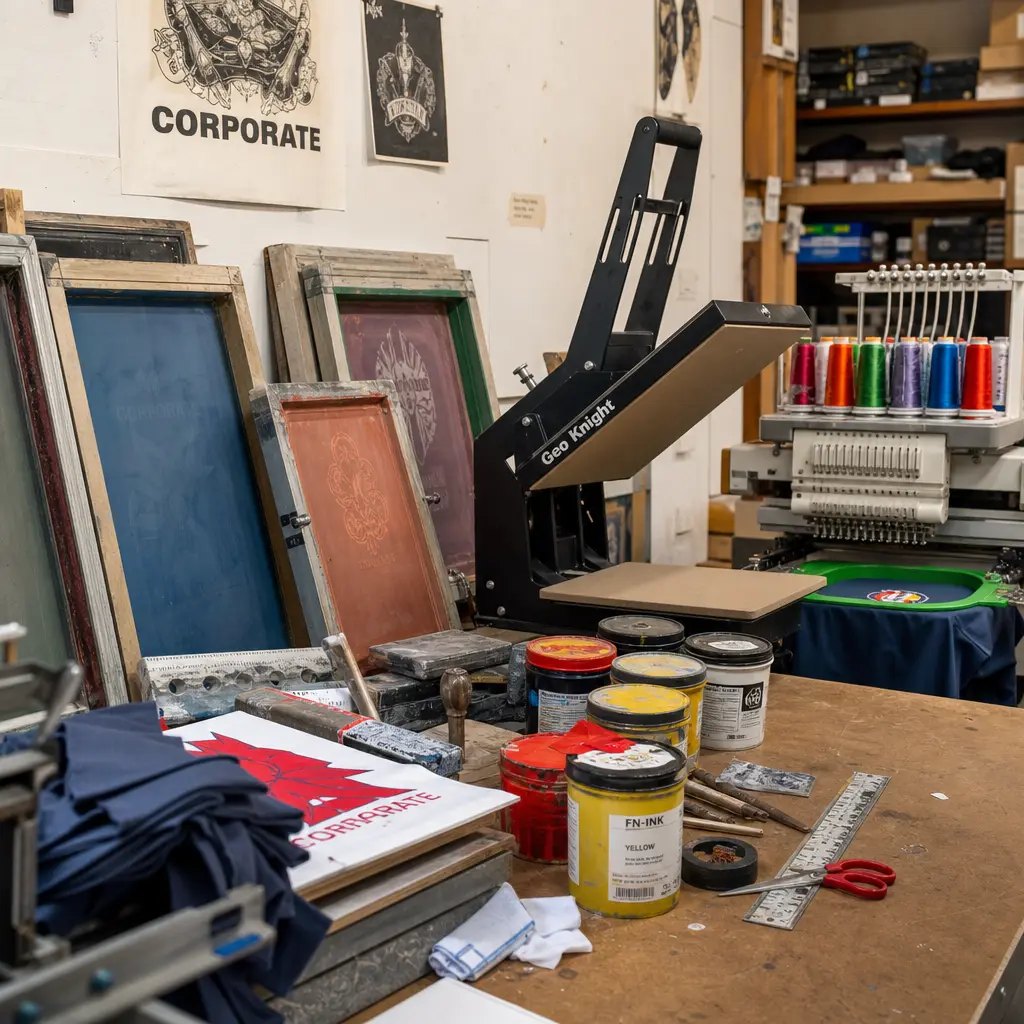
Screen printing remains the most practical method for many custom jute tote bags because the artwork is often a logo, event name, or sponsor mark in one to three colors. It gives predictable pricing and is usually suitable for the larger, simpler graphics common in trade show programs. The downside is that jute texture is uneven, so tiny text, thin rules, and tight registration can break up. The supplier should review the artwork at actual size and state clearly what is realistic on the selected jute grade.
Heat transfer can be a useful alternative when the artwork needs more detail, but it changes the feel of the surface and may not suit every natural-fiber look. Digital print is not the default for standard jute totes and should only be considered if the bag material and supplier process support it. The packing plan must also account for drying or curing time. Bags that are bundled before the ink is dry can pick up offset marks, odor, or blocking. That risk matters for trade show exhibitors because the bags often go directly to a warehouse or venue where presentation quality is visible the moment cartons are opened.
- For one-color and two-color logos, screen print usually gives the best cost-to-result balance.
- For fine detail, reduce line complexity or move the graphic to a smoother panel rather than forcing detail onto rough jute.
- For multi-color artwork, request a strike-off and define acceptable registration tolerance in writing.
- For dark-dyed or laminated jute, confirm ink adhesion and opacity on the actual material.
- For large runs, ask when the printed bags can be packed without offset or sticking.
Build MOQ around event volume, not supplier convenience
MOQ is rarely just a sales policy. It is usually the result of fabric purchase size, cutting efficiency, screen setup, labor time, and how much carton space the factory needs to make a job worthwhile. A buyer requesting 120 custom pieces with a custom size, reinforced handles, and event-specific labels should expect a different price structure from a buyer ordering 1,000 standard totes. The useful question is not just what the MOQ is, but why that MOQ exists and whether there is a standard size or material that can make the order more efficient without weakening the brand result.
For exhibitors, it helps to quote quantity breaks that match actual usage. A small run may fit a single booth, while a mid-size run might support a regional distributor or a chain of shows. A larger quantity can reduce the unit price and improve carton efficiency at the same time. The factory should show how the carton plan changes at each break, because more pieces do not always mean better landed cost. If the bag gets more efficient but the carton count becomes harder to move, the real savings may disappear in freight or handling fees.
- Request quote breaks that reflect real event scenarios, such as 300, 500, 1,000, and 2,500 pieces.
- Separate sample fee, print setup, and unit price so small-run economics are visible.
- Ask whether a stock bag size or stock jute width can reduce MOQ and shorten lead time.
- Confirm whether label printing, barcode stickers, or event routing marks are included or extra.
- Do not accept a low MOQ quote that depends on material substitution without written approval.
Use sample approval to prove the bag and the packing method
A pre-production sample should do more than confirm the logo. It should prove the bag structure, handle feel, print result, fold direction, and the way the product behaves after bundling. For trade show orders, one loose sample is not enough because the bag can look acceptable on a table and still pack poorly in a carton. The buyer should ask for the intended folding and bundling method, then review the sample after it has been compressed in a test carton or packed the way the mass order will be packed.
Jute naturally shows texture, shade movement, and slight fiber irregularity. Those traits are not defects by themselves. The real risk is when the packing method turns a good-looking bag into a wrinkled, crushed, or ink-marked one. If the bags will be handed to visitors, photographed at the booth, or used as sponsor gifts, unpacked appearance matters. The factory can usually adjust the bundle size, carton height, or handle fold pattern before production is locked, but only if the sample review includes packing, not just print approval.
- Approve one flat sample for dimensions, print, and handle construction.
- Approve one packed sample or test bundle to review compression and fold marks.
- Ask for photos of the intended bundle and carton arrangement before mass packing.
- Record the approved fold direction, logo orientation, and bundle count in the final spec sheet.
- If time allows, request a sample carton or partial carton for manual handling review.
Write carton labels for trade show routing, not just factory storage
Carton labels become critical once the shipment leaves the factory. A trade show order may move through a freight forwarder, customs broker, advance warehouse, venue dock, drayage company, or hotel receiving desk before the boxes are ever opened. If the carton label only says item name and quantity, it may not be enough for the receiving team to identify the right shipment quickly. Labels should connect the carton to the purchase order and the event receiving instructions, not just to the factory packing list.
Good labels also help booth staff open the right cartons first. A line of identical export cartons is difficult to manage if there is no clear carton sequence or destination data. The buyer should tell the supplier whether the event organizer requires specific receiving marks, whether carton codes must match an ASI or distributor routing sheet, and whether a second label is needed on the short side of the carton. This is one of the easiest areas to standardize and one of the most common sources of avoidable receiving friction.
- Include PO number, item code or SKU, product description, and quantity per carton.
- Add event name, exhibitor name, booth number, and warehouse or dock address when provided.
- Mark carton sequence clearly, such as 1 of 12, 2 of 12, and so on.
- Show gross weight, net weight, carton dimensions, and country of origin where required.
- Keep one label on the long side and one backup label on the short side for easier identification.
Compare landed cost using CBM, handling, and receiving risk
A low factory price can be misleading when the carton plan is inefficient. Jute tote bags are bulky relative to many other giveaway items, and gusseted styles or long handles can push the CBM up fast. Buyers should insist on carton dimensions, gross weight, and piece count in every quote. Without those numbers, a freight forwarder cannot give a realistic air, sea, truck, or warehouse estimate. This matters most when the show date is fixed and there is no room to absorb delays.
For urgent event shipments, air freight makes carton efficiency far more important. Even a small increase in carton volume can create a meaningful cost swing. For sea freight, the volume penalty may be smaller, but it still affects storage, handling, and the chance that the order must be split into partial shipments. The right procurement comparison is landed cost per usable bag, including factory price, printing setup, carton materials, freight, destination receiving fees, and the cost of any rework or repacking that may be needed at the warehouse.
- Compare quote A and quote B using carton CBM per 1,000 bags.
- Count how many cartons must be handled at the warehouse and at the booth, not only how many pieces are ordered.
- Check whether individual polybags add material cost, labor cost, and measurable volume.
- Plan split shipment only when early cartons are needed for setup or VIP kits.
- Keep a reasonable overage, but do not overbuy bulky cartons that have no return plan.
Set quality thresholds before final inspection
Natural jute varies by fiber, weave, and shade, so the buyer needs a clear line between acceptable natural variation and true defects. Small slubs, color movement, and minor surface irregularity are normal. Broken stitches, loose handles, odor, wet cartons, and skewed logos are not. A signed approved sample is the reference point, but it should be paired with measurable tolerances so there is no argument during inspection.
The highest-risk defects for trade show use are handle failure, print failure, and carton count errors. A tote with a slight weave variation still works. A tote with a weak handle can fail in front of a visitor and damage the brand impression instantly. Final inspection should open random cartons, count bundles, measure the bag size, check the printed position under normal light, and verify that the cartons are dry, clean, and within the freight dimensions quoted to the forwarder.
- Finished size should normally stay within plus or minus 1 cm unless a tighter tolerance is paid for.
- Print placement should be defined from the top edge and side seam with an acceptable skew limit.
- Handle reinforcement should show no skipped stitches, loose thread ends, or weak corner seams.
- Reject cartons with damp smell, mildew risk, wet board, or other moisture signs.
- Verify carton count by physical opening, not by relying only on the packing list.
Plan lead time backward from the receiving deadline
The true deadline is not the factory completion date. It is the time the cartons must be accepted at the correct destination with enough margin for the event team to fix any problem. A practical lead time plan starts from the advance warehouse cut-off or venue receiving window and then works backward through transit time, customs clearance, production, sample approval, artwork corrections, and carton label approval. If any of those pieces are vague, the schedule is fragile.
Jute tote production is usually straightforward once the material and print are approved, but delays often come from late artwork changes, slow sample signoff, unclear carton labels, or freight decisions made after packing has started. A trade show buyer should freeze the spec early and avoid last-minute changes to print placement, bundle count, or carton marks. If there is a risk of a delayed ocean shipment, the plan should include a fallback decision point for partial air freight or earlier dispatch of the cartons needed for booth setup.
- Work backward from the advance warehouse deadline, not the first show day.
- Reserve time for artwork correction after the first print strike-off.
- Allow extra buffer for dyed jute, special handle colors, or non-standard carton labels.
- Book inspection before cartons leave the factory, not after they reach the forwarder.
- Keep a contingency point for partial air shipment if sea freight becomes too risky.
Specification comparison for buyers
| Spec decision | Recommended option | When it fits | Buyer risk to check |
|---|---|---|---|
| Jute fabric weight | 13 oz to 15 oz jute, roughly 380 to 430 GSM, with laminated or unlaminated option stated clearly | Good balance for trade show giveaways that must stand upright and carry catalogs, samples, or light retail packs | Too-light jute collapses and wrinkles in cartons; heavy jute raises freight cost and may crack if folded tightly |
| Bag size for booth use | Common 14 x 16 in or 15 x 16 x 5 in gusseted tote, tolerance plus or minus 1 cm | Fits A4 catalogs, brochures, apparel samples, and sponsor inserts without oversizing the carton | Oversized bags reduce carton efficiency and can exceed show storage space limits |
| Handle construction | Cotton webbing or jute webbing handles with box stitch or cross stitch reinforcement | Cotton handles feel better for visitors carrying bags around the hall; jute handles match a rustic retail look | Weak handle stitching causes field failures even when the fabric itself is acceptable |
| Logo print method | Screen print for one to three solid colors; heat transfer only when fine detail or gradients are necessary | Screen print works for most exhibitor logos and keeps cost predictable at medium quantity | Jute texture breaks fine lines; artwork must be tested on actual jute, not only on cotton or paper |
| Carton packing style | Flat packed in polybag bundles of 25 or 50 pieces, then master carton of 100 or 150 pieces depending on size | Best for fast booth unpacking, easier counting, and lower wrinkle risk than random loose packing | Cartons packed too tightly deform handles, crease laminated jute, and slow receiving checks |
| Carton strength | 5-ply export carton for sea shipment or heavy handling; 3-ply only for local courier samples or small air shipments | Useful when cartons go through forwarders, advance warehouses, drayage handlers, and venue docks | Weak cartons burst at corners and may be rejected or re-taped before the show |
| Inner protection | Individual polybag only when required for retail presentation; otherwise bundle polybags to reduce plastic and unpacking time | Bundle packing fits trade show distribution where staff need quick access, not individual retail resale | Individual bags increase labor, plastic waste, and booth setup time; no protection risks moisture and dust |
| Carton label data | PO number, item code, event name, booth number if available, carton count, piece count, gross weight, and destination contact | Needed when shipping to show warehouse, hotel receiving dock, distributor warehouse, or 3PL staging point | Missing labels cause cartons to sit in exception areas even when they arrived on time |
| MOQ logic | MOQ based on fabric purchase, print setup, and carton efficiency; typical factory planning starts around a few hundred pieces per logo | Works for exhibitors ordering sponsor bags, retail launch kits, and distributor booth giveaways | Very small runs carry high setup cost and may force substitute fabric, stock size, or digital transfer |
Buyer checklist before sampling
- Define the event date, advance warehouse receiving window, booth number, final delivery address, and whether cartons ship to a venue, 3PL, hotel dock, or your own office.
- Lock the finished bag size, gusset, handle length, fabric weight, lamination choice, and logo position before requesting carton dimensions.
- State whether bags will be handed out empty, pre-packed with brochures, or used as retail merchandise because this changes carton count and handling needs.
- Approve a physical pre-production sample made from the nominated jute weight and actual print method, not a digital mockup only.
- Set carton packing quantity per carton, bundle size, maximum carton weight, and carton label format in the purchase order.
- Require carton strength suitable for the route: factory to forwarder, forwarder to warehouse, warehouse to show site, and booth handling.
- Compare quotes using landed cost per usable bag, including carton volume, freight, warehouse receiving fees, and rework risk.
- Reserve production and packing buffer for artwork revisions, jute shade variation, drying time after print, and final inspection.
- Confirm acceptable tolerances for bag size, handle length, print placement, color difference, carton size, and carton gross weight.
- Keep a carton map or packing list that tells booth staff how many cartons to open per day and where sponsor or VIP bags are packed.
Factory quote questions to send
- What jute weight in GSM or oz is included in your quotation, and is it laminated or unlaminated?
- What finished bag size, gusset size, handle length, and size tolerance are included?
- How many pieces are packed per inner bundle and per export carton?
- What are the proposed carton dimensions, gross weight, net weight, and CBM per carton?
- Which print method is quoted, how many colors are included, and what artwork limitations apply on jute texture?
- Does the MOQ come from fabric cutting efficiency, print setup, or available stock fabric width?
- Can you provide a physical pre-production sample with the same jute, handle, stitching, and carton packing method?
- What carton grade will be used, and is it suitable for export handling and trade show warehouse receiving?
- What inspection points will be measured before cartons are sealed?
- What is the latest artwork approval date to meet the event delivery window with a realistic buffer?
Quality-control points to confirm
- Finished size measured flat with tolerance normally within plus or minus 1 cm unless a tighter retail spec is agreed.
- Jute GSM or oz checked against approved sample and purchase order, with fabric shade variation accepted only within the signed sample range.
- Handle length and handle seam strength tested by static load suitable for the intended contents, not only visual inspection.
- Print position measured from top edge and side seam; logo skew and color coverage checked on real jute texture.
- Stitching inspected for broken threads, skipped stitches, loose lockstitch ends, and uneven reinforcement at handle attachment.
- Carton piece count verified by bundle count, with random carton opening during final inspection.
- Carton compression condition reviewed after packing so bags are snug but not crushed.
- Carton labels matched against packing list, PO, event name, item code, and destination requirements.
- Moisture and odor checked before sealing, especially for laminated jute and humid-season production.
- Master cartons weighed and measured to confirm they match the freight quote and warehouse receiving limits.