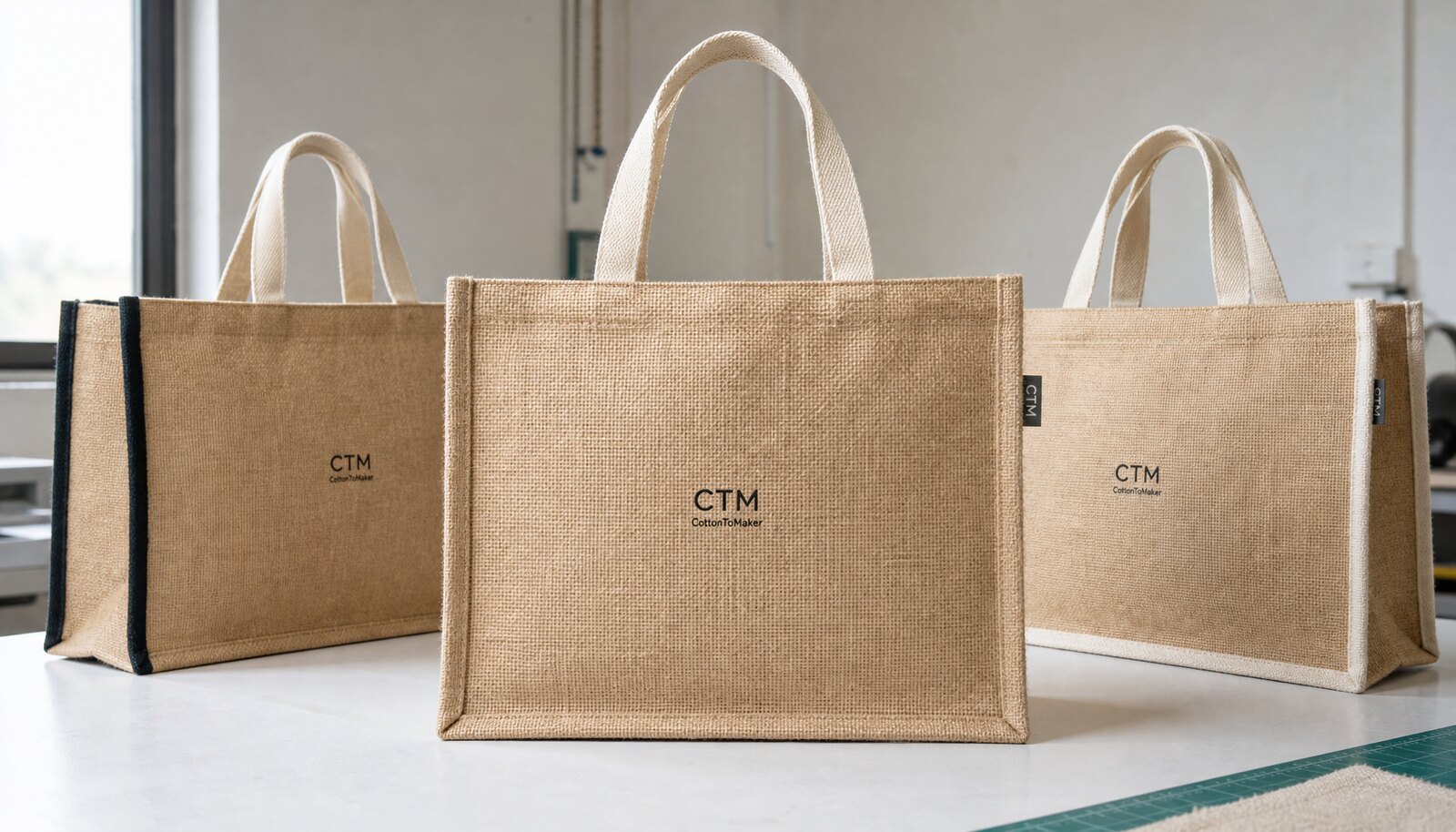
Why the carton plan is part of the product
For corporate gifting, a custom jute tote bag is not finished when the sewing line completes the last seam. The bag still has to be folded, counted, bundled, labeled, sealed into cartons, stored, loaded, shipped, received, and often redistributed to offices, event venues, sales teams, or gift-kit assembly partners. If the carton packing plan is left as a factory default, the supplier may choose the fastest packing method for output rather than the method that protects presentation, count accuracy, and warehouse handling.
Packing decisions affect both cost and quality. Overfilled cartons can crush handles, bend gusset corners, create deep crease lines, and leave pressure marks on printed logos. Loose cartons create a different problem: bags shift, rub, and pick up dust from the carton walls. Cartons that are too heavy may breach receiving rules or create manual handling issues. Cartons with unclear marks can slow distribution when several departments, regions, or event dates use similar-looking tote bags.
The phrase custom jute tote bags carton packing plan for corporate gifting sounds operational, but it is really a procurement control point. Corporate gifting programs usually have fixed event dates, approved brand artwork, recipient counts, and internal stakeholders. A weak carton plan can appear as damp odor, mixed SKUs, missing units, wrinkled presentation, or emergency repacking labor at the worst possible time. Treat packing as a required specification in the RFQ, not as a detail to settle after unit price negotiation.
- Confirm flat, folded, lightly stuffed, or insert-supported packing before comparing quotes.
- Require carton count, carton dimensions, net weight, gross weight, carton mark, and inner pack method in every supplier quote.
- Set maximum carton weight from the receiving warehouse or carrier limit, not from factory habit.
- Approve one packed carton sample or documented packing trial before bulk shipment release.
Start with the gifting use case, not the bag size
A jute tote used as a one-day conference giveaway does not need the same build as an executive client gift, employee onboarding kit, retail-style brand package, or product launch mailer. Before discussing price, procurement should define what the bag must carry, how long it must be used, and how it will be presented. A tote holding brochures and a pen can be lighter than one carrying a bottle, boxed product, apparel, notebook, and electronics accessory. The expected load influences body GSM, handle strength, gusset depth, stitching, and carton density.
Presentation standards also vary. A broad promotional giveaway may tolerate minor natural shade variation, a simple one-color logo, and efficient bulk packing. A premium client gift usually needs cleaner handle alignment, tighter logo positioning, lower carton compression, and better controlled inner bundles. Buyers should avoid buying a promotional build for a relationship-sensitive gift moment. Thin fabric, narrow handles, uneven printing, or compression creases can make a thoughtful gift feel under-specified.
Distribution method matters as much as recipient profile. If bags ship to one assembly center, the carton plan should help operators count and pull quickly. If cartons go directly to branch offices, the carton count should match branch allocation where possible. If the tote is handed out immediately at an event, arrival condition matters more than maximum carton density. If the bag will be repacked with other gift items, inner bundles should be easy to open without cutting or damaging the bags.
Write the use case into the brief. Suppliers make better decisions when they know whether the bag is a container for a kit, the gift itself, a retail-style brand item, or a low-cost giveaway. This does not require a long story. A few precise details about contents, recipient level, delivery route, and presentation expectation will improve the quote and reduce later revisions.
- List expected gift contents and estimated loaded weight before approving handle and seam construction.
- Classify the program as promotional, employee, client, executive, event, retail-style, or assembly-ready.
- Align carton quantity with downstream distribution counts when cartons are split by location or department.
- Tell suppliers whether bags must be gift-ready on arrival or will be unpacked, aired, steamed, filled, or relabeled.
Specify jute construction with measurable terms
Jute is a natural fiber, but it is not one fixed material. Final appearance and performance depend on fiber grade, weave, body GSM, lamination, lining, dyeing, finishing, and blending. For many corporate tote programs, 250-300 GSM natural jute is a practical starting range for standard flat bags and light gift contents. For more structure, heavier contents, or a more premium hand feel, buyers may consider 320 GSM or higher. Confirm the choice by sample because GSM alone does not describe weave tightness, stiffness, odor, or surface cleanliness.
The RFQ must clarify what the GSM refers to. Some suppliers quote the jute fabric before lamination. Others refer to a laminated composite or use trade shorthand that is not directly comparable. Ask whether the bag is unlaminated jute, laminated jute, lined jute, jute-cotton blend, or dyed jute. Lamination can improve structure and reduce fiber shedding, but it changes hand feel, fold behavior, and end-of-life claims. Lining can improve presentation and help protect gift contents from fibers, but it adds sewing steps, cost, and bulk inside cartons.
Finished dimensions should be written as finished bag size, not fabric cut size. A clear RFQ format is width x height x gusset depth, plus handle drop. For sewn bags, practical tolerances often sit around plus or minus 5 mm for handle placement and smaller measurements, and plus or minus 10 mm for larger body dimensions, depending on construction. If a program needs tighter alignment, ask the supplier to confirm feasibility before PO placement rather than rejecting bulk goods against unrealistic numbers later.
Handles are a frequent cost-substitution area. Cotton webbing handles often feel smoother and more comfortable than jute tape handles, especially when bags carry heavier gifts. The RFQ should specify handle material, width, length or drop, color, attachment location, stitch pattern, and reinforcement. If the contents are heavy, ask for a load test based on the actual intended use rather than accepting a generic statement that the handle is strong.
- State finished size, gusset depth, target GSM, material construction, lamination or lining, and tolerance.
- Ask whether quoted GSM is fabric weight before lamination or finished composite weight.
- Specify handle material, width, drop, color, attachment, reinforcement patch, and stitch pattern.
- Request a physical material swatch or pre-production sample before bulk cutting.
Choose decoration that works on rough jute
Logo decoration is where many corporate gifting issues become visible. Natural jute has texture, slubs, color variation, and fiber irregularity. Artwork that looks crisp on a digital mockup may lose edge clarity on the actual bag. Small type, fine taglines, thin outlines, tight reverse details, and close multi-color registration are higher risk on coarse jute. Bring brand teams into the material decision early so the artwork is adapted to the substrate instead of judged against a flat white-paper expectation.
Screen printing is commonly used for custom jute tote bags because it can provide solid coverage when the logo is bold enough and the ink is properly cured. The quote should state number of colors, print positions, maximum print area, color reference, and whether screens or setup fees are included. A Pantone reference is useful, but natural jute is not a white substrate. The same ink will appear different on darker, lighter, laminated, or uneven jute. For brand-sensitive work, approve a strike-off or pre-production sample on the actual material.
For detailed logos, a cotton patch, canvas panel, woven label, or sewn brand label may give a cleaner result than direct printing. These options improve legibility but add components, sewing time, and placement checks. Embroidery can work for simple marks, though dense embroidery may distort coarse jute or feel heavy unless backing and stitch density are controlled. The right decoration method is the one that fits the artwork, recipient expectation, budget, and inspection standard.
Placement tolerance must be measurable. Instead of approving a logo centered by eye, state distance from top edge, side seam, or panel center, with an allowed tolerance. For many tote orders, plus or minus 3-5 mm may be realistic for logo position on a stable panel. More complex shapes or softer constructions may require a wider tolerance. The approved artwork proof should include print size, position, and color references so QC teams can measure rather than debate.
- Avoid very small text, thin lines, tight outlines, and complicated multi-color registration on coarse jute.
- Approve a print strike-off on the actual bulk material before mass printing.
- Define print size and placement from fixed reference points, with a written tolerance.
- Check ink coverage, adhesion, curing, rub resistance, shade, and registration during inspection.
Build the carton packing plan from the bag spec
A good carton packing plan starts with the physical behavior of the bag. Jute totes are usually shipped flat because flat packing controls carton cube, supports cleaner counting, and avoids unnecessary shaping pressure. Flat packing still needs rules. The factory must decide whether handles are tucked inside, laid straight, folded over, or protected; whether bags are bundled in 5s, 10s, or another count; whether paper bands, inner polybags, or carton liners are used; and whether the master carton is filled tightly or given room for presentation protection.
There is no universal pieces-per-carton rule. Many jute tote programs may fall between 20 and 60 pieces per master carton, but the correct count depends on bag size, GSM, handle bulk, gusset depth, lining, logo surface, shipping mode, and receiving limits. A small flat 250 GSM tote can usually pack more densely than a larger 320 GSM gusseted tote with wide cotton handles. A gift-ready program may intentionally use fewer pieces per carton to avoid crease memory and handle distortion.
Gross carton weight should be controlled early. Some receiving warehouses set specific limits; where no limit is stated, many buyers prefer manual cartons around 12-18 kg because they are easier to handle without repacking. Large export cartons can exceed that range if nobody checks the math. Ask the supplier to calculate net weight, gross weight, carton dimensions, and total carton count before price approval. Those figures are essential for freight comparison and warehouse planning.
Carton strength should match the shipping lane. Domestic courier shipments, air freight, LCL sea freight, and full-container sea freight each create different handling risks. For export sea freight or high stacking, double-wall corrugated cartons may be appropriate. Buyers can request carton ply, board grade, or supplier’s carton strength standard, but they should also ask for practical packing evidence: sealed carton photos, dimensions, gross weight, and condition after stacking where possible.
Carton labels deserve the same attention as the bag logo. A clear label should show buyer PO, item or SKU, description, color or logo version if relevant, quantity per carton, carton number, total cartons, gross weight, net weight, dimensions, destination, and any warehouse code or barcode required. If several departments or regions use similar totes, use a no-mix carton rule unless mixed cartons are explicitly approved and labeled.
- Quote pieces per carton, inner bundle count, fold orientation, carton size, net weight, gross weight, and carton quantity.
- Keep carton weight within warehouse limits, commonly targeting 12-18 kg when manual handling is expected unless the warehouse permits more.
- Use stronger export cartons for long transit, high stacking, LCL handling, or palletized distribution.
- Require carton labels that match PO, SKU, quantity, destination, carton number, gross weight, and dimensions.
Control moisture, odor, and storage risk
Jute is a natural fiber and can absorb moisture if stored or shipped poorly. Moisture issues can show up as musty odor, staining, mold, weakened cartons, or complaints from recipients. Procurement should not rely on a generic promise that goods will be dry. The RFQ should ask how the supplier stores jute fabric, how long finished bags are aired before packing, whether cartons are kept off the floor, and whether the factory uses moisture control during humid seasons or sea freight.
Moisture control should match the route. For short domestic delivery in a dry season, normal dry cartons may be enough. For humid production regions, rainy-season loading, long sea transit, transshipment, or extended warehouse dwell time, buyers may require carton liners, desiccant inside cartons, container desiccant, dry loading checks, and covered loading. Desiccant quantity should follow supplier recommendation and shipping conditions, not be added randomly at the end.
Odor control is related but not identical. Natural jute can have an earthy smell, and laminated materials or inks may add odor if packed too quickly. The approved sample should define what is acceptable. If the gift is premium or will be packed with apparel, food-adjacent items, paper goods, or cosmetics, the buyer should be stricter about airing time, ink curing, and carton ventilation before sealing. An inspection checklist should include odor condition after opening sampled cartons, not only the exterior carton condition.
Packaging reduction needs a practical plan. Many corporate buyers want less plastic, but removing all inner protection can increase moisture or abrasion risk. A better approach might use paper bands for bundles, a carton liner for moisture protection, or limited polybags only where presentation or humidity requires them. The buyer should specify the desired packaging approach instead of asking broadly for eco-friendly packing.
- Ask how jute fabric and finished bags are stored before packing, especially in humid seasons.
- Specify carton liner, desiccant, container desiccant, or covered loading when route risk requires it.
- Check odor after opening sampled cartons, not only on loose sample bags.
- Reduce plastic with specific alternatives such as paper bands or carton liners rather than vague sustainability wording.
Use samples to approve production, not just design
A good-looking sample is only the start. For procurement, the sample must prove that the supplier can reproduce the intended material, dimensions, decoration, handles, and packing method in bulk. Measure body width, height, gusset, handle drop, handle spacing, logo size, logo position, stitch quality, and fold behavior. Compare the sample to the written spec, not to memory or a digital mockup. If the sample uses substitute fabric, substitute handles, or hand-applied artwork, label it as a concept sample only.
The pre-production sample should be made with intended bulk material and the intended production method. This matters because sample rooms often work slower and cleaner than bulk lines. Bulk production introduces fabric-lot variation, faster sewing speeds, print pressure changes, curing variation, and carton compression. The approved pre-production sample should become the physical acceptance standard for material hand feel, surface grade, logo appearance, handle build, and finishing level.
A packed carton sample or documented packing trial is equally important. The buyer should see the planned count, inner bundle method, orientation, handle placement, carton label, carton sealing, and gross weight. If shipping a complete carton sample is impractical, the factory should provide a photo set: empty carton, open carton with first layer, bundle close-up, full carton before sealing, carton mark, measured carton dimensions, scale weight, and sealed carton. This evidence catches overpacking, poor labels, and counting mistakes before the full order is sealed.
Sample approval should end in a controlled production file. The approved bag, artwork proof, carton label, carton count, tolerance list, inspection checklist, and shipping details should use the same PO reference. A common sourcing error is approving the bag while leaving carton marks, destination labels, or moisture protection unresolved. The factory then fills in the blanks, and those assumptions become difficult to change after production starts.
- Measure the sample against written dimensions, logo placement, handle drop, and stitch requirements.
- Separate concept samples from pre-production samples in all internal approvals.
- Approve a packed carton trial before mass packing, especially for gift-ready or multi-destination orders.
- Keep approved sample, artwork, carton label, packing plan, and QC checklist under one PO file.
Ask quote questions that expose the real cost
A usable supplier quote should make assumptions visible. For custom jute tote bags, the quoted price should state whether it includes fabric, handles, lining or lamination, logo decoration, setup charges, sewing, trimming, finishing, inner packing, export cartons, carton marks, moisture control, testing, inspection support, inland transport, and documents. Without this detail, a low unit price may simply mean that key items are excluded.
Hidden costs often appear in screen charges, artwork revisions, print color changes, sample remake fees, special carton labels, stronger cartons, desiccant, palletization, third-party inspection support, and destination split packing. None of these costs are unusual. They just need to be visible before supplier comparison. A buyer comparing one all-inclusive quote with one stripped quote is not comparing suppliers; they are comparing assumptions.
MOQ and SKU splits also change cost. A supplier may quote efficiently for one size, one logo, one carton mark, and one shipment. If the buyer later divides the order into several departments, regional labels, language versions, or event dates, the factory may need extra setup, carton segregation, packing lists, and inspection time. These split requirements belong in the RFQ, even if the total quantity is unchanged.
Overrun and underrun terms should be settled before the PO. Many sewn-product factories prefer a small production tolerance to account for material yield and defects. Corporate gifting orders often need exact counts because each bag corresponds to a recipient list or kit quantity. If exact quantity is required, state whether the factory must produce extra at its own risk, how rejected pieces will be replaced, and whether surplus pieces may be invoiced.
- Ask suppliers to separate included items, optional charges, and exclusions.
- Compare setup, samples, cartons, moisture control, inland freight, palletization, and inspection support.
- Disclose size, logo, destination, language, and department splits during RFQ.
- Set rules for overruns, underruns, rejected pieces, replacement timing, and surplus invoicing.
Inspect the bag and the carton together
Pre-shipment inspection should not stop at loose finished bags. Inspectors should verify both product quality and packing accuracy. The checklist should include finished dimensions, fabric match, approximate GSM evidence or approved material comparison, surface cleanliness, logo placement, print adhesion, seam security, handle attachment, odor, moisture condition, carton count, carton marks, carton dimensions, gross weight, and inner bundle method. If cartons are already sealed, selected cartons should be opened according to the agreed sampling plan.
Defect classification makes decisions faster. Critical defects may include mold, wrong logo, wrong material, unsafe contamination, severe odor, or cartons labeled for the wrong destination. Major defects may include open seams, broken handles, severe print misplacement, incorrect carton quantity, heavy stains, or failed load checks. Minor defects may include small loose threads, slight natural fiber variation, or tiny shade differences within the approved sample range. The buyer and supplier should agree on what requires rework, replacement, discount, or shipment hold.
AQL levels should be chosen based on program risk. Many consumer-goods inspections use general inspection level II as a starting point, with AQL limits such as 0 for critical defects, 2.5 for major defects, and 4.0 for minor defects, but buyers should set levels according to order value, brand sensitivity, and destination requirements. For high-visibility executive gifting, tighter criteria or additional checks may be justified. For carton count and wrong-logo issues, buyers often want zero tolerance because one mistake can disrupt distribution.
Carton release evidence is practical and valuable. Ask for photos of representative finished bags, close-ups of logo and handle attachment, opened cartons, inner bundles, carton marks, sealed cartons, pallet arrangement if used, and loading condition. These photos do not replace inspection, but they create a record before goods leave the factory. If moisture protection is specified, the evidence should show desiccant placement, carton liner use, and dry storage or loading conditions.
- Inspect opened cartons as well as loose product samples.
- Use defect categories for mold, wrong logo, open seams, handle failure, stains, odor, and carton mismatch.
- Set AQL or sampling rules before inspection booking, and state which defects have zero tolerance.
- Require release photos of products, labels, cartons, pallets, and loading where applicable.
Compare landed cost, not only FOB price
The lowest FOB unit price is not always the lowest program cost. Jute tote bags can be bulky, and carton decisions directly influence freight, warehouse labor, storage, and damage risk. A supplier saving a few cents through thinner cartons or higher compression may create higher repacking cost or more presentation defects. Another supplier may look more expensive but provide cleaner carton counts, stronger export packing, and better labeling that reduces receiving work.
Landed-cost comparison should include unit price, logo setup, sample charges, carton costs, moisture control, inland freight, international freight, duty, destination handling, inspection, storage, repacking, and last-mile distribution to offices or event locations. For air freight, dimensional weight can become the deciding cost driver. For sea freight, carton cube, palletization, container loading, and receiving labor still matter. Logistics teams need carton dimensions, gross weight, and total carton count early enough to model the real cost.
Operational cost is especially important for corporate gifting because timelines are often fixed. If a warehouse must open every carton to identify contents, relabel cartons, count shortages, air out odor, or flatten distorted bags, the program loses time. A carton count that matches kit-building quantities may cost slightly more in freight but save labor. Clear carton labels may prevent distribution errors that are far more expensive than the label itself.
Sustainability statements should be specific and supportable. Jute is often chosen because it is a natural fiber and reusable, but buyers should avoid broad claims unless backed by material information or certifications. Ask for material composition, lamination details, dye information, packaging materials, and available declarations. If reducing packaging is a goal, state the packaging hierarchy: no individual polybag unless required, paper bands preferred, carton liner acceptable for moisture, and desiccant where route risk requires it.
- Compare total cost per gift-ready unit, not only factory unit price.
- Model freight from carton dimensions, gross weight, total carton count, and shipping mode.
- Include receiving, relabeling, repacking, storage, damage, and distribution labor in supplier comparison.
- Use specific material and packaging facts before making sustainability claims.
Specification comparison for buyers
| Sourcing route | Best fit | Spec and packing control to require | Procurement risk to check |
|---|---|---|---|
| Direct jute tote factory | Repeat corporate gifting programs where bag size, logo placement, fabric lot, carton count, and ship date must stay consistent | Written specification sheet covering finished dimensions, GSM, handle build, print method, carton count, carton size, gross weight, carton marks, and pre-shipment inspection | Confirm which steps are truly in-house. Cutting, sewing, printing, packing, carton making, and final QC may not all be controlled by the same facility |
| Export-oriented bag factory near port | Sea-freight orders with fixed delivery windows, container loading, port booking, and warehouse receiving requirements | Double-wall or specified export carton, moisture-control plan, packed carton photos, loading photos, carton label template, and container loading sequence where relevant | Check storage conditions before loading, whether cartons are re-taped after inspection, and who controls final release documentation |
| Integrated print-and-pack factory | Brand-sensitive programs needing stable logo position, clean folding, controlled inner bundles, and gift-ready presentation | Approved strike-off, print placement tolerance, ink adhesion check, packed carton approval, and carton-by-carton SKU segregation | Confirm screen or plate ownership, Pantone or brand color reference, bulk shade tolerance, and reprint responsibility if logo defects exceed the agreed standard |
| Trading company managing one factory | Mixed gifting projects where the buyer wants one commercial contact but still needs a stable bag source | Factory name or production source disclosure where possible, written sample transfer standard, final packing evidence, and defect ownership terms | Risk increases when the trader changes factories after sampling or cannot answer GSM, carton size, handle reinforcement, or inspection questions precisely |
| Multi-category promotional supplier | Simple standard tote runs with common size, one-color logo, and ordinary export packing | Clear confirmation that price includes logo, packing, carton marks, export cartons, and any destination labels | Watch for generic wording such as natural jute bag, standard handle, and normal carton. These phrases hide substitutions and make quotes hard to compare |
| Domestic importer or local decorator | Small urgent programs, domestic drop shipments, or logo decoration on imported blank stock | Incoming blank-bag inspection for size, GSM, handle drop, carton count, and odor before decoration begins | Imported blanks may vary by lot. Decoration may be approved while the underlying bag does not match the original sample |
| Low-MOQ sample workshop | Concept validation, stakeholder approval, size testing, logo scale review, or early market testing | Label all samples as concept or pre-production, and document material substitutions before using them in internal approvals | Do not assume sample-room workmanship, fabric, print setup, or carton packing will match bulk production without a transfer standard |
| Factory plus third-party inspection | First-time suppliers, large order value, executive gifting, or programs with strict warehouse receiving rules | Inspection checklist covering finished size, GSM evidence, handle pull, print placement, odor or moisture, carton count, carton marks, and sealed-carton condition | The inspection booking must happen before cartons are fully loaded. Otherwise the buyer may only receive surface-level photos |
| Consolidator using shared carton plan | Campaigns with similar bag sizes, one distribution format, and centralized receiving | SKU map, carton label format, carton count by SKU, no-mix carton rule, and pallet label requirement if palletized | Shared packing can hide mixed counts, generic labels, or wrong destination marks when several departments or regions order similar bags |
Buyer checklist before sampling
- Confirm finished width, height, gusset depth, handle drop, and tolerances before requesting prices. For many sewn jute bags, a practical dimensional tolerance is plus or minus 5 mm for small measurements and plus or minus 10 mm for larger body dimensions, unless the supplier confirms a tighter workable range.
- State body material clearly: natural jute, laminated jute, lined jute, jute-cotton blend, dyed jute, washed jute, or another construction. Include target GSM and clarify whether the value is fabric GSM before lamination or finished composite weight.
- Define handle material, width, drop, attachment position, reinforcement patch if any, and stitch pattern. Ask for a load test based on the intended gift contents plus a safety margin.
- Specify logo method, number of colors, artwork format, print area, color reference, print position, and placement tolerance. Flag minimum line thickness concerns because coarse jute texture can blur fine detail.
- Require the quote to show pieces per carton, inner bundle method, carton dimensions, net weight, gross weight, total carton quantity, carton board type, sealing method, and carton mark format.
- Set a maximum gross carton weight aligned with the receiving warehouse or carrier requirement. Many buyers prefer cartons in the 12-18 kg range for manual handling, but the warehouse limit should control the final number.
- Request one pre-production bag sample made with intended bulk material and one packed carton sample or documented packing trial before bulk cutting and bulk packing are released.
- State destination country, Incoterm, shipping mode, target delivery date, receiving warehouse restrictions, palletization requirement, carton label fields, and whether carton barcodes are needed.
- Set overrun and underrun rules, AQL or inspection sampling expectations, defect classifications, rework responsibility, carton photo requirements, and shipment-hold authority before issuing the PO.
- Confirm moisture controls such as dry storage, airing time, carton liner, desiccant, container desiccant, and maximum acceptable odor condition for the shipping lane and storage period.
Factory quote questions to send
- Does your unit price include the finished printed bag, inner packing, export carton, carton marks, moisture protection, loading preparation, and normal export documentation, or are any items quoted separately?
- What is the exact body material and GSM? Please clarify whether GSM refers to unlaminated jute fabric, laminated composite, or lined construction.
- What finished dimensions, gusset depth, handle drop, and measurable tolerances are included in the quoted price?
- What handle material, handle width, handle length, stitch pattern, reinforcement patch, and load-test method are included?
- Which logo method is quoted, how many colors and positions are included, what is the maximum print area, and what artwork limits apply on natural jute texture?
- Can you provide a print strike-off on the actual bulk jute material before mass printing, and what is the expected lead time after artwork approval?
- What is the proposed carton packing plan: pieces per carton, inner bundle count, fold orientation, carton size, net weight, gross weight, and total carton quantity?
- What carton board grade or ply, edge crush or burst strength if available, sealing method, strapping method, and moisture-control items are included?
- Which production steps are in-house and which are outsourced, including fabric sourcing, lamination, cutting, printing, sewing, ironing or finishing, carton packing, and final inspection?
- What is your standard overrun and underrun tolerance, and how will extra pieces, shortages, rejected goods, and reworked goods be handled commercially?
Quality-control points to confirm
- Finished dimensions must match the approved spec for body width, height, gusset depth, handle drop, handle spacing, and logo reference position within written tolerances.
- Material must match the approved construction, including jute type, lamination or lining, fabric hand feel, approximate GSM evidence, color tone, and surface grade.
- Jute surface must be clean for the approved natural grade, with no mold, heavy oil stains, wet marks, unacceptable odor, insect contamination, or excessive fiber shedding beyond the approved sample.
- Logo decoration must match the approved artwork and strike-off for placement, size, color reference, ink coverage, edge clarity, registration, curing, rub resistance, and adhesion.
- Sewing must be secure and even, with no open seams, skipped stitches, broken stitch lines, untrimmed long threads, sharp exposed ends, or raw edges outside the approved construction.
- Handle attachment must be symmetrical, centered, reinforced as specified, and strong enough for the intended gift load. Pull or load checks should be recorded on sampled units.
- Bag opening, gusset, bottom seam, lamination, lining, and inner finishing must be checked for distortion, delamination, bubbling, tearing, weak bonding, or construction mismatch.
- Carton quantity must match the packing list exactly, with no mixed SKUs unless explicitly approved, no unlabeled overpacks, and no hidden short cartons.
- Carton strength, sealing, tape, straps if used, gross weight, and stacking condition must be suitable for the shipping lane, warehouse handling, and pallet or floor-loaded arrangement.
- Packed goods must be dry, aired, odor-controlled, and protected from moisture during storage, export handling, container loading, and final transit.