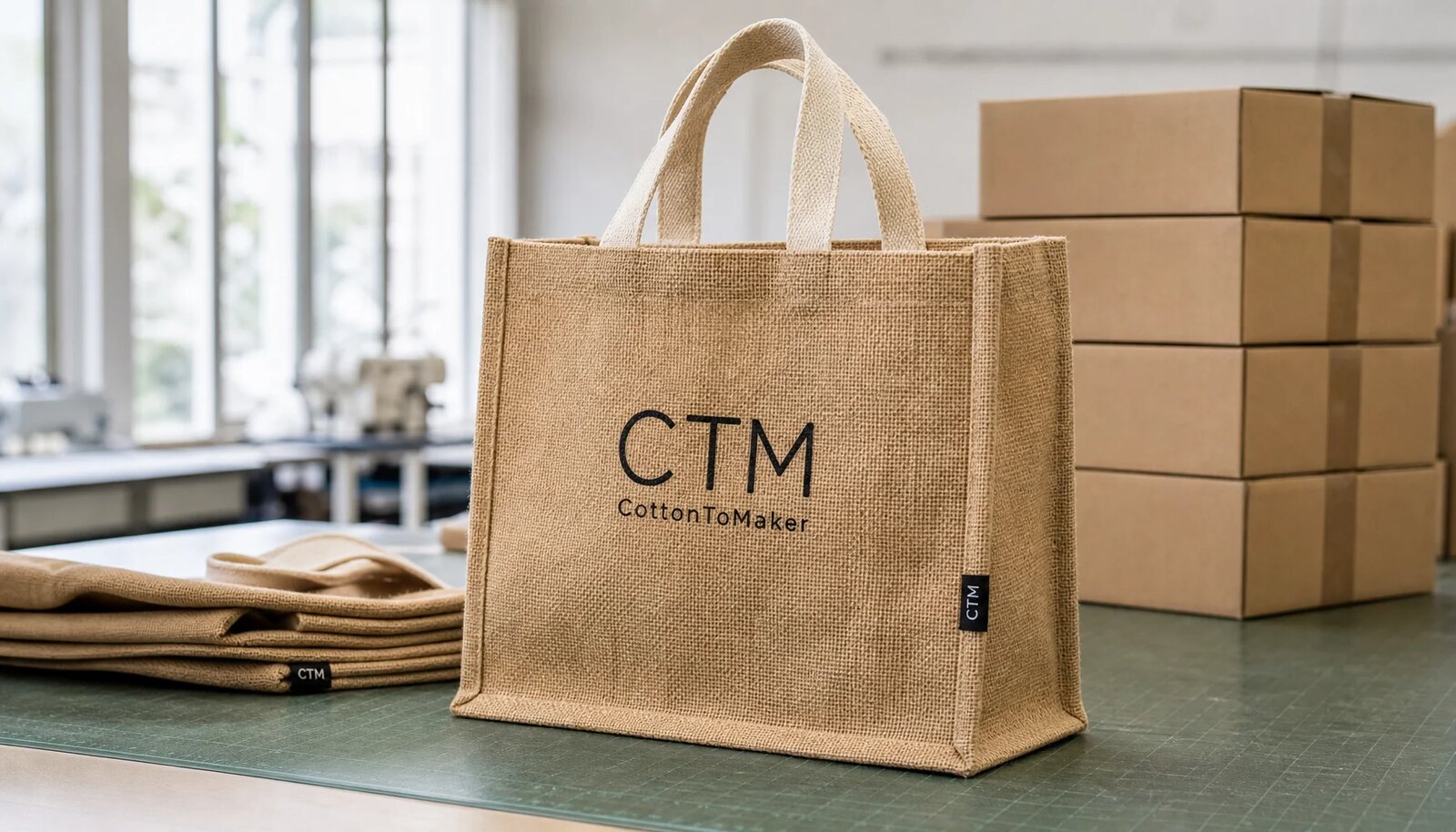
Start with the commercial job of the tote
A custom jute tote bag for craft fairs is more than a branded giveaway. It may be a resale item, a packaging component, a booth replenishment unit, and the customer’s walking advertisement after purchase. That is why the carton packing plan should be part of the first RFQ, not a warehouse detail left until production is nearly finished.
Jute is bulky, textured, and less forgiving than cotton canvas when it is compressed. If the factory guesses the fold method or pushes too many pieces into one carton, the order can arrive with crushed gussets, bent handles, hard logo creases, ink transfer, trapped odor, or cartons that bulge before they reach the venue. None of those problems are helped by a low unit price.
Craft fair programs add their own pressure. Event dates are fixed. Receiving teams are often small. Some orders include several maker logos, sponsor versions, or destination splits. A carton that looks efficient on a quote sheet can become slow and expensive on the floor if the SKUs are mixed, the marks are unclear, or every bag has to be reshaped before display.
Procurement, logistics, and QC should therefore treat the carton as part of the product specification. Carton cube affects freight cost. Bundle count affects receiving speed. Fold direction affects print condition. Carton marks affect allocation. A supplier cannot quote a reliable packing plan if gusset depth, lamination, handle thickness, and print position are still undecided.
- Include carton packing requirements in the RFQ so each supplier quotes the same physical shipment.
- Ask for carton L x W x H, pieces per carton, gross weight, and board grade before comparing landed cost.
- Define whether the order is for resale, giveaway, booth supply, retailer distribution, or mixed-destination delivery.
- Treat fold direction, bundle count, carton marks, and SKU separation as commercial controls, not preferences.
- Use packed-carton approval for event-dated or multi-logo orders where repacking time is limited.
Define dimensions before packing math
A reliable carton plan starts with a precise finished bag specification. The common shortcut is to ask for a small, medium, large, or market tote. Those labels are too loose for procurement. Width should usually mean the front panel measured left to right. Height should exclude the handles unless stated otherwise. Gusset should be measured after the bag is opened and the base is squared, not only while the bag lies flat.
Handle drop also needs a clear reference point. A practical method is to measure from the top edge of the bag to the inside top of the handle arc. Handle placement should be checked from the side seams or centerline, depending on the construction. These details sound small until the first carton count is wrong because one supplier measured cutting size while another measured finished size.
For craft fair use, buyers often work with three size families. A small jute gift tote around 25 x 20 x 10 cm may suit soaps, candles, ornaments, preserves, and event kits. A medium market tote around 35 x 30 x 15 cm can work for maker market purchases, packaged foods, folded textiles, and small boxed goods. A large shopper around 40 x 35 x 18 cm may be used for apparel, books, blankets, and multi-item purchases. These examples are not universal standards, but they show why a single carton rule cannot cover every SKU.
Tolerance should be written before sampling. For many sewn jute totes, +/-1 cm on width, height, gusset, and handle drop is more realistic than paper-product precision. Print placement is often controlled within +/-5 mm to +/-10 mm, depending on bag size and seam variation. Buyers using inserts, retail shelves, pre-packed merchandise, or tight booth fixtures may need tighter control, but the factory must confirm it before the order is priced.
- State bag dimensions as width x height x gusset, in centimeters, measured after sewing.
- Clarify whether gusset depth is measured flat or after the base is opened and squared.
- Set tolerances for size, handle drop, handle placement, and print placement before sample approval.
- Confirm that the quote is based on finished size, not cutting size before seam allowance.
- Run separate carton calculations for each size, lining, handle, and lamination option.
Choose construction with freight in mind
Jute weight and construction change the look of the bag, but they also change the carton. Light unlaminated jute folds flatter and may reduce shipping volume. It can also collapse on a booth table, wrinkle more visibly after compression, and shed more loose fibers. Heavier laminated jute usually stands better and gives a cleaner retail shape, yet it springs back inside cartons and can make overfilled boxes round out at the sides.
A practical range for many craft fair totes is 280-340 GSM for unlaminated jute or 13-15 oz for laminated jute, depending on the supplier’s measurement system. The key is to avoid vague terms such as standard jute, heavy jute, premium burlap, or export quality. Ask which unit the factory uses, what tolerance it can hold, and whether bulk material will match the approved swatch. A +/-5% fabric-weight tolerance is a common procurement reference when agreed, but the PO should state the final standard.
Lamination can help the tote stand open and reduce fiber shedding. It can also introduce plastic odor, cracking at sharp folds, and claim-language issues if the buyer markets the product as plastic-free. Unlaminated jute has a more natural handfeel and may fit certain brand values better, but it needs careful seam control and sensible packing pressure. Cotton lining improves the interior finish and can be useful for premium craft goods, food-adjacent packaging, or retail-ready totes; it also adds labor, weight, thickness, and new inspection points.
The smartest construction choice is not always the heaviest material. It is the one that meets the product load, display expectation, brand position, and freight budget at the same time. A bag that stands beautifully but doubles the carton cube may not be right for a giveaway program. A very flat unlaminated tote may not be right for a premium maker shop selling fragile products.
- Use laminated jute when the tote needs structure, upright display, and cleaner shape recovery after unpacking.
- Use unlaminated jute when natural handfeel and lower plastic content matter more than rigid presentation.
- Use cotton lining when interior cleanliness, premium finish, or protection from loose fibers is important.
- Approve a bulk fabric swatch and keep one reference with the buyer, factory, and inspector.
- Check lamination odor and fold cracking after the bag has been packed, not only on a loose sample.
Engineer handles for real craft fair loads
Handles are a high-risk area because they do the hardest work and are often described too casually in RFQs. A craft fair customer may load one tote with candles, jars, ceramics, books, framed prints, textiles, and purchases from several booths. The bag can look fine on the sewing table and still fail in use if the webbing is too narrow, the reinforcement is weak, or the stitch quality is uneven.
The quote should define handle material, webbing width, handle drop, attachment length, reinforcement pattern, stitch density, thread color, and thread quality. Cotton webbing is common because it is comfortable and consistent. Jute webbing gives a rustic look but may feel rougher and vary more in thickness. Rope handles, padded handles, and leather-look trims can support a premium style, but they increase carton volume and may create pressure marks unless the fold plan is adjusted.
Handle design should be reviewed together with carton packing. Thick handle attachments can stack in one corner and press dents into the bag below. Long shoulder handles can twist, crease, or sit unevenly inside bundles. If the factory alternates handle direction in the carton, it may reduce pressure buildup and improve the final presentation.
A practical load test should be agreed before production. It does not need to be complicated, but it must be measurable. The buyer can define the expected product load and require testing at that load plus a buyer-approved safety margin. The weight, test duration, sample count, and failure criteria should be recorded. Some buyers prefer a static hang test; others add a short lift-and-lower cycle. Either way, the inspector needs a pass/fail rule, not a general promise that the handle is strong.
- Specify handle width, commonly 2.5-4.0 cm depending on bag size, comfort, and target cost.
- Define handle drop for hand carry, shoulder carry, or a buyer-approved hybrid length.
- Require box-and-cross or approved equivalent reinforcement for heavier craft fair contents.
- Check that handle reinforcement does not stack in one carton corner and create pressure marks.
- Record load-test weight, test duration, sample quantity, and failure criteria in the QC checklist.
Control artwork before the strike-off
Screen printing is common on custom jute tote bags because it suits simple logos, maker names, sponsor marks, and event graphics. The surface is the challenge. Jute is coarse, uneven, and absorbent compared with smooth cotton canvas or paper. Fine serif type, hairline strokes, tight letter spacing, gradients, small QR codes, and large solid ink blocks may not reproduce cleanly.
A digital mockup is useful for layout, but it is not proof that the artwork will work on actual jute. Buyers should provide vector artwork and define print size, color reference, position, and acceptable variation. The factory should confirm the minimum text height, line weight, and spacing it recommends for the selected fabric and print size. Dark one-color printing is usually easier to control than pale ink or tight two-color registration.
Two-color designs need realistic registration tolerance because the weave and sewing variation can shift the print surface. If a QR code, barcode, sponsor list, or small farm-shop detail is essential, it should be tested at final size on the actual jute before bulk approval. If the test fails, simplify the art before screens are made, not after hundreds of panels have been printed.
Curing and packing should be discussed at the same time as artwork. Ink that feels dry on one loose sample may still transfer under bundle pressure if packed too soon. Heavy ink coverage can stick to another bag, mark lamination, or crack when folded through the print. The RFQ should ask whether printed panels will be stacked print-to-print, print-to-back, or protected by fold orientation, paper, tissue, or bundle separation.
- Send vector files and specify Pantone, CMYK reference, or approved physical color target.
- Approve a printed strike-off on actual jute, not only a digital proof or paper printout.
- Set print placement from a measurable reference point such as top edge, side seam, or panel center.
- Avoid tiny text, thin strokes, gradients, and QR codes unless tested at final print size.
- Confirm curing time before bundling and inspect for ink transfer after stacked packing.
Build the carton plan from trial packing
Carton quantity should be an engineering result, not a guess. For a medium laminated jute tote, 40-60 pieces per export carton is a practical starting range, with 50 pieces often used for trial packing. Small flat gift totes may fit 80-100 pieces when they are light and unstructured. Large laminated gusset totes may need 25-35 pieces to avoid crushed corners, rounded cartons, and deep fold marks.
The right pack count is the highest count that still protects sellable presentation, keeps gross weight practical, and supports quick receiving. A high pack count may look attractive because it lowers carton count. It can also shift cost into rework, venue labor, damaged display stock, or claims. For craft fairs, the buyer usually needs bags that can be opened, counted, and placed into booth use quickly.
The carton should be designed around the folded bag. Ask the supplier to show fold direction, bundle size, bundle orientation, handle direction, and whether the printed panel faces inward or outward. Bundles of 10 or 20 are usually easier for count checks and booth replenishment than loose pieces. Paper bands or master polybags can control the bundle without adding an individual polybag to every tote. Individual polybags should be used when required for barcode labeling, dust protection, retailer compliance, or long storage, not by default.
Carton strength depends on the shipping route. For sea freight, LCL, consolidation warehouses, and mixed cargo, a 5-ply export carton is safer than a lightweight 3-ply carton. For air shipments, dimensional weight matters, but weak cartons can still crush during inland handling. Ask for carton board grade, tape method, carton dimensions, net weight, gross weight, and total carton count. A practical handling target is often below 18-22 kg gross per carton unless the buyer approves heavier handling.
- Start trial packing at 50 pieces for medium totes, then adjust by size, lamination, handle bulk, and shape recovery.
- Use 10-piece or 20-piece bundles for faster count checks and booth replenishment.
- Ask the factory to alternate handle direction if reinforcement stacks create uneven carton pressure.
- Reject overfilled cartons with rounded sides, split tape, crushed corners, or pressure marks through the logo.
- Record final carton L x W x H, pieces per carton, gross weight, and carton board grade on the PO.
Separate MOQ, setup, and landed cost
MOQ for jute tote bags is driven by several variables, not only order quantity. A supplier may support a lower quantity for a stock-size natural jute tote with a one-color screen print. Custom dimensions, dyed jute, cotton lining, zippers, contrast handles, inside pockets, and several small logo versions can raise MOQ pressure quickly.
Ask for MOQ by size, material color, logo version, print color, lining, and packing style. A single blended MOQ hides the real constraint and makes negotiation harder. If the program includes multiple craft fair vendors or sponsor logos, ask whether the same material run can be shared while cartons stay separated by SKU and destination.
Cost comparison should separate unit cost, setup cost, packing cost, and logistics cost. Screen charges, artwork cleanup, swatches, strike-offs, pre-production samples, individual polybags, barcode labels, stronger cartons, carton marks, and packed-carton samples may all be legitimate charges. The problem is not that those costs exist. The problem is when one supplier hides them in the unit price while another lists them clearly.
For jute totes, landed cost can move because the product is bulky. A low FOB price may come with an aggressive pack count that crushes bags or a carton size that raises freight cube. Another supplier may quote stronger cartons and lower pack counts, increasing volume but protecting saleable presentation. Procurement should compare cost per sellable bag, not only cost per produced bag. That comparison should include estimated defect allowance, inspection cost, repacking risk, inland handling, and carton cube.
- Request price breaks at realistic quantities such as 500, 1,000, 2,500, and 5,000 pieces.
- Ask whether multiple logos can share one material run while remaining separated by carton and SKU.
- List screen charges, sampling charges, label costs, and upgraded carton costs separately.
- Compare FOB cost together with carton cube, gross weight, total carton count, and defect risk.
- Clarify overrun and underrun policy by SKU so extra pieces do not create mixed-carton confusion.
Approve samples in a locked sequence
A single loose sample is not enough for an event-dated custom jute tote order. It may show the general size, print, and handle feel, but it does not prove bulk fabric consistency or carton performance. A stronger approval sequence is fabric swatch, printed strike-off, full pre-production sample, and packed-carton method.
Each stage answers a different question. The swatch confirms material, weight, shade, lamination, and handfeel. The strike-off shows how the artwork behaves on the actual jute. The pre-production sample confirms finished construction, seams, handles, lining, print position, and measurement method. The packed-carton method shows whether the tote can survive the planned fold, bundle count, carton pressure, and shipping presentation.
The pre-production sample should lock what cannot change in bulk. If the approved bag uses 15 oz laminated jute, 3 cm cotton handles, box-and-cross reinforcement, and a specific fold method, the factory should not switch to softer fabric, narrower handles, or different packing without written approval. If the approved carton uses 10-piece bundles and 50 pieces per carton, bulk cartons should follow the same arrangement unless a revised packing approval is issued.
A packed-carton review can be simple. Ask for photos of the folded bag, bundle, open carton, closed carton, carton mark, scale weight, and carton dimensions. For higher-risk orders, request one physical trial carton or ask the inspector to verify packing during an in-line or pre-shipment check. Keep approved references with the buyer, supplier, and inspection provider so everyone judges bulk production against the same standard.
- Approve fabric swatch before bulk material purchase or cutting.
- Approve print strike-off before mass printing, especially for pale ink, two-color logos, or small text.
- Measure the pre-production sample after the gusset is opened and lightly filled.
- Approve the packed-carton method before mass packing starts.
- Keep approved references for fabric, print, finished bag, and carton packing with all inspection parties.
Write QC criteria inspectors can use
Jute is a natural material, so the QC plan should allow normal texture while rejecting problems that affect function or saleability. Small slubs, slight yarn irregularity, and modest shade movement may be acceptable if they match the approved standard. Large stains, oil marks, mildew, broken yarns, severe roll-to-roll mismatch, open seams, crooked handles, sticky ink, and strong odor should be defined as defects.
Many B2B textile bag orders use a recognized sampling plan such as General Inspection Level II with AQL 2.5 for major defects and 4.0 for minor defects. The buyer should choose the inspection standard, but AQL alone is not enough. It does not automatically decide whether odor, carton bulging, wrong bundle count, or print transfer is major or minor. Those classifications should be written before inspection day.
Inspection should cover the bag and the carton. Inspectors should measure finished width, height, gusset, handle drop, handle placement, and print position against the approved sample and purchase order. They should open sealed bundles to check odor, moisture, ink transfer, and SKU mix. They should verify carton quantity, bundle count, carton marks, gross weight, label accuracy, and carton condition.
For multi-logo programs, carton-mark accuracy may deserve 100% checking because one wrong mark can misroute inventory. If the order is going to several craft fair locations, venue teams may not have time to open every carton and sort by hand. Clear marks and correct packing lists reduce receiving disputes and keep allocation work under control.
- Classify critical, major, and minor defects before inspection, including odor, mold, ink transfer, and wrong logo mix.
- Measure dimensions with a tape and use agreed reference points instead of visual estimates.
- Open random sealed bundles to inspect hidden odor, moisture, print transfer, and count accuracy.
- Verify carton marks against PO, SKU, logo version, destination, quantity, and carton number.
- Photograph failed cartons and defects with measurement tools visible when possible.
Protect the craft fair delivery schedule
Craft fair inventory has a deadline-driven value curve. A late tote shipment may be technically acceptable but commercially useless if the event has passed or the booth team has no time to receive, count, and allocate stock. Lead time planning should start from the date goods must be in the buyer’s warehouse or event location, not from the factory’s most optimistic production estimate.
Work backward through local delivery, importer receiving, customs clearance, international transit, inspection, production, sample approval, artwork approval, and material booking. The schedule should also include time for unpacking, count checks, booth allocation, and any repacking needed for maker kits or sponsor bundles. If the order is split by destination, build that sorting time into the plan.
The highest schedule risks often appear before sewing begins. Artwork may need simplification for jute printing. A strike-off may show that small text is unreadable. The approved fabric weight may not be available in the required quantity. Lamination may need airing time before sealed packing. Carton dimensions may change after trial packing. Multi-logo orders may need extra labeling and carton separation time. These risks should be discussed before deposit, not after the production window is already tight.
The purchase order should define when production lead time starts. Some factories count from deposit. Some count from artwork approval. Others count from strike-off approval or pre-production sample approval. For event-dated programs, that difference matters. Buyers should write cut-off dates for artwork approval, sample approval, production start, inspection booking, cargo-ready date, and shipment handover. They should also require packing list, carton marks, and pre-shipment photos before release.
- Build the schedule backward from the date goods must be counted and ready for booth allocation.
- Add approval time for fabric swatch, strike-off, pre-production sample, and packed-carton method.
- Ask the factory to confirm event-risk items: material availability, print setup, carton supply, and capacity.
- Book inspection early enough to allow corrective action before cargo handover.
- Require final packing list, carton photos, and shipment documents before balance payment or release.
Specification comparison for buyers
| Spec decision | Recommended option | When it fits | Buyer risk to check |
|---|---|---|---|
| Finished size and tolerance | State W x H x D gusset in cm, measured after sewing; use a typical tolerance of +/-1 cm for W/H/gusset unless the design needs tighter control. | Any order where carton cube, shelf fit, booth replenishment, or insert packaging depends on predictable dimensions. | Supplier may quote cutting size, measure gusset flat, or use a loose size name, causing wrong carton counts and inconsistent bag opening. |
| Jute fabric weight | Quote by GSM or oz with test tolerance, such as 280-340 GSM unlaminated or 13-15 oz laminated jute, with bulk tolerance normally within +/-5% if agreed. | Craft fair totes for candles, ceramics, books, soaps, packaged foods, textiles, and multi-item customer purchases. | Vague terms like premium jute or normal quality allow fabric substitution, thinner handfeel, extra wrinkling, or higher freight cube. |
| Lamination or lining | Use inside lamination for structure; use cotton lining when interior cleanliness and retail finish matter; specify thickness, odor limits, and fold-crack acceptance. | Bags that must stand open at booths, protect goods from loose fibers, or support a cleaner retail presentation. | Plastic odor, cracked folds, lining shrinkage, misleading sustainability wording, and unapproved substitution after sample approval. |
| Handle construction | Cotton webbing or jute webbing, usually 2.5-4.0 cm wide, with box-and-cross reinforcement, stitch density target, and handle drop tolerance of +/-1 cm. | Repeated customer handling and heavier craft fair products such as jars, ceramics, books, and bundled purchases. | Quote may omit webbing width, attachment length, stitch pattern, thread strength, or load-test method. |
| Print method and artwork limit | Use one- or two-color screen print on an actual jute strike-off; avoid fine lines below supplier-confirmed minimum and set print placement tolerance, commonly +/-5 mm to +/-10 mm. | Maker logos, event graphics, farm shop marks, sponsor names, and simple retail branding. | Small serif text, gradients, QR codes, and heavy ink blocks can bleed, fill in, transfer, or crack when folded. |
| Pieces per export carton | Use trial packing: 80-100 pcs for small flat gift totes, 40-60 pcs for medium totes, and 25-35 pcs for large structured laminated totes. | Buyers balancing freight cube, carton handling, bag shape recovery, and receiving speed. | High pack count lowers carton count on paper but can create crushed gussets, bent handles, bulging cartons, and unsellable display bags. |
| Inner packing method | Use bundles of 10 or 20 with paper bands or master polybag; use individual polybag only when required for retail barcode, dust control, or long storage. | Distributors and event teams needing fast count checks, SKU separation, and booth replenishment. | Loose pieces create count disputes; individual bags add plastic, labor, dimensional volume, and potential compliance issues. |
| Carton strength and weight | Use 5-ply export carton for sea/LCL/mixed cargo; keep gross weight practical, commonly below 18-22 kg unless the buyer approves heavier handling. | Shipments moving through consolidation warehouses, inland trucking, storage, and event venue unloading. | Quote may not state carton board grade, burst/ECT reference, tape pattern, gross weight, or stacking suitability. |
| Carton marks and SKU control | Outer marks should show PO, SKU, logo version, color, quantity, carton number, gross/net weight, dimensions, destination, and barcode if required. | Multi-logo programs, retailer drop-shipments, booth location splits, and craft fair delivery waves. | Mixed or unclear cartons slow receiving, create short-ship disputes, and make event allocation unreliable. |
Buyer checklist before sampling
- Define finished bag size as width x height x gusset in cm, measured after sewing, with gusset checked after opening and squaring the base.
- State tolerances for bag width, height, gusset, handle drop, handle placement, print position, fabric weight, and carton gross weight before sampling.
- Specify jute weight by GSM or ounces, lamination or lining type, handle material, handle width, thread color, reinforcement pattern, and stitch quality standard.
- Send vector artwork with Pantone or approved color reference, final print dimensions, print position reference point, and minimum acceptable readability for text on coarse jute.
- Ask the factory to confirm whether the logo panel will be folded, stacked print-to-print, stacked print-to-back, or protected by orientation, tissue, or bundle separation.
- Request a carton packing diagram showing fold method, pieces per bundle, bundles per carton, carton L x W x H, carton board grade, net weight, gross weight, and carton marks.
- Set defect definitions for odor, mildew, stains, broken yarns, loose seams, skipped stitches, crooked handles, ink transfer, print bleeding, carton bulging, and wrong SKU mix.
- Require fabric swatch, print strike-off on actual jute, full pre-production sample, and packed-carton method approval before bulk cutting or mass printing.
- Ask for one trial packed carton for high-value or event-dated orders, or at least open/closed carton photos with dimensions, weight, bundle layout, and compression notes.
- Compare suppliers by landed cost per sellable bag, including FOB price, screen charges, sample fees, carton cube, inspection, labels, inland handling, repacking risk, and defect allowance.
Factory quote questions to send
- What exact jute weight is quoted, in GSM or ounces, and what bulk tolerance will you accept against the approved swatch?
- Is the jute laminated, unlaminated, cotton-lined, dyed, bleached, or natural, and will bulk material come from the same approved quality as the sample?
- What are the finished size tolerances for width, height, gusset, handle drop, handle width, handle placement, and print placement?
- How is the gusset measured in your quote: folded flat, opened and squared, or measured at the side seam before forming?
- What handle material, webbing width, webbing thickness, drop length, stitch pattern, stitch density, reinforcement size, and thread type are included?
- What practical load test can you perform, what weight and duration will be used, and how many samples will be tested during inspection?
- Which print method, ink type, number of colors, screen charge, curing time, and artwork adjustment cost are included in the quote?
- What minimum text height, line weight, and gap between letters do you recommend for this jute weave and print size?
- Will the printed panel be folded, stacked print-to-print, or protected by fold orientation, paper, tissue, or bundle arrangement?
- How many pieces are packed per inner bundle and per export carton, and what are the carton dimensions, net weight, gross weight, and total carton count?
Quality-control points to confirm
- Fabric weight should be checked from bulk production material, not only sample-room stock, with an agreed tolerance such as +/-5% unless another standard is specified.
- Natural jute shade may vary slightly, but severe roll-to-roll mismatch, dark streaks, mildew marks, oil stains, or visibly different panels within one SKU should be classified as defects.
- Finished width, height, and gusset should be measured after sewing; gusset depth must be checked after the bag is opened and squared, not only while flat.
- Handle drop and placement should be measured from agreed reference points, with common tolerance of +/-1 cm for drop and visually symmetrical left-right placement.
- Handles should match approved material and width, with box-and-cross or approved reinforcement, no skipped stitches, broken thread, loose ends, or weak attachment points.
- Handle load testing should reflect intended craft fair contents, commonly intended load multiplied by a buyer-approved safety factor, with the exact weight, duration, and sample count recorded.
- Screen print should be checked for readability, color match to approved strike-off, ink bleeding, pinholes, missing strokes, registration drift, sticky surface, odor, and ink transfer after stacking.
- Print placement should be measured from the specified reference point, such as panel center, top edge, seam edge, or handle centerline, not judged by eye only.
- Odor should be checked after sealed packing because laminated jute, ink, moisture, and warehouse storage can trap smell inside bundles and cartons.
- Moisture and mildew risk should be checked on random opened cartons, especially for sea shipments, humid production seasons, or long warehouse storage.