Start With the Bookstore Buying Problem
A university bookstore usually buys custom jute tote bags for a specific commercial reason: higher-value retail merchandise, orientation welcome kits, alumni weekend sales, conference packs, or a reusable checkout bag with a campus identity. The buying problem is not simply finding the lowest tote price. It is building a bulk pricing plan that protects the university brand, arrives before a fixed campus date, and still leaves room for resale margin or program budget.
Jute tote bags sit in a different cost and risk category than basic cotton drawstring pouches or canvas grocery totes. Jute has a stronger natural texture, higher perceived retail value, and more visible variation. That is useful for bookstore displays, but it makes print testing, handle strength, lamination choice, and carton packing more important. A good RFQ should make these details measurable so every supplier quotes the same bag rather than a cheaper lookalike.
- For resale, define target shelf price and required landed cost before choosing GSM or decoration.
- For orientation kits, prioritize delivery date, packing efficiency, and logo approval over premium trim.
- For alumni merchandise, allow more budget for lined construction, upgraded handles, or woven labels.
- For checkout use, focus on durability, repeat use, and easy carton handling at the bookstore receiving dock.
Choose a Jute Spec That Matches Bookstore Use
For custom jute tote bags in university bookstore programs, a practical body weight is often around 270-320 GSM. Lighter jute may help reduce unit price, but it can feel thin when the bag carries books or heavy drinkware. Heavier jute can look more premium, yet it increases material cost, shipping cube, and sometimes stiffness. If the bag must stand upright on a retail shelf, the structure matters as much as GSM.
The most common decision is laminated versus unlaminated jute. Laminated jute has an inner backing that stabilizes the fabric, reduces shedding, and helps the bag hold shape. It can also create concerns if the buyer wants a fully natural positioning. Unlaminated jute feels more rustic, but it can be harder to print cleanly and may shed more fibers inside the bag. For bookstore retail, laminated natural jute with cotton webbing handles is usually the safer commercial spec.
- Common retail size: about 35 x 40 cm with 10-15 cm gusset for books, apparel, and gifts.
- Heavier load programs should use reinforced handle stitching, not only thicker body fabric.
- Natural jute color variation must be accepted within a defined range because it is not a dyed canvas base.
- If the bag will carry boxed mugs or bottles, gusset depth and bottom seam construction need early confirmation.
Build Price Breaks Around One Fixed Specification
Bulk pricing becomes misleading when each quote uses a different bag. One supplier may quote 300 GSM laminated jute with cotton handles and a two-color screen print, while another quotes lighter unlaminated jute with smaller print area and thinner handles. The second price will look better on a spreadsheet but may fail the bookstore's retail requirement. The RFQ should lock the specification first, then request volume breaks.
A useful bulk pricing ladder for university bookstore planning is 500, 1,000, 2,500, and 5,000 pieces. At 500 pieces, setup charges, sample cost, fabric sourcing, and printing preparation carry more weight. At 2,500 or 5,000 pieces, material purchasing, cutting efficiency, and carton loading become more favorable. Buyers should ask suppliers to show what changes, if anything, between price breaks. The answer often reveals whether the supplier is reducing cost through scale or by quietly changing the product.
- Keep size, GSM, lamination, handle, print colors, and packing identical across all price tiers.
- List setup fees separately so procurement can compare repeat-order cost correctly.
- Request an optional reorder price without new sample or screen charges when artwork is unchanged.
- Ask whether overrun or underrun tolerance applies, especially for licensed bookstore merchandise.
Understand the Main Cost Drivers
The largest cost drivers are jute weight, bag size, gusset construction, handle material, decoration method, packing method, and order quantity. A wider gusset uses more fabric and may slow stitching. A long cotton handle improves comfort but adds webbing cost. A large multi-color front print uses more screens, more setup time, and more reject risk on rough jute texture. These are normal factory realities, not supplier excuses.
Freight can also change the real price more than buyers expect. Jute totes are not extremely heavy, but gusseted bags can take carton space if packed poorly. Individual polybags may protect each piece but increase labor, material cost, and waste. If the bookstore has sustainability rules, individual polybags may also create internal objections. A clean quote separates ex-factory unit cost from packing and freight assumptions so landed cost can be calculated honestly.
- Material cost rises with higher GSM, larger panels, deeper gussets, lining, and dyed handles.
- Printing cost rises with more colors, larger coverage, tighter registration, and artwork revisions.
- Labor cost rises with inner pockets, zipper closures, binding, labels, and special folding.
- Freight cost rises with inefficient carton dimensions, low carton quantity, and rush air shipment.
Select the Print Method Before Artwork Approval
Screen printing is usually the most practical method for custom jute tote bags used by university bookstores. It works well for bold logos, department names, simple mascot graphics, and one- to three-color designs. The rough jute surface can break very fine lines, so artwork that looks sharp on a PDF may not hold on the actual fabric. Buyers should review the print at true size, not only as a digital proof.
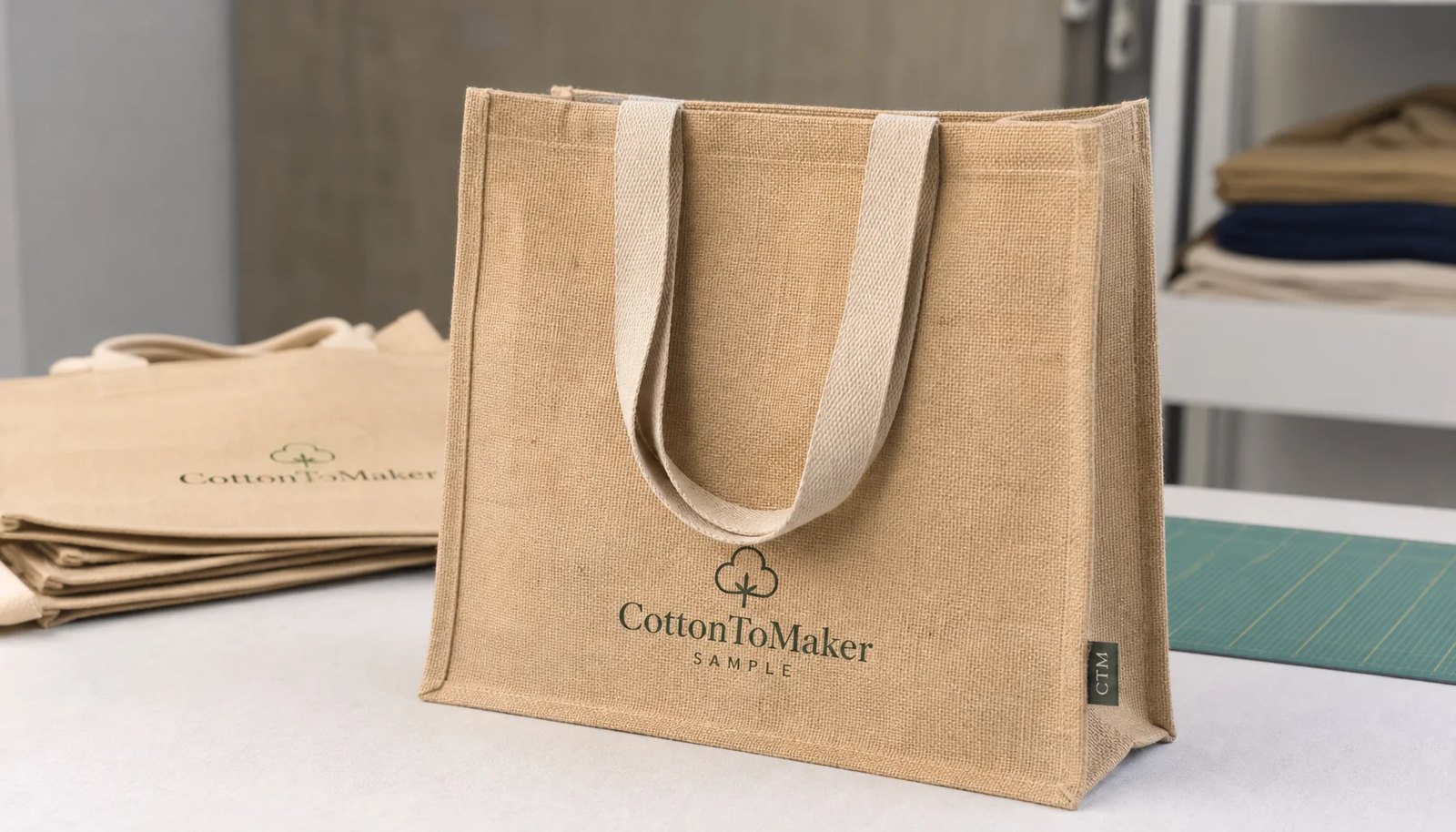
Heat transfer can help with more detailed artwork or gradients, but it changes the hand feel and may not match the natural retail character of jute. Embroidery is possible on some constructions, yet it can pull the fabric and increase cost. Woven labels are a good option for subtle branding, care information, or CTM-style sample identification, but they do not replace a large front bookstore logo. The safest route is to approve a physical strike-off or pre-production sample before bulk printing.
- Use Pantone references, but allow a realistic tolerance because ink sits differently on natural jute.
- Avoid thin strokes, tiny legal text, and complex mascot shading unless tested on real material.
- Define print placement tolerance, such as centered within an agreed centimeter range.
- Require dry rub review after curing, especially for dark ink on natural jute.
Use Supplier Evidence, Not Only a Low Quote
For a university bookstore program, supplier selection should include evidence of production control. A serious supplier can explain their jute GSM, show handle reinforcement options, identify suitable print limits, and provide carton packing data before the buyer pays for bulk production. A weak supplier may only answer with a unit price and a generic product photo. That is not enough for licensed university merchandise.
Direct factories, importers, and distributors can all be valid options, but they fit different buying situations. A direct factory is stronger for repeat bulk orders and custom development. A distributor is useful when the buyer needs local service, smaller quantities, or domestic replenishment. Local decorators can be fast for simple programs, but their base bags may not match the desired GSM or handle quality. The quote comparison should include route risk, not just unit cost.
- Request real sample photos showing stitching, gusset, inside lamination, handle attachment, and print close-up.
- Ask for carton dimensions and quantity per carton before freight comparison.
- Confirm whether the supplier controls sewing and printing or subcontracts one process.
- Review communication quality during sampling because it usually predicts bulk production discipline.
Approve Samples With Measurable Acceptance Criteria
A pre-production sample is not a souvenir. It is the control standard for bulk production. The sample should be checked for dimensions, fabric hand feel, GSM claim, lamination condition, odor, handle comfort, stitch reinforcement, print color, print sharpness, and packing fold. If the bookstore has a brand licensing office, the logo approval step should happen before the factory begins bulk printing.
Buyers should avoid vague approvals such as 'looks good' when the product will be repeated or distributed across multiple campus departments. Write the approved details into the purchase order or sample approval sheet. If the supplier later ships bags with shorter handles, lower GSM, smaller print, or different carton packing, the approved sample gives procurement a concrete basis for correction.
- Measure bag body, gusset, handle length, and print placement with photos kept in the order file.
- Carry a realistic load such as books and apparel for a short handling test.
- Inspect inside lamination for bubbling, cracking, sharp edges, or strong odor.
- Compare the logo against the licensed artwork and note any acceptable texture-related breaks.
Set QC Thresholds for Jute-Specific Defects
Jute is a natural material, so the QC standard must separate acceptable texture from real defects. Minor slubs, shade variation, and fiber irregularity are normal. Oil stains, mold marks, heavy shedding, broken yarns, loose handles, bad odor, and unreadable print are not normal. If these points are not defined before production, the supplier may treat too much variation as acceptable while the bookstore sees it as unsellable.
A practical inspection plan reviews incoming fabric, print output, sewing quality, finished dimensions, and packed cartons. For retail bookstore products, the front logo panel deserves extra attention because it is what the end customer sees on the shelf. Cartons should also be opened and checked for compression marks, moisture, and quantity accuracy. Bad packing can turn acceptable bags into creased or stained inventory before they reach the store.
- Major defects: broken handles, wrong logo, severe stains, mold, strong odor, open seams, and incorrect size.
- Minor defects: small loose threads, slight shade variation, minor slubs, and small non-critical print specks.
- Functional checks: handle pull, seam security, lamination condition, and carton compression resistance.
- Brand checks: logo position, color range, spelling, trademark details, and approved label placement.
Plan Packing for Store Receiving and Landed Cost
Packing is part of the pricing plan, not an afterthought. University bookstores often receive goods through a campus dock, central warehouse, or third-party logistics point. Cartons need readable labels, correct PO references, SKU information, quantity, and carton numbering. If the goods are for an event kit, the buyer may need inner bundle counts or department sorting. If the bags are for retail shelves, flat packing and print protection matter more.
A common export approach is 25-50 pieces per carton depending on bag size, handle bulk, and whether the jute is laminated. Overpacking can crease panels and damage the print. Underpacking increases carton count and freight cost. Individual polybags may be required by some retail systems, but many university buyers prefer reduced plastic. If individual bags are not required, use a master poly liner or paper separator only where needed to protect print surfaces.
- Quote carton dimensions, gross weight, net weight, and pieces per carton with the unit price.
- Use carton labels that match the buyer's PO, SKU, color, and destination requirements.
- Avoid tight compression when laminated jute must arrive flat for retail display.
- Confirm palletization if the bookstore or distributor cannot handle loose export cartons efficiently.
Control Lead Time Around Campus Dates
University bookstore orders are often tied to fixed dates: orientation, back-to-school, commencement, alumni weekend, and department conferences. Missing the date can turn useful merchandise into leftover inventory. The production calendar should include artwork finalization, trademark approval, sample making, sample shipping, sample review, bulk material preparation, printing, sewing, final inspection, export packing, and freight.
The highest schedule risks are late artwork approval, unclear logo licensing rules, slow sample feedback, and last-minute changes to packing or labeling. Sea freight needs more planning but protects landed cost. Air freight can rescue a late program, but it may destroy the price logic for bulky tote bags. A buyer-friendly quote gives lead time after sample approval, not only an optimistic production number from the first inquiry date.
- Build the calendar backward from the required in-store or event distribution date.
- Freeze artwork before pre-production sampling to avoid repeating print setup.
- Reserve extra time for university trademark or licensing approval.
- Treat freight mode as a cost decision early, not a panic decision after production finishes.
Specification comparison for buyers
| Spec decision | Recommended option | When it fits | Buyer risk to check |
|---|---|---|---|
| Sourcing route for repeat bookstore orders | Direct factory with export packing and sampling control | Best for annual orientation, alumni, bookstore retail, and department orders above a stable MOQ | Factory must quote the same GSM, lamination, handle, print, carton pack, and inspection standard each time |
| Sourcing route for small trial programs | Distributor or importer stock base with local decoration | Works when the bookstore needs 300-800 pieces fast and accepts limited size and color choices | Unit price may look simple but often excludes decoration setup, rush freight, and repacking labor |
| Fabric body weight | Natural jute around 270-320 GSM with optional laminated inner backing | Suitable for retail totes carrying books, apparel, bottles, and campus gifts without feeling too stiff | Quotes using lower GSM can appear cheaper but may sag, shed fiber, or distort during printing |
| Handle construction | Cotton webbing handles stitched with box-X reinforcement or heavy bartack points | Fits bookstore shoppers who carry heavier textbooks, hoodies, and drinkware | Rope or thin jute handles may reduce cost but create comfort complaints and higher seam failure risk |
| Logo decoration | Screen print for bold one- to three-color bookstore graphics; heat transfer only when fine detail is required | Screen print is usually the stable choice for campus logos, department marks, and retail shelf programs | Jute texture can break fine lines, so artwork must be tested at actual print size before bulk approval |
| MOQ and price break structure | Quote 500, 1,000, 2,500, and 5,000 pieces using one confirmed spec | Helps procurement compare real economies of scale instead of unrelated supplier offers | Some suppliers lower unit cost by changing handle, GSM, carton count, or print coverage between tiers |
| Packing method | Flat packed 25-50 pieces per export carton with polybag only if required by the buyer | Keeps freight cube reasonable and protects print surfaces for bookstore receiving | Overstuffed cartons crease laminated jute, while individual polybags add cost and sustainability objections |
| Lead-time route | Pre-production sample approval before bulk fabric cutting, then booked production window | Best for seasonal bookstore launches, orientation kits, and homecoming merchandise | Late artwork approval and unclear label requirements are common causes of missed campus event dates |
Buyer checklist before sampling
- Define the exact bookstore use case: retail resale, welcome kit, event giveaway, alumni merchandise, or reusable shopping bag.
- State bag size, gusset depth, target load, handle length, handle material, and whether the bag must stand upright on shelf.
- Specify jute GSM range, laminated or unlaminated construction, inner coating color, and acceptable natural fiber variation.
- Send vector artwork with Pantone references, maximum print area, placement tolerance, and whether the university mark requires licensed approval.
- Request pricing at the same specification for 500, 1,000, 2,500, and 5,000 pieces rather than comparing mixed specifications.
- Require a physical pre-production sample for GSM, handle strength, print sharpness, odor, lamination, and packing confirmation.
- Confirm carton quantity, carton dimensions, gross weight, pallet needs, barcode labels, inner polybag policy, and receiving instructions.
- Set QC acceptance criteria for dimensions, stitch strength, color variation, print registration, loose fibers, stains, odor, and carton condition.
- Align the production calendar with bookstore receiving windows, campus launch dates, trademark approval, and sea or air freight cutoff dates.
- Ask suppliers to separate unit price, tooling or screen charges, sample fee, packing cost, freight term, and any artwork or rush charges.
Factory quote questions to send
- What jute GSM and construction are included in the quoted unit price, and is the fabric laminated or unlaminated?
- Which handle material, width, length, and reinforcement method are included, and what is the recommended safe carrying load?
- What print method is quoted, how many colors are included, what is the maximum print area, and what artwork limitations apply on jute texture?
- Are setup charges, screens, digital proofing, physical sample cost, courier cost, and revision fees included or listed separately?
- What are the price breaks for 500, 1,000, 2,500, and 5,000 pieces using the identical bag specification and packing method?
- What is the sample lead time, bulk production lead time after approval, and the latest artwork approval date for the buyer's required delivery window?
- How many pieces are packed per carton, what are the carton dimensions and gross weight, and can cartons carry bookstore SKU or PO labels?
- What inspection standard is used for jute tote bags, and what defect limits apply for stains, print defects, seam failure, odor, and size tolerance?
- Can the supplier provide photos or video from bulk production showing fabric, cutting, printing, stitching, and packed cartons before shipment?
- Which Incoterm is quoted, what port or warehouse is used, and what information is needed to estimate landed cost for the bookstore buyer?
Quality-control points to confirm
- Fabric weight should be verified by cutting and weighing a sample panel or by supplier lab record, with practical tolerance agreed before production.
- Finished bag dimensions should normally stay within about plus or minus 1 cm for body size and gusset, unless a tighter retail display requirement is agreed.
- Handle stitching should show clean reinforcement with no skipped stitches, loose thread nests, or weak corners at the load-bearing points.
- Print should pass a dry rub test and visual review on real jute texture, with no major ink bleeding, pinholes in critical logo areas, or wrong brand color.
- Lamination should not bubble, crack at fold lines, or create strong chemical odor after normal airing time.
- Natural jute slubs and minor fiber variation should be accepted within an agreed range, while dark stains, oil marks, mold, and heavy shedding should be rejected.
- Cartons should protect the front print panel, avoid excessive compression, and include clear PO, SKU, color, quantity, and carton number labels.
- AQL or buyer inspection rules should define major and minor defects clearly, because jute appearance variation can otherwise create avoidable disputes.