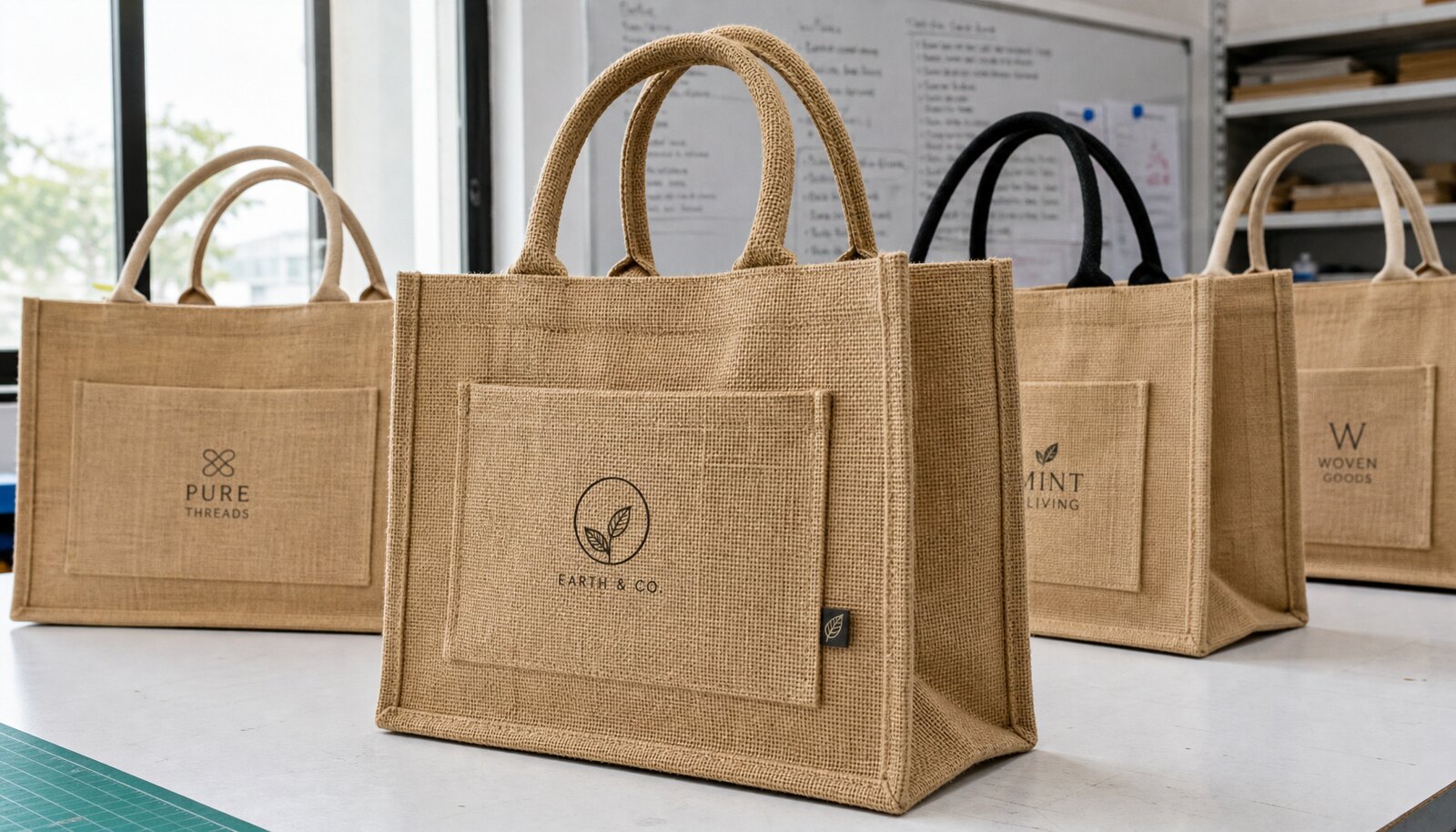
Why a bulk pricing plan matters before you ask for jute tote quotes
Gift-shop buyers usually do not lose margin because jute totes are expensive in the abstract. They lose margin because each supplier is quoting a different product. One quote includes heavier fabric. Another simplifies the handle. A third leaves packing vague and assumes the buyer will finish retail preparation locally. If the specs are not aligned, the lowest unit price can be the worst commercial deal.
A useful bulk pricing plan does three jobs at once. It defines the bag for retail use, exposes the real cost drivers, and shows what the total landed cost will be when the bags arrive ready to sell. That means the plan has to go beyond a single unit price and cover MOQ breakpoints, sample costs, freight assumptions, packing format, and reordering rules.
For gift shops, the use case is often narrower than for general retail. The tote may need to hold postcards, candles, mugs, books, souvenirs, or boxed gift sets. A bag that looks good for paper goods may fail once it carries ceramics or heavier hardcover items. The buyer should start with the end use, not the logo. Once the use case is fixed, pricing becomes easier to compare and easier to defend internally.
- Start from use case, not artwork.
- Make suppliers quote the same construction, packing, and trade term.
- Compare landed cost per sellable unit, not only ex-factory price.
The spec set that drives price: size, fabric weight, handles, and structure
The strongest pricing decisions usually start with a clear product definition. For many gift-shop programs, a medium tote in a mid-to-heavy jute construction is a practical starting point because it has enough body to stand on shelf and enough durability for retail traffic. If the tote will carry lightweight souvenirs or paper goods, a simpler construction may be enough. If it must hold books, bottles, or boxed gifts, the supplier should quote stronger reinforcement and a load-appropriate build.
Size should be tied to actual merchandise, not to a generic wish list. A tote that is too shallow may look neat but fail to hold the intended items. A tote that is too narrow may collapse or appear flimsy. Buyers often start by fixing width and height first, then adjust gusset depth based on what the shop actually sells. Handle length matters too. Short handles may lower cost and suit hand carry; longer handles can improve comfort and premium presentation, but they usually need better reinforcement and may increase carton volume.
Structure affects price more than many first-time buyers expect. An unlined, unlaminated tote can deliver a natural look at a lower cost. A lined or laminated version can improve shape retention and make the bag feel more polished on the shelf. The buyer should decide whether the selling point is rustic texture, durability, or premium presentation. Once that is clear, the supplier can quote a real product instead of a vague description like 'good quality jute bag.'
- Use a real retail load target: postcards, books, mugs, or boxed gifts.
- Define gusset depth if the bag must sit upright or hold rigid merchandise.
- Choose handle length based on display and carry comfort, not only on cost.
Practical unit-price ranges and MOQ breakpoints for gift-shop buyers
The ranges below are planning guidance, not a market quote. They are useful when the spec is close to a standard medium retail tote with one-color decoration and bulk packing. Actual price depends on origin, material availability, artwork complexity, carton efficiency, order timing, and whether the supplier is a factory, trader, or stockist. The point is to start with a credible budget range so the buyer can screen out quotes that are too high, too low, or missing key cost items.
For a medium unlaminated tote with a simple one-color screen print and bulk packing, many buyers plan around USD 1.05-1.65 at 1,000 pieces, USD 0.85-1.35 at 3,000 pieces, and USD 0.70-1.10 at 5,000 pieces. If the bag is laminated, heavier, lined, or finished to a more premium retail standard, a practical planning range is closer to USD 1.40-2.20 at 1,000 pieces, USD 1.15-1.80 at 3,000 pieces, and USD 0.95-1.50 at 5,000 pieces. Extra print positions, woven labels, or gift-ready packing can add cost on top of that.
The price break usually appears when setup is spread across more units and the supplier can run material and labor more efficiently. For many orders, the first meaningful breakpoint is around 3,000 pieces. A second step-down often appears around 5,000 pieces if the factory can buy material and trim in more efficient lots. Buyers who only request one quantity may miss the best commercial point and end up overpaying for the first order.
- Ask for quote tiers at 1,000, 3,000, 5,000, and 10,000 pieces if annual demand supports it.
- Treat unusually low prices as a spec check, not a win, until fabric, handle, and print method are verified.
- Expect retail-ready packing, labels, or premium finishing to add real cost even if the base bag is unchanged.
Landed-cost examples gift shops can actually use
Procurement should compare total landed cost per sellable tote, not just the ex-factory number. The landed cost includes the bag price, export handling, freight, duty, customs clearance, warehouse receiving, and any local finishing the retailer must do before the product can be sold. A bag with a lower unit price can become more expensive if the cartons are oversized or the packing format creates extra labor.
Consider two planning scenarios. In Scenario A, a medium unlaminated tote is priced at USD 0.98 ex-factory at 3,000 pieces. Bulk packing is compact, and ocean freight is shared with other seasonal goods. If freight, duty, and inbound handling add USD 0.22-0.35 per unit, the landed cost may land around USD 1.20-1.33 before local tagging or shelf prep. In Scenario B, a laminated premium tote is priced at USD 1.42 ex-factory. Because the bag is larger and more rigid, carton volume increases and freight rises. If logistics add USD 0.30-0.48 per unit, the landed cost may land around USD 1.72-1.90 before local finishing.
That difference matters in two ways. First, the retail price has to support the landed cost while leaving margin. Second, a bulkier tote can consume more backroom space, which is a real cost for seasonal retail stock. The better question is not, 'What is the unit price?' It is, 'What will this product cost on the shelf and in the warehouse?'
- Use landed cost to compare materials, not just supplier quotes.
- Check carton volume because freight often moves with cubic meters, not weight alone.
- Do not ignore local receiving and relabeling costs if the bag is not shelf-ready.
How to compare supplier models without being misled by a low headline price
A low headline quote is only useful if the buyer knows exactly what it includes. A direct factory may quote lower because it owns the production line and can repeat the job without extra coordination. A trading company may quote a little higher but absorb some communication, artwork, and issue-handling burden. An independent agent can look attractive on service but may not own production, which makes claim handling harder if there is a defect or delay.
The commercial question is accountability. If the print is misaligned or a seam fails, the buyer needs a supplier who can either remake the batch or compensate the shortfall in a way that protects the retail program. Direct factories usually have the clearest chain of responsibility because they control sewing and finishing. Trading companies can be effective if the actual factory is disclosed and the claim path is written into the order. Agents are best treated as coordinators unless they can prove production ownership, final inspection control, and claim responsibility.
For gift shops with repeat seasonal promotions, direct factory or factory-backed trading company is often the most workable route. For a small pilot or a one-time event, a trusted trader or importer can be acceptable if speed matters more than long-term price control. The key is to match the sourcing route to the order complexity rather than to the first number on the page.
- Direct factory usually gives the clearest long-term price control.
- Trading company can reduce communication friction but may add margin.
- Agent-only quotes need explicit proof of production ownership and claim handling.
What a procurement-ready RFQ should contain
A good RFQ reads like a production instruction, not a brainstorming note. If the supplier has to guess the size, print coverage, handle finish, or packing format, the quote will be built on assumptions. Those assumptions often become change orders later. The goal is to remove ambiguity before the factory starts calculating fabric, labor, and carton space.
The RFQ should state the bag dimensions, gusset depth, handle length, fabric weight target, print method, print position, logo color count, lining or lamination choice, packing method, carton count, and trade term. If possible, include a reference photo or an existing bag sample. For gift-shop buyers, it also helps to identify the retail setting: museum store, tourist shop, coastal gift shop, seasonal pop-up, or general souvenir line. That context tells the supplier whether appearance, durability, or low cost should lead the quote.
Ask for comparable quotes across multiple quantities and require the same construction at each level. That is how the buyer sees the real breakpoint from 1,000 to 3,000 to 5,000 units. Without aligned specs, a lower price may simply reflect a lighter bag or simpler packing, not a better deal.
- Include a reference image or sample if the tote must match an existing retail line.
- Ask suppliers to quote the same construction at several quantities.
- State the end use so the supplier does not overbuild or underbuild the bag.
Quality control thresholds that are useful in procurement, not just in approval meetings
Gift-shop totes need QC standards that a factory can inspect and a buyer can reject against. Vague language such as 'good stitching' or 'nice print' is not enough. Procurement should set measurable expectations before production begins and tie them to the approved sample. For example, size tolerances can be written by dimension class, while stitch and print checks should be tied to the actual bag design rather than a generic retail standard.
On seams and reinforcement, the buyer should define the stitch pattern, reinforcement style, and any stress points that matter for the intended use. A bag that will hold books should not be inspected the same way as a giveaway tote. Ask the supplier to show where reinforcement is placed and how the handle attachment is tested. If the supplier describes a load check, ask for the method used, the sample count, and the pass criteria. That is more useful than a vague promise that the bag is 'strong enough.'
Print control needs similar discipline. Rough jute texture can affect detail sharpness, so very small text and thin lines should be reviewed with caution. If the bag includes a woven label, side tag, or patch, ask the supplier to show the attachment method and appearance standard. For retail programs, many buyers use an AQL-style inspection framework, but the acceptance limit should be written into the order and linked to defect severity and lot size. Critical defects should remain zero tolerance.
- Set size, stitch, and print tolerances before bulk production.
- Use a load check that matches how customers will actually use the bag.
- Treat critical defects as zero tolerance, especially on branded retail goods.
Packing and freight economics: where small choices change total cost
Jute tote pricing does not end when the bag is sewn. Packing format can change freight cost, warehouse cost, and how much local labor is needed before the product can reach the shelf. A standard bulk pack in inner protection and master cartons is usually the most cost-efficient starting point. It protects against dust and abrasion without adding too much volume. If the retailer or distributor will add tags locally, this is often the right commercial choice.
Retail-ready packing sounds minor, but it can change the economics quickly. Individual hang tags, barcode stickers, tissue inserts, or presentation boards add labor and often enlarge the carton. That means more cubic volume and sometimes more freight. For a gift-shop buyer, the question is whether the added presentation improves sell-through enough to justify the cost. In many cases, the cleaner choice is to keep factory packing lean and finish retail prep closer to market.
Carton planning should be part of the quote, not an afterthought. Ask for carton dimensions, packed quantity per carton, gross weight, and whether the cartons can be optimized for pallet or container loading. Two quotes with the same bag price can create very different freight costs if one supplier uses oversized cartons or packs inefficiently. If freight is part of the landed-cost model, better carton efficiency can matter as much as a small price drop.
- Request packing count, carton dimensions, and gross weight in every quote.
- Bulk pack when the local team can finish retail preparation.
- Treat carton efficiency as part of the margin, not just a logistics detail.
How to choose the right sourcing route for a gift-shop program
Direct factories, trading companies, agents, and domestic stockists each solve a different commercial problem. Direct factories are best when the buyer needs repeatability, specific QC thresholds, and better control over price breakpoints. They are especially useful when a gift shop chain wants to reorder the same tote across seasons or locations. The tradeoff is that the buyer must handle more production detail and should be comfortable reading line-level quotes.
Trading companies make sense when the order has more moving parts: multiple SKUs, mixed materials, packaging variations, or artwork that needs more coordination. A good trading company can save time and reduce communication errors, but the buyer should expect some margin in the quote. That is not a problem if the trading partner actually adds value through coordination, inspection, or claim support. The key is to verify that value in writing.
Agents are the most variable model. Some are useful, especially if they know the factory and can solve language or follow-up issues. Others add little beyond introductions. The danger is not simply commission. The danger is losing accountability. If the agent cannot show the manufacturing site, the QC process, and the claim path, the quote should be treated as a lead, not a committed supply solution. Domestic wholesalers or importers can work for urgent or very small orders, but they usually remove the buyer from the bulk-manufacturing cost advantage. For planned gift-shop programs, they are a convenience option, not the lowest-cost path.
- Choose direct factory for repeatability and pricing control.
- Choose trading support when coordination complexity is high.
- Treat agent-only quotes cautiously unless production accountability is explicit.
A reusable buying model gift-shop teams can apply season after season
The most useful buying model is a simple one that can be repeated. First, define the tote as a sellable retail item: size, weight target, handle style, logo coverage, and packing format. Second, request quotes at several quantities and insist that all suppliers quote the same spec. Third, compare unit price, sample cost, carton data, and landed cost together. Fourth, approve a production-matched sample and lock a written QC standard. Fifth, make sure the reorder path is clear so the next purchase does not restart from zero.
This approach turns jute tote sourcing into a managed program rather than a one-time purchase. Gift shops often buy in seasonal bursts, so the real advantage goes to buyers who can repeat a spec cleanly. Once the supplier understands the line, the price usually becomes more stable, the sample stage gets shorter, and the risk of mismatch drops. In commercial terms, the best pricing plan is not the lowest first quote. It is the quote structure that stays understandable at reorder time.
If the business wants a premium retail position, the same process can be used with heavier fabric, cleaner print, a woven label, tighter seam control, and more careful packing. If the business wants the lowest possible bulk cost, the same process can be used with a simpler build and bulk packing. Either way, the decision stays commercial because the buyer has already defined the spec, the cost breakpoints, and the acceptable quality level.
- Build one reusable spec sheet for every reorder.
- Lock the QC standard before production starts.
- Optimize for repeatability if the tote will be a seasonal staple.
Specification comparison for buyers
| Commercial sourcing route | How it usually works | Best fit for gift-shop programs | Pricing and accountability impact | Buyer verification to request |
|---|---|---|---|---|
| Direct factory | The sewing, printing, and packing happen under one production owner. | Repeat orders, tighter spec control, and buyers who want stable reorders. | Usually strongest for unit price and change control at scale; accountability is clearer if the factory truly owns production. | Ask for factory name, production site photos, line QC records, and confirmation that the quoted site will sew the order. |
| Factory-backed trading company | A commercial team coordinates one or more factories and handles communication. | Seasonal collections, mixed-SKU orders, or teams that need faster quote handling. | May cost a little more than direct factory, but can reduce coordination burden if the supply chain is real and disclosed. | Request the actual factory, written responsibility for defects, and the inspection party named in the quote. |
| Independent sourcing agent | A middle layer introduces the buyer to a factory and manages follow-up. | Small teams entering a new sourcing region or buyers needing language support. | Can appear low-cost early, but hidden risk rises if production ownership and claim handling are unclear. | Require factory disclosure, a written QC scope, and a clear process for substitutions, delays, and claims. |
| Domestic wholesaler / importer | Stock is already landed locally or bought in advance. | Urgent replenishment, tiny orders, or buyers unable to wait for overseas lead times. | Highest unit price is common, but freight and customs burden may be lower or already absorbed. | Check actual material, print method, carton age, and whether stock matches the current retail line. |
| Private-label factory program | A semi-standard bag is customized with limited options. | Fast launches when the gift shop wants branded bags without a full new development cycle. | Can lower setup cost and shorten lead time, but only if the allowed customization still fits the retail brief. | Confirm control over size, handle length, print area, and carton packing before accepting the program. |
| Material specification | Fabric weight, blend, lining, lamination, odor control, and shade consistency determine the construction. | Before comparing price quotes. | Different cloth weights or finishing levels are not directly comparable if the supplier is quoting different material levels. | Ask for a named reference sample or construction description, not just a generic 'good quality' promise. |
| Construction specification | Handle attachment, seam reinforcement, gussets, and edge finishing affect durability and labor. | Before sample approval. | Weak structure creates returns, QC failures, and hidden rework cost. | Request stitch detail, reinforcement points, and load-use assumptions in the quote. |
| Decoration method | Screen print, transfer, woven label, embroidery, or patch each behave differently on jute texture. | Before artwork signoff. | The wrong decoration method can crack, blur, or look uneven on rough fibers. | Ask for print method, color count, and a production-matched sample on the same fabric. |
Buyer checklist before sampling
- Define the retail use case: souvenir bag, book carrier, gift bag, premium shopping tote, or event giveaway.
- Lock bag width, height, gusset depth, handle length, and intended load before requesting quotes.
- State fabric weight or equivalent construction in the RFQ; avoid vague language like 'strong' or 'premium.'
- Specify whether the tote is unlined, lined, laminated, or reinforced at key stress points.
- Send final vector artwork and confirm the maximum print colors, print position, and any text-size limits.
- Ask suppliers to quote at multiple quantities so you can see the breakpoint, not just the lowest headline price.
- Request separate line items for sample fee, setup or screen fee, unit price, packing, and freight term.
- Ask for a production-matched pre-production sample made from the same fabric, handle, and print method.
- Set acceptance criteria for stitch quality, print alignment, defect types, and carton count before bulk production starts.
- Confirm the defect resolution path: replacement, rework, or credit, and who pays return or replacement freight.
Factory quote questions to send
- What fabric weight or construction are you quoting, and will the same material be used in the pre-production sample and the bulk lot?
- Please separate base bag price, print charge, setup or screen fee, sample fee, packing fee, and freight term in the quotation.
- What is the unit price at 1,000, 3,000, and 5,000 pieces, and what changes at each breakpoint?
- What is the MOQ per size, per artwork, and per print color?
- What handle construction is included, and how are the handle ends reinforced?
- What are the carton dimensions, packed quantity per carton, and gross weight?
- Which trade term are you quoting—EXW, FOB, or CIF—and what exactly is excluded?
- What defect types do you classify as major, minor, and critical during final inspection?
- Can you send a blank sample first, then a printed pre-production sample made from production materials?
- If we reorder the same design, do we pay setup or screen charges again, or are they retained?
Quality-control points to confirm
- Use a defined reference sample or sealed approved sample; do not rely on verbal approval alone.
- Check fabric weight against the agreed construction, using the same method for all suppliers you compare.
- Confirm overall dimensions, gusset depth, and handle length against the approved spec; set tolerance by bag size and keep it documented in the PO or tech pack.
- Inspect seam quality for skipped stitches, seam gaps, loose thread ends, and uneven tension; record the exact defect type, not just 'poor stitching.'
- Verify reinforcement at handle attachment points with the agreed stitch pattern or bartack count.
- Match print position and color to the approved artwork and sample; rough jute texture can reduce sharp detail, so small text and thin lines should be reviewed carefully.
- If load performance matters, ask the supplier to define the test method they used rather than quoting a universal pass/fail number; align the test with the bag's actual retail use.
- Treat torn seams, missing handles, contamination, and severe misprint as critical defects with zero tolerance in the shipment plan.
- For retail programs, many buyers use an AQL-style inspection framework, but the acceptance limit should be written into the order and tied to defect severity and lot size.
- Require carton count verification and random carton checks so the shipped quantity matches the invoice and packing list.