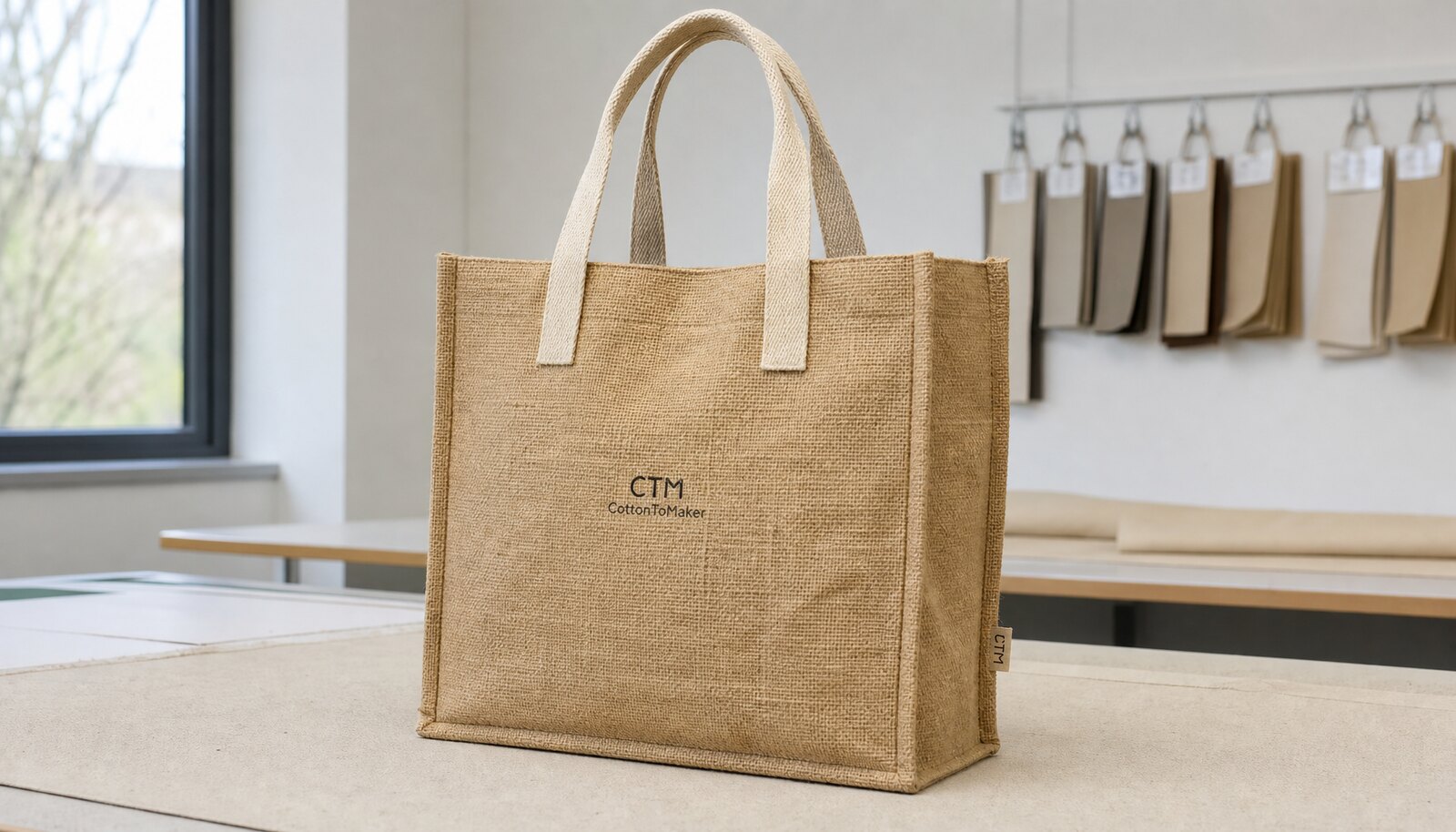
Why hotel jute bags fail when the spec is too vague
Most problems with custom jute bags for hotels start before production. Buyers send a logo and a rough size, then expect the supplier to fill in the rest. That usually creates a bag that looks acceptable in a quote but fails in daily use: the body collapses, the handle length feels wrong, or the print sits crooked on the front panel. For hotel programs, the bag needs to work as a guest-facing item, not just as a cheap carry bag.
The better approach is to define the use case first. A welcome bag for check-in has different priorities from a laundry bag, spa bag, or retail souvenir bag. Once you know what the guest will carry, how long the bag needs to survive, and where it will be displayed, the rest of the spec becomes easier to control. That means fewer revision rounds and fewer surprises in the quote.
- Guest welcome bags should look neat, hold shape, and print cleanly.
- Laundry or housekeeping bags need stronger seams and a wider opening.
- Retail resale bags need better finish quality and more consistent branding.
- Spa or amenity bags often need moisture tolerance and easier wipe-down surfaces.
Choose the right jute construction before talking about decoration
For hotel programs, the base material matters more than the logo. A typical buyer-friendly range is 280–320 GSM for laminated jute when the bag must look structured and present well at reception. If the bag is unlaminated, it can feel more natural and flexible, but the body may show weave irregularity and absorb dirt faster. For guest-facing applications, laminated jute is usually easier to standardize across batches.
Handle construction is the next decision. Cotton webbing handles feel cleaner and are easier to grip, while self-fabric jute handles can look more integrated with the body. In either case, the important part is reinforcement. Bar-tacks, box stitching, or reinforced seam ends are what keep the bag from failing after repeated loading. If the buyer plans to place towels, slippers, or bottled amenities inside, the handle and seam build should be written into the RFQ, not left to factory judgment.
- 280–320 GSM: common range for structured hotel bags.
- Lamination improves wipeability and body control.
- Cotton webbing handles usually feel softer in guest use.
- Reinforcement stitching should be visible and repeatable across the lot.
Print method should match the logo, not the sales brochure
Most hotel buyers only need a simple one-color logo, room number, or property name. In that case, screen printing is usually the most efficient route because it keeps setup cost manageable and gives solid coverage on jute. If the artwork has multiple colors or a more detailed emblem, heat transfer or a more controlled decoration method may be needed, but it will add cost and can change the hand feel of the bag surface.
The key mistake is approving artwork that is too fine for the substrate. Jute is textured, so thin lines, small reversed text, and tight registration are all risk areas. Keep the print zone large enough to read from a distance, and simplify gradients unless you are prepared to pay for a higher-end process. For hotel use, clarity is usually more valuable than visual complexity.
- Screen print fits simple logos and medium-volume programs.
- Heat transfer can work for detail, but needs careful durability review.
- Keep small text and thin strokes out of the design if possible.
- Define exact print position on front panel and side panel before sampling.
How to compare supplier quotes without missing hidden cost drivers
A good quote for custom jute bags for hotels should break out the actual build, not just give one neat unit price. Two suppliers can quote the same looking bag at very different numbers because one is using thinner cloth, less reinforcement, or a cheaper print process. Another may be padding the price with unnecessary labor because the spec is not detailed enough to price accurately. If the quote is vague, the risk sits with the buyer.
When you compare quotes, focus on the pieces that move cost and quality together: GSM, lamination, handle type, print method, packing count, and carton size. A slightly higher bag price can be cheaper overall if the supplier packs efficiently and avoids damage. For hotel procurement, the right question is not only “what is the unit price,” but “what is the landed, usable cost per approved bag delivered to the property or warehouse?”
- Check whether the quote includes artwork setup or plate charges.
- Compare whether sample charges are deductible from bulk PO.
- Ask if carton dimensions are optimized for freight and storage.
- Compare packing density because loose packing can raise shipping cost.
Supplier comparison: factory direct versus trading route versus local converter
Hotel buyers often see three sourcing routes. Factory direct gives the cleanest path on spec control, repeatability, and unit economics, especially if the bag will be reordered across properties. A trading company may respond faster and can sometimes solve coordination issues, but you need to verify who actually makes the bags, who prints them, and who owns the final spec. Local converters can be useful for urgent replenishment, but they often buy the base material from elsewhere and may have less room to optimize cost or construction.
For a branded hotel program, supplier transparency matters. You want to know who is cutting, who is printing, who is packing, and which step can cause defects. If your quote source cannot identify the actual material basis or cannot provide a clear pre-production sample, that is a signal to slow down. For a launch order, the cheapest quote is rarely the best route if it introduces schedule risk or inconsistent logo placement.
- Factory direct: best for repeatable spec and clearer cost breakdown.
- Trading route: useful when coordination is easier, but verify the real maker.
- Local converter: useful for speed, but often less efficient on unit cost.
- For hotel rollouts, insist on one golden sample tied to the bulk PO.
What a useful MOQ really means in hotel sourcing
MOQ is not just a factory number; it is a function of fabric width, print setup, and packing efficiency. If you only need one hotel property, a lower MOQ may be possible, but the unit price will rise because the supplier is spreading setup and labor across fewer bags. If the same design is shared across several hotels or departments, the order becomes more efficient and the quote usually improves. The strongest leverage comes from reducing variation: one size, one print, one handle type, one pack count.
Buyers should also separate MOQ by artwork and by size. A supplier may accept 1,000 pcs total, but if the order is split into three sizes and two colors, the real effective MOQ is much higher. Ask for a price ladder if the quantity changes. That gives procurement a real view of the breakpoints and helps determine whether to standardize one bag across the hotel group or use a property-specific version.
- Lower variation usually beats lower quantity in pricing discussions.
- Separate MOQ by size, color, and print artwork.
- Ask for a price ladder at 1,000, 3,000, and 5,000 pcs if the supplier can support it.
- Standardization across properties can reduce sample and setup costs.
Sampling: the stage where most avoidable mistakes are caught
For hotel bags, the sample should be judged as a production reference, not a showpiece. The approved sample needs to show the actual jute weight, the exact handle type, the final print color, and the packing style that will go into bulk production. If the sample looks neat but differs in material or reinforcement from the bulk plan, it is not a useful control point. The goal is to lock one version that the factory can repeat.
A proper sample review should include functional checks. Fill the bag with realistic contents, hold it by the handles, and look for tilt, seam stress, or print cracking at the fold. Smell the laminated material, inspect for patchy coating, and compare logo placement on multiple units if a pre-production set is available. If the sample varies too much bag to bag, the bulk run will likely vary as well.
- Use real contents during sample testing, not an empty bag.
- Review print sharpness and color under daylight or neutral indoor light.
- Check handle symmetry and reinforcement stitching on both sides.
- Approve only after the sample matches the intended carton packing method.
Packing choices affect storage, freight, and hotel delivery accuracy
Packing is often treated as an afterthought, but for hotel procurement it affects freight cost, warehouse handling, and distribution to multiple locations. Flat-packed jute bags generally ship well, but the folding method needs to protect the print and keep the bag from taking a permanent crease. If the bag has structure or a board insert, the supplier should define whether it is packed folded, nested, or partially stuffed to retain shape. Those choices change carton dimensions quickly.
If bags are going to multiple properties, carton marking matters. Outer cartons should carry the item code, quantity, color, and destination split if needed. The buyer should decide whether the factory packs per hotel, per floor, or per distribution center. That decision reduces repacking work on arrival and helps procurement reconcile quantities against the PO.
- Specify inner folding to avoid print cracking.
- Set carton count based on what the warehouse can lift and store.
- Use clear carton marks for SKU, color, size, and destination.
- Ask for carton dimension approval before shipment booking.
Lead time planning: where schedule risk actually comes from
A standard jute bag program can often move in roughly 3–4 weeks after sample approval when materials are in stock and artwork is final. That timeline gets longer if the order uses custom lining, special handles, multi-color printing, or a unique carton format. The most common delay is not sewing capacity; it is late artwork sign-off, material substitution, or waiting on a revised sample after the buyer changes the logo size.
For hotel openings or seasonal campaigns, the buyer should work backward from the delivery date and leave a buffer for one sample revision cycle. If the bags must arrive at different properties, add time for domestic distribution or cross-docking. It is better to lock one standard order early than to split the order into urgent and non-urgent pieces, because split orders usually create inconsistency in shade, handle length, or packaging.
- Standard lead time is shorter when materials are common and artwork is simple.
- Custom trims, special closures, and multiple SKUs extend the schedule.
- Allow time for one sample revision if the logo placement is not final.
- Distribution to multiple hotel sites should be planned before production starts.
A practical QC standard for hotel-facing jute bags
Quality control for hotel jute bags should focus on appearance, strength, and packing accuracy. Start with dimensions and compare finished size to the approved spec with a reasonable tolerance, then inspect the seam structure, handle attachment, and print alignment. On laminated bags, the surface should be even, with no peeling, bubbling, or oily feel. On unlaminated bags, the weave should be consistent and free of heavy loose fibers or dirty spots that will stand out in guest use.
It also helps to define reject conditions in plain language. Crooked logo placement, uneven handle length, weak bar-tacks, and carton count errors are not minor issues when the bag is representing a hotel brand. If the order is for multiple properties, one bad batch creates uneven guest presentation across sites. The acceptance standard should be written before production, not argued after the goods land.
- Size tolerance: practical, not cosmetic; keep it narrow enough for repeatability.
- Logo placement: centered and consistent across the lot.
- Handle strength: no slippage, loose ends, or uneven stitch density.
- Carton count: reconcile packed quantity against PO and SKU list.
Specification comparison for buyers
| Spec decision | Recommended option | When it fits | Buyer risk to check |
|---|---|---|---|
| Fabric weight | 280–320 GSM laminated jute for guest-facing bags | Front desk, welcome kits, amenity carry bags, and retail resale where shape and appearance matter | Too light will sag, show weave gaps, and distort after packing heavier items |
| Lamination | PE or PP inner lamination for cleaner body and easier wipe-down | Hotels wanting a tidier look and better resistance to moisture from amenities or laundry items | Over-lamination can make the bag stiff, noisy, and harder to fold or store in bulk |
| Handle build | Cotton webbing or self-fabric handles with reinforced bar-tacks | Repeated daily use by guests or housekeeping where handle fatigue is a known failure point | Short handles and weak stitching cause returns and complaints, especially on loaded carry bags |
| Print method | 1-color screen print or heat transfer for simple logo placement | Logo bags with clear artwork, medium runs, and controlled decoration cost | Fine gradients, thin lines, or dark-to-light contrast can break down if artwork is not simplified |
| MOQ route | Direct factory order from 1,000–3,000 pcs or lower with fewer size/color combinations | Brands testing a hotel rollout or opening multiple properties with a shared design | Too many variants split MOQ and increase unit cost, sample cost, and packing complexity |
| Lining and closure | Open top for amenity bags; zipper or magnetic closure only when the hotel use case demands security | Spa kits, gift sets, and retail-grade presentation bags | Extra hardware increases cost, lead time, and failure points in QC |
| Packing method | Flat-packed 25–50 pcs per export carton with moisture protection and carton marks | Bulk procurement and warehouse distribution to multiple hotel locations | Loose stuffing wastes freight space; missing carton labels complicate property-level delivery |
| Supplier route | Factory direct with sampling and pre-production approval | Best when you need artwork control, repeat orders, and cost transparency | Trading layers can hide fabric source, print process, and actual carton count |
| Lead time profile | 3–4 weeks for standard materials after sample approval; longer for custom trims or complex finishing | Scheduled hotel openings and seasonal promotions with fixed launch dates | Late artwork approval and material shortages are the main schedule risks |
Buyer checklist before sampling
- Confirm the bag use case: guest welcome, spa, laundry, retail resale, or housekeeping transport.
- Lock the finished size, target carry weight, and required appearance level before requesting quotes.
- Specify jute weight in GSM, plus whether lamination, lining, or board insert is required.
- Provide logo artwork in vector format and define one-color, two-color, or full-area print limits.
- State handle length, handle material, reinforcement style, and whether the bag must stand upright.
- Define carton pack count, carton size limit, barcode or label needs, and any hotel distribution split.
- Request a pre-production sample and inspect seam density, print registration, odor, and handle pull strength.
- Compare supplier quotes on fabric basis, printing process, packing method, and freight-ready carton efficiency.
- Approve a written golden sample before bulk production starts.
Factory quote questions to send
- What is the exact GSM of the jute cloth, and is it laminated, unlaminated, or blended with another fiber?
- Which print method is included in the quote, how many colors are covered, and what is the setup charge?
- What is the MOQ per size and per print artwork, and how does pricing change if we reduce color variants?
- Are handles self-fabric or cotton webbing, and what reinforcement stitching is used at the stress points?
- What packing count, carton dimensions, and outer carton markings are included in the base quotation?
- What is the sample process, sample charge, and whether the sample charge can be deducted from the bulk order?
- What is the production lead time after sample approval, and which parts of the schedule are most likely to delay shipment?
- Can you provide photos or a spec sheet of the actual base material and a reference packed carton before PO confirmation?
Quality-control points to confirm
- Measure finished size against the approved spec with a practical tolerance of about +/- 0.5 to 1.0 cm depending on bag size.
- Inspect print alignment, ink coverage, and edge sharpness; reject blurred logos, visible smearing, or heavy ghosting.
- Pull-test handles and seam junctions; reinforcement stitching should be even, tight, and free from skipped stitches.
- Check jute body for weak weave areas, fiber shedding, stains, oil marks, and odor, especially on laminated material.
- Verify carton count, carton labels, and inner packing so every hotel location receives the right quantity.
- Open random packed bags to confirm folding method does not crack print, crease the body, or deform the handles.