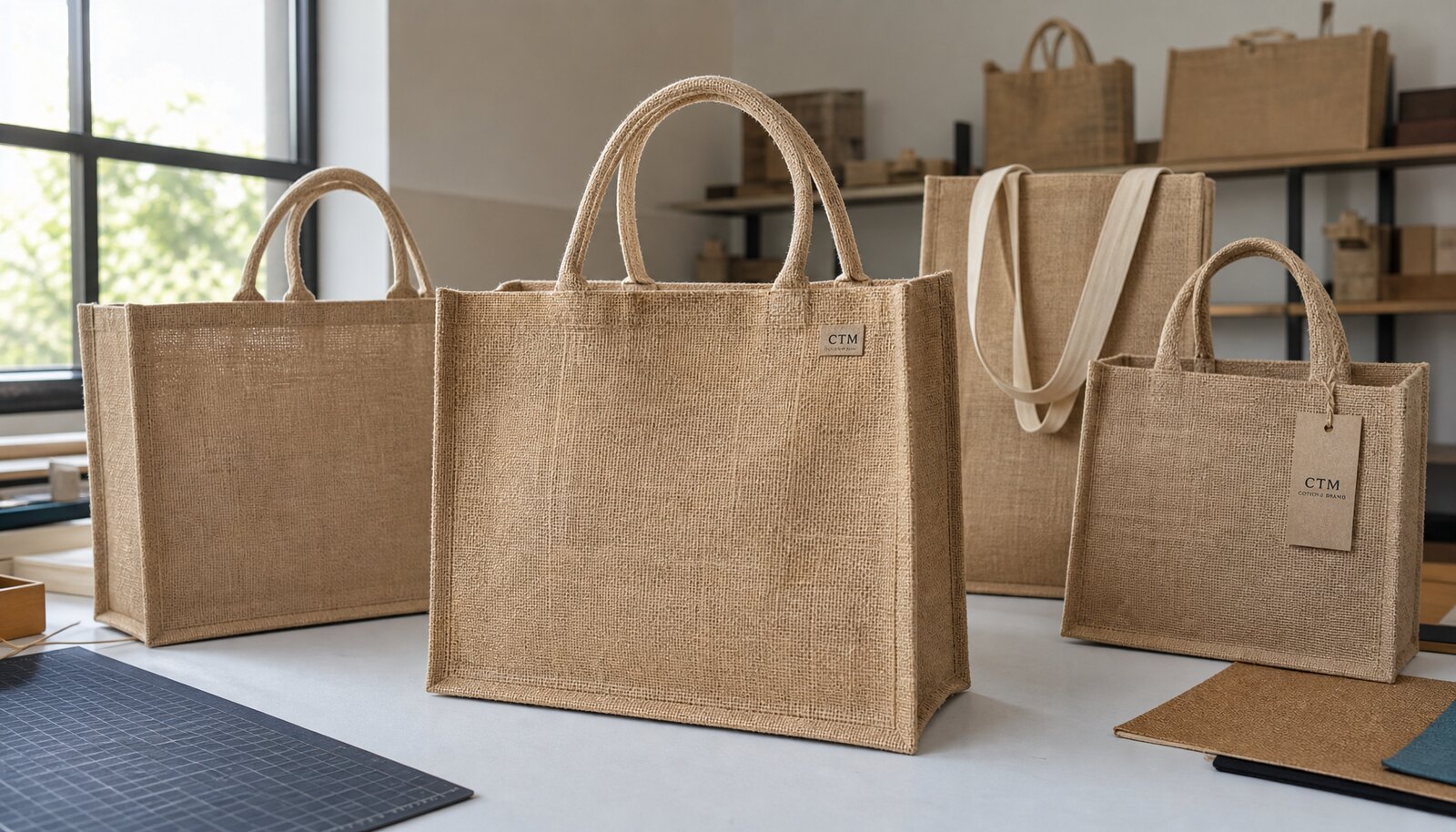
Why ecommerce jute bags fail when the spec is too loose
Most sourcing problems with custom jute bags for ecommerce begin with a weak brief. The buyer asks for a natural jute tote, the supplier fills in the missing details with its standard pattern, and the quote looks attractive because the factory has assumed a lower fabric weight, a simpler handle, or a looser packing method. The order then changes in the wrong direction: the bag feels flimsy, the print looks rougher than expected, or the carton configuration causes avoidable freight waste.
For ecommerce, a jute bag does three jobs at once. It presents the brand, protects the goods, and moves through a warehouse or courier network without failing. That combination means procurement should manage it like a controlled component, not a generic promotional item. The bag size, fabric, handle, print, packing, and inspection standard all need to be written down before the supplier prices the job.
A good spec does more than reduce mistakes. It also makes the quote easier to audit. When each supplier prices the same fabric weight, the same handle type, and the same packing method, you can actually compare landed cost instead of guessing why one quote is 18% cheaper than another.
The most common error is to approve style before structure. A visually appealing sample can still be wrong for ecommerce if the handles twist, the gusset collapses, or the print is too fragile for repeated handling. Buyers who treat the bag as a procurement item instead of a design object usually get better repeatability and fewer rework cycles.
If you only lock one thing early, lock the final use case. Is the bag carrying retail product to the consumer, acting as a branded insert for a subscription box, or moving as a warehouse pack-out item? That answer determines the fabric, the closure, the packing, and how strict the QC standard needs to be.
- A vague brief usually creates the biggest price spread between suppliers.
- The cheapest-looking quote is often missing one material, packing, or finishing assumption.
- A sample is only useful if it reflects the final production spec, not a showroom version.
Choose the right jute build for the job
The first sourcing decision is not the logo. It is the bag construction. Natural jute gives the strongest organic look and is often preferred when the brand wants a handmade or premium-gift feel. It is usually the better choice for ecommerce brands that care about texture and a less processed look, but it can be rougher, more variable in appearance, and less forgiving if the artwork is too detailed.
Laminated jute is a different commercial trade-off. An inner PP or PE layer can improve shape retention, reduce dust transfer, and add some moisture resistance. That can be valuable in humid shipping lanes, storage rooms, or fulfillment centers where bags may sit before use. The downside is a firmer handfeel, more processing cost, and a different visual and tactile expectation that should be tested against your brand position.
For specification purposes, ask the factory to state the fabric in a unit the production team can actually use. If your team works in GSM, get GSM. If the factory quotes in ounces or a local weave standard, require a written conversion and a sample reference. Avoid phrases like "sturdy," "premium," or "heavy" unless they are backed by numbers.
Size matters more than many teams expect. Typical ecommerce tote-style jute bags often fall in the rough 25-40 cm width range, but the right size depends on the inner product, not the marketing plan. A bag that is too shallow may distort the product and stress the stitching; one that is too large may waste material, occupy more carton space, and look oversized in the customer unboxing.
Handle choice also changes the buying equation. Cotton webbing handles are cleaner, more consistent, and often more comfortable for repeated carrying. Reinforced jute handles can look more cohesive with a natural bag body, but they need stricter control at the attachment points. If the bag will carry weight or get frequent handling, ask for reinforcement rather than assuming the body fabric alone will compensate.
- Natural jute: best for premium texture and a less processed look, but more variable surface quality.
- Laminated jute: better for structure, dust control, and warehouse handling, but stiffer and usually costlier.
- One-size-fits-most is often a trap; define the internal product or pack item before you pick the bag dimensions.
- Handle length should be fixed in the spec, not left as a factory standard.
Practical size, stitch, and seam standards buyers can actually specify
Procurement teams get better results when the purchase order includes measurable construction details. For example, define finished dimensions, not just nominal size. If you want a 30 x 35 cm bag with an 8 cm gusset, say so, and state the tolerance. A practical tolerance band for many jute bags is often tighter on print placement than on body dimensions, but you should decide that based on the use case. Ecommerce bags used as packaging usually need tighter consistency than bags used for casual retail giveaways.
Stitching is another area where vague language causes trouble. Ask the supplier to confirm stitch density or stitch pattern in plain terms. If the factory cannot quote stitches per inch or a comparable sewing standard, request a reference photo and a sample note showing seam type, needle count, and reinforcement points. Side seams and bottom seams should not be left to interpretation, because that is where load stress concentrates.
A useful buyer spec can include handle attachment method, seam reinforcement, and edge finishing. For example: cross-stitch plus bartack at the handle root; turned-and-stitched mouth; reinforced bottom seam; thread color matched to fabric or approved contrast. This is not over-specifying. It is giving the factory enough room to price correctly while removing ambiguity that later becomes a dispute.
Acceptable defect examples should also be written into the spec sheet. Natural jute will never look perfectly uniform, and that is part of the appeal. But there is a difference between ordinary variation and a defect that affects saleability. Buyers should distinguish harmless weave variation from visible holes, oily contamination, broken thread clusters, crooked handles, or prints that drift into the seam allowance.
If your team uses carton-level receiving checks, include an easy pass/fail note. Example: all bags must stand square without obvious deformation, no open seams visible from the outside, handles aligned within the agreed tolerance, and no more than a small percentage of bags may show minor loose fibers that can be trimmed without rework. This kind of language helps warehouse teams inspect consistently.
- Define finished dimensions with tolerance, not nominal size alone.
- Ask for seam construction, reinforcement points, and handle attachment method in writing.
- Add example defects to the spec so receiving teams know what to reject.
What drives quote differences between suppliers
Unit price comparisons are often misleading because suppliers do not include the same assumptions. One quote may include only the sewn bag body. Another may include lamination, print setup, carton packing, and export labels. A third may omit accessory costs and add them later. For custom jute bags for ecommerce, procurement should compare quotes on the same line-item basis before looking at price.
The largest cost drivers are usually fabric weight, lamination, handle material, print setup, sewing complexity, and packing format. A simple natural jute bag with one-color screen print and basic bulk packing is usually the most economical route. As soon as you add lamination, multiple colors, cotton webbing, inner sleeves, or retail-ready packing, the quote rises because the factory needs more materials, more labor, or more setup time.
There is also a practical cost effect from yield. If the bag is oversized, heavily gusseted, or built with a complex panel shape, more fabric is consumed per unit and cutting waste can increase. If the print area is large or requires careful registration, more pieces may be scrapped during setup. Buyers should expect some quote variation based on factory capability, but not on hidden spec changes.
When a supplier says a quote is stable, ask what that means operationally. Stable against what: raw jute price changes, same-season production, locked artwork, or a fixed order quantity? If a factory is holding a price for a short period, that may be normal procurement practice, but it should not be treated as a promise that all future orders will price the same way. Quote stability is stronger when the material spec is fixed and the order quantity is repeatable.
For landed cost thinking, include more than the bag price. Freight volume, carton count, repacking labor, and rework risk all affect the real spend. A slightly higher unit price can still be the better choice if it reduces damaged units, simplifies warehouse intake, or cuts inspection time. That is especially true for ecommerce, where the bag passes through many hands before the customer sees it.
- Insist on a cost split where possible: fabric, sewing, print, packing, and export prep.
- A cheaper quote with weak packing can become more expensive after freight and rework.
- Ask what part of the quote is locked and what part can move before production starts.
Comparison of sourcing routes for ecommerce jute bags
Direct factory sourcing is usually the most useful route when the jute bag will be reordered, branded consistently, or used as part of a fulfillment system. It gives the buyer cleaner visibility into material choices, sewing method, and production sequence. The downside is that the buyer must manage more of the specification and follow-up work, especially for first-run products.
Trading companies can be useful when the buyer needs mixed-category consolidation or does not want to coordinate multiple factories. In that model, the commercial simplicity can be attractive, but the actual production site may be less visible. That does not automatically mean worse quality, but it does mean the buyer should ask more questions about who is making the bag, who controls the sample, and who signs off on changes.
Local sourcing can reduce communication friction and often makes sampling faster. It may also help if the bag is needed urgently or if freight complexity is more important than absolute unit cost. The trade-off is that local suppliers may have fewer options for fabric, finishes, or large-volume pricing. For some brands, that is acceptable if the bag is only a short-run promotional item.
The best sourcing route depends on what the order needs to optimize. If repeatability and QC control matter, direct factory is often the best fit. If the order is small, mixed, or needs fast coordination across categories, a trading route may be more efficient. Procurement teams should choose the route that best matches the order profile instead of defaulting to the lowest initial quote.
Whichever route you use, ask for the actual production owner, not just the sales contact. That helps when sample revisions, packing changes, or inspection questions come up. A smooth RFQ is useful, but a clear line of responsibility is what protects the purchase order once production starts.
- Direct factory: best for repeatability, material visibility, and clean corrective action.
- Trading company: useful for consolidation, but ask who owns the real production line.
- Local supplier: good for speed and communication, but not always the best for larger price-sensitive orders.
How to write a tighter RFQ that suppliers can price correctly
A strong RFQ is short enough to read and detailed enough to price. For custom jute bags for ecommerce, the RFQ should include the finished size, gusset depth, fabric weight or ounce equivalent, lining or lamination requirement, handle material, handle length, print method, print colors, logo placement, packing style, and intended order quantity. If you want a fair quote, remove ambiguity before the supplier starts estimating.
You should also tell the supplier what not to change. If the bag must remain natural and uncoated, say so. If the color must remain the raw fiber tone and not drift toward a dyed finish, say so. If the artwork has fine text, ask the factory to confirm whether the print method can handle it on jute texture. The more specific the artwork limitations are, the fewer sample revisions you will need.
A good RFQ also separates the commercial questions from the technical questions. One part should ask for unit pricing at the target quantity and any lower or higher tier. Another part should ask for sample cost, lead time, MOQs, and packing recommendations. If the factory can quote an itemized price, that makes future change requests easier to assess without redoing the whole negotiation.
It helps to include a simple approval rule. For example: production may begin only after the buyer signs off on size, fabric, handle, artwork placement, and packing sample. If the buyer wants one retained sample and one factory control sample, state that now. If you need carton marks or barcodes on each unit, define the label format before the quote is finalized.
For larger procurement teams, it can be useful to ask the factory to state any assumed substitutions in the quotation itself. That may include thread color, carton grade, inner wrap, or print ink family. If the factory does not state assumptions, your team should treat the quote as incomplete until the missing items are clarified in writing.
- Give the factory one exact spec, not a range of possible ideas.
- Separate sample cost, unit price, packing, and labels so you can compare quotes fairly.
- Tell suppliers which items are non-negotiable and which can be optimized.
Sample approval: the point where many orders go wrong
The approval sample is where procurement either locks the order or creates a future dispute. A sales sample may show the style and general proportions, but only a pre-production sample built from the final material set should be used for mass-production approval. That means the same fabric weight, same handle material, same print process, same seam construction, and same packing style as the order you intend to release.
The sample review should be practical, not just visual. Measure the finished dimensions. Check whether the bag sits square. Inspect the handle attachment points. Test whether the print looks legible at normal viewing distance on the actual jute surface. If the bag is intended for ecommerce packaging, try a realistic pack-in and pack-out cycle to see whether the opening is usable and whether the body collapses too much when empty.
A good sample signoff should also define what can still vary in bulk production. Natural jute will have normal fiber variation. That is acceptable if the variation is within the brand's tolerance. What is not acceptable is a sample that is structurally different from the bulk order. This is why a retained signed sample matters: it becomes the reference if the factory delivers a bag that looks acceptable in photos but is different in hand.
If the order includes multiple colors, do not approve only the main color. Check the logo color against the chosen fabric tone and verify how it reads from a small distance. Jute surface texture can change how inks appear, especially on coarse weave. If the artwork has small lettering or a fine line border, verify whether the factory can hold detail without filling in the weave gaps.
For procurement records, keep the sample signoff language simple: approved for size, material, print, handle construction, and packing. If one item is approved but another is not, note that separately. Partial approvals can work, but only if the unresolved points are written down before bulk production starts.
- Approve only a final-material pre-production sample for mass production.
- Measure size, check square shape, and test pack-in behavior before signoff.
- Keep one retained sample and one factory control sample tied to the PO.
QC thresholds that matter on jute, not just generic AQL language
AQL is useful, but only if the defect categories are defined for the product. Jute bags need their own inspection logic because a natural woven surface has a different tolerance profile from a smooth synthetic bag. Buyers should classify defects into critical, major, and minor with examples attached to the PO or inspection sheet. That gives the factory and the inspector a shared language.
Critical defects should include broken seams, missing handles, severe size deviation, unreadable or missing print where the logo is essential, contamination, mold, or odor that would make the bag unsellable. Major defects can include off-center print, incorrect handle length, poor stitch finish, visible material damage, or a bag that does not sit correctly because the gusset is miscut. Minor defects may include loose fibers or slight natural weave variation that do not affect function or saleability.
Practical thresholds help more than vague promises. For example, the buyer can specify that the bag must hold a certain weight for a short period without handle detachment or seam failure. The exact number should match the use case, but the format matters: define the test load, duration, and failure condition. Likewise, if a pull test is used, say whether you are checking the handle attachment only or the full seam.
Inspection levels should match order risk. A small pilot order may need full piece-by-piece visual review, while a repeat order may use a standard sampling plan with extra attention on handle sewing, print registration, and carton count. If the factory cannot run a lab test, a manual load test and a controlled visual inspection are still better than leaving the order to subjective judgment.
The key procurement point is that QC must be actionable. If an order fails, what happens next? Rework, replacement, sorting, or partial hold should be agreed in advance. Otherwise, the buyer may discover that a failed batch still needs to move because the shipment window is already open. A clear remedy clause is part of quality control, not just commercial protection.
- Define critical, major, and minor defects with examples specific to jute.
- Set a load or pull test in writing: load, duration, and failure condition.
- Agree the remedy for a failed batch before production begins.
Packing, carton loading, and warehouse handling
Packing affects cost, presentation, and damage risk at the same time. Jute bags packed too loosely can arrive wrinkled, dusty, or odor-prone. Bags packed too tightly can flatten the fibers, crease the handles, and leave pressure marks that a retail buyer or warehouse team will notice immediately. The right method depends on what happens after arrival: direct-to-consumer, 3PL intake, retail shelving, or long-term storage.
Bulk carton packing is usually the most efficient route when the bags are going to be repacked or fulfilled later by your own warehouse. It reduces labor and minimizes extra packaging material. If the bags must arrive retail-ready, then individual polybags, paper sleeves, or a branded insert may be necessary. That can be the right choice commercially, but buyers should remember that it adds cost, space, and handling time.
Carton planning should be part of the quote, not an afterthought. Ask the supplier to state how many bags per carton they recommend and what gross weight they expect. This matters for warehouse receiving and freight booking. A carton that is too heavy can slow handling; a carton that is too empty can waste volume and raise shipping cost. In other words, packaging is part of landed cost, not just a final step.
If moisture risk is real, define the protection you need. That may mean a poly liner, desiccant, or a storage note requiring dry conditions before packing. Do not assume jute will behave the same as a synthetic bag in transit or storage. Jute is more sensitive to humidity, smell, and pressure marks, so the packing spec should reflect the route and the receiving environment.
Barcode and SKU labels should also be decided early. If the warehouse expects carton labels in a specific location or format, put that into the PO or shipping instruction sheet. It is easier to ask for a label placement standard before production than to relabel a full shipment at the receiving dock.
- Define carton count and maximum carton weight for warehouse handling.
- Choose bulk pack unless the bag must be retail-ready on arrival.
- Specify label format, inner protection, and storage conditions before bulk packing starts.
Lead time, production risk, and how to avoid schedule slips
Lead time for custom jute bags for ecommerce is driven less by the sewing line than by the readiness of materials and approvals. If the factory has stock fabric, standard handles, and ready artwork, production can move quickly. If the bag needs special lamination, new screens, custom labels, or a revised pattern, the schedule expands because each of those items has its own lead time.
The safest way to manage schedule is to freeze the spec early. Buyers often delay themselves by changing artwork, handle length, or carton marking after the sample is already underway. Even small changes can push a factory back into layout updates, new setup work, or revised inspection steps. When the shipping deadline is fixed, avoid mid-run changes unless there is a clear commercial reason and a documented timeline impact.
Production risk also depends on factory capability. A supplier that regularly makes simple natural jute bags may be fast and consistent on that item, but slower on laminated or highly finished versions. That is not a failure; it is a capability boundary. Procurement should ask the supplier which step is most likely to extend the schedule: fabric sourcing, screen making, curing, sewing, or packing. The answer tells you where the hidden bottleneck is.
For first orders, a buffer is wise. Build time for sample approval, possible corrections, and freight booking. If your shipment date is tied to a launch campaign, the cushion matters more than it would for replenishment stock. The commercial cost of a missed launch is usually much higher than the small carrying cost of an earlier order.
Finally, ask the factory what must be approved before bulk sewing starts. Some suppliers cannot safely begin until artwork, sample, packing, and carton marking are all closed. Others can proceed with partial approvals if the risk is low. Knowing that gate helps procurement avoid a false sense of progress when the schedule is still open-ended.
- Ask which step is the real bottleneck: materials, screens, sewing, or packing.
- Freeze artwork and packing instructions before bulk starts.
- Build extra time into first orders and launch-critical shipments.
Specification comparison for buyers
| Spec decision | Recommended option | Cost impact | Lead-time impact | When it fits |
|---|---|---|---|---|
| Jute fabric weight | State a true fabric spec in GSM or ounce equivalent and ask the factory to confirm the weave count and backing, if any | Heavier fabric raises material cost and can increase sewing time | Low to medium; may require different stock fabric or slower sewing | Ecommerce bags that need structure, better presentation, or repeated handling |
| Bag size | Use one standard size first, often in the 25-40 cm width range, with depth and handle length fixed in the spec | A larger bag increases fabric usage and carton volume | Low if the factory has a standard pattern; medium if it needs a new cutter pattern | First-run SKUs, subscription packaging, retail inserts, and tote-style shipping bags |
| Lamination | No lamination for natural premium feel; PP or PE lamination only when you need moisture resistance, dust control, or shape retention | Adds material and processing cost | Medium; lamination may require another production step and drying time | Warehouse handling, humid climates, or products that need better surface protection |
| Handle construction | Cotton webbing handles or reinforced jute handles with cross-stitch and bar-tack at stress points | Cotton webbing usually costs more than basic jute handles | Medium if handle material must be sourced separately | Retail parcels, heavier inserts, and repeated consumer use |
| Handle length | Set a standard finished length, commonly 35-60 cm depending on hand-carry or shoulder use | No major unit-cost impact unless extra webbing is needed | Low | If the bag is carried by hand, over the shoulder, or packed with a thick insert |
| Print method | Screen print for 1-2 colors; use heat transfer or digital only when artwork complexity truly requires it | Screen print is typically lowest cost for simple art; digital or transfer adds cost | Medium; screen setup and color approval add prep time | Simple logo branding, seasonal ecommerce packaging, and repeat orders |
| Closure | Open top unless closure is needed for security or dust control; then consider zipper or velcro | Closures add sewing and hardware cost | Medium | Fulfillment-friendly bags or premium retail packaging |
| Packing route | Bulk pack in export cartons unless the bag must arrive retail-ready or dust-protected | Bulk packing is usually lowest cost; individual packing adds labor and carton volume | Low for bulk packing; higher for sleeve or polybag packing | Warehouse replenishment, 3PL intake, and mixed-SKU distribution |
| Supplier route | Direct factory for repeat orders; trading company only when consolidation or multi-category sourcing is needed | Direct sourcing often gives the best price transparency | Trading route can be faster for mixed shipments but not always for production | Brands that want stable specs and clearer production control |
Buyer checklist before sampling
- Finished bag size in cm or inches, plus tolerance on width, height, and gusset depth. Example: ±0.5 cm on small bags or ±1.0 cm on larger totes, if your use case allows it.
- Target fabric weight or ounce equivalent, and whether the bag is natural jute, laminated jute, or jute with an inner lining.
- Handle material, finished handle length, stitch pattern, and the minimum load or pull test you want the factory to meet.
- Artwork file, logo size, print location, color count, and whether a Pantone match or visual match is required.
- Packing requirement: bulk pack, inner polybag, paper sleeve, carton count, barcode label, and outer carton mark format.
- Acceptance criteria for samples, including what must match exactly and what can vary within a tolerance band.
- Target MOQ, pilot quantity if you want a trial run, and whether first production can be held pending pre-shipment inspection.
- Material substitution rules: whether the factory may replace fabric, thread, webbing, ink, or carton stock without written approval.
- Defect examples that are not acceptable, such as broken stitching, open seams, loose threads at handle ends, ink smearing, oil stains, or odor.
- Sample signoff language: who signs, which sample is retained by buyer and factory, and whether the signoff applies to size, print, and packing together.
Factory quote questions to send
- What exact fabric spec is included in your quote, including weight, weave, backing or lamination, and whether it is a standard stock material or a custom weave?
- Please quote the sample, production unit price, packing, labels, and export cartons separately so we can compare apples to apples.
- Is the quoted sample made from the same fabric batch, handle material, thread, and print process as production? If not, what will differ?
- What is the minimum order quantity for this exact size and spec, and which item creates the MOQ: fabric, print screens, sewing line setup, or packing?
- What finished size tolerance do you guarantee on width, height, and gusset depth, and what is your remedy if the batch falls outside tolerance?
- What handle pull test or seam strength test do you use, and what is the pass/fail threshold in practical terms?
- How many bags per carton do you recommend for this spec, and what carton size and gross weight do you expect?
- Can you state whether any material substitutions are allowed without prior written approval, and who on your side must approve them?
- What is the production lead time after sample signoff, and which step usually causes delay: material sourcing, screen making, sewing, curing, or packing?
- If we require pre-shipment inspection, what documents will you provide: size report, packing list, QC photos, carton count, or test record?
Quality-control points to confirm
- Fabric identity matches the approved spec: no quiet downgrade in weight, weave density, or backing type. If you use a supplier reference sheet, keep it attached to the PO.
- Finished dimensions stay within the agreed tolerance on width, height, gusset depth, and handle length. Verify random samples from multiple cartons, not just the top carton.
- Seam construction is consistent: no skipped stitches, broken needle marks, loose thread clusters, or open ends at stress points.
- Handles are attached with the agreed stitch pattern, bartack, or reinforcement patch, and the attachment point does not twist or pull away under test.
- Print quality matches the approved sample on actual jute fabric: correct placement, readable text, no major smear, and no obvious color mismatch beyond the agreed allowance.
- Surface condition is acceptable: no oil marks, mold, heavy odor, visible contamination, or excessive loose fibers that would be obvious to a retail or fulfillment team.
- Packing matches the shipping instruction sheet: correct carton count, label placement, inner protection, and carton strength.
- If you require a load test, define it before production. Example format: "bag must hold X kg for Y minutes with no seam failure or handle detachment". Do not leave this vague.
- If you require a visual defect standard, define acceptable, minor, major, and critical defects with examples so the factory knows what can be reworked and what must be rejected.