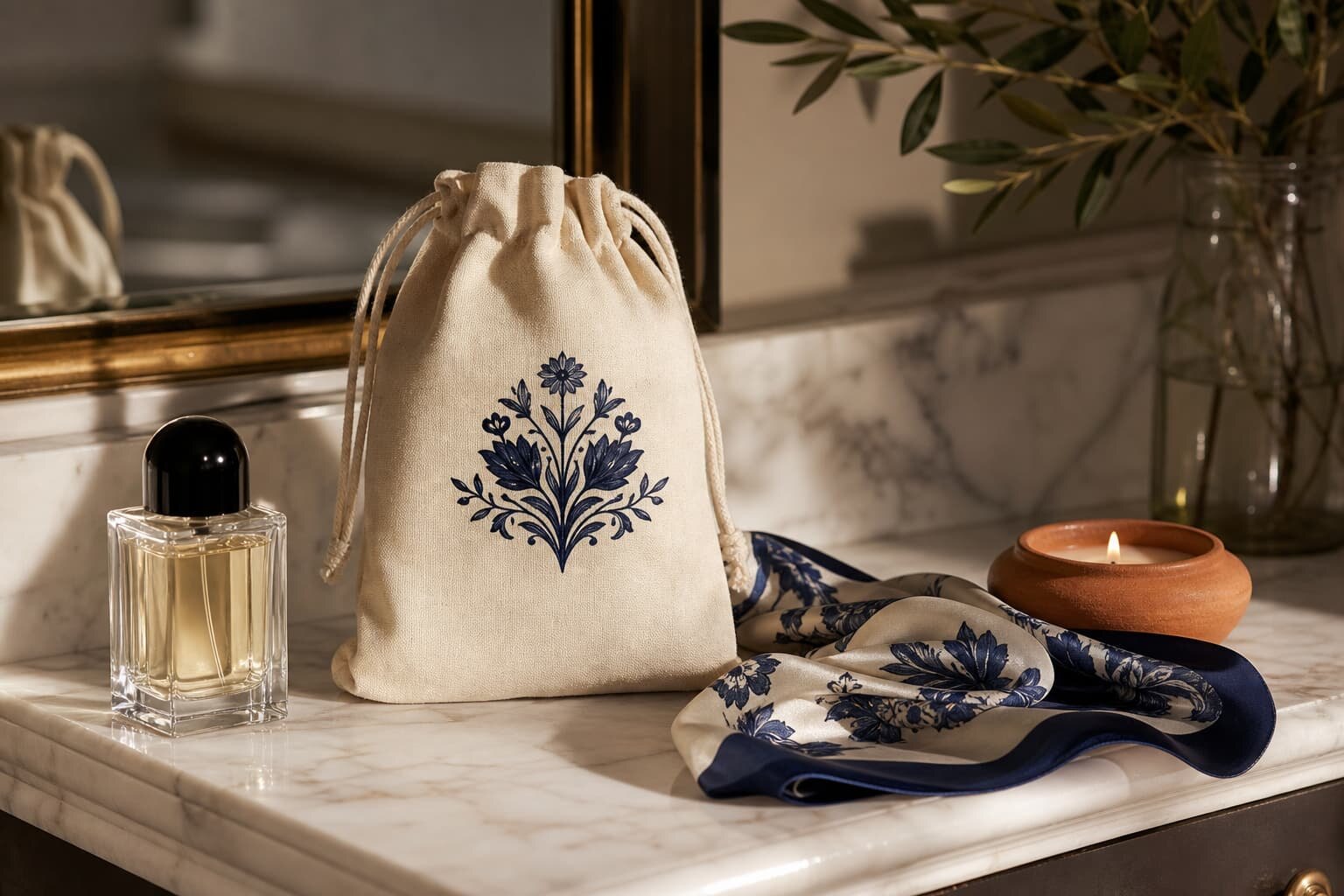
Why Jewelry Pouch RFQs Need More Than Size and Logo
When buyers search for a custom jewelry drawstring pouches wholesale supplier, many RFQs are too short: size, fabric, quantity, and logo. That may be enough for a promotional giveaway pouch, but it is not enough for jewelry packaging. Rings, necklaces, earrings, bracelets, and small plated accessories can be scratched, tangled, stained, or poorly presented if the pouch is specified like a general gift bag.
A good RFQ should tell the factory what the pouch must protect, how it will be handled, and how it will be packed for retail or distribution. The supplier can then quote fabric, sewing, cord, logo, lining, packing, and carton data on the same basis. This prevents the common problem where one factory quotes a basic unlined cotton pouch and another quotes a lined velvet pouch, while both appear to be quoting the same item.
- State the jewelry type and whether it is boxed, carded, loose, plated, silver, gold tone, or stainless steel.
- Clarify whether the pouch is primary packaging, gift packaging, travel storage, or an outer retail accessory.
- Ask suppliers to separate material, logo, packing, and freight-related data so quote comparisons are not misleading.
- Use one approved sample as the control standard for size, handfeel, logo, drawcord, and packing.
Start With the Product Inside the Pouch
The first specification is not the pouch size; it is the product that must fit inside. A 7x9 cm pouch may work for a ring, but it may be too small for earrings on a card or a necklace with a pendant and care insert. A 9x12 cm pouch can look generous for small earrings but tight if the necklace chain must sit flat without tangling.
For procurement teams, the best practice is to send the supplier the largest product dimensions, the packing method, and a photo or drawing of the item position inside the pouch. If you cannot send the real jewelry for sampling, send a dummy with the same thickness and shape. This is especially important for rigid pendants, bracelets, charms, and sets with polishing cloths or certificates.
- For rings: confirm whether the pouch holds only the ring or a small ring box.
- For necklaces: test chain tangling, pendant pressure points, and whether the drawcord catches the chain.
- For earrings: confirm card size and whether sharp posts need an inner card, foam, or lining.
- For bracelets: check curved shape, pouch depth, and closure bulk at the top.
- For gift sets: allow space for inserts, tissue, barcode stickers, and retail handling.
Choose Fabric by Protection, Handfeel, and Brand Position
Jewelry pouches are often small, so fabric choice affects perceived value more than it does on a large tote bag. A 120-140 GSM cotton pouch is light, natural, and economical for simple jewelry packaging. A 180 GSM cotton or 10 oz canvas pouch feels more substantial but may be bulky for tiny rings. Velvet and satin create a premium gift appearance, while microfiber is useful when the pouch touches polished metal, plated surfaces, lenses, or delicate finishes.
Buyers should ask for fabric weight or construction in the quote. Some suppliers use loose names such as cotton, velvet, or suede-like fabric without giving enough detail. If two quotations use different fabric grades, the lower price may simply be a lighter fabric, thinner lining, or a lower-density pile. Always compare fabric swatches before judging price.
- 120-140 GSM cotton: suitable for light natural packaging and low-bulk shipments.
- 160-180 GSM cotton: better handfeel for branded jewelry and repeated use.
- 200-240 GSM canvas: durable but may be too stiff for very small pouches.
- Velvet around 200-250 GSM: gift appearance, but lint and pile direction must be checked.
- Satin: smooth premium look, but sewing marks and snagging need attention.
- Microfiber: practical for protection, but color and thickness should be confirmed by swatch.
Logo Method: Match Artwork to Fabric, Not the Other Way Around
The logo method should be chosen after fabric selection. Screen printing is usually the practical choice for cotton and canvas pouches, especially for one-color or two-color logos. Heat transfer can hold fine detail but may look less natural on cotton and can be risky if the pouch is squeezed or rubbed often. Foil stamping can suit gift jewelry, but it needs testing because foil adhesion changes with fabric surface.
Small jewelry pouches leave little print area. A logo that looks acceptable on a tote bag may fill in or look crooked on a 7x9 cm pouch. The factory should confirm minimum line width, minimum letter height, logo position tolerance, and whether the logo is printed before or after sewing. Printing before sewing may improve efficiency but can cause slight position variation after the pouch is folded and stitched.
- Screen print: good for cotton, canvas, simple logos, and stable bulk production.
- Heat transfer: useful for gradients or fine detail, but rub and edge lifting should be tested.
- Embroidery: only suitable for heavier fabric and simple artwork; not ideal for tiny text.
- Woven label: strong for brand identification and works well when front logo printing is not needed.
- Foil stamping: attractive for gift lines, but request adhesion and rub testing on the final fabric.
- Debossed patch: possible with PU or leather-like labels, but adds material and sewing cost.
Size, Seam Allowance, and Drawcord Channel Details
A pouch size written as 10x15 cm is usually the finished flat size, but not every supplier quotes it the same way. Some factories discuss cut panel size, while buyers assume finished size. On small pouches, a 5 mm difference is visible and may affect how the product fits. Ask the supplier to confirm finished width, finished height, drawcord channel height, bottom seam, and usable internal height.
The drawcord channel also changes the practical capacity of the pouch. If the product reaches too close to the channel, the pouch will not close neatly. For jewelry, the top closure should gather cleanly without creating a hard knot or distorted shape. This matters for retail presentation and for e-commerce unboxing, where the pouch may be the first branded item the customer touches.
- Confirm whether dimensions are finished flat size, cut size, or usable internal size.
- Allow space for drawcord gathering, especially for necklaces and bracelets.
- For tiny pouches, define size tolerance clearly, such as plus or minus 3-5 mm depending on construction.
- Check whether rounded bottom, flat bottom, or gusset is required for the jewelry shape.
- Request a photo of the product inside the closed sample before approving bulk production.
MOQ Logic for Wholesale Jewelry Pouch Orders
MOQ is not only a number of pieces. For custom jewelry drawstring pouches, MOQ is affected by fabric color, size, logo method, print color, cord color, lining, and packing style. A supplier may accept 1,000 pieces total, but not 10 colors at 100 pieces each if every color requires dyeing, cutting setup, print setup, and separate packing control.
Importers and distributors should ask for MOQ by variable. If you need the same pouch in three sizes for rings, necklaces, and bracelets, the factory may be able to combine fabric purchase but still needs separate cutting and sewing setup. If you need five fabric colors with the same logo, stock fabric colors may help reduce MOQ. Custom dyed fabric usually increases MOQ and lead time.
- Ask MOQ per size when ordering multiple pouch dimensions.
- Ask MOQ per fabric color, especially for dyed cotton, velvet, satin, or microfiber.
- Ask MOQ per logo color if screen printing uses separate screens or ink changes.
- Ask whether cord color can be changed without increasing MOQ.
- Ask whether individual barcodes or SKU packing require extra minimums or handling fees.
Sample Approval Should Test Use, Not Just Appearance
A jewelry pouch sample can look good in a photo and still fail in use. The drawcord may be too stiff, the channel too tight, the logo too close to the seam, the lining too bulky, or the fabric may shed lint onto polished items. Sample approval should include handling the pouch several times, inserting the real jewelry, closing it, reopening it, and checking the jewelry surface afterward.
For branded orders, approve both a material sample and a printed or sewn sample. If time is short, ask for a fabric swatch and logo strike-off first, then a full pre-production sample. The approved sample should be kept as the reference for bulk inspection. Do not approve bulk production from a digital proof only unless the order is low-risk and repeat.
- Measure finished size and compare with the RFQ specification.
- Check logo size, color, position, edge sharpness, and rub resistance.
- Pull the drawcord repeatedly to test smooth closure and knot strength.
- Place actual jewelry inside to check fit, scratches, lint, odor, and dye transfer.
- Review sewing quality: straight seams, clean channel openings, loose threads, and neat bottom corners.
- Confirm packing style on the sample, including sticker, hangtag, barcode, or individual bag.
Packing and Carton Data Affect Cost More Than Buyers Expect
Small pouches seem simple to ship, but packing decisions still affect labor, carton volume, inspection speed, and warehouse handling. Bulk packing in inner polybags is efficient for distributors that will repack locally. Individual OPP bags, paper bands, tissue wrap, barcode labels, or SKU stickers add labor and material cost but may be necessary for retail or e-commerce fulfillment.
Ask for carton quantity, carton size, gross weight, and packing method before placing the purchase order. Jewelry pouches can be compressed, but over-compression may wrinkle satin, crush velvet pile, deform cords, or make individual packing look untidy. Moisture protection is also important for cotton, jute, paper labels, and metal accessories such as cord tips or charms.
- Bulk pack: lower cost and suitable for local repacking or wholesale distribution.
- Individual OPP: clean and easy to count, but plastic use and wrinkle control should be considered.
- Paper band or tissue wrap: better presentation, but more handling and possible scuffing.
- Barcode or SKU label: useful for retail, but confirm label position and scan readability.
- Export carton: confirm ply strength, carton marks, inner bags, and moisture barrier if needed.
Lead Time Depends on the Slowest Custom Step
Lead time should not be treated as one fixed number. It starts after all production inputs are approved: deposit, artwork, fabric color, logo method, sample, packing file, barcode data, and shipping marks. If a buyer changes cord color or logo size after sample approval, the production clock may restart because materials and print screens may need adjustment.
For planning, separate sample lead time, material preparation, cutting, printing or embroidery, sewing, packing, inspection, and export booking. A supplier with stock fabric and a simple screen print can move faster than a supplier waiting for custom dyed fabric or special lining. Buyers should ask what part of the schedule is most sensitive and which approval delays will affect the ship date.
- Sample stage: fabric swatch, logo strike-off, and full pouch sample may each require separate approval.
- Material stage: stock fabric is faster than custom dyeing or custom woven labels.
- Logo stage: embroidery, foil, labels, or heat transfer may require extra setup time.
- Packing stage: barcode labels, individual wrapping, and SKU separation add labor time.
- Inspection stage: schedule final inspection after packing, not before all cartons are completed.
How to Compare Supplier Quotes Without Being Misled
The lowest unit price is not always the lowest landed cost or the safest production choice. A quote may exclude individual packing, use lighter fabric, omit lining, assume bulk carton packing, or quote a lower MOQ by using only available stock colors. Another quote may include better fabric, logo testing, carton data, and inspection support. Procurement teams need a comparison sheet that normalizes specifications before price negotiation.
Ask each supplier to quote the same specification and then show optional upgrades separately. This makes it easier to decide whether a velvet lining, woven side label, or paper band is worth the additional cost. It also prevents internal confusion when merchandising, logistics, and quality teams review different supplier offers.
- Compare fabric type and GSM, not just the word cotton or velvet.
- Compare finished size, lining, cord type, and logo method line by line.
- Check whether sample cost, mold or screen cost, label cost, and packing cost are included.
- Request carton dimensions and gross weight to estimate freight and warehouse cost.
- Ask for defect tolerance and inspection criteria before using price as the final deciding factor.
Specification comparison for buyers
| Spec decision | Recommended option | When it fits | Buyer risk to check |
|---|---|---|---|
| Outer fabric | 120-180 GSM cotton, 180-240 GSM canvas, velvet, satin, microfiber, or jute blend | Cotton for natural brands, velvet or satin for premium jewelry, microfiber for lens or plated item protection | Confirm handfeel, color fastness, lint level, and whether fabric weight is quoted before or after washing |
| Pouch size | Base jewelry sizes such as 7x9 cm, 9x12 cm, 10x15 cm, or custom flat size with seam allowance | Rings, earrings, necklaces, bracelets, small accessories, gift sets, or retail insert packaging | Do not approve size from flat artwork only; test the actual product inside after drawcord closure |
| Closure | Single or double cotton cord, polyester cord, satin ribbon, or waxed cord | Double cord is better for retail handling; ribbon gives a gift look; cotton cord supports natural positioning | Check cord shedding, knot security, pull smoothness, and whether bead stoppers are included in the quote |
| Logo method | Screen print, heat transfer, woven label, embroidery, foil stamping, or debossing for PU patches | Screen print for bulk cotton, foil for gift jewelry, woven label for reusable pouches, embroidery for heavier fabrics | Match artwork detail to fabric texture; very small text may fill in on velvet, jute, or coarse cotton |
| Inner finish | Unlined, self-fabric, satin lining, microfiber lining, or anti-tarnish insert if required | Unlined for simple promotional use; microfiber or satin lining for plated, polished, or delicate jewelry | Ask whether lining changes usable size, sewing tolerance, and unit weight for freight calculation |
| MOQ logic | MOQ by fabric color, pouch size, logo color, and sewing setup rather than only total quantity | Works for mixed SKUs if colors and print plates are consolidated | A low MOQ may hide higher unit cost, shared fabric color limitations, or manual cutting variation |
| Packing | Individual OPP, paper band, tissue wrap, or bulk pack by inner carton with size and color labels | Retail-ready orders need individual packing; e-commerce kits need barcode and SKU separation | Confirm carton quantity, moisture protection, inner polybag, carton marks, and whether strings are tied or loose |
| Tolerance | Agree size tolerance, print position tolerance, color tolerance, and defect classification before PO | Useful when importing for retail chains, marketplaces, or brand packaging programs | Without written tolerances, minor visual differences may become disputes after production |
Buyer checklist before sampling
- Define the jewelry item to be packed, including largest product dimensions, chain length, box insert, card, polishing cloth, or care leaflet.
- Select fabric by purpose: cotton for natural branding, velvet or satin for gift jewelry, microfiber for surface protection, canvas for heavier reusable packaging.
- Confirm fabric weight or material construction, such as 120 GSM cotton, 180 GSM cotton, 240 GSM canvas, 200-250 GSM velvet, or microfiber thickness.
- Request real fabric swatches in the chosen color before approving logo artwork, especially for dark velvet, jute, or dyed cotton.
- Specify finished pouch size and usable internal size after seams and drawcord channel, not only flat cut size.
- State logo size, position, print color, and artwork file format; ask the factory to warn if thin lines or small text are not production-safe.
- Decide whether the pouch needs lining, gusset, rounded bottom, side label, care label, barcode sticker, or individual retail packing.
- Ask for MOQ broken down by pouch size, fabric color, logo method, and packing style.
- Approve a pre-production sample with the actual jewelry or dummy item inside, then record size, weight, logo position, and closure performance.
- Confirm carton packing, carton dimensions, gross weight, moisture protection, and shipping marks before bulk production starts.
Factory quote questions to send
- What fabric options and GSM do you recommend for our jewelry type, and can you quote two practical alternatives for comparison?
- Is the quoted size the finished flat size or cut panel size, and what is the usable internal size after sewing?
- What is the MOQ by fabric color, size, print color, and packing method?
- Which logo methods are stable on this fabric, and what minimum line width or text height should our artwork follow?
- Can you provide a material swatch and printed logo strike-off before the full sample?
- What are the sample cost, sample lead time, and whether the sample charge is refundable against bulk order?
- What sewing, size, logo position, and color tolerances will you apply in bulk production?
- How many pieces are packed per inner bag and export carton, and what are estimated carton dimensions and gross weight?
- What inspection standard do you use for defects such as dirty marks, loose threads, off-center logo, cord fraying, and uneven pouch size?
- What information must be confirmed before production lead time starts: deposit, artwork, sample approval, fabric color, packing file, or barcode data?
Quality-control points to confirm
- Measure finished pouch width and height after sewing, not only before drawstring channel folding.
- Check that the jewelry item fits easily and the drawcord closes without forcing the product shape.
- Rub-test printed logos on the selected fabric, especially metallic ink, foil, heat transfer, and prints on velvet or jute.
- Inspect drawcord pull strength, knot security, cord length balance, and whether the cord frays after repeated opening.
- Check sewing line straightness, seam allowance, skipped stitches, loose threads, and channel opening symmetry.
- Compare bulk fabric shade against the approved swatch under consistent lighting.
- Review logo placement tolerance from the pouch centerline and top edge because small jewelry pouches show misalignment quickly.
- Confirm lint, odor, dust, and dye transfer risk before packing polished, plated, silver, or light-colored jewelry.
- Verify individual packing style, barcode position, SKU separation, carton marks, and carton compression condition.
- Keep a signed pre-production sample and inspection checklist as the reference for final random inspection.