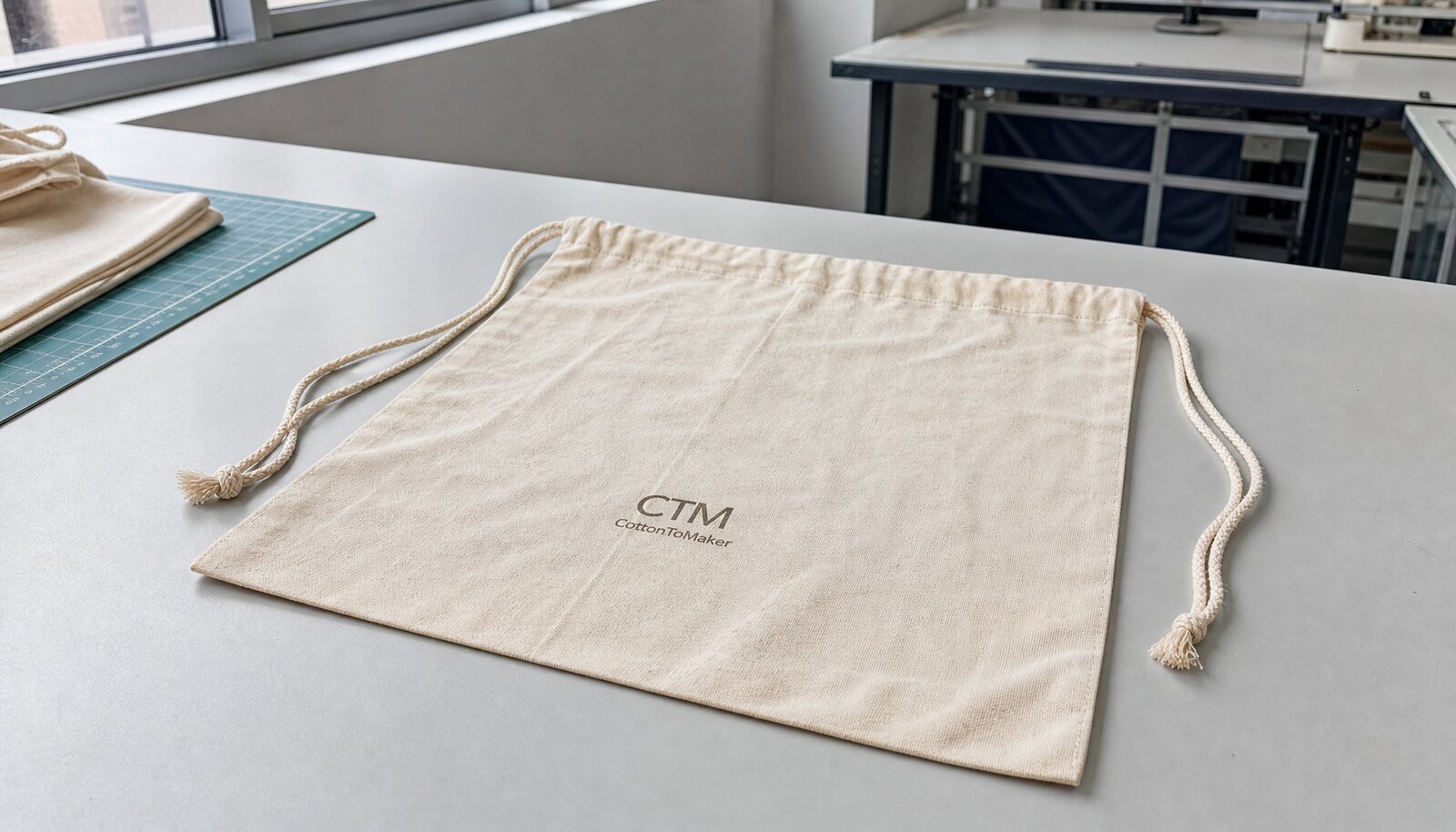
1. What procurement teams should define before asking for quotes
The biggest mistake in sourcing custom ink drawstring bags is treating the request like a simple print job. In practice, the bag is a packaged product with multiple cost drivers: fabric weight, weave, seam construction, cord style, print method, packing format, and inspection standard. If any of those are left open, suppliers will fill the gap with their own assumptions, and the quotes will not be directly comparable.
A procurement buyer should think in terms of a production specification. That means defining what the bag must do, what it must look like, and how much variation is acceptable. A giveaway bag for an event can tolerate more variation than a retail accessory bag that sits on a shelf next to a competitor’s product. A linen-look pouch for cosmetics has different expectations from a cotton promo bag carrying brochures. The more clearly you define the use case, the less likely you are to overpay for features you do not need—or underbuy and end up with a bag that feels flimsy.
A useful RFQ should answer five basic questions before the supplier even starts pricing: what the bag carries, how the brand should appear, how the bag will be packed, how many units you need by version, and what acceptance criteria will be used at receiving. If you build the RFQ around those points, the quote becomes a commercial document instead of a rough estimate.
One practical way to avoid confusion is to divide your spec into a must-have section and a preferred section. Must-have items include finished size, fabric type, print method, and pack format. Preferred items can include hand feel, natural cotton tone, cord color matching, or retail label placement. That separation helps the factory price the core order correctly while still seeing where there is room for value engineering.
- Define the end use first: promo handout, retail packaging, hospitality amenity, or product storage.
- Set finished size, fabric, print, cord, packing, and inspection requirements before requesting a price.
- Separate must-have specs from preferred features so suppliers can quote the core job without guessing.
2. Fabric, GSM, and weave: the decisions that shape cost and performance
Fabric choice drives more of the buyer experience than most people expect. For custom ink drawstring bags, cotton remains the most common option because it prints well, feels natural in the hand, and is easy to present as a reusable product. But cotton is not one spec. Natural cotton, bleached cotton, dyed cotton, and recycled or blended materials can all land at different points on cost, color, and surface smoothness.
GSM matters because it affects opacity, structure, and perceived value. A 120–140 GSM cloth is usually appropriate for light promotional use and modest retail presentation. If the bag will carry heavier contents, needs a more substantial feel, or must hide the contents more effectively, a buyer can move upward into the 140–180 GSM range. Those numbers are a practical buying band, not a universal standard. The right answer depends on the product inside, the brand position, and whether the bag will be reused by the end customer.
Weave structure matters too. A plain weave is common because it balances cost and print clarity. If the weave is too loose, artwork can look less crisp and the bag can appear uneven after packing. If the weave is too dense or stiff, the bag may cost more to cut and sew and can consume more carton space. That freight effect is often overlooked in early RFQs.
Buyers should also ask whether the supplier is quoting stock cloth or newly produced cloth. Stock cloth can shorten lead time and reduce MOQ, but it may limit shade control and surface consistency. New weaving or custom dye increases control, but it almost always adds time and sometimes exposes you to shade variation that needs approval. If the bag is part of a product launch, the buyer should request a stable lot or reserve fabric from the same mill batch where possible.
- Confirm whether the fabric is natural, bleached, dyed, or blended before comparing quotes.
- Ask for a GSM target and the measurement method used to verify it.
- If opacity or premium feel matters, move up in weight rather than relying on artwork to hide the fabric.
- Check whether stock fabric is acceptable for your program or whether you need a dedicated production lot.
3. Stitching, seams, and cord construction: small details that prevent big failures
Procurement teams often focus on the print and overlook the sewing. That is risky, because the seam structure determines whether the bag survives repeated handling, packing, and pull stress at the opening. A good custom ink drawstring bag should have neat side seams, a clean cord channel, and reinforcement where the cord enters the opening. If those areas are weak, the bag may look fine in a photo and still fail in use.
A useful way to discuss sewing with the factory is to ask for seam type rather than just ‘good stitching.’ For example, ask whether the bag uses an overlocked seam, folded seam, or another clean-finish method. Ask whether the channel has bar-tacks or reinforced stitching at the entry points. If the bag is expected to carry weight, carry products with sharp edges, or be reused many times, those small reinforcements matter more than decorative finishing.
Stitch density is another point worth clarifying. Buyers do not need to force a factory into a single universal stitch count, but they should request a consistent construction standard and enough density to avoid loose seams. A low stitch density can reduce labor but can also create weak points or visible gaps along the seam. For branded retail use, a poor seam finish is visible immediately when the bag is held up to light.
Cord choice is part of the same discussion. Cotton cord is common because it matches the bag body and keeps the product fully natural-looking. Polyester cord can improve abrasion resistance and may reduce fraying, but it changes the appearance and may be less aligned with an all-cotton brand story. Buyers should specify cord diameter, length, end finish, and whether the bag needs a single cord or double cord closure. The wrong cord can change both the look and the user experience.
- Ask for seam type, reinforcement points, and cord channel construction instead of using only subjective language.
- Require cord diameter and finished length so the closure feels consistent across production lots.
- Use reinforcement at stress points if the bag will carry heavier items or be reused frequently.
4. Print method, artwork prep, and why color count changes the economics
For bulk custom ink drawstring bags, screen printing is still the default choice when the artwork is simple and the order is large enough to justify setup. It works well for logos, bold typography, and flat spot colors. The reason is not tradition alone; it is repeatability. A clean screen print can be easier to reproduce at scale than a more elaborate transfer method, especially when the buyer wants a stable result over multiple reorders.
The tradeoff is that print quality depends heavily on artwork prep. Suppliers need vector files, clear color definitions, and a defined print area. If the logo is too small, uses thin lines, or places text too close to the edge of the artwork block, the final result may look weaker than expected. That problem is not always the printer’s fault; it often starts with artwork that was created for a screen display rather than a textile surface.
For more detailed art, a transfer process may improve the appearance of gradients or fine text in the sample stage. The buyer still needs to ask the uncomfortable question: how will that print hold up after folding, packing, and repeated handling? Some transfer processes look excellent on day one and become a liability after use. If the bag is retail-facing or intended to be reused, durability matters as much as initial appearance.
The best quote comparison is built around measurable print data. Ask for the print size in millimeters, the distance from seam to artwork edge, the number of colors, and whether the quote includes one or both sides. If the factory uses different screens or plates for each color, extra color count can influence both setup time and scrap risk. That is why a two-color logo may cost more than buyers expect—not because of the ink itself, but because of the extra handling and inspection points.
- Provide vector artwork and specify the exact print area in millimeters.
- Use screen print for simple logos and repeat orders where durability and consistency matter.
- Treat gradients, micro text, and photographic effects as higher-risk artwork on textile bags.
- Confirm whether the quoted price includes one side or both sides, because placement affects setup cost.
5. How MOQ is actually calculated, and how to negotiate it without damaging the order
MOQ for custom ink drawstring bags is rarely a single fixed number. It usually reflects a combination of fabric utilization, print setup, sewing efficiency, and packing labor. That means one supplier may quote a low MOQ only because the order uses stock fabric, one color, and standard packaging. The same supplier may need a much higher quantity if the buyer wants custom dye, multiple print locations, or a nonstandard cord color.
The key procurement habit is to ask for MOQ by version, not just by total order. Version means size, color, and artwork combination. A quote that says 5,000 pieces may mean 5,000 of one design, not 5,000 mixed across three colors and two logo placements. If your business needs smaller test quantities, clarify whether the factory will accept a pilot order with standard materials and a simplified print spec. That can lower the threshold without confusing the pricing model.
There is also a negotiation point that many buyers miss: some factories will lower MOQ in exchange for limited customization. That may be a good trade if the first order is a market test. If you are launching a stable program, however, a lower MOQ should not push you into a spec that creates future problems. A cheaper first order is not a win if the supplier cannot repeat the same shade, fabric, or seam standard on the reorder.
Another useful approach is to ask where the MOQ pressure comes from. Is it cutting waste, print plate setup, label insertion, or custom packing? Once the supplier names the bottleneck, procurement can decide whether to accept a simpler spec, split the order by color, or absorb the setup cost in exchange for a lower per-unit price. That is more productive than asking for a discount in the abstract.
- Ask for MOQ by size, color, and artwork version rather than by total order only.
- Use a simpler spec if you need a pilot run, but do not let the pilot become an unrepeatable standard.
- Find out which setup step creates the MOQ pressure so you can negotiate intelligently.
6. Comparing supplier routes: direct factory, trading company, and stock-program vendor
Choosing the right supplier route can matter as much as choosing the right spec. A direct factory is usually the strongest option for repeat custom programs because it gives the buyer direct access to fabric, sewing, printing, and packing decisions. That makes it easier to lock down the technical details and handle reorders without losing consistency. The tradeoff is that factories often expect cleaner RFQs and may be less flexible if the buyer’s artwork or packing instructions are vague.
A trading company can be useful when the buying team wants one communication channel, needs mixed-category sourcing, or wants help consolidating orders. The downside is that the actual production details may be further away from the person writing the quote. That creates a risk of quote drift, especially if the intermediary is adjusting the spec to match a different factory’s process. Buyers should always ask who the actual maker is and what part of the spec is controlled in-house versus outsourced.
Stock-program vendors are worth considering when speed matters more than precision. They may already have bags on hand, or they may be able to print quickly on a standard product. This route can work for a short-run campaign or an internal event, but it is not ideal when the bag must support a branded retail launch. Once the order needs exact shade control, consistent GSM, or controlled packing, the advantages of stock speed start to fade.
A simple rule helps: if the bag is a repeat item, go deeper into factory control; if the bag is a one-time event item, prioritize availability; if the bag is a multi-SKU retail item, make sure the supplier can handle technical consistency across versions. That decision tree is more useful than chasing the lowest quoted unit price.
- Use a factory when repeatability and spec control matter.
- Use a trading company when consolidation matters, but verify the real production source.
- Use a stock-program vendor only if timing is more important than exact customization.
7. Supplier comparison table: what to weigh beyond the unit price
A procurement team should compare supplier routes on measurable operating impact, not just on quote aesthetics. The same bag can look similar in a quotation and still behave very differently in production, freight, and receiving. The factors below show the kind of details that change real landed cost and risk. In particular, MOQ and lead time are not just schedule questions; they often reflect how much customization the supplier can absorb without losing efficiency.
The table also highlights a common issue: lower unit price can hide higher cost elsewhere. A quote that looks attractive may require heavier freight because of bulky packing, more inspection rework because of weak sewing, or more delays because the supplier needs extra setup time. A buyer who only compares ex-works price may miss those downstream costs.
Use the table as a shortlist filter, then ask the factory to quote to the same spec line by line. If one supplier cannot quote to the same level of detail, that is already a signal about how much control you are likely to have later.
- Compare the spec, not just the number.
- Check how MOQ affects both flexibility and repeatability.
- Treat lead time as a risk variable, especially when multiple custom elements are involved.
8. Sample approval: what the pre-production sample must prove
The sample stage is where many buyers either gain control or lose it. A useful sample for custom ink drawstring bags is not just a preview; it is the reference standard for bulk production. The right sample should match the final fabric, seam method, cord spec, print size, and packing approach. A blank sample can help verify structure and size, but it cannot approve the visual and handling factors that usually create disputes.
The most practical approval process is to divide the sample into separate checks. First, inspect the bag body: does the size match the drawing, and does the fabric feel right? Second, inspect the print: is the logo positioned correctly, is the color consistent with the approved artwork, and does the print surface remain stable after light bending? Third, inspect the cord and closing action: does the bag pull evenly, or does one side gather faster than the other? Fourth, inspect the packed form if the bags are to be sold or distributed in cartons as delivered.
Once the sample is approved, the buyer should freeze the specification in writing. That means no silent changes to artwork placement, print dimensions, cord color, packing count, or fabric source. If a change is needed after sample approval, ask for a revised quote and updated timing. That may sound strict, but it is the simplest way to prevent disputes when the bulk lot arrives.
For higher-risk orders, the buyer should also ask the supplier to mark the approved sample version and keep a signed reference. That can be a physical sample, a dated approval photo set, or both. The more expensive the order and the tighter the launch window, the more valuable that documentation becomes.
- Approve the final fabric, print, cord, and pack format before bulk starts.
- Check print after folding and bending, not only in a flat studio photo.
- Freeze the spec in writing and require a revision if anything changes after approval.
9. QC standards that procurement buyers can actually use
Quality control becomes more useful when it is specific enough to act on. For custom ink drawstring bags, a procurement-grade QC plan should include measurable checks on dimensions, fabric, print, stitching, cord performance, contamination, and carton packing. If the factory only sends a few nice photos, that is not a QC plan. It is marketing material.
A sensible receiving check begins with dimensions. Buy with a tolerance range, then measure a random set of bags from several cartons. For many small pouches and drawstring bags, a practical starting point is ±5 mm on smaller dimensions and ±10 mm on larger ones, unless the supplier proves they can hold tighter control. The point is not to force the factory into a universal number; it is to make sure everyone knows what counts as acceptable drift.
Print inspection should include placement, clarity, and durability. Look for blurred edges, broken lines, uneven ink density, and color variation from one carton to another. Then perform a simple bend or rub check on a sample set to see whether the print cracks or flakes. If the bag will go through retail handling or repeated reuse, this check matters more than a pretty first impression.
Stitching and seam checks should focus on weak points: skipped stitches, loose threads, uneven seam allowance, and reinforcement at the cord channel. For bags carrying product weight, it is worth performing a pull test on several samples from the lot. The goal is not to destroy every bag. The goal is to find out whether the construction is consistent enough to survive normal handling.
Sampling should be documented. A random carton pull is better than checking only the top layer of the first carton. If a lot shows recurring defects, buyers should increase inspection intensity or hold the shipment until the supplier corrects the process. That kind of discipline is cheaper than sorting problems after arrival.
- Measure size across multiple cartons, not just one sample bag.
- Check print quality after folding, bending, and light rubbing.
- Inspect seam integrity and cord channel reinforcement at stress points.
- Use a documented random sampling plan and escalate if defects repeat.
10. Packing, carton marks, and freight planning: the overlooked cost layer
Packing choices can move the landed cost more than buyers expect. Bulk carton packing is usually the best option for wholesalers, distributors, and importers because it reduces labor and keeps the order compact. Retail polybags or inserts are only worth the extra cost if the bags will be displayed or sold exactly as packed. If the receiving warehouse is going to relabel or rebag the product, overpacking just adds cost without adding value.
Carton dimensions matter because they affect freight, storage, and receiving labor. A quote that looks inexpensive can become expensive if the bag is folded in a way that wastes space or if the supplier uses oversized cartons for convenience. Buyers should request carton count, gross weight, and carton size early enough to compare freight options before approval. It is also smart to ask whether the cartons need moisture protection or desiccant if the goods will ship through a humid lane.
Carton marks should be treated as part of the order, not an afterthought. The receiving team needs clear SKU labels, color identifiers, quantity marks, and any compliance text required by the destination market. If the carton mark format is vague, the warehouse may mis-sort product on arrival, which creates avoidable labor and delays.
If your team buys regularly, use the packing data to build a standard landed-cost model. Once you know how many units fit per carton and how the supplier packs the product, you can forecast freight more accurately and avoid underestimating the real cost of a 'cheap' unit price. That is especially useful for replenishment programs where margin depends on repeatability, not just first-order savings.
- Prefer bulk carton packing unless the shelf presentation requires retail-ready packaging.
- Request carton dimensions and gross weight before freight booking.
- Standardize carton marks so receiving can sort by SKU, color, and quantity quickly.
- Check whether moisture control is needed for cotton bags packed in humid conditions.
Specification comparison for buyers
| Spec decision | Recommended option | When it fits | Buyer risk to check | Typical cost or lead-time impact |
|---|---|---|---|---|
| Bag fabric | 120–140 GSM cotton for light retail and promo use; 140–180 GSM for better opacity, hand feel, and repeat reuse | Cosmetics, tea, jewelry, gift sets, retail accessory bags, branded event packs | Very light cloth can show contents, warp after packing, and reduce print crispness | Heavier GSM usually raises fabric cost and cutting weight; custom weaving or dyeing can add 7–14 days |
| Weave / fabric structure | Plain weave cotton for most branded drawstring bags; canvas-like structure if you need a stiffer look | Most bulk programs where logo clarity and packing efficiency matter | Loose weave can distort fine artwork; overly stiff fabric can create bulky cartons | Denser weave increases cost and may reduce cartons per shipment |
| Closure style | Single drawcord for entry-level promo bags; double drawcord for better balance and cleaner opening | Single-use handouts, hospitality amenities, premium retail presentation | Single-cord bags can skew or twist if the channel and bar-tack points are weak | Double cord adds labor and sometimes cord cost; usually increases assembly time slightly |
| Print method | 1–2 color screen print for most bulk orders; heat transfer or digital transfer for short runs with fine detail | Simple logos, clean typography, repeat orders, or small artwork detail | Artwork that is too fine can blur, crack, or lose edge definition after folding | Screen print usually has lower unit cost at scale; transfer methods often raise per-piece cost and QC sensitivity |
| Print placement | Measured placement in millimeters from top edge and side seam, with a defined max print area | Any order where brand positioning or retail display matters | Placement only described as 'centered' is too vague for repeat production | Tighter placement controls do not usually add much cost, but late changes can delay sample approval |
| Bag dimensions | Set finished size with tolerance: typically ±5 mm for small bags, ±10 mm for larger bags unless the factory proposes tighter control | Orders that must fit a product, gift box, or inner tray | Loose tolerance can create fit issues and make cartons harder to standardize | Tighter tolerance can increase rejection risk and may require more careful cutting and sewing |
| Seam construction | Side seams with clean overlock or folded seam finish; bar-tack or reinforced stitching at stress points | Bags carrying heavier contents or used repeatedly | Weak seams and inconsistent stitch density can lead to open seams or cord-channel failure | Reinforced seams add labor but reduce failure risk in transit and use |
| Sample approval | Pre-production sample that matches final fabric, print, cord, stitching, and packing format | Any branded order, especially with retail or launch deadlines | Photo approval alone misses hand feel, print density, and actual fold-and-pack behavior | Sample stage can add 7–15 days depending on artwork, fabric, and correction cycles |
| Packing format | Bulk packed in cartons with quantity marks; retail polybags only when shelf presentation requires it | Wholesale, import consolidation, warehouse distribution | Excess packing inflates freight cost and can trap moisture if bags are not dry before packing | Retail packing increases labor and carton volume; bulk pack is usually cheaper and faster |
Buyer checklist before sampling
- Final bag size in centimeters, with tolerance for width, height, and gusset if any
- Fabric type, weave, and GSM target, including whether stock fabric is acceptable or custom dye is required
- Print artwork in vector format, number of colors, print size in millimeters, and exact placement from edges and seams
- Drawcord specification: material, diameter, length, end finish, and whether single or double cord is required
- Stitching specification: seam type, reinforced points, and any minimum stitch density or bar-tack requirement
- Packing requirement: bulk carton count, retail polybag requirement, barcode label format, and master carton mark wording
- Target order quantity by color, by size, and by print version so MOQ can be calculated correctly
- Required sample type: blank sample, printed sample, or pre-production sample
- Inspection standard: acceptable defect limit for seams, print, sizing, contamination, odor, and carton marks
- Freight planning data: carton dimensions, gross weight target, and whether cartons need moisture protection
Factory quote questions to send
- What fabric GSM, weave construction, and fiber source will you use, and is the material stock fabric or newly produced for our order?
- Is the quoted price based on one-color print, and what is the surcharge for each extra color, extra print location, or larger print area?
- What is the exact MOQ by size, by color, and by artwork version, and does the MOQ change if we accept stock fabric or standard cord colors?
- What are the seam details, stitch type, and reinforcement method at the cord channel and stress points?
- What is the cord material, diameter, and finished end style, and how is the drawcord secured so it does not fray or pull through?
- What sample will you provide before bulk production, and will it match the actual fabric, print method, stitching, and packing format?
- Can you share the actual finished size tolerance you can hold, especially for width, height, and print placement?
- What carton pack count, carton dimensions, and gross weight should we expect for freight planning and warehouse receiving?
- What is the standard production lead time after sample approval, and which steps can extend it, such as dyeing, label changes, or rework?
- What QC records, inspection photos, or measurement sheets can you provide before shipment, especially for seam finishing, print alignment, and carton accuracy?
Quality-control points to confirm
- Measure finished dimensions from multiple cartons and compare against the agreed tolerance range; flag lots that drift beyond the approved spec
- Check fabric GSM against the approved target using a consistent method or supplier certificate, especially when stock cloth is used
- Inspect print alignment, ink coverage, and edge clarity on representative samples from different cartons; verify that artwork placement matches the PO drawing
- Perform bend and rub checks on the print after folding to confirm that the ink does not crack, flake, or transfer excessively
- Inspect seam lines for skipped stitches, loose threads, uneven seam allowance, and weak stress points at the cord channel and side seams
- Apply a pull test to several bags per lot to verify that the closure works smoothly and that the drawcord does not cut into the channel
- Check for contamination, odor, dust, oil spots, and moisture before packing approval, especially for cotton bags stored in humid conditions
- Confirm carton labels, quantity breakdown, SKU marks, and color coding against the purchase order and packing list
- Sample every lot using a documented plan rather than only visual spot checks; escalate inspection if first samples show recurring defects