Start by defining the bag, not just the supplier
A custom gym drawstring bag wholesale supplier can only quote accurately when the product is defined beyond a logo and quantity. The same product name may cover a thin event sack, a reinforced sports bag, a school drawstring backpack, or a retail canvas style. If each supplier assumes a different fabric, cord, corner treatment, or packing method, the lowest unit price is usually not the best comparison. It may simply be a cheaper construction.
For B2B buyers, the useful first step is to write a compact product brief. Include the channel, expected contents, target price level, required durability, logo method, and packing need. A gym chain giveaway may prioritize cost and fast delivery, while a retail or school program needs stronger seams and more controlled presentation. The clearer the brief, the easier it is to compare factories on real capability instead of sales wording.
- Identify the channel before requesting quotes: promotion, retail, school, club, or corporate wellness.
- State expected load: light apparel only, shoes and towel, or daily-use mixed contents.
- Ask suppliers to flag any assumptions that differ from your RFQ sheet.
- Do not compare prices until size, fabric, logo method, reinforcement, and packing are aligned.
Match fabric to use case and cost target
Fabric choice controls cost, hand feel, print result, freight weight, and complaint risk. For many wholesale gym drawstring bag programs, 210D polyester is the entry point because it is light, widely available, and suitable for simple screen printing. It works for event distribution, membership kits, and price-sensitive promotions. The tradeoff is that it can feel thin and may need better corner construction if users carry shoes or bottles.
A stronger option is 300D polyester, often used when buyers want a firmer hand feel and more durable daily use. Canvas or cotton blends create a more natural look for lifestyle and retail programs, but they absorb moisture more easily and increase shipping weight. Avoid generic fabric names such as premium polyester or heavy duty canvas. Ask for denier, composition, coating, GSM or oz weight, and color availability.
- 210D polyester: best for high-volume promotions and simple branded gym sacks.
- 300D polyester: better for repeat-use gym, school, and sports merchandise programs.
- 6-8 oz canvas: useful for natural branding, retail styling, and simple printed logos.
- Coated polyester: check whether PU or PVC backing changes print, weight, smell, or hand feel.
- Stock colors reduce MOQ and lead time; custom dyeing increases both.
Size, load, and construction should be approved together
A drawstring bag that looks acceptable flat on a table can fail quickly when loaded. Shoes, water bottles, towels, and locker items stress the bottom corners and the drawstring channel. If the program is strictly a lightweight giveaway, a simple construction may be acceptable. If the bag will be used repeatedly, reinforcement is usually a better investment than upgrading only the fabric.
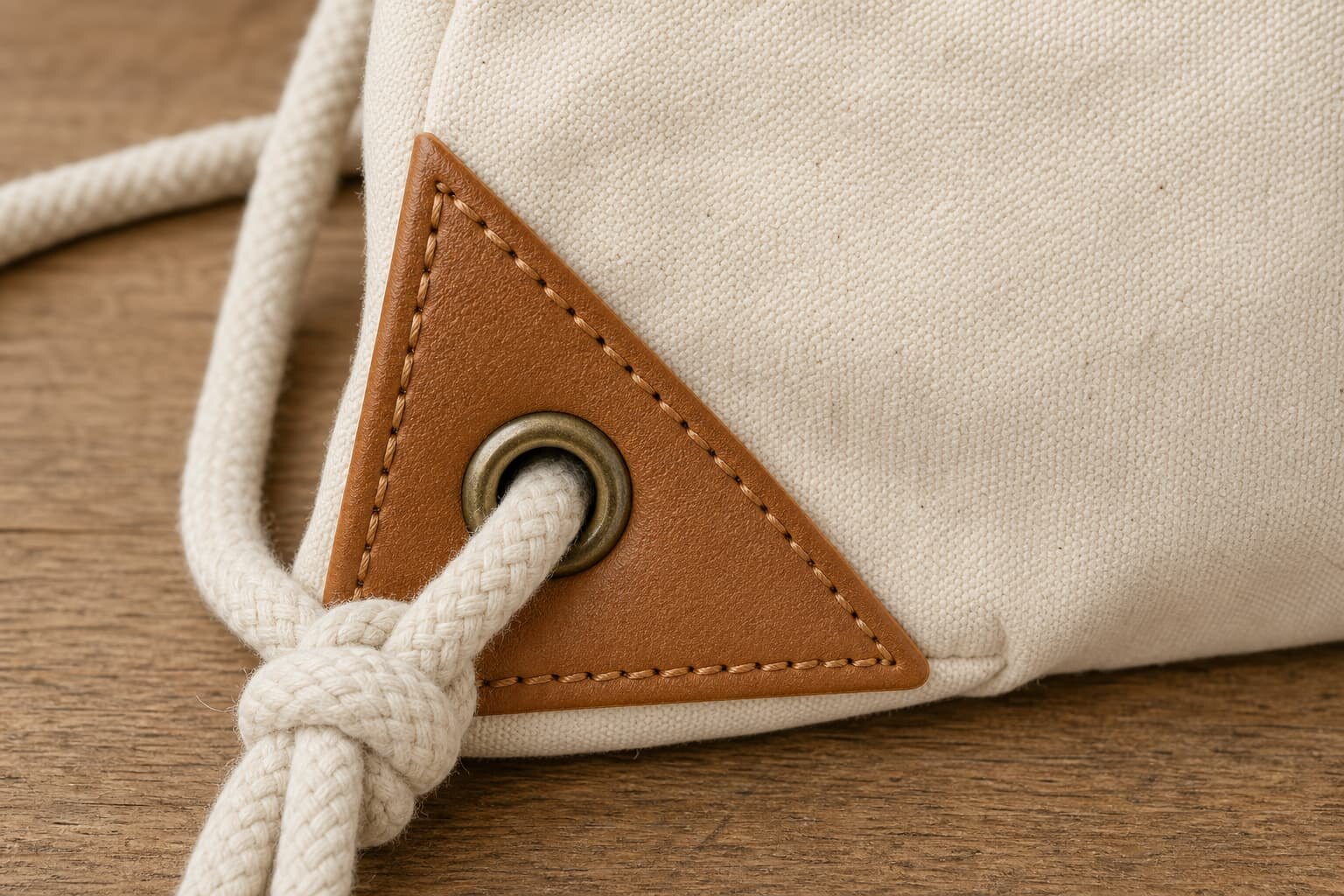
The most important construction areas are the cord exits, bottom corners, side seams, and top channel. Reinforcement can be doubled fabric, PU patches, webbing tabs, metal eyelets with backing, or bartacks. Metal eyelets are not automatically stronger unless the fabric around them is supported. Ask the supplier to show the reverse side and inside seams, not only the front beauty photo.
- Common size range: 34 x 42 cm for compact promotions to 40 x 48 cm for gym gear.
- Light use: basic seams may be enough when contents are mostly apparel or flyers.
- Regular gym use: specify stronger corners, secure cord exits, and smoother channel stitching.
- Retail or school use: consider thicker fabric, reinforced base, and stricter inspection tolerances.
- Measure samples after sewing, because finished size can differ from cut panel size.
Cords affect comfort, strength, and perceived quality
Cord specification is often overlooked, but it strongly affects user experience. A thin cord can cut into shoulders, look cheap, or slip unevenly through the channel. An 8-10 mm PP or polyester cord is common for sporty synthetic bags. Cotton rope looks better on canvas and lifestyle designs but can absorb moisture and may require cleaner knotting to prevent fraying.
The approved sample should match bulk production for cord diameter, color, material, knot position, and end finish. Buyers should also check whether the cords are tied, heat-cut, tipped, or simply trimmed. If the bag is packed tightly, cords can tangle or crease; ask how the factory arranges them before carton sealing.
- PP cord: economical, moisture-resistant, and common for sports promotions.
- Polyester cord: smoother hand feel and good color consistency for many bulk programs.
- Cotton rope: better visual match for canvas but less ideal for wet gym environments.
- Reflective cord: useful for visibility-oriented programs, but confirm cost and MOQ.
- Flat webbing straps: premium option, but construction and sewing labor change significantly.
Choose logo method by artwork and fabric surface
Screen printing is usually the most practical logo method for custom gym drawstring bag wholesale orders with one or two solid colors. It is cost-efficient, scalable, and works on many polyester and canvas fabrics. The buyer should define print size, placement, PMS reference, and minimum line thickness. Small text and thin strokes may fill in on textured fabric or move slightly if panels shift during sewing.
Heat transfer is useful for gradients, detailed logos, or lower quantities where multiple screens are not efficient. It can look sharp, but buyers must check film feel, edge lifting, cracking, and adhesion after folding. Embroidery is better on heavier fabric and may pucker thin polyester. For any method, approve a physical print strike-off or production sample before bulk printing.
- Use screen print for simple solid logos, strong value, and larger quantities.
- Use heat transfer for full-color graphics, gradients, or fine detail.
- Use embroidery only when the fabric is heavy enough to handle stitching.
- Confirm whether printing happens on cut panels or finished bags, because placement tolerance changes.
- Ask for curing, rub, adhesion, and blocking checks before packing.
MOQ and price depend on more than quantity
MOQ differences are often logical once the cost drivers are separated. A supplier using stock black 210D polyester and one-color screen print can often support a lower MOQ than a supplier using custom-dyed fabric, woven labels, special cords, and retail polybags. A low MOQ may still carry setup charges that make the true unit cost higher than expected.
Ask suppliers to quote the same specification at several quantities if your forecast is not fixed. The quote should separate sample fee, unit price, print setup, print running cost, packing adders, label costs, and any surcharge for custom fabric or accessories. This lets buyers compare first-order cost, reorder cost, and price sensitivity without reopening the entire negotiation.
- Stock fabric and standard print usually produce the lowest MOQ.
- Custom color, special cord, woven label, and retail packing raise MOQ or add setup fees.
- Request price breaks at 500, 1,000, 3,000, and 5,000 pieces when demand is uncertain.
- Ask which charges disappear on repeat orders, such as screens or artwork setup.
- Confirm MOQ by bag color and logo design, not only total order quantity.
Sample approval needs measurable checks
A digital mockup is useful for layout, but it is not enough for production approval. A sewn sample or pre-production sample should confirm fabric, size, cord, corner construction, logo method, and packing if relevant. Measure the bag with a ruler, pull the cords, inspect the inside seams, and compare the print to the artwork sheet.
For complex orders, use staged approval: fabric swatch, print strike-off, sewn sample, then final pre-production sample. If timing does not allow every stage, at least confirm which parts are approved and which remain pending. For example, a sample may be approved for construction only while the final logo color still requires strike-off approval.
- Measure finished width, height, and channel depth; record tolerance in writing.
- Check print placement from top edge and side seams, not by visual estimate.
- Load the sample with expected contents and carry it briefly to test stress points.
- Photograph inside seams, bottom corners, cord exits, and the reverse side of logo areas.
- State approval status clearly: visual sample, construction sample, print strike-off, or full pre-production sample.
Packing choices change landed cost and receiving quality
Drawstring bags compress well, so packing format can meaningfully affect freight volume. Bulk packing by dozen or by carton is often best for event giveaways and internal distribution. Individual polybags are useful when retail handling, barcode scanning, clean storage, or kitting requires them. They also add material cost, labor, and carton volume.
Before confirming an order, request carton quantity, carton size, net weight, gross weight, and packing photos based on the actual bag specification. If the print requires curing time, rushed packing can create blocking or surface scuffing. For retail orders, confirm barcode placement, hangtag attachment, suffocation warning requirements if applicable, and carton assortment.
- Bulk pack is usually lowest cost and lowest plastic use.
- Individual polybag supports retail receiving but raises cost and freight volume.
- Carton specs should include pieces per carton, dimensions, gross weight, and shipping marks.
- Ask whether cords are tucked consistently to prevent tangling during unpacking.
- Inspect labels and carton counts carefully when the shipment contains multiple colors or designs.
Lead time should be broken into production stages
A single lead time number hides the real schedule risk. For custom gym drawstring bags, timing depends on fabric availability, print method, accessory sourcing, sample approval speed, sewing capacity, inspection, and packing. Stock fabric with one-color print can move quickly. Custom-dyed fabric, special cords, woven labels, multi-color transfer, or retail packing can extend the schedule.
Ask the supplier to provide a milestone schedule: artwork confirmation, sample making, sample approval, material booking, printing, sewing, final inspection, packing, and shipping handover. This makes it easier to see where delays may occur. For launch-driven orders, request milestone photos during material arrival, print start, sewing, and final packed cartons.
- Confirm when material is booked: at PO, deposit, or after sample approval.
- Separate sample lead time from bulk production lead time.
- Add buffer for artwork changes, print strike-off revisions, and label approval.
- Ask whether peak season or holiday closures affect the quoted schedule.
- Tie shipment release to inspection results and complete packing documents.
Set QC standards before production starts
Quality control is most effective when the supplier knows the rejection standard before cutting fabric. The approved sample should be supported by written tolerances for size, fabric, logo position, print quality, seam strength, reinforcement, cord function, and packing. This prevents arguments after production about whether a visible problem is acceptable variation.
Focus inspection on issues that create claims or receiving delays. Open seams, tearing corners, wrong logo, missing cords, poor print adhesion, incorrect barcode labels, and carton shortages matter more than a few loose internal threads. If the order is retail-facing, carton labels and barcode accuracy can be as important as sewing quality because receiving systems may reject incorrect units.
- Critical defects: wrong logo, missing cord, open seam, torn fabric, unsafe sharp part, wrong quantity, or wrong carton mark.
- Major defects: weak reinforcement, print outside tolerance, visible stain, large color mismatch, defective barcode, or failed pull check.
- Minor defects: small loose thread, slight crease, or non-visible mark within agreed tolerance.
- Check production at cutting, printing, sewing, and final packing, not only after cartons are sealed.
- Keep a signed approved sample and inspection checklist for repeat orders.
Specification comparison for buyers
| Spec decision | Recommended option | When it fits | Buyer risk to check |
|---|---|---|---|
| Main fabric | 210D polyester for price-sensitive promotions; 300D polyester for stronger repeat-use programs; 6-8 oz canvas for natural retail styling | Use 210D for events and giveaways, 300D for gym or school carry, and canvas when the brand wants a lifestyle look | Do not accept vague terms like thick polyester; ask for denier, composition, coating, GSM or oz weight, and tolerance |
| Finished size | Common bulk range: 34 x 42 cm to 40 x 48 cm, measured flat after sewing | Smaller sizes fit light giveaways; larger sizes fit shoes, towel, and gym clothes | Factories may quote different sizes under the same name; lock width, height, channel depth, and measurement tolerance |
| Bottom reinforcement | Double-layer fabric, PU corner patches, webbing tabs, or bartack stitching at cord exits | Recommended for bags carrying shoes, bottles, lockers items, or retail daily-use loads | Corner tearing is a common claim point; confirm reinforcement material, stitch type, and whether it is included in the unit price |
| Drawcord material | 8-10 mm PP or polyester cord for sports use; cotton rope for canvas and lifestyle styles; reflective cord for visibility-focused programs | Synthetic cord handles moisture and lower cost; cotton improves appearance on natural fabrics | Bulk cords may be thinner than sample cords; ask for diameter, color, end finish, knot method, and pull test expectation |
| Logo method | Screen print for 1-2 solid colors; heat transfer for gradients or detailed multi-color art; embroidery only on thicker fabrics | Screen print is usually best value for wholesale gym bags; heat transfer helps complex artwork; embroidery suits premium canvas or heavier polyester | Fine lines can fill in and transfers can crack if poorly cured; approve a real strike-off and ask for rub or adhesion checks |
| Pocket and accessory add-ons | Keep the base style simple unless the channel needs zipper pocket, mesh pocket, label, or hangtag | Useful for retail, school, or club merchandise where perceived value matters | Each add-on adds labor and defect risk; ask whether the supplier has made that construction before and request close-up sample photos |
| Packing format | Bulk pack by dozen for promotions; individual polybag with barcode or hangtag for retail receiving | Bulk packing reduces plastic, carton volume, and landed cost; individual packing supports warehouse scanning and cleaner retail handling | Packing is often repriced late; specify units per polybag, carton quantity, carton size, gross weight, barcode labels, and shipping marks |
| Inspection standard | Use approved sample plus written tolerances for size, fabric, print, sewing, reinforcement, and packing | Works for importers, distributors, gyms, schools, and private-label programs that need repeatable production | Without defect definitions, the factory may treat logo drift, loose cords, or weak corners as acceptable variation |
Buyer checklist before sampling
- Define the selling or distribution channel: gym membership giveaway, sports event, school program, retail shelf, club merchandise, or shoe-and-clothes carry bag.
- State the expected load range and use frequency so the supplier can recommend fabric, corner reinforcement, and cord strength.
- Specify finished size in centimeters, measured flat after sewing, including width, height, drawstring channel depth, and acceptable tolerance.
- List fabric by composition, denier or oz weight, approximate GSM, coating if any, color, and whether stock color or custom dye is required.
- Confirm bottom construction: simple seam, doubled fabric, PU corner patch, webbing tab, metal eyelet, bartack, or reinforced base panel.
- Define cord material, diameter, color, end treatment, knot style, and whether both sides must pull evenly after packing.
- Provide artwork as vector files when possible and state logo method, print size, print colors, placement, and PMS reference if needed.
- Ask for close-up sample photos of inside seams, bottom corners, cord exits, drawstring channel, print surface, and packed units.
- Separate the quote into bulk unit price, sample cost, print setup, print running cost, packaging adders, label or hangtag cost, and freight-ready carton details.
- Set approval and QC criteria before deposit: fabric weight, size tolerance, print placement, seam strength, loose threads, stains, carton count, barcode accuracy, and shipping marks.
Factory quote questions to send
- What exact fabric is included in this quote: composition, denier or oz weight, GSM range, coating, and stock color status?
- Is the price based on our requested finished size, cord diameter, corner reinforcement, logo size, and packing method, or are any assumptions different?
- What MOQ applies by bag color, logo design, print color count, fabric type, and custom accessory?
- Does the quoted price include screen charge, print strike-off, PMS color matching, two-side printing if requested, and curing time before packing?
- Can you provide a physical sample or close-up sample photos showing fabric weight, cord diameter, reinforcement, inside seams, and print surface?
- What is the lead time for artwork confirmation, sample making, sample approval, material booking, printing, sewing, final inspection, and packing?
- What carton quantity, carton dimensions, gross weight, net weight, and shipping marks are assumed in the quote?
- What inspection standard do you use for this item, and which defects are considered critical, major, and minor?
- For screen print or heat transfer, what checks do you perform for rubbing, adhesion, cracking, color match, and blocking before cartons are sealed?
- What price change should we expect if we move from 210D to 300D polyester, add reinforced corners, add a second print color, or switch from bulk pack to individual polybag?
Quality-control points to confirm
- Measure finished width, height, and drawstring channel depth against the approved sample and written tolerance.
- Check fabric hand feel, weight, coating, color, and opacity against the signed sample or swatch card.
- Inspect print size, print position, color, edge sharpness, curing, adhesion, and surface scuffing after normal handling.
- Pull both cords repeatedly to confirm smooth movement, equal length, secure knots, and no tearing at cord exits.
- Review bottom corners, reinforcement patches, eyelets, bartacks, and seam intersections for skipped stitches or weak attachment.
- Check inside seams for unraveling, exposed raw edges, loose threads, fabric holes, stains, and trapped offcuts.
- Confirm barcode labels, hangtags, polybags, carton count, color assortment, inner packing, shipping marks, and packing list accuracy.
- Open random cartons after compression or drop handling to check print blocking, carton damage, tangled cords, and count shortages.