Start With the Event Load, Not the Bag Name
A custom event drawstring bag looks simple, but the correct specification depends on what the attendee will actually put inside it. A bag for one brochure and a lanyard can use a lighter construction than a bag expected to carry a metal bottle, folded hoodie, product samples, and a printed catalog. If the RFQ only says custom event drawstring bag, suppliers will usually quote the cheapest standard option they think can win the price comparison.
Procurement teams should write the load condition into the RFQ before asking for unit prices. This helps the factory choose the fabric weight, cord size, corner reinforcement, and carton packing. It also makes quotes easier to compare because each supplier is pricing against the same real usage, not against their own assumption.
- Light event handout: 210D polyester or 80-100 GSM non-woven PP can be enough for low-load use.
- Conference attendee kit: 210D or 300D polyester with reinforced corners is usually safer.
- Retail-style merchandise: 6-8 oz cotton canvas or heavier polyester gives a better perceived value.
- Sports or outdoor event: polyester or RPET polyester handles moisture better than untreated cotton.
- Heavy sample kit: ask for load testing instead of accepting a standard giveaway construction.
Choose Fabric by Weight, Feel, and Failure Point
Fabric selection is the main cost driver after printing. For event drawstring bags, common choices include 210D polyester, 300D polyester, 80-120 GSM non-woven PP, 5-8 oz cotton, and 6-10 oz canvas. Denier describes yarn thickness for synthetic fabric, while GSM describes fabric weight per square meter. Buyers should ask for both the commercial fabric name and a measurable weight, because one supplier's 210D can feel different from another supplier's material.
The lowest-cost material is not always the lowest-risk material. Very light fabric may pass a visual sample review but fail when attendees carry giveaways around the venue for several hours. Cotton and canvas feel more premium, but they increase carton weight, freight cost, and the chance of shade variation. Polyester is usually the most practical event choice when the order needs bright colors, quick drying, and compact packing.
- 210D polyester, about 80-95 GSM: practical for mass giveaways and sponsor bags.
- 300D polyester, about 120-150 GSM: better body, stronger hand feel, higher unit cost.
- Non-woven PP, about 80-120 GSM: low cost, but weaker at stitch holes and less premium.
- 5 oz cotton, about 170 GSM: natural look, suitable for light retail or eco-positioned events.
- 8 oz canvas, about 270 GSM: stronger and more premium, but heavier to ship and pack.
Specify Size Around Real Contents
Many event bags are quoted at standard sizes such as 34 x 42 cm, 35 x 45 cm, or 14 x 18 inches. These sizes are useful starting points, but they do not guarantee the bag will fit the event kit. A rigid brochure, boxed sample, water bottle, and T-shirt all use volume differently. If the bag is too narrow, the contents push against the side seams and make the printed logo wrinkle when worn.
The RFQ should include the largest item dimensions and the expected stack height. If the buyer has a mandatory insert, such as an A4 folder or retail box, mention whether it must lie flat. For better approval accuracy, ask the supplier to make the sample with a paper insert or dummy load matching the event contents.
- A4 documents usually need a finished width of at least 34-36 cm, depending on seam allowance.
- Shoes, apparel, and bottles need more height and corner strength than flat documents.
- Large front prints need enough blank panel space below the cord channel.
- Finished size tolerance should be stated, for example plus or minus 1 cm for sewn fabric bags.
- If the bag will be inserted into an event box, carton and folded bag dimensions also matter.
Match Print Method to Artwork and Fabric
Most event drawstring bags use screen printing because it is economical, durable, and clean for simple logos. For one-color or two-color sponsor marks, screen print is usually the safest quote baseline. However, the buyer must provide the print size, number of colors, Pantone references, and print position. Without these details, a supplier may quote a small one-color print and later add setup costs after artwork review.
Full-color artwork, gradients, or photographic designs need a different print method. Heat transfer works on polyester and cotton but creates a film feel that some brands do not like. Sublimation can produce full-color artwork on white or light polyester, but it is not suitable for dark cotton canvas. Digital printing may fit smaller orders, but buyers should check wash resistance, edge sharpness, and whether the printed panel is cut after printing or printed after sewing.
- Screen print: best for bold logos, spot colors, and medium to large bulk orders.
- Heat transfer: useful for full-color logos, but test the edge and hand feel.
- Sublimation: good for full-panel polyester designs, usually on white or light base fabric.
- Embroidery: premium look, but can pucker light fabrics and is not ideal for very thin 210D.
- Woven label: useful for subtle branding when the front panel must stay clean.
Do Not Treat Drawcords and Corners as Minor Details
The drawcord system is where many event drawstring bags fail. The front panel may look fine, but the cord pulls through a weak grommet or tears the fabric at the lower corner. A cheap sample often hides this risk because the sample is handled gently. During an event, attendees pull the cords repeatedly, overfill the bag, and carry it on one shoulder. The corner construction must match that real behavior.
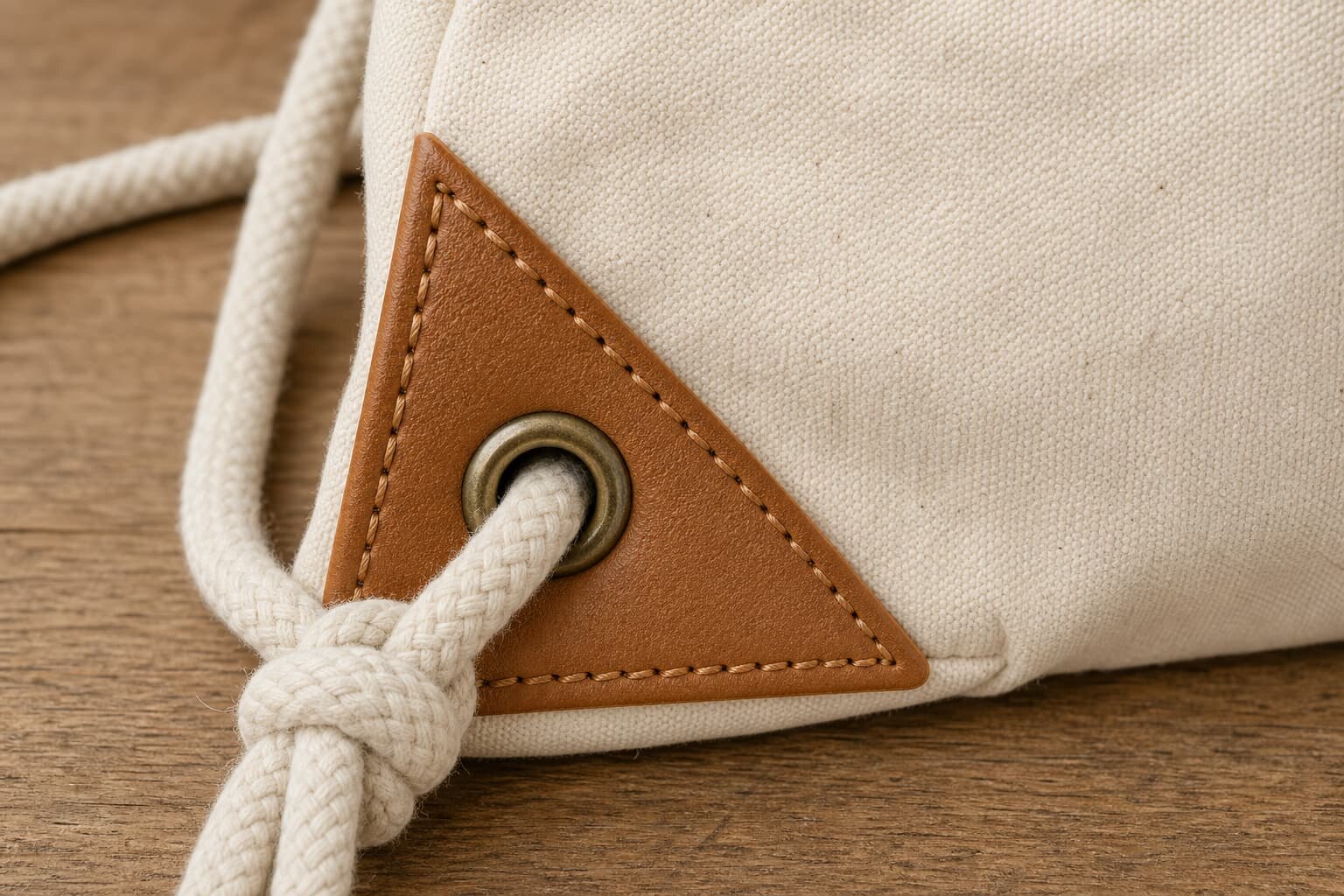
Common options include sewn fabric corner tabs, triangular reinforcement patches, metal eyelets, plastic eyelets, or cord loops captured in the side seam. For very light giveaway bags, a basic stitched corner may be acceptable. For sports events, student events, and product sample kits, reinforced corners and bar tacks are worth specifying. Ask the supplier to show close-up photos of the inside and outside corner construction, not only the front logo view.
- Flat polyester cord around 4-5 mm is common for event bags and packs well.
- Round cotton cord feels better but can cost more and absorb moisture.
- Metal eyelets look clean but can tear out if the base fabric is too light.
- Bar tacks at stress points reduce seam opening during repeated use.
- Cord color should be listed as stock match, close match, contrast, or Pantone dyed.
Understand MOQ Logic Before Comparing Suppliers
MOQ is not only a sales policy. It comes from fabric availability, dyeing minimums, print setup, cutting efficiency, and packing labor. A stock black 210D polyester bag with one-color print may have a much lower MOQ than a custom-dyed cotton canvas bag with full-color print and private carton labels. If a buyer asks for a low MOQ with many custom details, the unit price will rise because setup work is spread across fewer pieces.
For event orders, the best RFQ approach is to ask for price breaks instead of one quantity. Request quotes at the real target quantity and one or two higher breaks, such as 1,000, 3,000, and 5,000 pieces. This shows whether the cost is driven by setup or by material. It also helps distributors decide whether to order extra inventory for late registrations or sponsor additions.
- Stock fabric and stock cord usually support lower MOQ and faster sampling.
- Custom fabric color often requires higher MOQ because of dye lot minimums.
- Multi-position printing increases setup time even if the bag itself is simple.
- Individual polybagging adds labor and material cost, especially on low quantities.
- Price breaks should include the same print, packing, and reinforcement spec.
Build a Quote Sheet That Prevents Hidden Changes
A useful supplier quote should be more than a unit price. It should show what material, size, print, cord, reinforcement, packing, sample terms, lead time, and trade terms are included. If these lines are missing, two quotes that look equal may actually describe different products. One factory may include 300D polyester and reinforced corners, while another quotes 210D polyester with simple stitched corners.
Ask suppliers to separate cost items that can change. Print setup, sample charge, custom labels, individual polybags, carton relabeling, and inspection support should be visible. This does not mean the buyer must negotiate every line separately. It means the buyer can see why a price is higher and decide whether the extra construction has value for the event.
- Material: exact fabric type, GSM or denier, coating, and color basis.
- Construction: finished size, seam type, cord type, corner reinforcement, and tolerances.
- Decoration: print method, colors, position, size, setup, and artwork file requirement.
- Packing: pieces per inner bag, pieces per carton, carton dimensions, gross weight, and marks.
- Commercial terms: MOQ, price breaks, sample cost, sample time, bulk lead time, and Incoterm.
Approve Samples Like a Production Buyer
A pre-production sample is not only for checking whether the logo looks nice. It is the buyer's control point before fabric cutting, screen making, and mass sewing. The sample should use the same fabric weight, cord, print method, reinforcement, and packing approach planned for bulk production. If a supplier sends a sample from existing stock and says bulk will be similar, ask which parts are different.
Sample approval should be written, measurable, and tied to bulk tolerance. Mark the approved logo position from the top edge and side seams. Check print opacity under normal light and on the actual fabric color. Load the bag with the expected event contents and pull the cords several times. If the bag twists, the corners pucker badly, or the print cracks, correct it before bulk production starts.
- Measure finished width and height after sewing and compare with the RFQ.
- Check whether the cord slides smoothly and closes the opening evenly.
- Rub the print surface lightly after curing to see if ink transfers.
- Photograph approved print placement with a ruler for factory reference.
- Keep one signed sample with the buyer and one signed sample with the factory.
Plan Lead Time Around Artwork, Materials, and Event Date
Event bags have a fixed deadline, so lead time must be managed backward from the delivery date. The production clock should not start when the first RFQ is sent. It should start after artwork approval, sample approval, deposit, and material confirmation. If the buyer delays artwork or changes sponsor logos after screen setup, the factory may need to remake screens or reprint samples.
A practical schedule separates sample time, approval time, bulk material preparation, printing, sewing, packing, inspection, and shipping. During peak seasons before trade shows, school terms, and holiday campaigns, production capacity tightens. Buyers should ask the supplier which dates are firm and which dates depend on buyer-side approval.
- Sample preparation commonly takes several working days, depending on fabric and print method.
- Custom-dyed fabric adds time compared with stock fabric selection.
- Large logo prints need curing and handling time before sewing or packing.
- Inspection should be scheduled before final carton sealing when possible.
- Keep buffer time for sponsor artwork changes, carton mark approval, and customs documents.
Control Packing Before the Bags Reach the Venue
Packing is often ignored until the bags arrive wrinkled, mixed, or difficult to count. For event distribution, the carton plan matters almost as much as the bag itself. A distributor may need carton quantities that match venue kit assembly. A retail buyer may need individual barcodes. A brand owner may want bags folded consistently so the logo is visible during packing into attendee boxes.
The RFQ should state whether bags are bulk packed, inner polybagged by count, individually polybagged, or packed with barcode labels. Carton size and gross weight affect freight cost and warehouse handling. Overpacked cartons can crush prints and create heavy wrinkles, while loose cartons waste volume. Ask for carton photos during production packing if the event schedule leaves no room for repacking.
- Bulk pack is cheapest but can increase wrinkles and counting time.
- Inner bags of 50 or 100 pieces help warehouse teams verify quantities quickly.
- Individual polybags improve cleanliness but add plastic use, cost, and packing labor.
- Carton marks should include PO number, item name, quantity, gross weight, and destination if required.
- Moisture protection is important for cotton and canvas during ocean shipment.
Specification comparison for buyers
| Spec decision | Recommended option | When it fits | Buyer risk to check |
|---|---|---|---|
| Main fabric for short event use | 210D polyester, about 80-95 GSM | Trade shows, races, campus events, sponsor giveaways, light contents | Too thin fabric can show contents, wrinkle heavily, or tear at corners when loaded with bottles |
| Main fabric for retail or premium event use | 6-8 oz cotton canvas, about 200-270 GSM | Brand merchandise, paid attendee kits, reusable conference bags | Cotton shrinkage, dye lot variation, and higher freight weight must be included in quote comparison |
| Low-cost logo print | 1-2 color screen print | Simple sponsor logo, bold event mark, flat colors | Fine lines may fill in on textured cotton or distort near the drawcord channel |
| Photo or gradient artwork | Heat transfer or sublimation on polyester | Full-color race graphics, complex festival artwork, small order personalization | Transfer edge feel, wash resistance, and color shift after heat pressing must be checked on the actual fabric |
| Corner strength | Triangle reinforcement or metal eyelet plus bar tack | Events where bags carry brochures, bottles, apparel, or samples | Unreinforced grommets can pull out if the fabric is light or the cord is rough |
| Packing method | Flat pack 50-100 pcs per inner polybag, export carton by count and weight | Distributor warehouse receiving, event kit assembly, carton relabeling | Random stuffing increases wrinkles, carton cube, and miscounts during event fulfillment |
Buyer checklist before sampling
- Define the event use: giveaway, attendee kit, retail merchandise, sponsor premium, or staff equipment bag.
- Confirm finished size in width by height, not only approximate capacity.
- Specify fabric type, denier or GSM, coating if any, color standard, and expected hand feel.
- List the exact load items the bag must carry, such as catalogues, water bottle, T-shirt, samples, or shoes.
- Choose cord material and diameter, and state whether the cord must match, contrast, or follow a stock color.
- Confirm corner construction: sewn tabs, reinforced triangles, metal eyelets, or simple stitched cord channels.
- Provide vector artwork with print size, location, Pantone references, and tolerance for placement.
- Request one pre-production sample using bulk fabric, bulk cord, and final print method before mass cutting.
- Define packing: pieces per polybag, carton quantity, carton marks, barcode labels, and whether bags must be individually packed.
- Ask suppliers to separate tooling, sample, print setup, unit price, carton size, gross weight, and lead time in the quote.
Factory quote questions to send
- What fabric construction are you quoting: 210D polyester, 300D polyester, non-woven PP, cotton, canvas, RPET, or another material?
- What is the actual GSM or denier, and can you provide a fabric swatch or previous bulk sample in the same weight?
- Is the quoted fabric stock color or custom dyed, and what MOQ change applies if the color is custom?
- Which print method is included, and how many logo colors, print positions, and setup screens are covered?
- What is the maximum safe print area before the cord channel, side seam, or bottom corner reinforcement affects placement?
- Which corner reinforcement is included in the quoted price, and what is the extra cost for stronger reinforcement?
- What is the sample cost, sample lead time, and whether the sample charge is refundable after bulk order confirmation?
- What is the production lead time after artwork approval and deposit, and does it change during peak event season?
- What carton quantity, carton size, gross weight, and loading volume are estimated for the order?
- Which inspection standard do you support before shipment, and can you share an internal QC checklist for this bag type?
Quality-control points to confirm
- Check finished bag size against approved tolerance after sewing, not only cut panel size before sewing.
- Verify fabric GSM or denier by swatch comparison and weight check, especially when several suppliers quote similar-looking materials.
- Test drawcord pull strength at both bottom corners with the expected event load inside the bag.
- Inspect print registration, color, opacity, edge sharpness, and curing on the approved bulk fabric.
- Confirm logo placement from top edge, side seam, and cord channel because a small shift is very visible on simple drawstring bags.
- Open and close the cord channel repeatedly to check friction, seam catching, and cord shedding.
- Review carton packing for count accuracy, moisture protection, carton strength, and readable shipping marks.
- Check random pieces from top, middle, and bottom of cartons because wrinkles, shade variation, and print pressure can change during production.