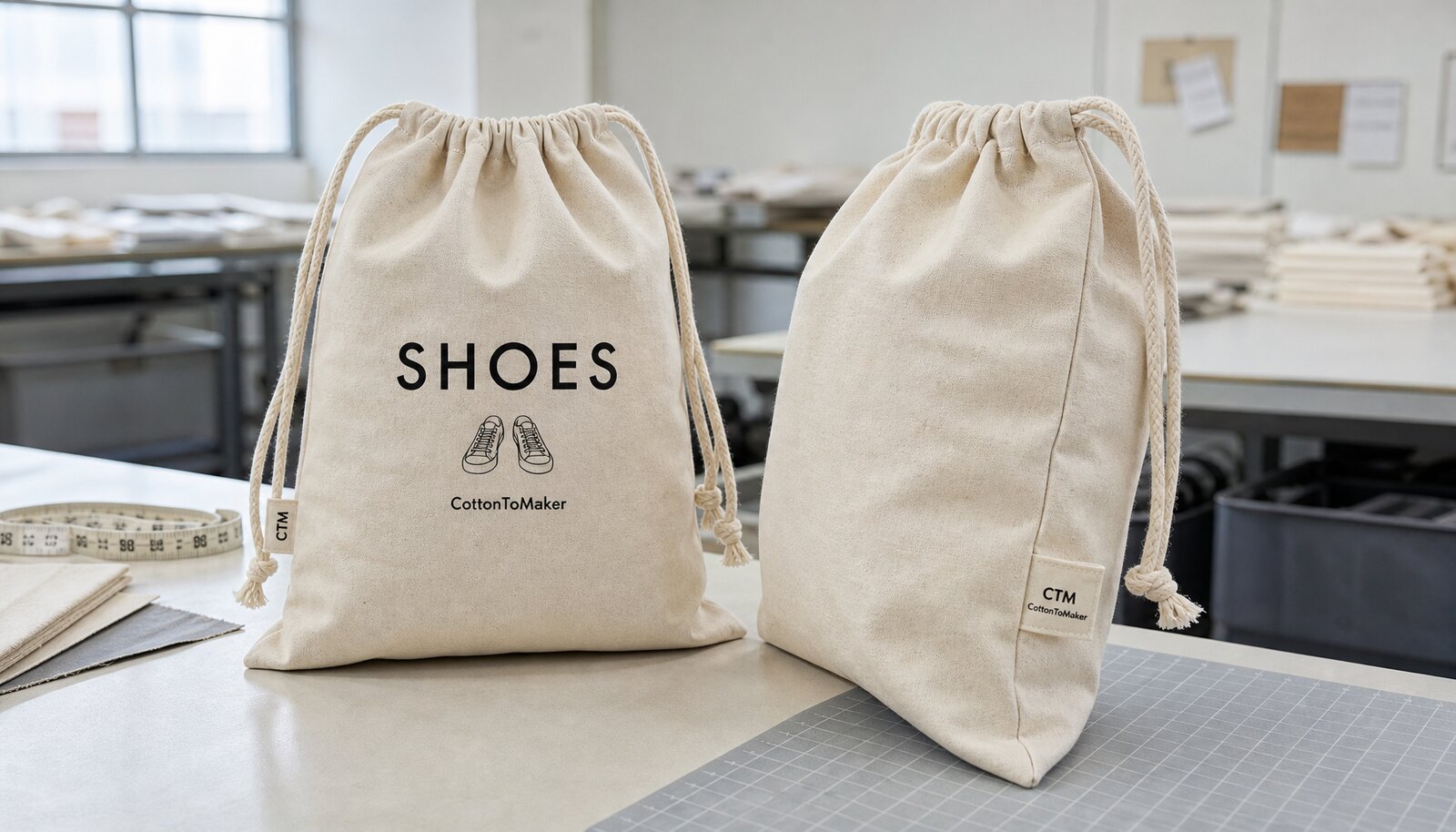
Start With the Shoe, Not the Bag
Custom drawstring shoe bags should be specified from the footwear they will carry, not from a generic pouch size. A slim dress shoe, a pair of sneakers, a heel, and a boot do not need the same bag height, opening width, or closure length. If the bag is for retail packaging, the buyer also has to decide whether it is doing dust protection, gift presentation, or travel storage, because each use case shifts the fabric weight and finishing standard.
The most common sourcing mistake is asking for a nice-looking bag without defining the real fit target. That creates quotes that look comparable but are not. A supplier may quote a smaller size in lighter fabric with a shorter cord, while another offers a larger bag with heavier canvas and better print coverage. To avoid that, lock the shoe type, the number of shoes per bag, the required fit margin, and the final use environment before you ask for pricing.
- State whether the bag holds one pair of shoes, one single shoe, or one pair plus laces or inserts.
- Give the largest shoe size the bag must fit, not just a sample size from your team.
- Define whether the bag is for shelf display, e-commerce fulfillment, travel kits, or premium packaging.
- Specify whether the bag must carry weight for repeated use or only protect shoes during shipment.
Choose the Fabric That Matches the Price Point
For custom drawstring shoe bags, fabric choice drives hand feel, print result, and landed cost more than most buyers expect. Cotton canvas in the 120 to 140 gsm range is a strong middle ground for retail use because it gives structure without becoming bulky. A lighter cotton muslin or plain cotton can work for promotional or dust-cover use, but it may look too soft for premium footwear. Polyester and recycled polyester are useful when moisture resistance, lower weight, or wipe-clean handling matters more than a natural hand feel.
GSM alone does not solve the decision. Two fabrics with the same weight can behave very differently if one is tightly woven and the other is loose or brushed. For shoe bags, the buyer should also care about opacity, shrinkage, odor, and how the print sits on the fabric surface. If your brand wants a clean premium look, pay for a better weave and a controlled dye lot before you add more complex branding. If the program is price sensitive, simplify the fabric and keep the logo method easy to repeat.
- Use 90 to 110 gsm for light promotional or travel dust bags where cost and packing volume matter most.
- Use 120 to 140 gsm cotton canvas for retail shoe bags that need structure and better perceived value.
- Use 150 gsm and above only when you need a heavier, more gift-like bag or stronger abrasion resistance.
- Choose polyester or RPET when moisture resistance and lower weight are more important than a natural textile look.
Get the Dimensions and Build Details Right
The finished size must reflect the shoe shape, not just the longest dimension of the outsole. A low-cut sneaker may fit well in a 30 x 40 cm bag, while a wide trainer, hiking shoe, or heeled shoe may need more width, a taller body, or a gusset. If you sell mixed footwear, a single bag spec can become the wrong compromise unless you define the largest product family it must support. That is where many RFQs fail, because the spec sheet lists a size but does not explain the real fit target.
Construction details change the usability of the bag. A clean top hem with a smooth cord channel is usually enough for most orders, but some buyers need metal eyelets, a reinforced channel, or a small gusset for bulkier shoes. The cord should be long enough to close easily without making the opening look uneven, and the seam allowance should be stable enough that the bag does not twist after a few pulls. If the bag is meant for retail, straight lines and balanced seams matter more than decorative features that add cost without improving function.
- Common starting sizes are 25 x 35 cm for smaller footwear, 30 x 40 cm for sneakers, and 35 x 45 cm for larger or bulkier shoes.
- Add a gusset only when the shoe profile needs depth, because it increases cutting complexity and sewing time.
- Set a clear tolerance on length and width before production, especially if the bag will be packed in pairs or sets.
- Specify cord ends, channel type, and stitching reinforcement so the quote reflects the real build, not a simplified sketch.
Branding Method Changes the Quote More Than Buyers Expect
For custom drawstring shoe bags, the logo method is not a cosmetic afterthought. It affects setup cost, minimum quantity, color accuracy, and how the bag performs after handling. A single-color screen print is usually the most cost-efficient option for large orders and simple logos. Woven labels or side labels work better when you want a cleaner premium look and less ink coverage on the fabric. Embroidery can look strong on heavier cloth, but it often distorts lighter fabric and adds needle marks that some buyers do not want on a shoe bag.
The best branding choice depends on where the bag sits in the product range. If it is a retail accessory inside a footwear box, subtle branding often looks more expensive than a large full-front print. If it is a promo item, bigger print area may be worth the tradeoff. Placement should be fixed in the artwork file and the approved sample, because suppliers can shift logos slightly to improve sewing efficiency unless the spec is explicit. Buyers should also remember that a two-color print is not just twice the cost of one color, since each color can add setup, alignment, and failure risk.
- Use screen print for simple logos, larger volumes, and the best unit economy.
- Use woven labels when you want a premium finish and less ink on the fabric body.
- Use embroidery only on heavier fabric where the needle holes will not weaken the bag.
- Lock artwork placement with a measured drawing or sample photo to prevent logo drift in mass production.
How MOQ and Price Really Move
MOQ for custom drawstring shoe bags is usually driven by fabric sourcing, print setup, and packing labor, not by sewing alone. A factory may be willing to sew a small batch, but if the fabric has to be custom dyed or the print screens take time to prepare, the order minimum rises. This is why one quote can look attractive on unit price while another has a higher setup charge but more realistic production economics. The real question is whether the supplier is quoting a stock fabric build, a semi-custom build, or a fully custom package with labels and retail packing.
Ask for the quote in line items so you can see where the money is going. Fabric cost, cut and sew, print setup, label cost, packing labor, carton cost, and freight should not be hidden inside one unexplained number. If two suppliers are close on the core product but one includes a better carton spec or clearer pack count, that quote is often the safer buy. If one quote is far below the others, look first at fabric GSM, print method, and whether packing or freight has been omitted.
- Request separate lines for fabric, sewing, printing, labels, packing, cartons, and freight.
- Compare quotes only after matching size, fabric weight, print colors, and packing format.
- Treat unusually low quotes as a spec review trigger, not as an automatic win.
- If the order will repeat, ask the factory what price breaks happen at 3,000, 5,000, or 10,000 pieces.
Sample Approval and QC Thresholds
A clean sample process prevents most production mistakes on custom drawstring shoe bags. Start with a pre-production sample that reflects the final fabric, print method, cord, label, and packing method. If the order is complex or repeat business matters, approve a top-of-production sample or a sealed golden sample before the main run starts. That gives both sides a physical reference for color, stitch line, and logo placement, which is better than relying on text alone in an email thread.
The approval criteria should be measurable. Buyers should state acceptable size tolerance, print alignment tolerance, seam quality, and what counts as a reject. A bag that fits the right shoe but has loose threads or a skewed label should not pass just because the outer appearance looks acceptable in a single photo. For shoe bags, use the sample to test drawcord pull, opening shape, fold consistency, and whether the fabric holds its line after a few handlings. Those details are cheap to test and expensive to fix after shipment.
- Measure the sample in at least three points so the factory cannot correct only one dimension.
- Test the cord pull by opening and closing the bag several times to catch weak channels.
- Check print rub resistance with a simple dry wipe and a light abrasion test on the approved sample.
- Reject stitching defects, stains, odor, crooked labels, or uneven top hems before production is released.
Packing Affects Damage, Labor, and Retail Readiness
Packing is part of the product spec, not a separate warehouse task. For custom drawstring shoe bags, the buyer needs to decide whether each bag is individually folded, polybagged, stickered, or packed loose in bulk. Retail programs usually need a cleaner fold, a barcode or SKU sticker, and a carton layout that keeps the bags flat. Bulk storage programs may want fewer inner packs and lower labor cost, but the tradeoff is more handling damage and less shelf readiness.
Carton choice matters when the bags are compressed for export. A tight carton can save freight, but if the pack is too dense the fabric arrives creased and the drawcords may kink. Moisture protection also matters if the route is long or the destination climate is humid. Buyers should specify carton dimensions, quantity per carton, and whether desiccants or outer poly liners are required. Without that, one supplier may quote a retail-ready pack while another quotes a loose export pack, and the unit price will not be comparable.
- Define whether the bag is packed flat, folded once, or rolled for retail presentation.
- State the number of pieces per inner bag and per master carton so the quote reflects labor and carton cost.
- Add barcode or SKU sticker requirements early if the bags will go directly to retail or fulfillment.
- Use carton marks and packing list language that match your warehouse receiving system.
Lead Time Risk Sits in Materials, Not Sewing
The sewing step for custom drawstring shoe bags is usually straightforward once materials are in house. The real schedule risk sits upstream in fabric availability, print approval, label production, and packing confirmation. If the design uses a special fabric shade, a custom woven label, or several print colors, the project can lose days before the first panel is cut. Buyers who only ask for a final ship date often miss the approval path, which is where the delay actually happens.
A realistic schedule should separate sample time, material booking, production, inspection, and freight booking. A small run with simple print and stock fabric may move quickly, while a larger retail order with custom packaging can take longer even if the sewing line is efficient. Seasonal footwear launches also create congestion, especially when many brands place packaging orders at the same time. Build in a buffer for artwork corrections and supplier questions, because those are normal, not exceptional, in factory work.
- Map the critical path as sample approval, fabric booking, label approval, production, inspection, and shipment.
- Ask which step is likely to hold the order if the date slips, then address that step first.
- If your launch date is fixed, make the artwork and packing spec final before you ask for the quote.
- Do not count on rushed production unless the factory has already confirmed material availability and line capacity.
Compare Sourcing Routes Before You Compare Unit Price
When buyers source custom drawstring shoe bags, the lowest unit price rarely tells the full story. A direct factory quote may be cheaper on paper, but it only stays cheaper if the factory is clear on materials, owns the sewing, and does not substitute components. A trading company can reduce admin load and help combine SKUs, but the buyer still needs visibility into the real factory and the QC flow. A domestic decorator or local supplier can be useful for speed, but the price gap is often the result of labor cost, not a better build.
The landed cost comparison should include freight, carton volume, duty, labeling, and any repacking at the destination. A bag that folds more compactly can save meaningful freight over a larger or heavier version, especially in bulk export. If the order is for a retail line, the best route is the one that keeps quality stable across reorders, not the one that wins a single quote battle. Buyers should compare the route, not just the price line.
- Choose direct factory sourcing when repeat volume, tighter spec control, and margin management matter most.
- Choose a trading company when you need multiple product types or simpler coordination across shipments.
- Choose a local supplier when time is short and the order is small enough that freight savings do not matter.
- Compare EXW, FOB, and DDP quotes separately because each term shifts cost and risk in a different way.
Build the RFQ so Quotes Are Comparable
A strong RFQ for custom drawstring shoe bags is short, but it has enough detail to prevent supplier guesswork. The packet should include a dimensioned sketch, the target shoe type, the fabric target, logo artwork, print color count, packing format, destination, and target volume. If the quote is meant for multiple suppliers, the spec should be identical across all of them so unit price differences reflect real cost differences, not different assumptions.
The most common procurement mistake is asking for a price before the bag spec is complete. That usually produces numbers that cannot be compared because one quote assumes a screen print, another assumes a woven label, and a third assumes a lighter fabric with a looser tolerance. A proper RFQ keeps the factory focused on the same assumptions from the start. It also gives your team leverage later, because you can compare first samples against a written standard instead of debating memory or opinion.
- Attach one reference image or sample and state which details are mandatory and which can be changed.
- List the exact items that must be included in the quotation, including packing and freight if needed.
- Ask the supplier to state all exclusions in writing so hidden extras do not appear later.
- Set a decision date for sample approval and quote review so the project does not drift while details stay open.
Specification comparison for buyers
| Spec decision | Recommended option | When it fits | Buyer risk to check |
|---|---|---|---|
| Source direct from a factory | Best for repeat programs with stable artwork and packaging | You need tighter control of fabric, print, and lead time | Confirm who owns QC, what is subcontracted, and whether the quote includes packing labor |
| Use a trading company or sourcing office | Useful when you need consolidation across multiple SKUs | You buy shoe bags with other packaging items in one shipment | Check margin markups, factory identity, and who signs off on production defects |
| Use a local decorator or domestic supplier | Good for urgent small runs or final-mile customization | You need a fast turn for events or short retail replenishment | Unit cost is usually higher and fabric choice may be limited |
| Choose 120 to 140 gsm cotton canvas | Balanced for retail shoe bags with a premium hand feel | You want decent structure and good print opacity | Too light looks thin and can show seams, while too heavy raises cost and fold size |
| Choose recycled polyester or polyester twill | Lower weight and better moisture resistance | You need travel or sports use, or a cleaner wipeable surface | Confirm print adhesion, smell, and whether the fabric feels too synthetic for your brand |
| Use a single-color screen print | Most cost-efficient branding method | Your logo is simple and the order is volume-driven | Artwork must be vector clean and registration tolerance needs to be set before mass production |
| Use a woven label or sewn side label | Better for subtle premium branding | You want the bag to stay clean-looking and reusable | Confirm label size, stitch pattern, and color match so the label does not distort the bag body |
| Use a simple flat drawcord with clean hem finishing | Keeps the build economical and easy to mass produce | You want retail-ready shoe bags without extra hardware | Check cord pull strength, end finishing, and whether the top hem holds shape after repeated use |
Buyer checklist before sampling
- Final bag size with tolerance, including whether the bag is for one pair or a single shoe pair plus accessories
- Target shoe type, such as sneakers, dress shoes, heels, boots, or travel shoe storage
- Fabric choice and target GSM, plus whether the fabric must be prewashed, brushed, or moisture resistant
- Logo method, number of colors, artwork file format, and exact placement on the bag or label
- Drawcord type, cord length, cord end finish, and whether metal eyelets or stitched channels are required
- Packing method per piece, carton quantity, barcode or retail sticker needs, and master carton marks
- Target MOQ, forecast volume, and whether the order is a one-time promotion or a repeat program
- Incoterm, destination port or warehouse, and whether the quote must include inland freight or DDP service
- Sample approval owner, approval timeline, and written acceptance criteria for size, print, and sewing
- Any compliance or market requirements, such as restricted substances, fiber labeling, or retail packaging rules
Factory quote questions to send
- What exact fabric, GSM, and weave are you quoting, and is it stock fabric or a custom run?
- What finished size, seam allowance, and gusset are included in the quote?
- Which branding method is included, how many print colors are priced, and what is the setup cost?
- Does the quote include woven label, care label, barcode sticker, or any retail hangtag?
- What is the MOQ per color, per artwork, and per size?
- What are the sample charges, sample lead time, and what kind of sample will you send first?
- What is the production lead time after sample approval, and what events can extend it?
- What packing format is included, and how many pieces go into one inner polybag and one carton?
- What is the defect tolerance, and what happens if size, print, or stitching is outside spec?
- Which Incoterm are you quoting, and what freight or destination charges are excluded?
Quality-control points to confirm
- Measure finished size against the approved spec and keep the agreed tolerance in writing before mass production starts
- Inspect seam strength at the top hem, side seams, and drawcord channel because these points fail first under repeated pull force
- Check print placement, color consistency, and rub resistance on the same piece, not only on a clean sample swatch
- Confirm fabric weight, hand feel, and shade consistency from roll to roll so the second production lot does not drift from the approved sample
- Reject bags with loose threads, oil marks, odor, broken stitches, or label misplacement because these defects are cheap to prevent and expensive to sort later
- Verify carton count, folding method, and compression resistance so the bags arrive flat, clean, and ready for shelf or fulfillment use