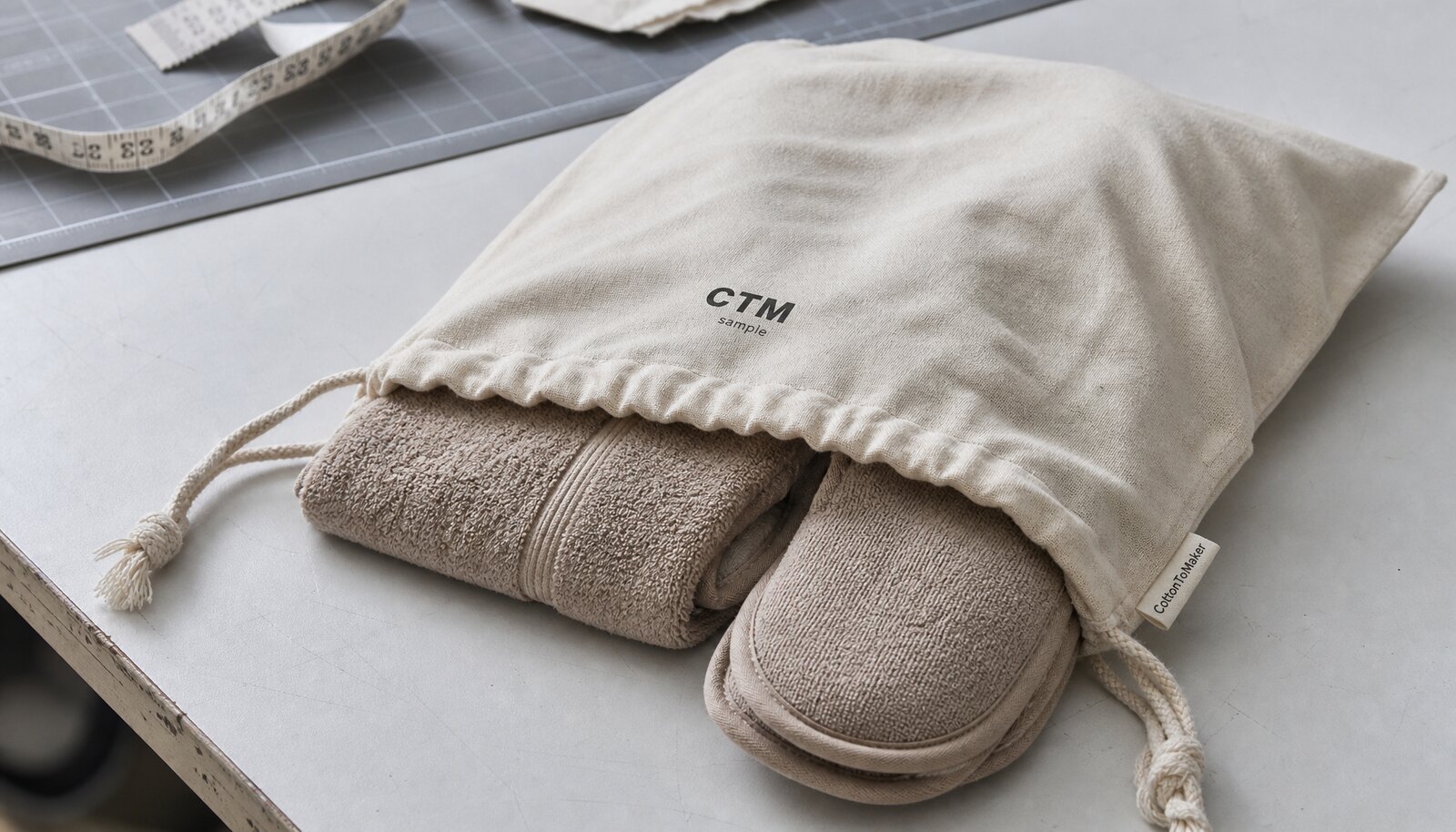
Start with the hotel use case, not the logo
Custom drawstring pouches for hotels are not one product. A pouch used for slippers at check-in has a different spec from a pouch used for spa retail, in-room amenities, or a welcome gift set. If you start with logo placement, the quote will look neat but hide the real commercial question: how much handling will the pouch take, how often will it be reused, and how should it feel when a guest opens it.
For procurement, the first decision is what problem the pouch solves. A back-of-house amenity pouch can be lighter and simpler. A guest-facing retail pouch needs better hand feel, cleaner stitching, and more stable color. Buyers who define the use case early get cleaner quotes, fewer sample rounds, and less rework when housekeeping or operations reviews the finished item.
- Separate room-use pouches from retail or VIP gift pouches.
- State whether the pouch is disposable, reusable, or meant to be kept by the guest.
- List the exact items the pouch must hold so the supplier can size it correctly.
- Tell the factory whether the pouch will be filled flat, folded, or overstuffed in packing.
Choose the right fabric and GSM for hotel handling
Fabric weight changes both the look and the quote. For many hotel programs, 120 to 140 gsm cotton is enough for light amenity packaging or short-use guest items. If the pouch needs a more substantial hand feel, better opacity, or a premium retail position, 160 to 220 gsm is usually the safer range. Heavier canvas can look stronger, but it adds cost, stiffness, and sometimes a slower sewing pace.
Do not treat GSM as a decorative spec. It affects drape, print clarity, seam bulk, and how the drawcord tunnel behaves under use. A thin fabric can make a logo look washed out and may show the contents inside. A heavier fabric can hide the contents better and support embroidery or woven labels, but it may also reduce packing efficiency. If shrinkage matters, request pre-shrunk or finished size confirmation before production.
- 120 to 140 gsm: light amenity pouch, lower cost, softer feel, higher risk of visible contents.
- 160 to 180 gsm: common middle ground for hotel pouches that need a more structured look.
- 200 to 220 gsm: better for premium retail, gift sets, and stronger logo presentation.
- Ask whether the mill fabric is pre-shrunk, bleached, dyed, or left natural, because that changes both appearance and size stability.
Match the branding method to the fabric and volume
Print method should follow fabric and order size, not the other way around. Screen print is usually the most practical choice for simple logos, one or two colors, and larger quantities. Embroidery works well on thicker fabric when the brand wants a more premium look, but it adds labor and can pull the fabric if the stitch density is too high. Woven labels are useful when the hotel wants a clean, durable brand mark without covering a large print area.
The main risk is not the print method itself. It is the lack of control over artwork placement, curing, and color tolerance. A logo printed too close to the top hem can distort when the cord channel is sewn. A dark print on a soft fabric can crack if the curing is poor. Ask for the exact print area, the color match method, and whether the factory will supply a strike-off or digital mockup before cutting bulk fabric.
- Use screen print for simple, repeatable artwork and better unit economics at volume.
- Use embroidery for thicker fabric, but confirm stitch density so the pouch does not pucker.
- Use woven labels when you need durability and a cleaner retail-style finish.
- Keep artwork clear of seams, cord entry points, and folded edges.
Size, closure, and functional details decide whether the pouch works
A hotel pouch that is the wrong size is expensive no matter how cheap the unit price looks. For slippers or small amenity sets, a compact pouch may work well. For toiletry kits, welcome packs, or retail add-ons, you may need a taller pouch or a gusseted base so the contents sit properly. The finished opening should be large enough to load quickly on the packing line without stretching the top hem.
The closure details matter more than most buyers expect. A 3 mm cord looks neat but can feel fragile if the tunnel edge is rough or the pouch is overfilled. A thicker cord can improve handling but needs a wider tunnel and more sewing time. If the hotel staff will reuse the pouch often, make the closure easy to open with one hand and avoid narrow openings that trap product corners or snag on packaging.
- Flat pouch: best for simple, low-cost amenity use and light contents.
- Gusseted pouch: better for fuller items, retail presentation, and better shelf shape.
- Cord diameter: balance premium feel against ease of sewing and closing.
- Top hem width: wide enough to protect the cord tunnel and reduce tearing.
Build the quote around the actual cost drivers
A useful quote separates the real cost drivers instead of hiding them in one unit price. Fabric GSM, dyeing or bleaching, print setup, embroidery stitches, cord type, packing style, and carton configuration all change the number. If a supplier gives you a low price without stating those assumptions, the quote is not comparable. It just means the missing pieces will surface later as add-ons, delayed approvals, or a different bulk spec.
For procurement, MOQ logic matters as much as price. One artwork set and one size are easier to produce than multiple colors, multiple hotel properties, or mixed pack-outs. Ask for tiered pricing at realistic order points such as 1,000, 3,000, 5,000, 10,000, and 20,000 pieces, then compare the curve rather than one headline number. A slightly higher base price can still win if the supplier keeps setup charges low and handles packing cleanly.
- Request separate line items for unit price, setup, sample fee, and packaging.
- Confirm whether MOQ is per color, per size, or per artwork version.
- Ask if the quote changes when you move from print to embroidery or woven label.
- Compare the full landed cost, not just factory price.
Use supplier evidence to sort real factories from brokers
For custom drawstring pouches for hotels, supplier type affects both control and risk. A direct factory usually gives better process visibility, especially when you need the same spec across repeat orders. A trading company or sourcing agent can help when the order includes several product categories or when your internal team needs one point of contact. A domestic decorator can be valuable for urgent openings, but the blank pouch spec may already be fixed before you approve it.
Do not accept a catalog quote as evidence of capability. Ask for production photos that show the sewing line, print setup, seam finishes, and packing stage. If the supplier cannot explain how they measure stitch density, control color, or inspect finished size, they may be brokering the item rather than making it. For hotel buyers, the best supplier is the one who can repeat the same result next season, not just ship one acceptable sample.
- Direct factory: strongest control on construction, best for repeat programs.
- Trading company: useful for mixed sourcing, but margin layers must be visible.
- Domestic decorator: good for rush orders, but blank options may be limited.
- Hotel amenity supplier: convenient, but confirm who actually makes the pouch.
Treat the sample as a production contract
A sample should prove the exact factory can make the exact pouch you plan to buy. Measure the finished size after sewing, not the cut size before assembly. Check the seam straightness, the cord pull, the label position, and the visual balance of the logo on the front panel. If the pouch will be washed or reused, test a sample for shrinkage, color transfer, and whether the seams hold after handling.
Good sample approval also needs traceability. Keep one sealed pre-production sample, one master reference sample, and one approved swatch set. If the supplier changes fabric lot or ink batch later, you need a reference to compare against. This matters even more for hotel groups that reorder by property, because a pouch that looks acceptable on one order can drift in size or color on the next one if the approval standard was informal.
- Size tolerance: define it before the first sample is approved.
- Stitch quality: look for loose threads, skipped stitches, and uneven hems.
- Color control: compare under daylight and warehouse lighting.
- Artwork control: lock logo size and position before bulk cutting starts.
Packing details affect hotel operations more than many buyers expect
Packing is not a minor detail when the hotel team must receive, store, and issue the pouches. Bulk packing is the cheapest route and usually the right answer for back-of-house amenity use. Individual polybags or set packing make sense when the pouch is sold at retail or needs to ship as part of a prepacked guest kit. If your operation uses barcodes, ask the supplier to place the labels in a consistent position so warehouse scanning is simple.
Carton planning should match your warehouse and room-service workflow. Ask for carton dimensions, gross weight, carton count, and whether the cartons can be palletized efficiently. If the pouch is folded, define the fold direction so the logo panel stays clean and the bag does not crease across the main branding area. A good pack spec reduces receiving errors, counting mistakes, and damage from overstuffed cartons.
- Bulk pack for lowest cost and easiest replenishment.
- Individual polybag or set pack for retail or guest gift kits.
- Standardize carton marks, SKU labels, and count per carton.
- Specify folding rules so the brand mark stays visible and clean.
Plan lead time and landed cost as one workflow
Lead time for custom hotel pouches is usually a sequence of small steps rather than one production block. Fabric sourcing, artwork approval, sample confirmation, printing, sewing, packing, inspection, and freight booking each add time. In practice, a buyer should expect sample development and approval to take a few weeks, then mass production to run on a separate schedule that depends on fabric availability and season. Rush work is possible, but the supplier will often charge for it or use stock materials that limit your choices.
Landed cost is where the quote becomes real. Add freight mode, customs handling, duty, inland delivery, and any hotel receiving charges. A low factory price can disappear once you switch from sea freight to air or add individual packaging. For recurring hotel programs, the best supplier is not always the cheapest on paper. It is the one who delivers consistent quality, avoids rework, and keeps the reorder process predictable enough for procurement to plan ahead.
- Ask for sample lead time and bulk lead time separately.
- Identify the real bottleneck: fabric, print, sewing, packing, or freight.
- Compare sea, air, and courier options only after the product spec is locked.
- Include import duty, brokerage, and inland delivery in the landed-cost view.
Write the RFQ so supplier quotes are directly comparable
A strong RFQ removes ambiguity. State the final finished dimensions, target fabric type and GSM, artwork size, print or embroidery method, cord type, packing standard, carton specification, quantity, delivery destination, and whether the order is a one-time hotel opening or a repeat replenishment program. If you manage several properties, say whether each property needs a separate SKU or whether the pouch is identical across sites with only the delivery split changing.
The most common RFQ failure is leaving the supplier to guess the details that actually drive cost. That creates quotes that are not comparable and samples that look fine until operations tries to use them. A buyer should reject vague answers around size, shrinkage, print durability, or pack-out. If the supplier cannot quote against a clear spec, the hidden cost will likely show up later as a delay, a reprint, or a claim on arrival.
- Lock artwork and size before asking for the final quote.
- State whether the pouch is for room use, retail, or a welcome kit.
- Tell suppliers if the order needs split delivery by site or one bulk delivery.
- Ask for all assumptions in writing so you can compare quotes line by line.
Specification comparison for buyers
| Spec decision | Recommended option | When it fits | Buyer risk to check |
|---|---|---|---|
| Direct factory order | Best for repeat hotel programs with one spec, one artwork set, and room for a larger MOQ | Fits branded chains, multi-property rollouts, and buyers who need stable reorders | Confirm whether the factory owns the sewing line and print setup, not just the quote sheet |
| Trading company or sourcing agent | Useful when you need multiple product types or limited internal sourcing capacity | Fits small procurement teams that want one contact for pouches, liners, and pack-outs | Ask who actually cuts, prints, and inspects the goods so margin layers do not hide quality risk |
| Domestic decorator with imported blanks | Good for pilot runs, urgent openings, and short shipment windows | Fits hotel launches, event kits, or replenishment orders under a tight deadline | Check whether the blank pouch size and fabric weight are fixed before you approve artwork |
| Fully custom overseas factory | Best when the hotel wants exact dimensions, brand colors, and controlled unit cost | Fits larger programs that can wait for sample approval and production planning | Verify sample sign-off timing, because late artwork changes can push the ship date back |
| Stock pouch with local print | Works for small trials and simple logos with low setup effort | Fits test orders, seasonal promotions, and low-risk amenity packs | Watch for size mismatch, weak fabric hand feel, and limited color options |
| Hotel amenity supplier | Convenient when the pouch is part of a broader room set or guest kit | Fits buyers who want one vendor for soaps, slippers, pouches, and packaging | Insist on pouch construction details, because amenity suppliers often subcontract the textile item |
| Regional warehouse stocking program | Best for fast replenishment across several properties | Fits chains that need shorter replenishment lead times after the first order | Confirm stock ownership, pallet labeling, and reorder minimums before relying on it |
| Dual-source strategy | Useful when one supplier handles core repeats and another handles rush orders | Fits groups that need risk control and supply continuity | Make sure artwork files, swatches, and carton specs are aligned across both sources |
Buyer checklist before sampling
- Final size in finished dimensions, not cut dimensions, with tolerance agreed in writing.
- Fabric type and GSM selected for the hotel use case, such as 120 to 140 gsm for light amenity use or 160 to 220 gsm for a more premium feel.
- Print method confirmed with artwork area, Pantone reference, and maximum logo distortion limits near seams or the drawcord tunnel.
- Cord material, cord diameter, and closure style approved with a pull test that matches how housekeeping will handle the pouch.
- Packing method defined, including bulk pack, inner polybag, barcode label, or set packing by room kit.
- Quote broken out by unit price, sample fee, setup fee, packaging, carton spec, and delivery term.
- Sample approval covers color, stitching, label position, size, and the exact fabric lot if shrinkage matters.
- Lead time includes fabric reservation, printing, sewing, packing, inspection, and freight booking, not just the sewing days.
Factory quote questions to send
- What is the MOQ by size, color, and artwork, and does the MOQ change if we use one-color print versus embroidery or a woven label?
- Please break out the quote into unit price, setup or screen fee, sample fee, packaging cost, and any carton or barcode charge.
- What fabric options do you recommend for hotel use, and what GSM do you actually stock or source most reliably?
- What size tolerance do you guarantee after finishing, and how do you control shrinkage if we choose cotton fabric?
- Can you show a sample pack-out photo or packing standard for bulk cartons, individual polybags, or set packing?
- What is your normal production lead time after sample approval, and what parts of the schedule are the usual bottlenecks?
- How do you control print registration, color matching, and logo placement between the first sample and bulk production?
- Which inspection steps do you perform before shipment, and can you share the QC checklist used on similar pouch orders?
Quality-control points to confirm
- Finished dimensions must be within the agreed tolerance after sewing and any prewash or finishing process.
- Seam lines should be straight, with no skipped stitches, loose thread bundles, or weak corners near the drawcord tunnel.
- Cord pull must be smooth, and the opening should close evenly without twisting the top hem.
- Logo placement should stay centered or within the agreed offset, with no print cut-off at seams or cord entry points.
- Color should match the approved swatch or Pantone target within the agreed visual tolerance under daylight and warehouse lighting.
- Fabric should be free from obvious slubs, oil marks, needle damage, and inconsistent weave density in visible areas.
- Packing count should match the purchase order, with carton marks, SKU labels, and bundle counts checked before sealing.
- Master sample, sealed pre-production sample, and bulk reference sample should all be traceable to the same approved spec.