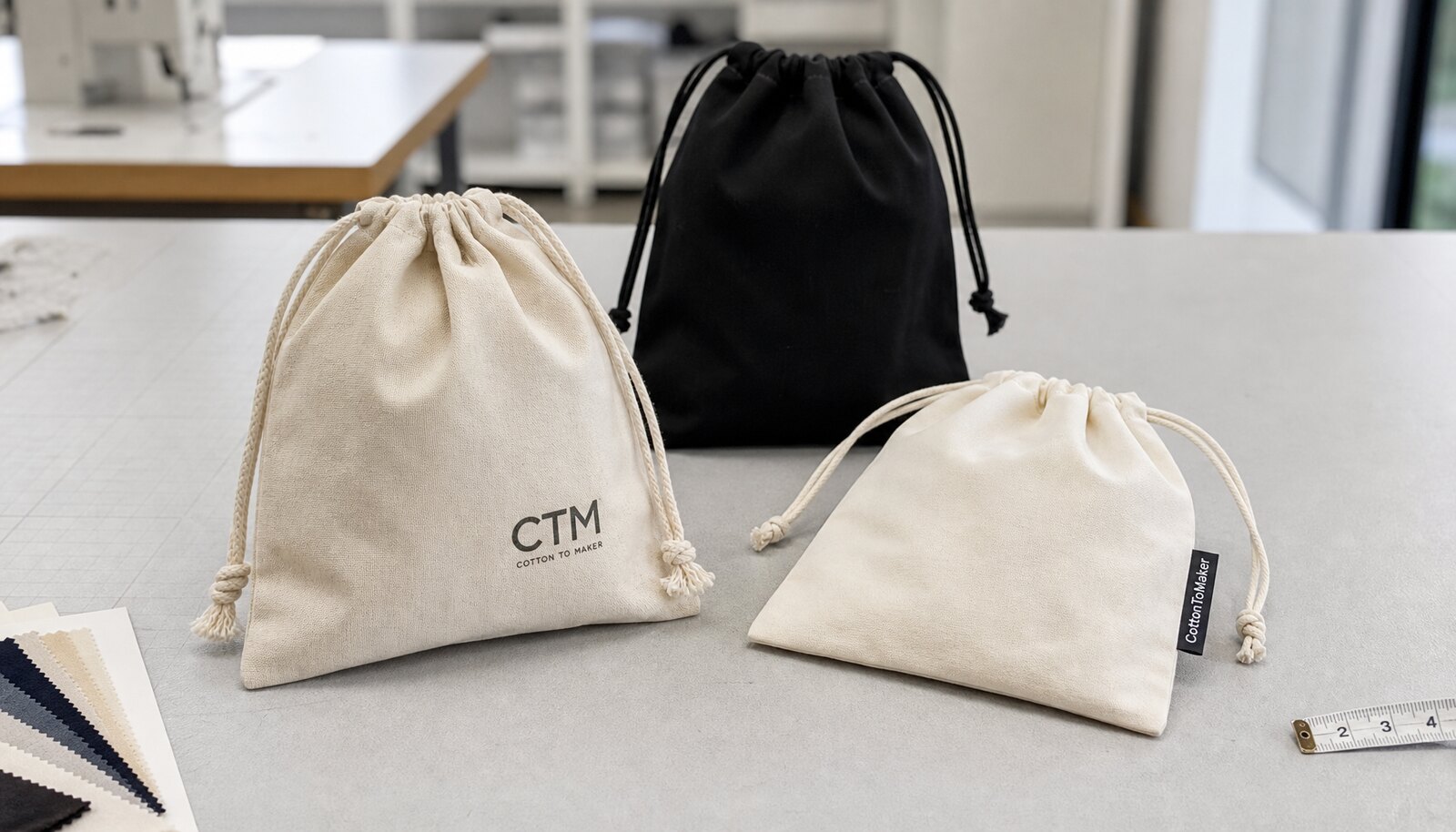
1. Why a small pouch can create a large sourcing problem
A pouch looks simple, which is why many teams underwrite the risk. In practice, the sourcing variables are numerous: fabric opacity, seam strength, logo registration, cord retention, pack count, carton loading, and how the pouch looks once it is filled and cinched. Each one can affect landed cost or customer perception.
The unit price can be misleading because the real cost shows up later. A pouch that prints poorly, arrives too thin, or needs rework at the warehouse creates labor cost that never appears in the quote. If the pouch is part of a gift set or premium unboxing flow, even a minor defect can drag down the perceived value of the whole order.
Procurement gets better results when the RFQ treats the pouch as a finished packaging component, not as a logo add-on. The supplier needs the use case, material target, decoration method, packing method, and acceptance rules. That level of clarity makes quotes more comparable and reduces post-sample disputes.
- A small item can still carry tight tolerance and defect-risk requirements.
- The cheapest quote is rarely the lowest landed cost once packing, setup, and rework are included.
- A pouch that looks fine flat can fail once filled, cinched, and packed into cartons.
2. Start with the use case, not the decoration
Before asking about logo method or Pantone matching, define what the pouch must do. A pouch for jewelry, cosmetics, or small apparel usually needs a different balance of softness, opacity, and closure strength than a pouch used as a gift bag or subscription insert. If the pouch is mainly presentation packaging, the surface finish and print consistency matter more. If it must be reused often, the cord channel, seam reinforcement, and fabric durability move to the front of the spec.
The most useful RFQs describe the packed item and how it is handled after filling. Will the pouch be placed inside a shipper carton, or will it be the final visible packaging? Will fulfillment staff fill it at speed, or will it arrive pre-packed? Will the customer reuse it? Each answer changes the opening width, the slack allowance, and the tolerance you can live with.
It also helps to define the failure mode. If the pouch tears, is the issue cosmetic or functional? If the pouch is a secondary insert, the standard can be lighter. If it is the face of the product presentation, even a minor defect can make the whole order feel off-spec.
- Product insert pouch: prioritize opening width, fast packing, and stable carton counts.
- Retail accessory pouch: prioritize seam finish, logo clarity, and consistent handfeel.
- Protective shipping pouch: prioritize opacity, stronger GSM, and cord retention.
- Reusable gift pouch: prioritize washability, abrasion resistance, and repeatable cinch action.
3. Fabric, weave, and GSM: what changes the quote and the feel
For custom drawstring pouches for ecommerce, many buyers land around cotton in the 120-140 GSM range or poly-cotton around 100-130 GSM. That range is useful, but it is not a rule. Lower GSM reduces material cost and can lower freight weight, yet it may show the contents, collapse at the opening, or feel cheap in the hand. Heavier cloth adds structure and opacity, but it raises cost and can reduce carton efficiency.
Cotton and poly-cotton also behave differently in manufacturing. Cotton tends to give a softer, more natural look that suits craft, wellness, or premium gifting. Poly-cotton is often easier to sew consistently and may hold shape a little better in repeated handling. If the pouch is going to be photographed for ecommerce, request swatches under the same light used for product imagery. A fabric that looks rich in the sample room can still appear thin under backlight or beside a dark insert.
GSM alone does not define the result. Two fabrics can share the same number and still behave differently because of yarn thickness, weave density, finishing, and shrinkage. Ask the supplier to state the exact weave, finish, and any expected shrink behavior. If the order is meaningful in volume, approve a physical sample instead of relying on a spec line alone.
- Lower GSM can save cost, but it can also show contents and distort shape when filled.
- Higher GSM improves structure, but it can increase freight and reduce carton density.
- Ask for the same weave density and finish, not only the same GSM.
- Compare swatches under backlight, not only on a desk under soft room light.
4. Size, closure style, and construction details that affect usability
Size should come from the packed product, not from a guess about convenience. Measure the item with any sleeves, cards, or inserts that travel with it, then add enough clearance for insertion and cinching. A filled sample is the best way to check whether the pouch feels neat or sloppy. Too large, and the pouch wastes fabric and can wrinkle around the logo. Too small, and the warehouse has to force product into the pouch, which slows packing and can split the seam.
Closure design deserves the same attention. A single cord can work for very light items, but a double-drawcord is usually easier to cinch evenly and less likely to twist the opening. The channel width, hem reinforcement, and cord finish should be part of the written spec. If the pouch will be reused, test whether the cord still slides cleanly after repeated pulls and whether the channel keeps its shape.
Other construction details matter in the real world: seam allowance, cord material, end finish, and whether the pouch needs a gusset or flat base. If it must sit upright on shelf or in a box, test the load behavior. If it is only an insert, the buyer can accept simpler construction as long as the pack-out stays clean and fast.
- Double-drawcord usually gives a better balance and user experience than a weak single-cord system.
- Confirm channel width and hem reinforcement in the sample, not only on the drawing.
- If the pouch will be reused, pull-test the cord several times and inspect for channel deformation.
- Ask how the cord channel meets the body: flat seam, overlock, or another finish.
5. Print method choices: where the quote and durability diverge
Decoration drives a lot of price variation because it changes setup, alignment, and defect risk. Screen print is usually the first option for simple logos and one or two spot colors. It is repeatable on steady orders and works well on cotton or blended fabric. The tradeoff is that each color adds setup and registration work, and very fine text can break up on textured cloth.
Heat transfer and digital methods are better fits when the artwork is more complex. That can help with gradients, small type, or multi-color art, but the buyer still needs a durability conversation. A print can look strong on day one and still crack, lift, or fade if the film, adhesive, or curing is weak. If the pouch will be packed tightly, rubbed by clothing, or handled often, ask how the print holds up after use and folding.
A woven or sewn label is sometimes the cleaner answer. It adds a different cost structure, but it avoids some ink-related issues and can create a more premium tactile result. The procurement question is not just which method looks best; it is which one gives acceptable durability, repeatability, and total cost at the planned quantity.
- Screen print fits simple logos, limited colors, and repeat replenishment orders.
- Heat transfer or digital can handle detailed artwork, but ask how the print handles rubbing and folding.
- Woven labels can reduce ink risk and create a premium finish for minimalist branding.
- If the logo has small text, ask the factory to show the smallest line width they can hold on the chosen fabric.
6. MOQ and order structure: what the supplier is really charging for
MOQ on pouch projects is rarely only about sewing capacity. It is usually shaped by fabric booking, cutting efficiency, print setup, color-change waste, and packing labor. A factory may accept a low total quantity and still require a minimum per color, per artwork, or per size. That is why one total-order number can hide a much narrower production reality.
Ask the supplier to explain MOQ in plain language. Is the minimum tied to material use, screen setup, or production-line efficiency? Those are different constraints. A brand testing three colors of the same pouch may find that stock fabric plus one logo color is the right launch route, while custom-dyed fabric only makes sense once demand is proven.
The fastest way to compare quotes is to model the same item several ways: one color, three colors, one logo, two logos, with and without labels. Ask for the price effect of each change. That tells you whether the factory is pricing transparently or hiding most of the cost in setup and changeover fees.
- Ask MOQ by size, color, and artwork separately.
- Check whether setup charges are one-time or charged again on reorders.
- Compare one-color versus multi-color pricing before choosing the branding format.
- If the supplier will not explain MOQ logic, treat that as a sourcing risk signal.
7. Supplier comparison: direct factory, trading company, or sourcing route
The sourcing route changes both transparency and accountability. A direct factory usually gives better visibility into fabric cost, sewing labor, printing setup, and packing assumptions. That makes quote comparison easier. The catch is that factory-direct only works well if the buyer can manage communication, approve drawings, and follow through on sample signoff and inspection notes.
A trading company or sourcing agent can help when the order is more complex than a single pouch. If the pouch is one component in a broader kit, a routed supplier can reduce coordination work. The tradeoff is less visibility into where fabric and decoration are actually coming from, and less clarity on what portion of the price is margin versus production cost.
The right question is not which route is cheaper in the abstract. It is which route gives the best control over repeatability. For stable repeat orders, direct factory often wins. For multi-item launches, a good trading partner can be worth the extra margin if they manage the moving parts cleanly. Ask who owns material approval, who signs off substitutions, and how quality responsibility is tracked if something goes wrong.
- Direct factory: best when repeatability, cost transparency, and re-order control matter most.
- Trading company: useful when multiple SKUs or packaging items must be coordinated together.
- Red flag: supplier will not state where fabric comes from or how substitutions are approved.
- Red flag: quote omits packing assumptions, inspection responsibility, or the basis for the MOQ.
8. Sampling and approval: what the pre-production sample must prove
A useful sample is not a visual placeholder. It should use the final fabric, final cord, final label or print method, and final size. If the supplier sends a blank bag or a sample made from substitute material, you are not approving the same item that will ship in bulk. That is how disputes begin when the production run feels thinner, darker, stiffer, or less durable than the sample you signed off.
Test the sample the way the warehouse and customer will actually use it. Fill it with the real product, or at least a close weight match, then check the opening width, the cinch action, and the logo position after loading. If the pouch is part of ecommerce presentation, inspect it closed, partially open, and inside a shipping carton. A flat sample can hide problems that appear the moment the pouch is filled.
Use the sample stage to lock down the small things that are easy to miss in an RFQ: cord end finish, thread trimming, label placement, channel symmetry, and whether the print stays centered once loaded. If the order has multiple sizes, approve one size fully before copying the spec across the rest of the line. That keeps mistakes from spreading.
- Approve the sample only when it uses final materials and final decoration.
- Test it filled, cinched, and packed, not only flat and empty.
- Check cord finish, label position, and logo placement after the pouch is loaded.
- Keep the approved sample physically or digitally documented for production comparison.
9. QC, AQL, and defect thresholds buyers should write into the PO
QC is where procurement becomes operational. A pouch spec should be inspectable without interpretation. Saying “good stitching” or “nice print” is not enough for a factory or inspector to use consistently. The PO should define defect classes, measurement methods, and a sampling reference. If you use a third-party inspector, tell them whether the pouch is packaging, retail, or reusable, because the acceptable finish level may differ.
If you use an AQL plan, write the sampling level and defect rules before production starts. The exact AQL number will depend on risk tolerance, but the categories should be clear. Critical defects might include wrong artwork, missing cord, broken closure, or an open seam. Major defects might include a crooked logo, a mixed-size inner pack, or a visible hole. Minor defects might include loose thread trimming or a slight shade shift inside one approved lot.
Measurement method matters too. State whether dimensions are measured flat, relaxed, or after filling. If the logo must sit a certain distance from the top edge, write that distance into the spec and allow a realistic tolerance. Pass/fail photo examples are useful because they reduce arguments later. One acceptable seam, one unacceptable seam, one acceptable print, and one unacceptable print will do more for QC alignment than a page of adjectives.
Keep the inspection checklist short enough to use on the line. For larger orders, add in-line checks so issues are found before all units are sewn. Rework on 10,000 pouches is expensive; catching the problem in the first hundred is far cheaper.
- Critical defects: wrong artwork, open seam, missing cord, broken closure, major stain, or incorrect size beyond tolerance.
- Major defects: crooked print, uneven channel, mixed sizes in one inner pack, or a visible hole.
- Minor defects: loose threads, slight pressing marks, or small shade variation inside one approved lot.
- Write how dimensions are measured: flat, relaxed, or filled.
- Use pass/fail photos in the PO or QC sheet so the inspector can see what acceptable means.
10. Packing, carton math, lead time, and landed cost
Packing decisions can change the economics as much as fabric choice. Bulk-packed pouches are cheaper to prepare and can improve carton density, but they increase the chance of scuffing, wrinkling, and count errors if handling is sloppy. Individual polybags improve cleanliness and make receiving easier, but they add material cost, labor, and waste. Inner bundles by size and color are often the best compromise for ecommerce teams that need predictable warehouse handling without paying for retail-style packaging.
Carton math matters because pouches are light but voluminous. A slightly heavier fabric or a thicker fold can reduce carton efficiency and increase freight cost even when sewing price looks fine. Compare quotes on the same basis: same size, same GSM, same decoration, same packing format, and same carton count. If one supplier excludes inner packaging, labels, or carton-mark revisions, the quote is incomplete, not cheaper.
Lead time should be handled as a workflow, not a single date. A realistic schedule includes sampling, approval, material booking, printing setup, cutting, sewing, packing, and outbound transport. Seasonal demand can tighten every step, especially if the factory is also booking fabric or screens for other orders. If you need custom shade matching, special labels, or artwork changes, the schedule usually moves.
The right internal view is landed cost: fabric weight, setup fees, print durability, packing format, carton efficiency, freight, and likely rework risk. The lowest unit price only matters if the pouch arrives on time, matches the sample, and does not add warehouse labor.
- Use the same basis when comparing quotes: size, GSM, print method, packing format, and carton count.
- Ask whether the quote includes inner packaging, labels, and carton marks.
- Leave buffer time for artwork corrections and carton rework.
- If the pouch is part of a retail bundle, include downstream handling labor in the real cost view.
Specification comparison for buyers
| Spec decision | Recommended option | When it fits | Buyer risk to check |
|---|---|---|---|
| Fabric choice | Cotton 120-140 GSM or poly-cotton 100-130 GSM | Ecommerce packaging, gift sets, jewelry, small apparel, cosmetic kits | Too-light fabric can show contents under backlight or tear at the channel; too-heavy fabric raises unit cost, carton weight, and freight cost |
| Closure construction | Double-drawcord with reinforced hem and a 1.5-2 cm channel | When the pouch will be reused, resold as an accessory, or shipped with heavier contents | Single-cord or narrow channels can slip, distort, or cut into the opening after repeated cinching; confirm knot retention and cord pull strength |
| Print method | Screen print for 1-2 spot colors; heat transfer or digital for detailed artwork; woven label for premium low-ink branding | When you need repeatable branding across cartons and a controlled logo position | Fine text, gradients, or thin lines can break up on textured fabric; ask how ink is cured and whether the print survives rub testing |
| Size strategy | Base the pouch on the actual packed product plus 10-15 mm clearance each side, then validate with a filled sample | When the pouch is sold with a known SKU set or used as an insert in a fixed kit | Oversized pouches waste fabric and freight; undersized pouches create bulging seams, slow packing, and a poor unboxing look |
| MOQ route | Factory MOQ by color/artwork, or stock-fabric plus custom print for lower launch quantities | When testing ecommerce demand or launching multiple SKU variants | Low MOQ can hide setup cost in printing, labels, cutting, or packing; confirm per-color and per-design minimums in writing |
| Sampling route | Pre-production sample with final fabric, final cord, final decoration, and final pack-out | When the pouch is part of a launch, influencer kit, or bundled retail set | Blank or visual-only samples do not prove print alignment, cord length, seam behavior, or carton packing efficiency |
| Packing method | Bulk pack by size/color in polybag or inner bundle, carton with clear carton marks | When fulfillment teams repack into ecommerce orders or FBA-style receiving | Loose packing increases scuffing and count errors; mixed lots create warehouse delays and receiving disputes |
| Supplier route | Direct factory for stable repeat orders; trading company or sourcing agent for multi-item bundles | When you need tighter price control or multi-SKU coordination | Trading layers can obscure fabric source and QC responsibility; factory-direct requires stronger document control and clearer inspection rules |
| Lead time plan | Build the timeline from sample approval, material booking, production, packing, and freight; standard sewing time is only one part | When the pouch is tied to a launch date or seasonal retail window | Calendar time slips because of approval delays, fabric shortages, artwork revisions, carton rework, and peak-season congestion |
Buyer checklist before sampling
- Define the pouch use case: product insert, gift pouch, protective packing, resale accessory, subscription insert, or fulfillment bag.
- State finished size, fabric type, GSM target, cord style, and whether the pouch must stay presentable after repeated handling.
- Specify logo size, print method, Pantone target if relevant, and the exact print location on front, back, or side label.
- Confirm MOQ by artwork, color, and size, not only by total order quantity.
- Require a pre-production sample using final fabric, final cord, and final pack-out format.
- Set acceptance criteria for stitch quality, seam width, print registration, and odor or contamination.
- Agree on carton count, inner pack format, and outer carton marks before production starts.
- Build lead time around sample approval, mass production, and inland freight, not only the sewing time.
- Request a quote breakdown that separates fabric, printing, label, packing, cutting, and setup charges.
- Ask for defect photos or inspection notes from a similar pouch order so you can judge the supplier’s standard before you buy.
Factory quote questions to send
- What fabric options are included in this quote, and what is the exact GSM, weave type, and shrink behavior for each option?
- Is the MOQ based on total quantity, per size, per color, or per artwork? Please separate each limit and any setup charge that changes with it.
- Which print method is included, how many colors are priced, and what fee applies for additional colors, plate changes, or artwork revisions?
- Will the sample be made with final fabric, final drawcord, and final packing, or is it only a visual reference?
- What is the exact finished-size tolerance you will hold, and how do you measure it: flat, relaxed, or filled?
- How are the pouches packed: bulk, inner bundle, polybag, retail-ready insert, or carton divider? What is the exact carton count and gross weight estimate?
- What lead time applies after sample approval, and what events can extend it, such as fabric booking, lab approval, color matching, or artwork changes?
- Can you provide photos or inspection notes from a similar pouch order showing stitching, hem construction, cord channel, and print quality?
- If the order repeats, will the second run use the same fabric lot or a comparable substitute, and how will shade variation be handled?
Quality-control points to confirm
- Finished size should stay within the written tolerance on the PO. For a small pouch, many buyers use roughly ±0.5 cm; larger sizes may allow ±1 cm, but the tolerance should match the use case and be confirmed against the approved sample.
- Fabric should match the approved sample in weight, handfeel, weave density, opacity, and shade. Check for thin spots, snags, oil stains, puckering, and visible contamination under normal light and backlight.
- Drawcord must slide smoothly without cutting into the channel. Pull it several times using normal hand force and confirm that knots, stoppers, or heat-sealed ends do not pull through.
- Stitching should be straight and consistent, with no skipped stitches, open side seams, broken thread, or loose ends longer than the agreed trim standard.
- Print should be centered within the agreed tolerance, with acceptable color density and no obvious misregistration, smudging, cracking, or color bleed after light rubbing.
- Packing count must match the packing list exactly. Check inner bundle count, master carton count, and SKU mix so the warehouse does not receive partial or mixed lots.
- Odor, dust, and loose fiber levels should be acceptable for retail or ecommerce unboxing. If the pouch is meant for beauty, wellness, or apparel gifting, define a stricter cleanliness threshold.
- Carton marks, SKU labels, and shipping marks must be readable and consistent with the PO, sample approval, and packing list.
- If you use third-party inspection, ask for an AQL plan in the PO or inspection instruction. For example, buyers often separate critical, major, and minor defects and state the sampling level before production starts.
- Pass/fail should be based on examples, not adjectives. For instance: pass = clean print and intact seams; fail = open seam, wrong logo, or broken closure; review = slight thread trimming issue or minor shade shift within the agreed lot.