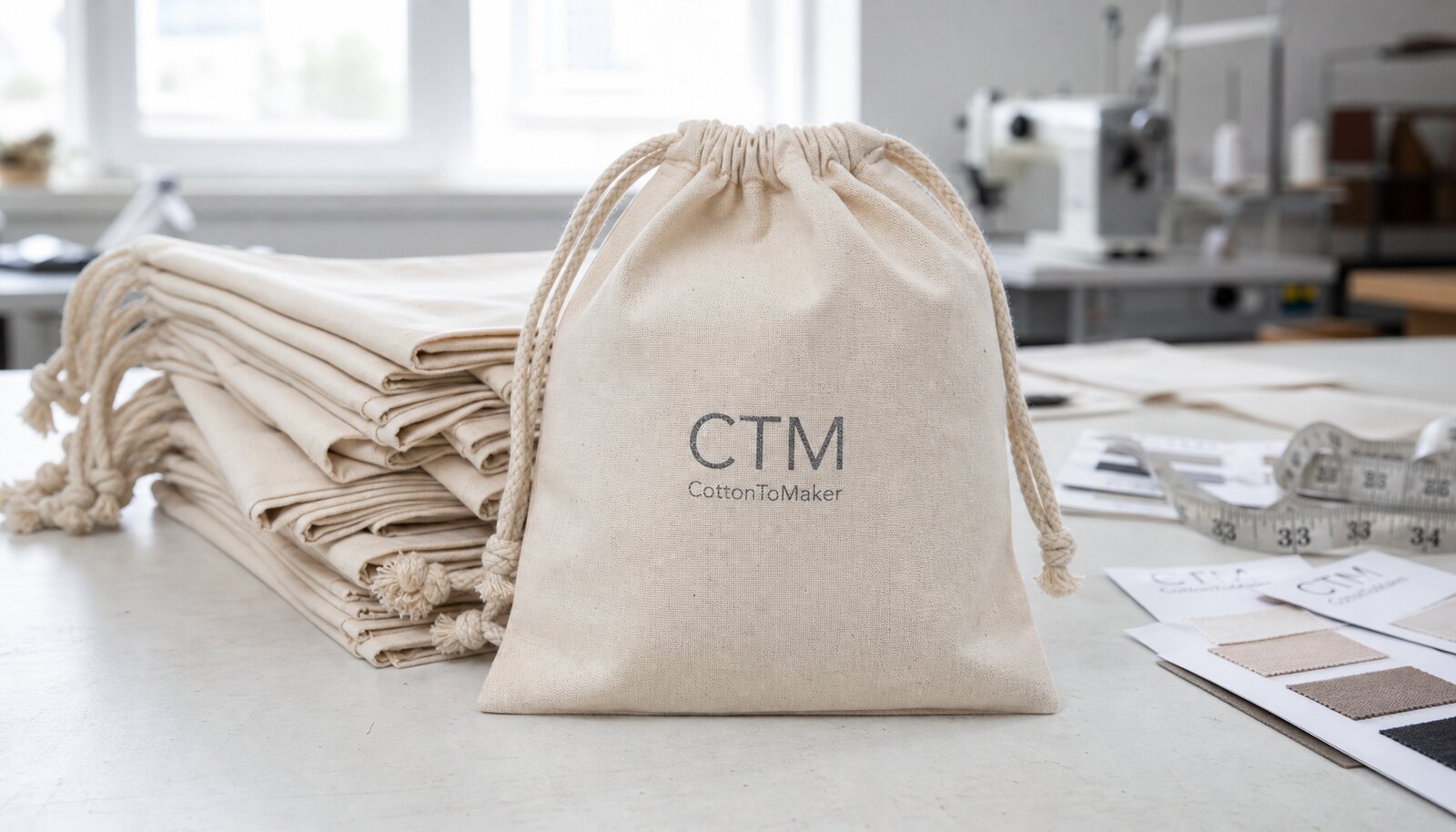
Why brand launches fail on pouch sourcing
Custom drawstring pouches for brand launches look simple from a distance, which is exactly why procurement teams sometimes under-spec them. The failures are rarely dramatic. More often they are quiet: fabric arrives lighter than the approved handfeel, the logo prints a few millimeters off-center, cord ends fray in transit, or carton counts do not line up with the launch plan. Those issues are expensive because they surface after the packaging has been tied to a campaign, a retail reset, a seasonal gift set, or a launch date that cannot move.
For brand buyers, the pouch is part of the product experience, not just a protective bag. It affects first impression, perceived value, and sometimes how the main product is judged on shelf or in the unboxing moment. If the goal is a polished launch, the buyer needs a manufacturing spec the factory can repeat, not just a clean design file. That means defining fabric, size, print method, cord finish, stitch quality, and packing instructions before requesting quotes.
The practical mindset is to treat the pouch like any sewn retail item with a quality standard. A factory can make a very nice sample and still miss a large order if the RFQ is vague. Conversely, a buyer who locks the critical details early can compare suppliers on the same basis, reduce sample churn, and keep the launch calendar intact.
The strongest launch programs usually start with one production version, one approved sample, and a clear acceptance threshold for bulk goods. That keeps procurement focused on repeatability. It also makes it easier to decide whether a supplier is capable of brand-level presentation or only generic promotional packaging. The difference shows up in the small details: how the hem sits, how the cord slides, how the print holds on actual fabric, and whether every carton arrives in the same condition.
- Treat the pouch as a finished sewn product with repeatable QC, not as generic packaging.
- Lock one approved sample to define handfeel, logo appearance, cord behavior, and packing quality.
- Build the RFQ around production realities: GSM, stitch construction, decoration method, and carton pack-out.
Start with the right fabric, weight, and handfeel
For most launch programs, cotton twill in the 120-150 GSM range is the practical starting point. It usually gives enough body for cosmetics, candles, supplements, jewelry, apparel accessories, and gift kits without making the pouch feel stiff. It also handles screen printing cleanly enough for most simple logos, provided the surface is not overly rough. If the brand wants a more structured and premium look, canvas in the 180-220 GSM range is common, but that choice changes the economics: more fabric cost, more sewing time, heavier cartons, and higher freight.
Very light cotton below roughly 100 GSM can still work for low-cost giveaways or mailers, but it often creates problems on retail orders. Thin fabric collapses too easily, can show seam lines or print shadowing, and may look less stable when filled. If the item inside has hard edges or moderate weight, light fabric can also wear at the bottom corners and around the drawcord channel. That does not always fail immediately, but it can create a poor impression when the brand opens the pack in front of a customer or retailer.
When procurement is comparing quotes, fabric should never be described only as 'cotton pouch' or 'canvas bag.' Ask for fiber content, weave style, GSM, and whether the fabric is bleached, dyed, or piece-dyed. If color consistency matters across a launch set, require a lab-dip or swatch reference. If the pouch is natural/off-white, define what level of shade variation is acceptable because natural cotton often varies more than buyers expect. The goal is to avoid a situation where suppliers quote the same name but build entirely different products.
A useful buyer rule is to align fabric with the weight and shape of the item being packed. Soft, light items can tolerate lighter twill. Heavier or sharper items need more structure, better seam strength, and sometimes a reinforced base or a denser weave. If the pouch is part of a premium launch box, the tactile feel can matter as much as the logo. A slightly heavier fabric often improves the perceived value enough to justify the cost difference, especially when the pouch stays with the consumer after the initial purchase.
- Use 120-150 GSM cotton twill for balanced cost, printability, and presentation.
- Use 180-220 GSM canvas when the launch needs more structure and a premium handfeel.
- If the packed item is hard, sharp, or heavy, avoid very light fabric and low stitch density.
Choose the decoration method by artwork and brand intent
The right decoration method depends on the logo, the number of colors, the brand’s visual style, and the quantity being ordered. Screen printing is usually the most efficient option for one to three solid colors, clean vector logos, and repeatable volume. It is stable, cost-effective, and easier to repeat across multiple production lots if the mesh, ink, and curing settings are controlled. For many launch orders, that gives the best balance between cost and consistency.
Embroidery can deliver a premium look when the logo is simple and sized appropriately, but it adds thread density and production time. It also has limits: tiny text can close up, sharp corners can soften, and very fine details may not survive the stitch path. Woven labels are useful when the logo contains small type or more detail than a stitched logo can comfortably handle. They also work well if the brand wants a neat label-like cue without covering the pouch face with ink. The label, however, must be sewn cleanly and positioned consistently or it can twist or flare after handling.
Heat transfer can be useful in some cases, but on cotton pouches it often has a narrower quality window than a well-made screen print. The buyer should ask what decoration process the supplier actually runs well rather than asking for the cheapest method by default. A supplier who pushes one process for every job may be trying to fit the design to the factory, not the other way around.
For launch orders, the best approach is to ask the factory for a strike-off or printed sample using the real fabric. Look at the edges of the logo, the opacity of the ink, and whether the design sits straight on the pouch face. If there is a legal line, tagline, or small website URL, verify it at actual size; text that looks fine on a screen can become muddy on the pouch. The buyer should also confirm whether the print is single pass, double pass, or requires a base coat, because that affects both cost and schedule.
- Use screen print for simple, repeatable launch graphics and solid colors.
- Use embroidery only when the logo remains legible at stitch resolution.
- Use woven labels when you need a premium cue and the artwork has detail or small type.
- Ask for a real strike-off or sewn sample, not just a digital proof.
How to compare supplier quotes without getting fooled by unit price
A low pouch quote often hides a spec downgrade. One supplier may quote a 120 GSM cotton pouch with controlled seam allowance and careful inner packing, while another quotes a similar-looking bag using thinner fabric, looser stitching, fewer QC steps, or a cheaper carton plan. On paper the unit price gap can look attractive. In production, the cheaper version can arrive with more rejects, more print inconsistency, and weaker retail presentation. That is a poor trade for a brand launch where the product is supposed to create confidence.
Quote comparison only works when every supplier receives the same RFQ. That RFQ should include finished dimensions, fabric GSM, weave, print method, cord spec, stitch requirements, packing method, inspection expectations, and required documents. If the buyer only sends artwork and a target price, the factories will fill in the blanks differently, which makes the quotes impossible to compare. One of the most common procurement mistakes is to compare a pouch quote with one hidden assumption against another with a different hidden assumption.
Commercial terms matter as much as unit price. EXW, FOB, and delivered quotes are not comparable unless freight, export handling, inland movement, and any domestic packing charges are normalized. A supplier with a higher EXW price may still produce the lower landed cost if their cartons are more efficient, their defect rate is lower, or their packing matches your warehouse requirements the first time. In other words, the quote is only the beginning of the math.
A practical buyer technique is to request the same line items from every supplier: fabric cost, sewing cost, print setup or plate cost, packing cost, sample cost, carton cost, and any testing or certificate cost if required. Then compare not just the price, but also the assumptions behind the price. If one supplier excludes label application or inner polybagging, that needs to be added back before a decision is made. Procurement should also ask for price breaks at several quantities so the launch team can see whether a small quantity surcharge is reasonable or inflated.
- Normalize every quote to the same spec sheet before comparing price.
- Separate fabric, sewing, decoration, packing, and shipping assumptions in the RFQ response.
- Compare landed cost, not just factory gate price.
- Ask for price breaks at 1,000, 3,000, and 5,000 units if launch demand is uncertain.
Supplier routes: direct factory, trader, or local converter
For brand launches, a direct factory is usually the strongest route when the order needs a specific fabric weight, careful logo placement, and controlled pack-out. A good factory can show seam samples, print strike-offs, and stitching details before bulk production begins. That reduces the chance of miscommunication, especially when the pouch is being used for a retail set rather than as a simple promotional giveaway. The key advantage is not only lower middleman cost; it is also better visibility into how the bag is actually made.
A trader or sourcing agent can still make sense when the order combines several product categories or when the buying team needs help coordinating sampling, shipment, and documentation. The tradeoff is visibility. Communication may be smoother, but the buyer should not assume the trader controls the plant. Ask for proof of the actual production site, the machinery used for sewing and printing, and sample photos from the same factory line. If the middleman cannot explain where the fabric is cut, who prints the logo, and who signs off the final cartons, the buyer is taking unnecessary risk.
A local converter or small workshop can be useful for very short runs, urgent domestic programs, or prototype-level testing. The drawback is usually higher unit cost, less material variety, and weaker scalability. Small converters may also have limited QC systems or inconsistent subcontracting. That does not make them bad suppliers; it simply means they fit a narrower set of launch scenarios. Procurement should choose the route based on the launch risk, the timeline, and the need for repeat orders, not only on who is fastest to reply.
The most reliable approach is to verify who actually performs each step: fabric sourcing, cutting, sewing, printing, finishing, packing, and final inspection. A supplier who says 'we can do everything' may still outsource key steps. That is not automatically a problem, but it must be disclosed so the buyer can assess quality control at each handoff. If the launch has strict standards, the sourcing decision should favor the route with the clearest production chain, not just the lowest headline quote.
- Direct factory: best for control, repeat volume, and lower middleman cost.
- Trader: useful for mixed-category consolidation, but request proof of the actual production site.
- Local converter: useful for speed and small runs, but usually less cost-efficient at scale.
- Always verify which steps are in-house and which are subcontracted.
MOQ, order planning, and how to keep the launch budget under control
MOQ should not be treated as a number the factory simply invents. It is usually tied to fabric roll widths, cutting efficiency, print setup, sewing time, and whether the order requires one decoration color or several. A single-size pouch with one-color screen print can often run at a lower MOQ than a launch kit with multiple sizes, different logo placements, and mixed packaging requirements. When the factory has to reset screens, trim changes, or sewing guides for each variation, MOQ rises quickly because the line loses efficiency.
For a launch, the smartest way to protect the budget is to reduce complexity before discussing scale. Start with one finished size, one print position, one primary colorway, and one packing format if possible. If the campaign performs well, the second order can introduce another size or another decoration variant. This is not just a cost tactic; it is also a buyer risk strategy. A lean first run makes it easier to adjust packaging based on sell-through, retailer feedback, or fulfillment feedback.
Procurement teams should also ask how the factory sets MOQ. Some suppliers quote a general MOQ but can lower it if the buyer accepts a narrower fabric choice or a standard drawcord. Others use a higher MOQ because they outsource printing or buy fabric in larger minimum lots. Understanding the driver behind the MOQ matters more than the number itself because it tells the buyer whether there is room to negotiate by simplifying the spec rather than just pushing on price.
If multiple sizes are needed, the buyer should ask for an MOQ per size and a combined MOQ across the order. That distinction matters. A supplier may be able to manufacture a larger total volume but still charge heavily for extra SKU setup. The commercial answer may be to place a single-size launch first, then expand only after there is real demand data. That gives the brand a cleaner inventory position and reduces the risk of ending up with dead stock in the wrong size or color.
- Expect MOQ to rise with extra sizes, extra print colors, special trims, and custom packing.
- Use one production version to test sell-through before expanding the line.
- Ask for MOQ per size, per color, and per print position—not just one headline number.
Sample approval: what the pre-production sample must prove
A digital proof is not enough for a launch order. The pre-production sample should use the actual fabric, actual cord, final stitch method, and final decoration process. That sample is the buyer’s reference for color, handfeel, logo placement, opening width, and how the pouch closes under real use. If the pouch will hold a retail item, gift set contents, or a product with rigid edges, the sample should also prove whether the seams can tolerate insertion without tearing or excessive stretching.
The sample review needs to be measurable, not purely subjective. Check the finished dimensions against the spec sheet, confirm the opening and cord length, and inspect the print edges under good light. If the pouch is meant to feel premium, assess whether the top hem sits straight, whether the drawcord exits cleanly from both sides, and whether the pouch collapses neatly when empty. If the print includes small text or fine lines, inspect them at arm’s length and again at close range; both views matter because the buyer and end customer do not look at the item the same way.
A sound workflow is to request a first sample, mark comments on it, and require a second round only if the correction is material. Then freeze the approved sample as the production reference, with one physical copy kept by the buyer and one retained by the factory. For larger launch programs, it is also smart to photograph the approved sample next to a ruler, a color standard, and the packed product. Those records reduce later disputes when the bulk order arrives and someone claims the pouch is 'close enough.'
Before bulk approval, confirm whether the factory wants a signed sample card, a PDF approval, or a stamped physical reference. The process should be documented in writing. If the supplier also handles the packing, ask for a small bulk-like pre-production run so the buyer can check the first sewn pieces and the final carton labels before the rest of the order is released. That simple step can catch assembly or labeling issues early enough to correct them without hurting the launch date.
- Require a pre-production sample with final fabric and final decoration method.
- Measure finished size, opening width, and cord length against the approved sheet.
- Approve color and print clarity under the same lighting used for receiving inspection.
- Keep one retained approved sample on both the buyer and supplier side.
Quality control: the checks that matter for sewn pouches
Procurement quality control should be specific enough that the factory knows what 'good' means. General instructions like 'nice stitching' or 'good print' are too vague to manage a bulk order. For drawstring pouches, the useful controls are measurable. Ask for stitch density targets, seam allowance expectations, finished size tolerances, print placement tolerance, and acceptable defect thresholds before production begins. That turns the bag from a subjective sample into a repeatable product.
A practical seam standard is to define the seam allowance in the spec, commonly around 0.5 to 1.0 cm depending on size and construction. Then ask the factory to maintain consistent stitch density across side seams, bottom seam, and the drawcord channel. The buyer should inspect for skipped stitches, broken stitches, seam puckering, uneven channel width, and loose threads that were not trimmed. If the pouch will be handled repeatedly, the drawcord channel and top edge deserve extra scrutiny because that is where failure usually starts.
Decoration quality should also be checked beyond 'does the logo look centered.' Screen print should be even, with no pinholes, blotching, ghosting, or obvious smearing. If the brand has a color target, ask for a visual match to a retained swatch or Pantone reference where feasible. For products with handling friction, ask about rub resistance or dry rub performance. Even a good print can disappoint if the ink transfers onto the product or onto adjacent pouches in transit. If the order uses embroidery, inspect for thread tension, backing visibility, and clean trimming around the design.
Defect acceptance should be set before the goods are made. In a launch setting, the buyer should distinguish between major defects and minor defects. Major defects might include wrong size, broken seam, unreadable logo, or staining. Minor defects might include a loose trim thread or a slight fold line that does not affect function. The buyer and supplier should agree on the inspection lot standard and the acceptable defect level for each category. Without that, disputes become subjective and the factory may argue that the lot is 'normal' even when the buyer cannot use it for launch.
Finally, ask the supplier to show you how they inspect. Do they check every piece, do an AQL-style lot inspection, or only spot-check cartons? There is no one universal answer, but the buyer needs to know what is being done. For brand launches, the right inspection is usually the one that matches the consequence of failure. If the launch is high visibility, more thorough final inspection is worth the time.
- Define stitch density, seam allowance, and size tolerance in the spec before production starts.
- Check print coverage, registration, rub resistance, and color match—not only logo placement.
- Set defect thresholds in advance by major vs minor defects.
- Ask the factory how final inspection is performed and what lot standard is used.
Packing, labeling, and compliance for launch channels
Packing is not a minor detail. It affects receiving speed, warehouse accuracy, and how the brand appears when the product reaches a store or fulfillment center. For wholesale or e-commerce launch programs, pouches should be packed by SKU, size, and color in a way that matches the buyer’s routing guide. If the cartons arrive mixed, unlabeled, or missing counts, the receiving team may hold the shipment even if the pouches themselves are well made. That creates delays that are completely avoidable.
Bulk packing in polybags with clear carton labeling is often the most efficient format for launch orders. Inner packs help protect the surface from scuffing and make count verification easier during inbound QC. If the printed logo can rub, consider an interleaf, a tissue layer, or a controlled fold direction to reduce mark transfer. If a retailer or warehouse needs barcode labels, carton codes, or pallet markings, those details should be in the RFQ, not added later. Late labeling changes are one of the easiest ways to delay a shipment.
Compliance needs depend on the channel. A simple cotton pouch for a gift set may only need basic material and packing confirmation, while beauty, children’s, wellness, or food-adjacent launches may require more documentation. The buyer should ask whether the supplier can provide fiber content declarations, colorfastness evidence, restricted-substance confirmation, or any other documents required by the target market. If the pouch is going into a regulated retail channel, do not assume it is exempt just because it is a soft accessory.
The commercial lesson is that packing and labeling are part of the product, not an afterthought. A great pouch in a bad carton system still causes launch friction. For that reason, procurement should specify the inner count, master carton count, carton dimensions, gross weight, carton marks, and any pallet requirements up front. Those details help with freight planning, warehouse receiving, and landed-cost calculation. They also let the buyer compare factories on more than just sewing quality.
If the launch is international, ask whether the supplier can keep the carton marks, SKU labels, and shipping marks consistent across samples and bulk. Small errors in labeling can create large problems at destination, especially when the same pouch comes in multiple colors or sizes. The buyer’s routing guide should be treated as a production document, not a reference file that the factory may or may not follow.
- Specify inner pack count, carton count, labels, and carton marks before production.
- Use protective packing if printed surfaces might rub in transit.
- Request compliance documents appropriate to the launch channel and destination market.
- Treat packing and labeling as part of the product definition, not as a post-production task.
Lead time planning and the points that usually slip
A realistic lead time for routine cotton or canvas drawstring pouches is often about 7 to 10 days for sampling and 25 to 40 days for production after approval, but only when the materials are standard and the artwork is final. If the order needs custom dyed fabric, multiple decoration steps, extra labeling, or unusual packing, the timeline extends quickly. Procurement should plan backward from the ship date, not from the PO issue date, because the approval cycle is usually where launch schedules lose time.
The most common schedule slip is late sample approval. The second is artwork correction after the first strike-off, which can delay screen setup and bulk start. The third is pack-out or barcode revision after production has begun. Every one of these slips is avoidable if the RFQ already includes the final print file, the exact carton marking, and the approval deadline. A launch buyer should treat those items as locked inputs rather than items that can be 'fixed later.'
The buyer should also ask the supplier where the bottleneck usually happens. Is fabric procurement the long pole, is cutting capacity limited, or does printing require extra setup time? If the factory is honest, it will tell you where the schedule risk lives. If the answer is vague, treat that as a warning sign. The best suppliers tend to be specific about their process because they know exactly which step can delay a launch. That kind of transparency is valuable even when the answer is not flattering.
For launch management, it is wise to build a small schedule buffer between sample signoff and the production commitment. That buffer gives procurement room to correct a label, change a carton mark, or adjust the final quantity without putting the shipment at risk. It also creates a cleaner decision point for the buyer: if the sample is not right, the order is not released. That rule is simple, but it prevents a surprising number of costly shortcuts.
- Work backward from the launch date and include approval time in the schedule.
- Freeze artwork, barcode data, and carton marks before production starts.
- Ask the supplier where schedule bottlenecks usually occur.
- Keep a small buffer between sample approval and bulk release.
Specification comparison for buyers
| Spec decision | Recommended option | When it fits | Buyer risk to check |
|---|---|---|---|
| Supplier route | Direct factory with sample room, cutting, sewing, and printing under one quality system | Brand launches that need tight control on artwork, stitch quality, revision speed, and pack-out | Confirm whether print, sewing, finishing, and carton packing are truly in-house or partly subcontracted |
| Fabric choice | Cotton twill 120-150 GSM or canvas 180-220 GSM | Retail launches that need better handfeel, logo clarity, and fewer wrinkles than light muslin | Low GSM fabric can feel flimsy, print may shadow through, and the pouch can distort after filling |
| Drawcord type | Cotton cord for natural positioning; polyester cord for smoother draw and less fray; locked or heat-sealed ends where appropriate | Lifestyle, beauty, wellness, candle, and gift packaging where presentation matters | Loose cord finish can fray, pull unevenly, or create inconsistent end appearance across cartons |
| Print method | Screen print for 1-3 solid colors; embroidery for premium icon-style branding; woven label for small text or detailed marks | Simple logos with repeat volume and a stable launch deadline | Fine lines, gradients, small legal text, and tiny taglines may not reproduce cleanly at production scale |
| MOQ strategy | Start with one size, one fabric, one print position, one colorway; expand after sell-through data | Launches where demand is uncertain and inventory risk must stay controlled | Too many sizes or decoration variants can push MOQ above realistic first-order demand |
| Sampling route | Pre-production sample using the actual fabric, actual cord, final stitch method, and final decoration process | Any launch where shelf presentation, unboxing, or retail compliance matters to the buyer | Artwork proofs alone do not reveal seam tension, opening width, cord glide, or print coverage on real fabric |
| Packing method | Bulk packed by SKU and color with inner packs, carton labels, and a carton count sheet; add protective tissue or interleaf if print rub is possible | Wholesale distribution, importers, and fulfillment centers receiving mixed SKUs | Incorrect pack ratios create receiving delays, inventory mismatches, and costly inbound rework |
| Lead time logic | 7-10 days sample; 25-40 days production after sample approval for routine cotton or canvas; add freight and customs time | Standard pouches with simple decoration and no special dyeing or custom trims | Peak season, special coloration, extra labeling, or subcontracted steps can extend the quote window materially |
| Landed-cost route | Compare EXW, FOB, and delivered quotes on one normalized spec sheet | Importers comparing multiple suppliers or consolidating with other soft goods | A low unit price can hide expensive packing, weak carton efficiency, higher inspection risk, or freight penalties |
Buyer checklist before sampling
- Finalized finished dimensions, not only flat cut dimensions
- Fabric specification with GSM, weave, fiber content, and color reference if dyed or bleached
- Artwork file with print size, placement, ink color code, and acceptable min line weight
- Cord material, cord diameter, end finish, and pull-test expectation
- Stitching requirement for side seams, top hem, and drawcord channel
- Packing specification by inner pack, master carton, carton markings, and palletization if needed
- Target order quantity by SKU and acceptable MOQ flexibility
- Approved sample standard covering color, measurements, print clarity, and acceptable defect levels
- Required test or compliance documents if the launch channel requests them
Factory quote questions to send
- What exact fabric GSM, weave, and fiber content are you quoting, and is the fabric sourced in-house or from a mill?
- Is your quoted price inclusive of sampling, printing setup, sewing, packing, and carton labeling, or are any of those separate charges?
- What is the MOQ per size and per print color, and can mixed colors or mixed sizes share the same production run without raising the unit price?
- Which print method are you quoting for my artwork, and what is the smallest text size, line thickness, or detail level you can hold cleanly?
- What measurement tolerance do you accept for finished size, cord length, and seam alignment?
- What is your stitch construction for the drawcord channel, side seams, and top hem, including seam allowance and stitch density?
- Can you share carton quantity, carton size, gross weight, pack-out pattern, and estimated loading efficiency for this order?
- What is the sample lead time, the production lead time after approval, and the most common reasons your schedule slips?
- Do you have in-house QC records or photo references for similar pouch orders with the same fabric and print method?
- Which steps are produced in-house and which are subcontracted, and how do you control incoming materials and final inspection if any work is outsourced?
Quality-control points to confirm
- Finished size within agreed tolerance, commonly +/- 0.5 to 1.0 cm depending on pouch size and fabric weight
- Fabric weight within agreed GSM tolerance and visually matched to approved sample under the buyer’s light source
- Seam allowance consistent, commonly around 0.5 to 1.0 cm depending on construction and pouch size, with no raw edge exposure beyond spec
- Stitch density consistent and visible on the approved sample basis, with no skipped stitches, broken stitches, or seam puckering at corners and channel ends
- Drawcord channel stitched evenly and strong enough to withstand a pull check without twisting, fraying, or tearing open
- Print registration centered within the approved visual window; no drift that makes the logo look off-center by eye
- Ink coverage even, with no pinholes, smudging, ghosting, cracking, or obvious color shift on folds
- Color fastness and rub resistance checked against the approved requirement; no excessive bleed or dry rub transfer to adjacent items
- No loose threads longer than the agreed trim standard, typically controlled to a short clean finish
- Count accuracy and pack ratio correct in each inner pack and carton, with SKU labels matching the PO and routing guide