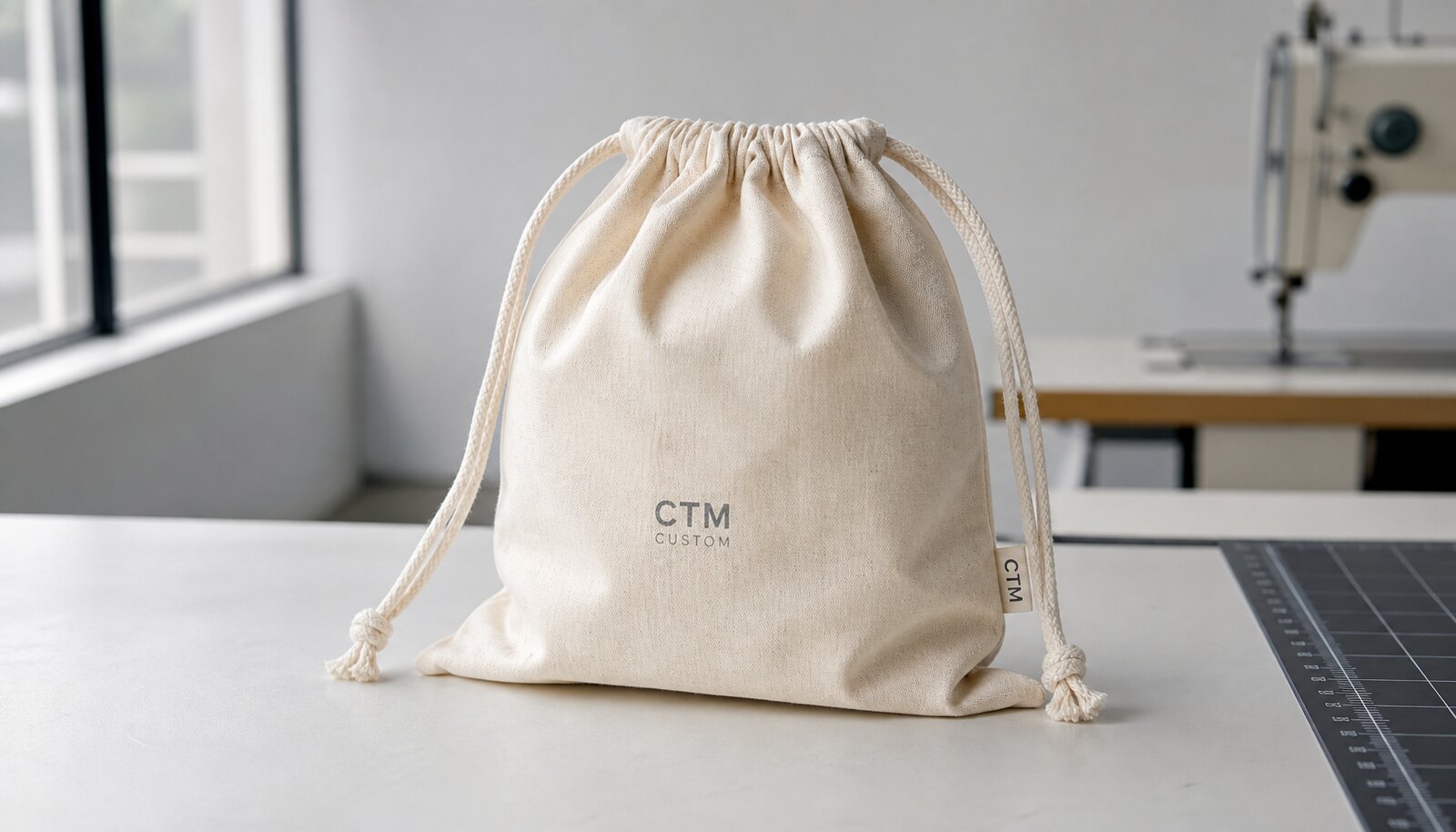
Define the pouch before you discuss decoration
Most quote problems start with a vague brief. A custom drawstring pouch is not just a logo surface; it is a small sewn product with a use case, a fill weight, a closure requirement, and a packing method. If the buyer only sends artwork and a target price, the factory will fill in the blanks with assumptions, and those assumptions are usually what cause the gap between sample approval and bulk production. Start with the commercial purpose. A pouch for cosmetics, retail accessories, seed packets, event giveaways, or premium gift presentation all need different fabric weights, cord types, and finishing levels.
The best RFQ gives the factory enough detail to price the real product, not a guess. Finished size should be stated in use terms, for example 10 x 15 cm or 15 x 20 cm, and you should say whether the pouch needs to hold a flat insert, a rounded item, or a loose bundle. If the pouch must stand up better on a shelf, add a gusset. If it is only protecting a product inside a carton, a simpler flat style may be enough. The shape decision drives fabric consumption, sewing time, and final appearance more than most buyers expect.
- State the end use and the fill item, not only the dimensions.
- Call out whether a gusset, lining, or reinforced top hem is required.
- Define the cord closure style: single draw, double draw, or braided loop.
Choose fabric weight for the job, not for the spreadsheet
Fabric selection should follow handling risk and brand position. For light promotional use, many buyers land around 120-160 GSM cotton drill or a comparable plain weave. That range keeps cost and bulk under control while still feeling more substantial than a thin synthetic bag. For retail packs or premium gifts, 180-240 GSM is a more credible range because the pouch holds shape better, hides contents more cleanly, and usually tolerates repeated opening and closing. Very light fabric can look acceptable in a quote but disappointing in hand, especially if the buyer expects the pouch to carry jewelry, skincare, or a small accessory kit.
The fabric decision also changes how the bag sews and prints. Heavier cotton needs cleaner seam allowances, better needle control, and more accurate cutting because the edges stack up faster at the hem and side seams. Natural fibers can also shrink, so the factory needs to know whether the fabric is pre-shrunk, washed, or left raw. If your bag will sit inside a larger kit, a slightly lighter fabric may be enough. If it will be sold as a standalone item, choose the weight that supports the shelf appearance first, then optimize the cost.
- 120-160 GSM: suitable for giveaways, sample kits, and low-cost inserts.
- 180-240 GSM: better for retail, gifting, and repeated handling.
- Ask whether the fabric is pre-shrunk and what shrinkage the factory prices against.
Decoration method should match artwork complexity and unit value
The print method matters as much as the pouch material. Simple one- or two-color screen print is usually the cleanest choice for natural cotton pouches because it keeps setup manageable and gives a strong logo presence. When the artwork has fine details, gradients, or many colors, heat transfer can reproduce more of the design, but it needs tighter control on film quality, press temperature, and wash performance. Embroidery feels premium on thicker fabrics, but on a small pouch it can distort the weave or become too heavy if the logo is large. Woven labels and sewn patches often work better when the pouch needs a finished retail feel without heavy print coverage.
Do not let decoration choices drift into a generic yes-to-everything quote. Ask the supplier to price each artwork version separately, because a front print, a back print, and a woven side label are three different cost structures. Also specify the print area in millimeters, not just in words like large or centered. Placement on a small pouch is sensitive to seam location and cord entry points. If the artwork crosses a seam, ask the factory to confirm whether it can be printed before sewing or after assembly, because that changes both alignment risk and visible result.
- Screen print works best for bold logos and repeat orders.
- Heat transfer suits detailed art but needs a durability check.
- Embroidery and woven labels work when the pouch is a retail item, not just a giveaway.
Make MOQ and pricing logic explicit in the RFQ
A clean unit price means more when the MOQ logic is visible. Custom drawstring pouch quotes often look similar until you separate the real drivers: fabric GSM, cut size, cord type, print colors, label type, packing method, and order quantity. A factory may quote a very competitive number on 5,000 pieces because the setup costs are spread efficiently, while a small order of 500 pieces can carry a much higher per-unit labor burden. If you ask only for a single price, you will not know whether the quote includes all colors, whether the packing is retail-ready, or whether the factory is assuming a simpler construction than you want.
The right way to compare quotes is to force them onto the same assumptions. Ask for the base bag price, decoration charge, packaging charge, and any special handling such as individual polybags, barcode labels, or assorted sizes. If you are managing a brand launch, it is also worth asking what happens when you split one order into two print versions. Some factories will keep the same price only if the total volume stays within a production run; others will add a setup charge per design. That detail matters more than a small unit-price difference.
- Compare price by size, fabric, print colors, and packaging, not just by piece count.
- Ask whether the MOQ is per style, per color, or per artwork version.
- Separate standard bulk packing from retail-ready packing in the quote.
Use supplier route comparisons before you chase the lowest quote
Many buyers compare factories too early. The more useful first question is which sourcing route matches the order risk. A direct factory makes sense when you need repeat control over size, print, and sewing details. A trading company can help when the order needs multiple product types or when your internal team wants one consolidated contact. A stock pouch decorated locally can work for short campaigns, but it usually limits fabric choice and construction control. If the pouch is going into retail, the route must support consistent size, color, and label placement, not just a low headline price.
Use the supplier route as a filter before you negotiate. If the order needs a custom cord color, a woven side label, and printed carton marks, a low-cost stock route may create more risk than savings. If you only need 1,000 pieces for an event and the delivery window is tight, a local decorator or regional converter may be more practical even if the unit price is higher. What matters is whether the supplier can actually meet the commercial promise you need downstream: stable artwork, stable packing, and stable lead time.
- Choose the route that matches your risk, not the route with the smallest quoted number.
- If your spec includes labels, barcode packing, and carton marking, verify the supplier controls those steps in-house.
- For repeat programs, prioritize consistency and documentation over one-off speed.
Treat samples as production controls, not souvenirs
A sample is only useful if it locks the production decisions. The first sample should confirm fabric handfeel, finished size, cord movement, and the visual balance of the logo on the bag. The pre-production sample is the important one because it should reflect the approved fabric batch, approved artwork, and approved packing method. If the sample arrives with a different cord, a different fabric shade, or a cleaner print than the bulk line can actually hold, the sample becomes a false reference. The factory should keep one sealed golden sample as the benchmark for production and final inspection.
Set acceptance criteria in practical terms. Measure the finished dimensions, not just the cut size. Check stitch security at the hem, cord exit points, and side seams. Make sure the pouch closes evenly and the logo lands where the buyer approved it. If the pouch is for retail, inspect the sample inside its final packing so you can see how the product presents in carton and on shelf. The best time to catch a mistake is before the first bulk fabric cut, not after the factory has already loaded the sewing line.
- Approve a blank sample if you need to confirm size and structure first.
- Approve a decorated pre-production sample before bulk sewing starts.
- Keep one sealed golden sample for inline and final inspection reference.
Set QC thresholds that a factory can actually inspect against
Quality control for drawstring pouches should be measurable. A buyer does not need a 20-page inspection manual, but the factory does need tolerance points that remove ambiguity. Set acceptable size variance, print placement tolerance, thread cleanliness, and closure function before production starts. If the bag is meant for retail, the standard should be stricter than if it is a free giveaway. Natural cotton also needs a realistic color expectation because shade variation is normal across batches unless the supplier controls dye lots tightly. If you do not define this, the buyer may call normal variation a defect and the factory may call it acceptable stock behavior.
Practical QC also means testing how the pouch behaves in use. Pull the drawcord repeatedly, check whether the seam opens under tension, and verify that the print does not crack or bleed when folded. If the pouch will carry heavier inserts, use a simple load test on samples before mass production. For orders that need consistency across a long campaign, inspect the first bulk cartons early rather than waiting until the entire run is complete. This lets the supplier correct a sewing drift, a label shift, or a print alignment issue before the problem becomes volume loss.
- Set size tolerance, print placement tolerance, and stitch quality in writing.
- Use a simple pull test and closure test for every sample approval.
- Define what color variation is acceptable before fabric is cut.
Packing affects retail readiness, warehouse speed, and freight cost
Packing is not an afterthought on small textile products. A custom drawstring pouch can be shipped in bulk, individually polybagged, barcoded, or assembled into an inner pack, and each choice changes labor, carton count, and warehouse handling. Bulk packed is cheapest, but it may not suit retail distribution or fulfillment centers that need scan-ready units. If the pouch is part of a gift set, ask the factory to pack to the exact count needed for the outer carton or master set so the receiving team does not have to split bundles on arrival. The wrong pack plan often creates more cost at the warehouse than it saved in the factory.
Ask for carton dimensions, gross weight, and pack count before you approve the order. Those numbers determine the container cube, pallet pattern, and freight plan. If the order travels by sea, overpacked cartons can add unnecessary freight volume. If it travels by air, even small differences in carton size can change the rate bucket. Label placement matters too. If the customer warehouse relies on barcode scanning, a readable label and clean carton mark are part of product quality, not just logistics detail.
- Bulk pack for the lowest factory cost.
- Individual polybags or barcodes for retail and warehouse receiving.
- Lock carton size and pack count before freight booking.
Plan the schedule around approvals, not just sewing time
Lead time on custom drawstring pouches is usually lost in approval steps, not in sewing. Fabric booking, print setup, sample approval, and packing confirmation all need time, especially when the order includes a new logo or a custom label. A factory may be able to sew quickly once the line is ready, but late artwork changes or delayed sample signoff can push the whole program out. Buyers who build a realistic calendar usually get fewer surprises than buyers who only ask for a production lead time and ignore the approval chain.
The schedule also needs buffer for raw material variability. If the order needs a specific cord color, a custom dyed fabric, or a special woven label, those items may have a separate lead time from the sewing line. If the order is seasonal, assume the factory will be managing several jobs at once and make sure your approval deadline is firm. A good sourcing workflow is to freeze the technical details first, approve the sample second, and only then confirm the bulk shipping window. That sequence avoids paying for rush air freight because an artwork or packing decision moved too late.
- Build time for sample review, corrections, and final approval.
- Separate material lead time from sewing lead time.
- Use a fixed signoff date to protect the ship date.
Compare landed cost before you close the order
A useful quote is a landed-cost quote. Unit price alone hides too much. Two suppliers can both quote a similar bag price while one includes simpler packing, slower dispatch, or less precise QC, and the other includes better carton control and a lower risk of rework. Buyers should compare the full picture: piece price, decoration, packing, cartonization, inland freight, inspection cost, duty exposure, and the shipping mode. If you are importing, even a small difference in pack size or carton cube can change freight cost enough to wipe out a unit-price saving.
The cleanest comparison sheet is built from the same assumptions across all suppliers. Put the same size, the same GSM, the same print method, the same label requirement, the same pack count, and the same delivery term in every RFQ. Then compare what the supplier actually included, not what you had to infer. This approach helps procurement teams avoid the common mistake of choosing the lowest ex-factory number and later discovering that the true landed cost is higher because the quote excluded essentials. For recurring programs, it is worth asking the factory to price a base version and an upgraded version side by side so the business can see exactly what better packing or stronger fabric costs.
- Compare ex-factory, packing, freight, duty, and inspection together.
- Use one specification sheet across all suppliers.
- Ask for a base version and an upgraded version if the program may scale.
Specification comparison for buyers
| Spec decision | Recommended option | When it fits | Buyer risk to check |
|---|---|---|---|
| Source route | Direct factory with bag-specific sewing lines | You need custom size, print, cord, and label control in one order | Confirm the factory really makes drawstring pouches, not only tote bags or outsourced packs |
| Source route | Trading company with factory backing | You need multiple product types in one shipment or want one point of contact | Check who owns the toolings, approvals, and quality decisions |
| Source route | Stock pouch with decoration applied locally | You need low MOQ, fast launch, or a short campaign run | Risk of limited size choice, weaker fabric consistency, and print placement limits |
| Fabric route | Cotton drill or plain weave around 140-180 GSM | Light promotional use, cosmetics, jewelry, samples, or event packs | Too light can look thin and wrinkle badly; too heavy can raise cost without adding value |
| Fabric route | Canvas or heavier cotton around 180-240 GSM | Retail sell-through, premium gifting, or repeated handling | Watch shrinkage, seam bulk, and higher freight weight |
| Decoration route | Single- or two-color screen print | Simple logo, large solid artwork, and repeat orders | Ask for registration tolerance and confirm ink opacity on natural cotton |
| Decoration route | Woven label or sewn patch plus small print | Brand-led packaging where the pouch must feel more finished | Verify label placement, seam allowance, and whether the label adds labor cost |
| Commercial route | Factory packs to your barcode and carton spec | Retail distribution, Amazon-style logistics, or warehouse receiving controls | Check carton cube, inner pack count, and master carton strength before approval |
Buyer checklist before sampling
- Define the end use first: giveaway, retail packaging, sample bag, travel pouch, or gift insert
- Lock finished size, not flat cut size, and note whether the pouch needs a gusset
- State fabric composition and target GSM, including any recycled or organic claim wording
- Specify cord type, cord diameter, cord color, and whether ends must be knotted, heat-sealed, or capped
- Provide artwork in vector format and define print size, print location, and Pantone references where relevant
- Decide if you need a woven label, side label, hangtag, barcode sticker, or care label
- Ask for a pre-production sample and a sealed golden sample before bulk production
- Confirm packing method, inner pack quantity, carton markings, and carton drop requirements
- Request the factory’s standard lead time plus the time needed for sample approval and raw material booking
- Compare landed cost, not only unit price, including packing, inland freight, duty, and inspection
Factory quote questions to send
- What finished size, seam allowance, and fabric cut size are you pricing?
- What GSM, weave, and shrinkage assumption are you using for the quoted fabric?
- Is the quoted price based on screen print, heat transfer, embroidery, or label only?
- How many print colors are included, and what is the setup charge per color or location?
- What is the MOQ per size and per artwork version?
- What packing is included: bulk packed, individual polybagged, barcoded, or retail-ready?
- What are the sample lead time, bulk lead time, and approval cutoff date?
- Which tolerance do you apply for size, print placement, color variance, and stitch defects?
- What carton size, carton quantity, and gross weight are you planning for this order?
- What documents can you provide with the shipment: packing list, invoice, and origin or material declarations if needed?
Quality-control points to confirm
- Finished dimensions should match the approved tech pack within the agreed tolerance, usually tighter on retail orders than on promotional orders
- Top hem and side seams should be straight, even, and secure with no skipped stitches, loose thread bundles, or seam puckering that affects closure
- Cord length and draw action should be symmetrical, with both ends closing the pouch evenly and no excessive fraying at the ends
- Print registration should stay within the approved position, with no major off-center logo, cracking, or bleed-through on the back side
- Fabric shade should sit within the approved batch standard, especially when natural cotton, recycled cotton, or dyed cord are involved
- Labelling should be secure and legible, with barcode or size stickers placed consistently if the pouch goes into retail or warehouse flow
- Cartons should carry the correct SKU, quantity, and gross weight, and should not collapse or open during normal handling
- If the pouch is for reuse or wash cycles, perform a practical wash and abrasion check on sample pieces before authorizing mass production