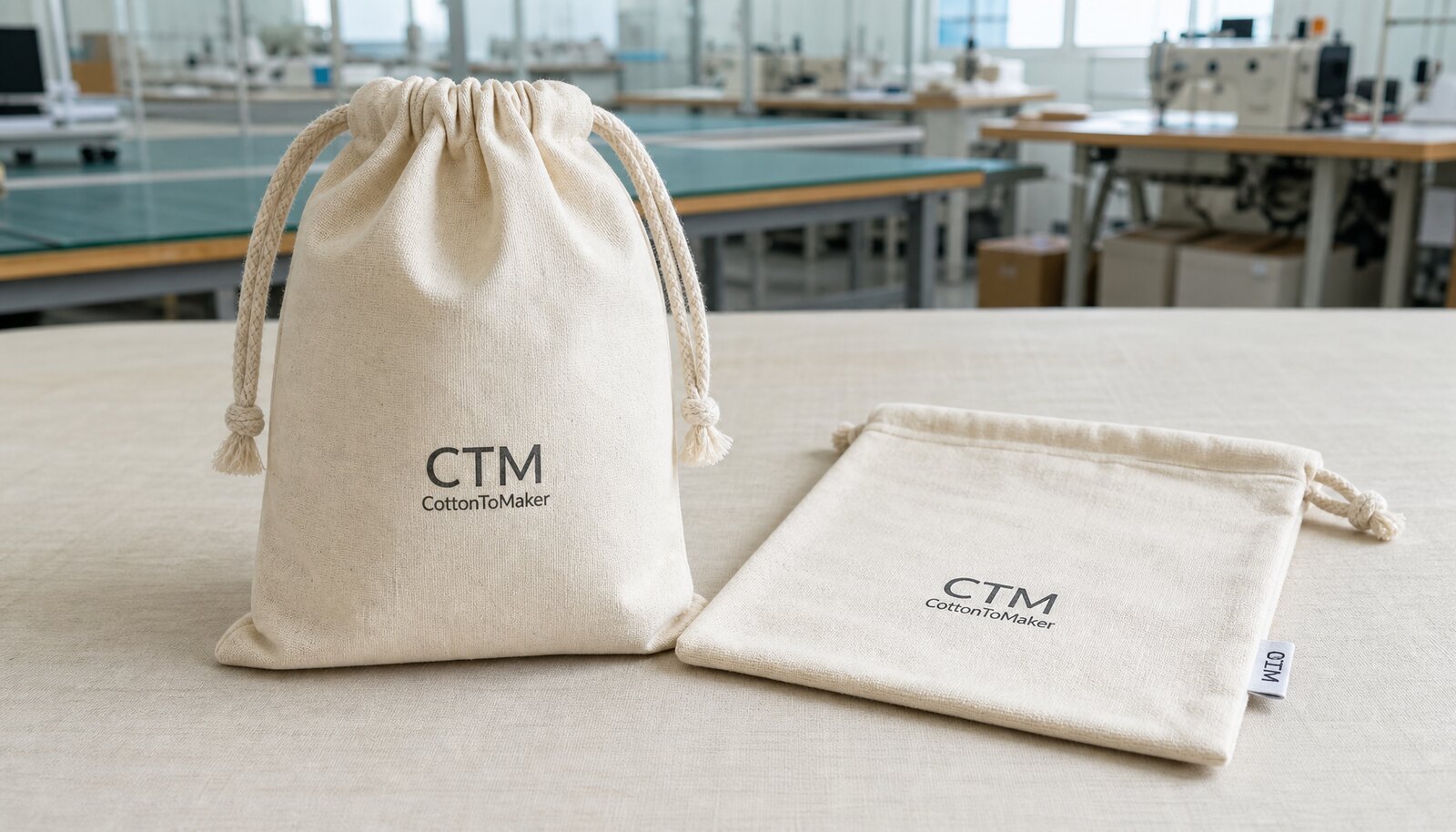
Why simple-looking pouches create difficult sourcing decisions
A custom drawstring pouch with logo looks straightforward until procurement has to compare quotes. On paper, it is only a small fabric bag with a cord and a printed mark. In practice, the pouch combines textile choice, sewing quality, decoration method, and packing decisions that all change price and performance. If any one of those elements is left vague, the supplier will fill in the gap with its own assumptions, and the buyer will receive a quote that is difficult to compare with other offers.
This is why some pouch programs fail at the quote stage. Buyers often send a logo file, a target price, and a rough size idea, then expect the supplier to “work out the details.” That approach makes the sourcing process look fast, but it hides the real buying decision. The correct method is to define the product from the inside out: what the pouch will carry, how often it will be opened, what the brand wants customers to notice first, and how much variation the business can tolerate in bulk.
The sourcing risk is not only decorative. A poor pouch spec can produce seam puckering, weak cord channels, print bleed-through, and packaging inefficiency. It can also create rework at the warehouse if the pouch is too small for the intended insert or too thin for repeated handling. For procurement teams, the job is to control those outcomes before the first production run starts, not after cartons arrive.
Start with use case, fill weight, and brand expectation
The right pouch structure depends on what it has to contain. A jewelry pouch, a cosmetic pouch, a small electronics accessory pouch, and a corporate gifting pouch all create different requirements for size, stiffness, opening width, and closure feel. A pouch that only holds a lightweight insert can be made from thinner cotton. A pouch that carries a bottle, a kit, or a set of boxed items needs more body, stronger seams, and a cord channel that does not distort when pulled.
For procurement buyers, finished size is more useful than flat-cut size. Flat-cut dimensions can be deceptive because the finished opening, seam allowance, and filling behavior determine whether the pouch actually works in use. A pouch may technically match a cut spec and still be awkward to pack if the opening is too narrow or if the usable depth is reduced by a bulky seam allowance. For that reason, always ask suppliers to quote finished dimensions and not only raw panel dimensions.
Use-case planning should also include presentation. If the pouch is part of retail packaging, the brand may want the logo centered, crisp, and visible even after the pouch is cinched. If the pouch is a giveaway or promotional insert, the priority may shift toward cost control and simple production repeatability. The quote should reflect that difference. A premium pouch can justify heavier fabric, cleaner stitching, and better print control; a promo pouch should be designed for efficient production and consistent fulfillment rather than luxury handfeel.
Fabric weight, weave, and finish shape the quote more than many buyers expect
Fabric is often the largest single cost driver after labor. Cotton is common because it prints well and feels familiar to buyers, but not all cotton is sourced or finished the same way. Natural cotton, bleached cotton, dyed cotton, and recycled cotton each behave differently in sewing and decoration. Natural fabric typically carries a more rustic look and can be the most economical. Bleached or dyed fabric adds process cost and may require better color consistency. Recycled or blended yarn can support a sustainability story, but the supplier should be able to explain what the recycled content is, how it affects surface texture, and whether print clarity changes on the finished cloth.
GSM matters, but it should not be treated as the only fabric decision. A 100–130 GSM pouch can work for light promotional use, but it may show more seam distortion, wrinkle easily, and allow print show-through if the logo is large or saturated. A 140–180 GSM pouch usually gives a better premium feel and is often the safer range for retail-facing programs, especially when the item inside has some weight. If the pouch is intended for repeated reuse, it is usually better to specify a slightly heavier cloth than to save a few cents and risk a bag that feels flimsy in hand.
The finish affects performance and not just appearance. Prewashed, heat-set, or tightly woven fabric can reduce shrinkage surprises and improve consistency from sample to bulk. If the pouch is going to be used in a brand kit or shipped long distance, ask whether the fabric has been stabilized before cutting. That question matters because a pouch that looks correct at approval can shrink slightly, skew at the seams, or relax after handling if the cloth was never stabilized. For a buyer, the important point is simple: quote fabric by composition, GSM, finish, and color state, not by a generic name alone.
Sizing, seam allowance, and stitch details need tighter control
Many pouch disputes come from dimensional ambiguity. A supplier may quote a pouch based on cut size while the buyer imagines the finished size. Because drawstring pouches are built from folded panels with side seams and a top channel, even a small difference in seam allowance can change usable width, opening size, and carton fit. A 5–10 mm shift may sound minor, but it can alter how easily a product inserts, how straight the logo appears, and how many units fit in a master carton.
The buyer should ask for three dimensions at minimum: finished width, finished height, and opening width or usable internal space. If the pouch is for a rigid or semi-rigid item, the internal measurement is especially important because the external size does not tell you whether the item will fit comfortably. It is also worth defining the acceptable tolerance band separately for each dimension. For example, width tolerance may need to be tighter than height if the pouch must stack neatly or align with a printed label.
Stitch construction deserves equal attention. The top hem should be wide enough to form a stable cord channel without collapsing. For a pouch that will be opened repeatedly, ask whether the factory uses single or double channel stitching and whether the ends of the channel are reinforced. Side seams should be inspected for stitch density and symmetry, especially on the left and right side where the pouch may lean if one seam is weaker than the other. If the pouch carries any real weight, specify a stronger seam construction rather than assuming standard stitching will be enough.
Cord, closure, and handling feel can change the buying outcome
The cord is a small part of the pouch, but it affects the first impression immediately. Buyers should specify cord material, thickness, length, and whether the cord is one continuous loop or two separate cords. A cord that is too thin can look inexpensive and may cut into the channel under load. A cord that is too thick can make cinching difficult or distort the top hem. The best choice depends on fill weight and the image the brand wants to project.
For lighter pouches, a standard cotton cord is often enough. For heavier or repeatedly used pouches, buyers may want a slightly thicker cord or a double-cord setup so the closure slides evenly and distributes stress more smoothly. If the pouch will carry products through shipping or retail handling, the cord ends should be finished so they do not fray or snag. In some builds, the factory will tie knots or heat-seal the ends depending on cord material. That detail should be included in the spec because it affects both appearance and long-term function.
The closing action should be tested on an actual filled pouch. Buyers should not approve a cord system from a flat sample alone. The pouch should cinch evenly, close without twisting, and remain usable when opened multiple times. If the closure fights against the top seam or folds the fabric awkwardly, the construction is not working as intended. This is one of the easiest problems to catch in sampling, and one of the most irritating to correct after mass production has already started.
Logo decoration: choose the process that fits artwork and volume
For most branded pouch programs, screen printing remains the most practical route because it handles simple artwork efficiently and usually gives a good balance between cost and appearance. It is best suited to one- or two-color logos with clear linework and limited detail. Buyers should still confirm the print size, position, ink opacity, and curing process. On darker fabric, a weak print can disappear into the cloth or look uneven after handling.
When the artwork contains tiny text, gradients, or a more complex mark, another decoration route may be proposed. Heat transfer or digital transfer can help short runs, but the buyer should confirm whether the chosen process has been tested on the actual pouch fabric. Not every transfer behaves the same on textured cotton. If the design is expected to be rubbed, folded, or packed tightly, the supplier should explain how it checks adhesion and abrasion resistance. Otherwise the logo may look fine on arrival and then fail quickly in use.
Embroidery can produce a premium effect, but it is a different product decision rather than a simple decoration change. It can add thickness, slow production, and increase cost, especially if the logo has dense stitching or small details. Woven labels and sewn side labels are better as secondary branding elements or when the front face needs to stay visually clean. In RFQs, the decoration method must be fixed before quote comparison. If one supplier uses screen print and another quietly prices transfer decoration, the numbers are not directly comparable.
A comparison of sourcing routes should include more than unit price
Procurement teams often ask which supplier type is cheapest, but the better question is which route gives the best control over the product you actually need. A factory-direct order can offer the cleanest path when the buyer wants stable size, confirmed materials, and repeat production. The downside is that the factory normally expects a clearer spec and may be less flexible on small, constantly changing orders. A trading company can make quoting easier and sometimes helps with mixed programs, but the buyer may lose visibility into who actually sews, prints, and packs the pouches.
The real sourcing choice depends on order pattern. If the program will repeat and the brand wants consistency, factory-direct sourcing usually gives better cost clarity and better access to production proof. If the buyer needs a low-quantity test or a mixed assortment, a trading route or stock-fabric route may be acceptable. What matters is that the supplier can prove what will happen in bulk, not only what looked good in a sales message.
What to request from suppliers before you award the order
A useful quote should read like a production summary, not a promotional reply. The supplier should identify the fabric composition, GSM, pouch dimensions, print method, color count, packing format, MOQ, sample cost, and lead time. If these items are not stated clearly, the buyer cannot know which costs are included and which are hidden in the background. This is especially important when comparing two factories that may be using different fabric sources or different finishing assumptions.
The best way to reduce ambiguity is to ask for itemized pricing. Separate the cost of the blank pouch, decoration, packing, labels, and any sample or setup charges. Ask the supplier to state whether the price is EXW, FOB, or another incoterm, and whether inland trucking, export documents, tax, or freight are included. Once the quote is broken apart, procurement can see whether a low unit price is actually a stronger offer or just a partially described one.
Verification is just as important as pricing. For an order that matters to the brand, ask for factory photos of the sewing area, printing area, and packing or warehouse area. Request a recent inspection report if one is available. Ask for the carton dimensions and gross weight so freight can be estimated early. If the supplier says the pouch is made in-house, ask for proof of the production stage that matters most to your risk profile, whether that is sewing, printing, or final packing. A serious supplier should not struggle to provide those basics.
Sampling should prove the real build, not just the artwork
A sample is only useful if it represents bulk production accurately. A photo sample can help align artwork and logo placement, but it does not prove the fabric handfeel, seam quality, cord behavior, or print opacity. For procurement decisions, the most valuable sample is a pre-production sample made with the same material, stitch construction, cord, and decoration method intended for the full order. That sample becomes the reference for bulk inspection.
The buyer should review the sample the way the product will actually be used. Fill the pouch with a realistic item, cinch it several times, and check whether the logo stays centered and readable. Make sure the opening is wide enough for easy packing but not so loose that the pouch loses shape. If the pouch is part of a kit, test it with the exact insert or an equivalent item. A pouch that looks perfect when empty can behave very differently once it is filled.
Document the sample review properly. Photograph front, back, side seam, cord channel, and a close-up of the logo. Write down any approved variation in color, stitch appearance, or print placement so the production team has a clear reference. If the supplier needs changes after sample review, make those changes before production release. Small changes after approval often trigger delays because the factory has to re-cut, reprint, or re-balance the batch.
QC should focus on the defects that actually affect use
For drawstring pouch programs, the main bulk defects are usually predictable: wrong size, misprint, loose thread, weak cord channel, stain, and shade variation. The buyer should define which of these are unacceptable, which are minor, and which can be reworked. Without that line, a supplier may ship cartons that technically pass their own inspection but still create sorting labor in the warehouse. A clear defect definition protects both sides.
Functional defects should carry more weight than purely cosmetic ones. A slight color shift may be acceptable on a promotional pouch but not on a retail-facing branded item. A loose thread near an inside seam might be tolerable if it does not affect use, but a broken cord channel or off-center logo should be treated as a real issue. The best QC plans distinguish between appearance and function instead of treating all defects as equal.
It also helps to use measurable checks. Inspect finished size across samples and bulk cartons. Confirm seam density at the top hem and stress points. Pull-test the cord and check that both sides cinch evenly without one side locking up. Review print opacity and edge sharpness on the actual fabric color. Open cartons from different points in the lot so hidden variation does not stay buried at the bottom of the shipment. These checks are simple, but they prevent the most common and expensive avoidable rejects.
Specification comparison for buyers
| Sourcing route | Typical order fit | Cost implication | Tradeoff / buyer risk | What to verify before award |
|---|---|---|---|---|
| Factory-direct custom production | Repeat programs, brand packaging, stable sizes and artwork | Best chance of lower unit price at volume, but tooling/setup may be charged separately | Requires clearer specs and usually higher MOQ; less flexibility if artwork keeps changing | Ask for factory photos, sewing line photos, in-house print capability, recent inspection report, and actual carton dimensions |
| Trading company with factory coordination | Mixed-item purchase programs, small tests, buyers needing one point of contact | Convenient quoting, but the trader margin can hide the real production cost structure | Lead times and quality consistency may vary if production is shifted between subcontractors | Request disclosure of the actual factory, sample origin, and who handles sewing, printing, and packing |
| Stock pouch with custom logo applied locally | Very small runs, rapid turn programs, event giveaways | Lower setup burden, but higher per-piece cost and fewer material choices | Limited fabric/color/size options; logo placement may be constrained by stock inventory | Confirm stock availability, decoration method, and whether the base pouch can be re-ordered later |
| Pre-made pouch with woven or printed label added | When branding is secondary to speed or budget | Usually cheaper than full custom construction, but not as brand-specific | Less control over size, fabric, and closure details; branding may feel generic | Check label attachment quality, artwork size, and whether the pouch body color matches your brand system |
| OEM/ODM with custom size, fabric, and print | Retail programs, cosmetics, jewelry, gift sets, subscription boxes | More expensive upfront because every spec is controlled | Highest brand fit, but more time needed for sampling and approval | Lock finished dimensions, GSM, cord spec, print method, and packaging before sample approval |
| Sustainable/recycled-material route | Brands with ESG requirements or sustainability messaging | Can cost more due to yarn/fabric sourcing and tighter quality screening | Recycled content may vary by batch and can affect surface finish or print opacity | Request material declaration, recycled-content evidence, and print test on the exact fabric |
| Short-run digital decoration route | Artwork with gradients, small texts, or many colors | Lower setup cost for short runs, but unit price can be higher than screen print | Not every digital process holds up equally on textured cotton; rub resistance can vary | Ask for adhesion, wash, and rub-test method used on the actual pouch material |
| Bulk-pack fulfillment route | E-commerce, kitting, warehouse distribution | Packing is optimized for freight, though extra handling details can add labor cost | Bulk cartons may scuff printed surfaces or require sorting on receipt | Confirm inner pack, carton count, carton dimensions, and outer protection requirements |
Buyer checklist before sampling
- Finished pouch size, not only cut size; include acceptable tolerance for length and width
- Fabric type, composition, and GSM, including whether the fabric is natural, bleached, dyed, recycled, or prewashed
- Cord specification: material, thickness, length, knotting method, and whether one or two cords are used
- Top hem and seam construction: single or double channel, stitch type, stitch density, and reinforcement at stress points
- Artwork file in vector format, plus PMS/Pantone or other color references if color accuracy matters
- Print method, print size, print position, number of colors, and acceptable registration tolerance
- Logo durability requirements: rub resistance, adhesion, and whether the pouch will be handled repeatedly
- Sample approval method: photo approval, courier sample, or pre-production sample made from bulk materials
- Packing format, inner pack count, carton count, barcode/label placement, and any retail-ready requirements
- Target order quantity, forecast for reorders, required delivery window, and destination incoterm
Factory quote questions to send
- Please quote with the finished pouch size, fabric GSM, cord specification, print method, and packing format listed separately.
- What is your MOQ by size, fabric weight, and print color count?
- Is the sample made with the same fabric, stitching, cord, and printing process as bulk production?
- What finished-size tolerance do you hold for length, width, and opening width?
- What tolerance do you allow for print placement and color variation?
- Can you provide carton dimensions, pieces per carton, gross weight, and the packing ratio?
- Please separate the quote into unit price, sample cost, setup cost, packing cost, and any label or barcode charges.
- Which parts are produced in-house, and which parts are subcontracted: sewing, printing, embroidery, labeling, or final packing?
- Can you send factory photos of the sewing line, printing area, and warehouse or packing area?
- What test method do you use for stitching strength, cord pull, and print adhesion on this material?
Quality-control points to confirm
- Measure finished size on pre-production samples and on random bulk cartons; compare against the approved tolerance rather than the flat-cut dimension.
- Check seam density, top hem width, and reinforcement where the cord channel bears tension.
- Inspect cord movement on both sides of the pouch to confirm smooth cinching without twisting, snagging, or uneven closing.
- Verify print opacity, edge sharpness, and color placement on the actual fabric color, not only on a white proof sheet.
- Run a basic rub check on the printed area if the pouch will be handled, stacked, or shipped inside retail kits.
- Open cartons from the top, middle, and bottom of the lot to catch shade, print, or stitching variation across production runs.
- Confirm carton count, barcode placement, and any insert sheets or packing slips before shipment.
- Record defect types separately: misprint, loose thread, skipped stitch, seam gap, stain, size out of tolerance, cord fault, or packing error.
- Review whether the pouch stands or collapses as expected when filled with the intended product weight.
- If the pouch is for retail, verify that the front logo remains centered and readable after filling and tying.