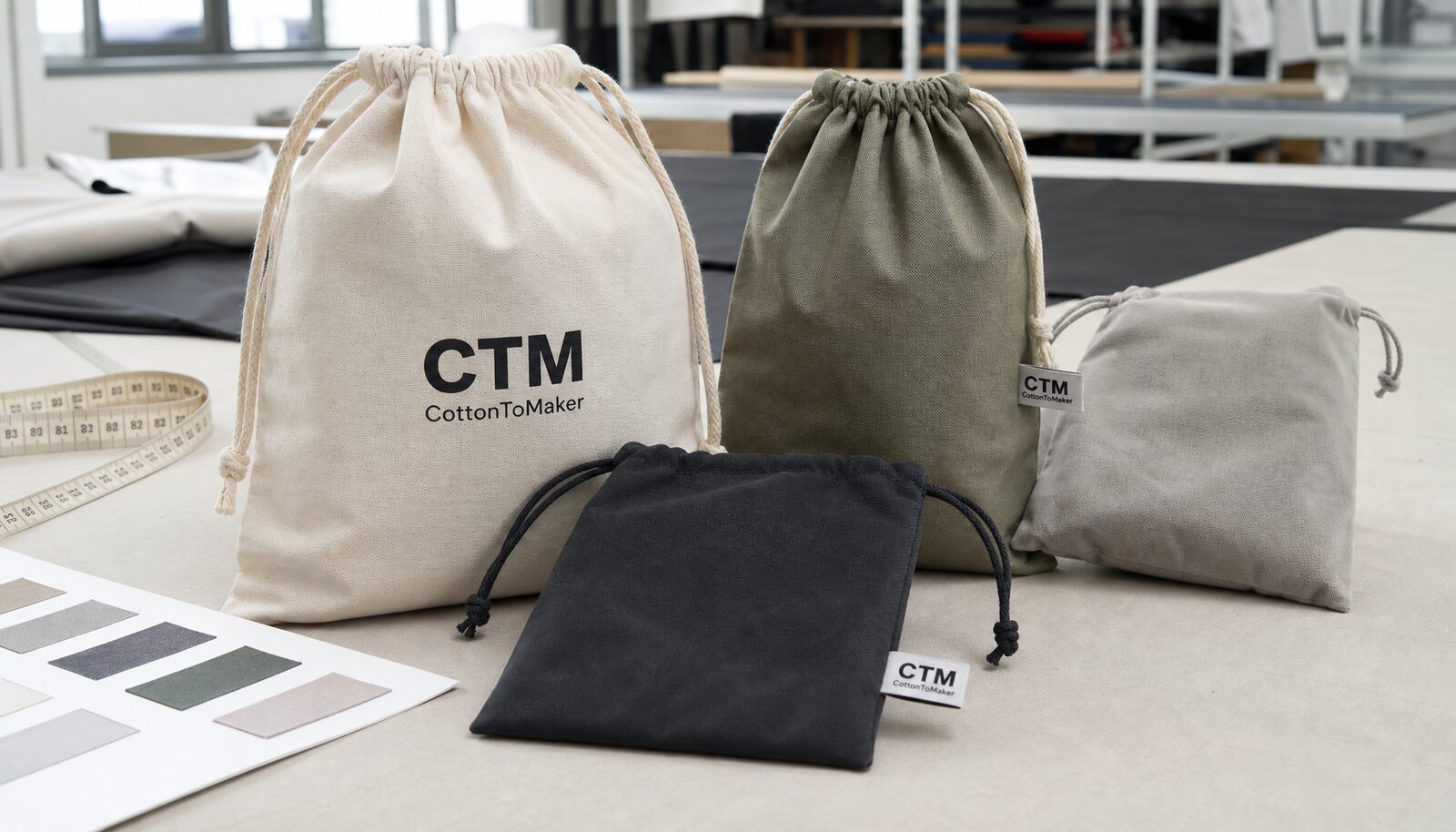
1. Start with the commercial job of the pouch, not the word “custom”
A custom drawstring pouch can serve very different jobs in a supply chain, and the right specification depends on which job matters most. A jewelry brand may need a pouch that feels premium in the hand and protects delicate surfaces. A tea or coffee company may care more about print readability, closure reliability, and shelf appearance. A distributor ordering for a trade show may need the lowest possible unit cost while still avoiding obvious defects that would hurt the brand on arrival. If you begin with “custom drawstring pouch” and stop there, suppliers will fill in the blanks with their default fabric, default cord, and default print process. That is usually where quote gaps and sample disputes begin.
The right way to brief suppliers is to describe the pouch as a functional component in the buying process. Is it packaging that will be discarded quickly, or part of the perceived product value? Will it hold a rigid item, a loose refill, a multi-piece kit, or a soft accessory? Does the pouch need to survive warehouse handling, repeated consumer opening, or light washing? These answers determine whether you optimize for cost, hand feel, abrasion resistance, print clarity, moisture resistance, or presentation. The more concrete the use case, the more comparable the quotes become.
- Examples of procurement use cases: jewelry inserts, cosmetics, tea and coffee packs, apparel accessories, samples, hotel amenities, event kits, and premium gift packaging.
- Commercial priorities to rank explicitly: lowest landed cost, premium appearance, repeated reuse, dust protection, moisture control, shelf presentation, or pack-out speed.
- If the pouch is only a product insert, fit and packing efficiency usually matter more than decorative upgrades.
- If the pouch is customer-facing, finish quality, logo clarity, and material hand feel usually matter more than shaving a small amount off the unit price.
2. Choose fabric by end use, not by habit
Fabric is the single biggest lever on perceived quality, but it should not be chosen only because it is familiar. Cotton is a common default for a custom drawstring pouch because it offers a natural look, prints well, and is easy for buyers to explain to end users. A mid-range cotton spec around 120–140 gsm is often practical for general promotional use or light retail packaging. If the pouch must look more structured or support heavier contents, many buyers move to 180–220 gsm canvas, which usually improves body and abrasion resistance. That upgrade often improves shelf presentation, but it also raises material cost, changes the way the pouch folds, and may reduce the effective opening if the spec is not adjusted.
Synthetic fabrics can be the better commercial choice when the business case requires moisture resistance, lower lint, or a lighter finished weight. Polyester and microfiber may look neat and offer efficient packing, but they need to be validated for print adhesion, seam behavior, and the way they handle heat or friction. In other words, the right fabric is not the one that sounds most premium in a catalog. It is the one that matches your risk profile in the warehouse, at the point of sale, and in the hands of the customer. For natural-branding programs, also specify whether the fabric is bleached, unbleached, recycled, dyed, or piece-dyed, because those choices affect both the look and the supplier’s ability to keep shade consistent across lots.
- Cotton is usually the safest default when you want a natural look and easy decoration.
- Canvas is often the better option when the pouch must feel sturdier or be reused more often.
- Polyester or microfiber can be justified when moisture resistance, low lint, or lower weight matters more than a natural fiber story.
- Ask for the fabric mill, GSM, weave type, and color standard; do not let “cotton” or “canvas” stand alone as a full specification.
3. Size, opening, and cord details determine whether the pouch actually works
Many sourcing problems start with a size misunderstanding. Buyers often think in terms of the item that must fit inside, while suppliers think in terms of flat cut dimensions and seam allowances. For a custom drawstring pouch, you should specify the finished internal-use size and the actual object it must carry. If the pouch is meant to hold a rigid box, a bottle, a tea tin, or a set of accessories, the inside dimensions need enough clearance for insertion and closure without stretching the fabric or distorting the channel. A pouch that is technically large enough on paper can still be awkward to pack if the opening is too narrow or the top edge deforms when the cord is pulled.
Cord design matters as much as size. Round cotton cord gives a softer, more natural appearance, while round polyester cord can reduce cost and improve consistency. Flat cord may feel more comfortable in the hand, but it can behave differently in the channel and may not suit every sewing method. Buyers should ask the factory to confirm cord diameter, total cord length, end finish, knot style, and how the cord is retained at the top opening. On heavier pouches, ask for reinforcement at the cord exit points and side seams so repeated pulling does not distort the top edge. A practical specification should also state whether the pouch must close fully around the contents or only gather loosely for presentation.
- Define finished size and intended contents together; do not rely on one without the other.
- Ask whether the quote is for cut size or finished size, and require a dimension drawing in the quotation file.
- Specify cord type, cord diameter, cord length, and end finish: knot, heat seal, metal tip, or plain cut.
- For heavier or repeated-use applications, require reinforcement at the opening and channel ends.
- If the pouch must sit upright or pack tightly into a carton, ask the supplier to test the shape with the actual product inside.
4. Decoration method should match artwork complexity and procurement volume
Decoration drives brand perception, but it should be chosen with the order profile in mind. For a custom drawstring pouch with a simple logo or one-color mark, screen print is often the most cost-efficient route because setup becomes more attractive as quantity rises. It usually gives strong opacity and clear edges on compatible fabrics, which is why it remains common for promotional and packaging programs. However, screen print is less forgiving when the artwork has many colors, tiny text, or fine registration requirements.
Heat transfer and digital printing are more flexible for short runs, variable artwork, or more complex color graphics. They can be useful when a buyer is testing a new design or needs a smaller first order. The tradeoff is that decoration may be more sensitive to handling, abrasion, or material compatibility, so durability needs to be validated against the actual use case. If the pouch is meant to be reused often or sit in a retail environment, woven labels, embroidered marks, or sewn patches can improve perceived value and long-term appearance. These methods usually cost more and can raise MOQ, but they may reduce the risk of a cheap-looking finish. In procurement terms, the best decoration method is the one that survives the pouch’s real life, not the one that only looks good in a sales photo.
- Screen print: best when the logo is simple, quantity is moderate to high, and cost efficiency matters.
- Digital or heat transfer: better when artwork is complex, color-rich, or the order is small.
- Embroidery, woven labels, or patches: useful when the pouch is part of a premium retail or gift program.
- Always request a measured artwork proof showing exact placement from seam, edge, and centerline references.
- If the logo is critical, ask for a strike-off or printed pre-production sample before approving mass production.
5. MOQ is not one number; it is the sum of several production constraints
Buyers often ask for the MOQ as if it were a single factory rule, but for a custom drawstring pouch it is usually a combination of material, process, and changeover constraints. If the factory already stocks the fabric and cord, uses a standard size, and prints one simple logo on one side, the MOQ can be relatively low. Once the order introduces custom dyeing, special trim, multiple print positions, mixed sizes, or a retail-ready pack, the factory absorbs more setup time and more material risk. The MOQ rises because the internal cost and the chance of leftover material both rise.
The smartest way to reduce MOQ is to simplify the first order without losing the commercial objective. A buyer testing a new product line should usually keep the pouch spec as close to stock as possible: standard fabric, one print color, one print position, and bulk packing. Once sales are proven, the second order can add woven labels, upgraded cord, special size variants, or premium retail presentation. That staged approach is often better than forcing a fully custom build into a tiny pilot order, because the latter can create a misleading unit price and make replenishment difficult later. When the supplier quotes MOQ, ask whether the limit applies to the pouch body, the print version, or the entire color-size-fabric combination. That distinction matters when you plan assortments or seasonal programs.
- Lowest-friction route: stock fabric, standard size, one-side print, and bulk packing.
- MOQ usually increases when you add custom dye, unusual cord, multiple print positions, or retail inserts.
- Ask the supplier to quote the MOQ by SKU, not only as a total order quantity.
- Pilot orders should prioritize a clean sampling path and repeatability over the lowest possible unit price.
6. Read quotes for landed cost, not just headline unit price
A quote for a custom drawstring pouch is only useful if it tells you what is included. The headline unit price rarely tells the full story because the real commercial cost includes setup, sampling, packing, carton loading, and freight assumptions. A low unit price can become the most expensive option if the supplier adds expensive printing charges, insists on separate color set-up fees, or charges heavily for individual packing. Buyers should ask for a quotation that breaks the offer into at least four parts: pouch body cost, decoration cost, packing cost, and shipping or ex-factory assumptions. That makes it easier to compare suppliers who structure their quotes differently.
For B2B procurement, the right comparison is landed cost per sellable pouch in your own channel. If the pouch will ship to a warehouse, you need to know carton dimensions, gross weight, and how many cartons fit into a container or pallet. If the pouch is for retail or e-commerce, you need to know whether the packing method supports barcode labels, insert cards, or shelf-ready presentation. Also ask about reasonable wastage. Some production loss is normal, but if the supplier is vague about trim loss, print misalignment, or packing overage, the quote may be too optimistic. A solid quotation should make assumptions visible so you can see which supplier is truly cheaper after you factor in defects, rework, and logistics.
- Do not compare unit price without checking setup, sampling, packaging, and freight assumptions.
- Ask whether print tooling, plates, or screens are amortized into the price or charged separately.
- Request carton dimensions and gross weight before freight booking.
- If two quotes look close, compare the total cost of usable inventory, not just the invoice line.
7. Supplier route changes the level of control you can realistically expect
The right supplier route depends on how much control you need over the final pouch and how much time you have. Direct factories are usually strongest when the order is repeated, the spec is stable, and the buyer wants tight control over fabric, sewing, decoration, and packing. This route often gives the most direct visibility into where the material is coming from and who is responsible when a defect appears. Trading companies can be practical when the buyer is sourcing several packaging items at once, needs lower coordination effort, or wants a more flexible order structure. Local converters can be valuable for urgent replenishment, fast physical samples, or language and time-zone convenience.
The key procurement issue is accountability. If the company quoting your custom drawstring pouch does not control the fabric, print line, and packing step, it may be harder to resolve defects or replicate the approved sample. Buyers should ask who buys the fabric, who performs the print, who sews the pouch, who packs it, and who signs the final inspection. If the answer is vague, the supplier may still be workable, but the buyer should adjust expectations and build more testing into the schedule. Price is only one part of route selection; predictability, responsiveness, and the ability to hold a spec over time often matter more on repeat programs.
- Direct factory: best for stable specs, repeat orders, and more transparent root-cause investigation.
- Trading company: useful when you want easier communication or multiple product categories under one purchase order.
- Local converter: useful when lead time or sample turnaround is urgent.
- Ask for the name of the actual sewing and printing site, not only the sales office or trading brand.
8. Sample approval should test the real production route, not a representative idea
A sample has value only if it reflects the same route the bulk order will use. For a custom drawstring pouch, the pre-production sample should be made from the same fabric, same cord, same decoration process, and same packing method that will be used in production. If the sample is printed on different fabric or made on a different sewing line, it tells you less than it appears to. Many buyer frustrations come from approving a handsome sample and then discovering that bulk production uses a looser fabric, a different print setup, or a different cord length. The safest sample approval is one that is boringly specific.
A proper sample review should be measured and tactile, not just visual. Check the finished dimensions, the channel opening, the logo placement, the cord movement, and the stitch finish inside and outside the pouch. Open and close the pouch multiple times. Put the intended product inside. Confirm whether the pouch still closes smoothly when filled and whether the top edge twists under normal handling. For larger programs, it is also wise to keep one signed gold sample, one measurement sheet, and one photo set tied to the same version number. That way the sample can function as a production reference, not just as a memory of what the first piece looked like.
- Approve only a pre-production sample made from the same production route as bulk.
- Record version number, date, and measurement sheet on the approval file.
- Test fit with the real contents, not a substitute item.
- Keep one signed gold sample in procurement or quality control for bulk comparison.
- If the supplier offers multiple sample types, ask which one is closest to actual mass production and use that one for approval.
9. Packing, lead time, and inspection should be planned together
Packing is not a minor detail in a pouch program. It affects labor, damage risk, cleanliness, and freight cost. Bulk-packed pouches are generally cheaper and easier to move through the supply chain, which makes them attractive for wholesale or internal distribution. But if the pouch is being sold directly to consumers, bulk packing can create wrinkles, dust contamination, or presentation problems that force additional handling later. Individual polybags, barcode labels, and insert cards add cost, but they may save more than they cost if the final channel requires retail readiness or e-commerce fulfillment. In procurement terms, packing should be chosen for the channel, not left to the factory’s default.
Lead time needs the same discipline. A supplier’s stated production time often excludes sample approval, artwork confirmation, material sourcing, and final inspection. For a new custom drawstring pouch order, the buyer should assume the schedule has at least three layers: pre-production proofing, bulk production, and shipment preparation. Rushing the timeline usually increases the risk of basic failures such as wrong logo placement, mixed cord lengths, incomplete trimming, or carton count errors. Inspection planning should also be explicit. Ask whether the supplier uses AQL-based inspection, what sampling level they follow, and which defects are considered critical, major, or minor. A useful program is one where the supplier already knows which failure modes will stop shipment and which will trigger rework.
A practical acceptance plan should define what happens if defects appear during pre-shipment inspection. If there are stains, open seams, print shift, or mixed quantities, the buyer should know whether the factory will sort, rework, remake, or hold shipment. That decision should be written into the order file before production begins, not negotiated after a problem is found.
- Bulk packing is usually best for wholesale, replenishment, and price-sensitive programs.
- Individual polybags or insert cards make more sense for retail and direct-to-consumer shipping.
- Confirm carton size, carton weight, and quantity per carton before booking freight.
- Ask what inspection level is used and how the factory classifies critical, major, and minor defects.
- Build time for artwork proofing and sample approval into the schedule instead of assuming they are automatic.
10. Use a side-by-side sourcing matrix before you place the PO
When buyers compare suppliers for a custom drawstring pouch, the most useful comparison is not a long email thread or a price list with missing assumptions. It is a side-by-side matrix that shows what changes from supplier to supplier and what should stay fixed. Without that structure, a low quote on one line item can distract from differences in fabric quality, tolerance, or packing. The table below is meant to help procurement teams compare options in a practical way, especially when one supplier is a direct factory, another is a trading company, and a third is a local converter. The goal is not to find a perfect vendor from the brochure. The goal is to pick the route that gives the lowest commercial risk for the intended use.
Use the matrix to separate spec decisions from vendor decisions. Spec decisions are things like GSM, size, closure, and decoration. Vendor decisions are things like who owns the process, how quickly they sample, and how clearly they document quality. If two suppliers offer the same spec but one cannot explain stitching control, packing count, or final inspection standard, they are not equivalent even if the unit price looks close. For repeat orders, document the chosen spec as a versioned master file so reorders do not drift. The more consistently you keep the spec, the easier it becomes to benchmark new suppliers and spot when a quote is missing something important.
- Compare suppliers using the same spec version, not slightly different emails.
- Ask for photos of sample stage, bulk packing, and carton markings before approving the order.
- Use a matrix to separate what is negotiable from what must stay fixed.
- If the first quote looks too simple, request a revised quote with line-item assumptions so you can audit it properly.
Specification comparison for buyers
| Decision area | Best default for most buyers | When to upgrade or change | What to verify before ordering |
|---|---|---|---|
| Fabric | 120–140 gsm cotton for general promotional use | Move to 180–220 gsm canvas for premium presentation or heavier contents; use polyester/microfiber if moisture resistance or low lint is more important than a natural hand feel | Ask for GSM, weave type, shrinkage range, color lot consistency, and whether the sample and bulk fabric come from the same mill batch |
| Size | Finished internal-use size based on the actual product or kit, plus closure allowance | Increase allowance if the pouch must fit a boxed item, irregular shape, or multi-piece set | Confirm whether the factory quotes cut size or finished size, and ask for a dimension drawing with tolerance on width, height, and opening |
| Cord and closure | Round cotton or polyester cord with a reinforced channel | Use flat cord for a softer hand feel or metal-tipped cords for retail presentation | Check cord diameter, length per side, knot method, and whether the channel is single or double stitched with bar-tacks |
| Decoration | 1-color screen print for simple logos | Use embroidery, woven labels, patches, or heat transfer if the logo is detailed, premium, or repeated handling matters | Confirm print area, Pantone references, registration tolerance, and whether the artwork proof is measured and signed off |
| MOQ route | Stock fabric + standard size + one-side print + bulk packing | Custom dye, special trims, multiple print positions, or retail packaging will usually raise MOQ | Separate MOQ by pouch body, print version, and color-size combination so you know what is actually constrained |
| Packing | Bulk packed for wholesale or internal distribution | Use individual polybags, barcode labels, or insert cards for retail and e-commerce | Check carton count, polybag thickness if applicable, carton dimensions, and label placement before freight booking |
| Supplier route | Direct factory for repeat programs and spec control | Use a trading company for mixed programs or a local converter for urgent replenishment and lower communication friction | Ask who owns fabric sourcing, printing, sewing, packing, and final inspection—do not accept a quote that blurs responsibility |
| Sample stage | Pre-production sample from the same fabric and same production route | Add a sealed gold sample or first-article approval for larger or higher-risk orders | Require a sample approval record with version number, measurements, photos, and sign-off date before mass production |
Buyer checklist before sampling
- Define the pouch’s end use first: product insert, retail packaging, gift bag, giveaway, storage pouch, or kit component.
- Lock the finished size using the actual product dimensions, not a generic pouch size pulled from a catalog.
- State the fabric type, GSM, color, and whether the fabric must be natural, recycled, bleached, unbleached, dyed, or moisture resistant.
- Specify the cord type, diameter, length, end finish, and whether the opening must close fully around the contents.
- Choose one decoration route and define the print area, color count, and placement reference point in millimeters.
- Request a dimension drawing showing finished size, seam allowance, channel depth, and logo position.
- State packing requirements by channel: bulk carton, individual polybag, insert card, barcode label, or retail master carton marking.
- Ask the factory to quote the same specification in three tiers if possible: economy, standard, and premium.
- Request a pre-production sample made from the same fabric, cord, print process, and packing method intended for bulk production.
- Ask for an inspection plan, not just a sample approval, so you know what defects will be checked before shipment.
Factory quote questions to send
- Can you confirm the exact fabric, GSM, weave, and color source you will use for bulk production, and will it match the approved sample lot?
- Is your quote based on finished size or cut size, and what tolerance do you commit for width, height, and opening width?
- Which decoration method is included in the price, how many colors are covered, and what are the setup or plate charges if artwork changes?
- What is the MOQ by pouch body, by decoration version, and by color-size combination if we need more than one variant?
- Can you separate unit price, print setup, sampling charge, packaging charge, and freight assumption so we can compare apples to apples?
- What cord type, diameter, and end finish are included, and how do you prevent fraying, twisting, or uneven lengths?
- How do you measure and control stitch density, bar-tack placement, and channel strength during production?
- What defects are unacceptable in your final inspection standard, and what AQL or sampling level do you use?
- How are pouches packed per inner pack and outer carton, and what are the carton dimensions and gross weight for freight planning?
- What is the realistic lead time after sample approval, and how much time should we add for artwork proofing, procurement, and inspection?
Quality-control points to confirm
- Measure finished width and height against the approved drawing; a practical tolerance is usually ±0.5 cm for small pouches and tighter where the pouch must fit a fixed product insert.
- Confirm fabric GSM and color against the approved reference sample or lab-dip standard; reject obvious shade drift, uneven dyeing, or fabric hand that differs from the approved sample.
- Check seam density on a 3 cm section; a practical internal target for many sewn pouches is consistent stitching with no skipped stitches, open seams, or loose thread tails longer than the agreed trim limit.
- Inspect the top channel and stress points for reinforcement; bar-tacks should be present where the cord exits or where the opening will take repeated pulls.
- Pull-test the cord several times on each sample or audit unit; reject slipping knots, twisting that jams the channel, or cords that fray after light handling.
- Verify print alignment to the measured artwork proof; a reasonable expectation is no visible shift, no cutting off of artwork, and no ink bleeding beyond the approved border.
- Check for common visible defects: stains, oil marks, holes, broken threads, puckering, fabric snags, and mismatched panels.
- Use a carton audit for quantity and packing consistency; reject mixed counts, missing inserts, damaged inner bags, or cartons that exceed the agreed weight limit for manual handling.
- Keep one signed gold sample and one signed measurement sheet as the production reference; bulk should be judged against that version, not only against photos.
- If the pouch is for retail or direct-to-consumer use, require a cleanliness threshold: no visible lint, dust, odor, or loose fibers inside the pouch or on the print surface.