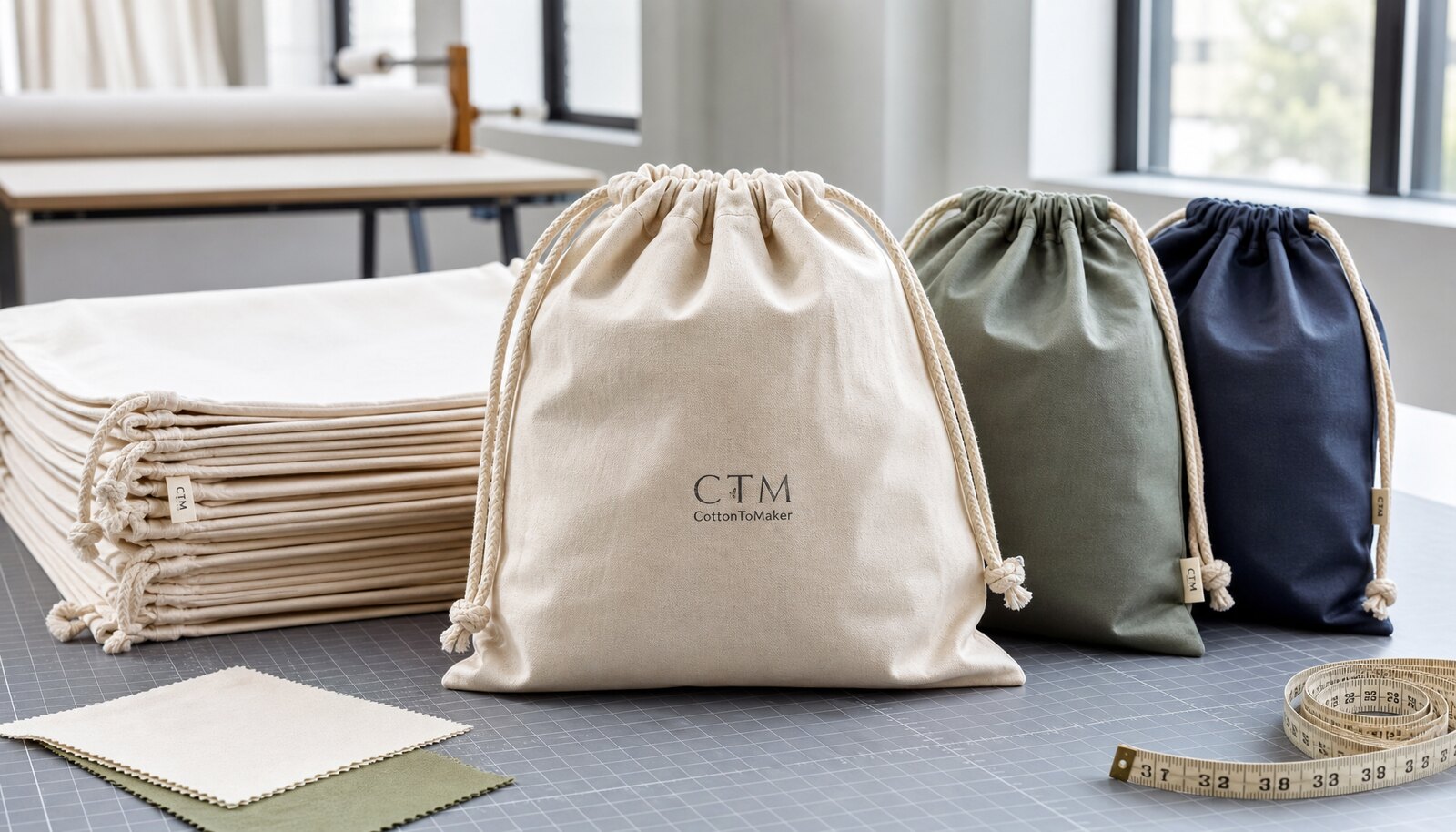
Why custom drawstring bags with logo fail in sourcing
Most sourcing problems on custom drawstring bags with logo are not caused by the logo file. They come from the buyer treating the bag as a simple commodity while the quote is actually a bundle of decisions: fabric weight, weave tightness, cord type, stitch construction, decoration method, packing format, and carton handling. If those items are not written the same way across suppliers, the cheapest quote is usually the least comparable one.
The second failure point is spec drift between sample and bulk. A supplier can show an acceptable sample, then quietly shift to lighter fabric, a thinner cord, or a looser stitch plan once the order is confirmed. Procurement teams need a buying model that ties the product to measurable inputs, not just to a product photo or a price sheet.
- A thin bag can make a logo look weak even if the print itself is accurate.
- Cord and channel construction affect both appearance and reusability.
- Packing choices can change freight cost and warehouse labor more than many buyers expect.
Define the product in measurable terms before you ask for quotes
For custom drawstring bags with logo, the right starting point is the end use. A jewelry pouch, a cosmetics kit, a retail gift bag, and an event giveaway all need different levels of structure, print clarity, and perceived quality. If the use case is not fixed first, the quote conversation becomes vague and each supplier fills in the missing details differently.
Once the use case is clear, lock the finished size and build requirements in measurable terms. State the bag width, height, and the clear opening created by the channel. Add tolerance for each measurement, because sewing and finishing will move the final size slightly. If the product will be reused, handled often, or displayed on shelf, include the feel you are trying to buy: soft and natural, firm and premium, or light and low-cost. That is not marketing language; it is a functional spec because it affects fabric, weave, and stitch density.
- Size should follow the packed product, not a generic catalog dimension.
- Set width, height, and channel depth separately so the opening is not undersized.
- If the bag must close cleanly around a bundle, test the measurement with actual samples inside it.
Fabric weight, weave, and construction: where quality is won or lost
For most custom drawstring bags with logo in cotton, 120-140 gsm is the practical starting point. That range usually gives enough body for clean printing, reasonable opacity, and a hand feel that does not read as flimsy. If the program is premium, reusable, or sold through retail, moving up to 150-180 gsm often makes more sense because the bag will hang better, hide contents more effectively, and resist creasing in transit.
Fabric weight is only part of the story. A tighter plain weave usually gives better logo definition on simple spot-color printing, while denser twill or canvas improves structure when the bag must keep its shape. Loose weave material may save cost, but it can make the print look fuzzy, show fiber slubs, and weaken the perceived value of the product. If the supplier says the fabric is 'good quality' without naming the gsm, weave, and finish, the quote is incomplete.
- Use 120-140 gsm for mainstream promo and retail programs.
- Move to 150-180 gsm when shelf presence and repeat use matter.
- Ask for weave type, yarn count, and whether the fabric has been pre-shrunk or washed.
Stitching, cords, and channel design should be treated as a spec, not a detail
The stitch plan matters as much as the fabric. A good baseline for many cotton drawstring bags is a continuous lockstitch on the side seams and bottom seam, with about 3-4 stitches per cm and bartacks at the cord exits. That structure is not exotic, but it gives procurement a visible standard to inspect instead of relying on the supplier's idea of 'strong sewing.'
The channel is where poor construction shows up quickly. If the channel is too narrow, the cord will bind; if it is too loose, the opening looks sloppy and the bag loses its shape. Cord material and diameter should also be named in the quote. Cotton cord gives a softer look, while polyester or blended cord may slide better and resist fraying more effectively. If the buyer wants a premium feel, cord color and end finishing should be controlled just as tightly as the fabric color.
- Require bartacks or equivalent reinforcement where the cord exits the channel.
- Check for puckering around the top seam, because that often signals uneven tension.
- Ask the supplier to show the inside of the bag in the sample, not just the front face.
Logo decoration: choose the method that fits the artwork and the material
Decoration method should follow the artwork, not the other way around. Silkscreen is usually the best value for one to three solid colors and repeat runs because it gives strong opacity and lower unit cost at scale. For small premium logos, embroidery can work well if the bag fabric is dense enough to hold stitching without puckering. For detailed graphics, heat transfer or DTF may be the practical route, but the buyer should expect a different hand feel and a more careful review of adhesion and wash behavior.
Placement matters as much as method. A logo too close to the channel can distort when the top seam is formed or when the bag is cinched closed. On textured cotton, fine text can disappear into the weave if the artwork is too small or the print area is too busy. For most orders, center-front placement with a clean margin around the art gives the supplier the best chance of repeatable production. If you need a small logo in a corner or near the bottom edge, make the minimum clear space explicit and ask for a sample that proves it works.
- Silkscreen fits simple logos and stable repeat orders.
- Embroidery fits premium badges and small placement areas.
- Heat transfer or DTF fits detailed art but needs a stronger sample review for durability.
How to compare supplier quotes without getting fooled by missing scope
A useful quote comparison starts with a common bill of materials. Every supplier should be quoting the same bag size, fabric gsm, weave type, cord type, logo method, packing format, carton count, and shipping term. If one supplier includes individual polybags, printed carton marks, and sample approval while another does not, the lower price is not the lower cost. It is just the incomplete cost.
Supplier type also changes how the quote should be read. A direct factory is usually stronger on repeat production control, color consistency, and line-level issue handling. A trader or sourcing agent can help when you need mixed products, consolidated shipments, or a faster first contact, but the buyer should still know who is actually sewing, printing, packing, and inspecting the order. A print house can be a good route when artwork complexity is the main risk, while a promotional products reseller may be fine for stock blanks with simple decoration. The wrong route is the one that hides the real production path.
- Compare all quotes on the same spec sheet and carton assumptions.
- Ask who owns sewing, printing, packing, and final QC.
- Treat stock blanks and full custom production as different buying routes.
Sample approval is where real procurement control begins
A digital proof is not a production sample. For custom drawstring bags with logo, the pre-production sample should use the final fabric, final cord, final print method, and final packing format. If the order will ship in cartons with barcode labels or retailer marks, the sample should show that too. This is the point where the buyer can still catch weak fabric hand feel, an off-color print, or a cord that does not sit well in the channel.
A good sample review looks at function, not just appearance. Check whether the bag closes evenly when filled with the intended product. Check whether the logo stays legible when the bag is cinched. Check whether the side seam keeps its shape and whether the inside finish is clean enough for the use case. If the bag may be washed, steamed, or reused in a higher-touch environment, ask for a simple shrinkage or rub test before approval. Common references for measurable testing include AATCC 135 or ISO 5077 style dimensional change testing and AATCC 8 or ISO 105-X12 style crocking testing where a lab report is needed.
- Approve one physical master sample and keep it as the reference.
- Mark logo placement, print size, and color on the sample with dated notes.
- Do not approve bulk if the sample differs from the quote or from the intended packing format.
QC thresholds that make production inspection more useful
QC needs a threshold, not a vague instruction to 'check quality carefully.' For drawstring bags, the most useful controls are fabric weight, size, stitch integrity, logo position, cord function, and packing accuracy. If you use an inspection plan like AQL, define the level before production starts. Many consumer-goods buyers use AQL 2.5 for major defects and AQL 4.0 for minor defects, but that should be set by your channel requirements, not copied blindly.
Dimensional tolerance should be practical. Smaller pouches usually need tighter control because a few millimeters matter more when the product inside is small. Larger bags can tolerate slightly more deviation, but the opening, channel, and finished height still need to match the approved sample closely. On the print side, placement drift of a few millimeters may be acceptable for a simple logo, but not if the art sits close to the seam or includes fine text. Good inspection catches these issues early, before the bag is packed into cartons and made expensive to rework.
- Fabric weight should stay close to the approved gsm target and within an agreed tolerance.
- Side seams and bottom seams should show no skipped stitches or open ends.
- Logo position should be checked against the physical master, not just the artwork file.
- Cord movement should be smooth, with no twisting or fraying after repeated pulls.
- Packing count and labels should match the shipping plan exactly.
Packing, carton data, and freight planning are part of product quality
Packing changes the landed cost and the buyer experience. Bulk packing usually gives better carton efficiency and lower labor cost, which is useful when the receiving team will repack the product anyway. Individual polybags add labor and cube, but they can be necessary when the channel expects shelf-ready presentation or when bags must stay clean through distribution. The quote should state the packing method clearly because a bag quote without carton data is not yet a freight-ready quote.
Carton data matters at the sourcing stage, not after the goods are finished. Ask for carton dimensions, gross weight, and carton quantity so your forwarder can estimate space and your warehouse can judge handling risk. As a practical benchmark, many mid-size cotton drawstring bag programs aim to keep cartons around 12-16 kg gross for easier manual handling. Very small bags may ship in denser cartons, while larger bags may need lower counts per carton to avoid crush and wrinkling. If the carton is too heavy or too bulky, the lowest unit price can become the worst landed cost.
- Bulk pack if the receiving center will re-pack anyway.
- Use polybags only when the channel requires shelf-ready presentation or cleanliness control.
- Request carton dimensions, carton count, and gross weight before confirming freight.
Lead time, change control, and which supplier route makes sense
Lead time should be read as a chain: sample approval, material prep, printing, sewing, packing, and final inspection. When a supplier quotes 10-15 days, that often means production time after approvals, not the entire calendar from artwork handoff to shipment. If the order still needs screen setup, label approval, or cord sourcing, the real schedule is longer. That distinction matters because custom drawstring bags with logo are often bought for events, seasonal retail windows, or kit launches where a missed date is more expensive than a slightly higher unit price.
Different supplier routes fit different risk profiles. A direct factory is usually the right answer when you have repeat demand, a stable spec, and a need to control fabric and sewing quality. A trader or sourcing agent can be useful for mixed-item orders or when you need one point of contact across several products. A print house can be the best fit when the decoration is the main technical issue and the base bag is already decided. If the supplier will not tell you who actually makes the bag, prints the logo, and closes the cartons, that is a signal to slow down.
- Treat quoted lead time as production-only unless the supplier explicitly includes approval and material sourcing.
- Do not change artwork, packing, or cord color after sample approval unless you accept a schedule reset.
- Ask the supplier to identify the longest lead-time item in the order before you confirm.
Specification comparison for buyers
| Spec decision | Recommended starting point | Why it works | Buyer control point |
|---|---|---|---|
| Fabric weight | 120-140 gsm cotton for mainstream promo and retail use; 150-180 gsm for premium or reusable bags | Balances hand feel, print quality, and cost without looking flimsy | Set a gsm target and allow only about +/-5% tolerance on the approved lot |
| Fabric construction | Tight plain weave for cleaner print; denser twill or canvas when the bag must hold shape better | A tighter surface improves logo sharpness and reduces the washed-out look seen on loose weave stock | Ask for weave type, yarn count, and whether the fabric is pre-shrunk or not |
| Stitch spec | Continuous lockstitch on seams, 3-4 stitches per cm, reinforced bartacks at cord exits | Reduces seam failure and helps the channel keep its shape after repeated opening and closing | Require photos of side seams, bottom seam, and channel construction before approval |
| Shrinkage allowance | 3-5% after the agreed wash or steam process for washable cotton; 1-2% if the bag is not expected to be laundered | Prevents finished size and logo position from drifting after finishing | Make the shrinkage test method part of the quote and sample approval |
| Logo method | Silkscreen for 1-3 spot colors; embroidery for premium small logos; heat transfer or DTF for detailed artwork | Matches decoration method to artwork complexity and order quantity | Confirm cure method, ink system, and whether the artwork will sit on textured fabric |
| Sample acceptance criteria | Physical pre-production sample using final fabric, cord, print, and packing format | Shows the real result instead of only a digital proof | Approve against a signed master sample with measured size, placement, and color notes |
| Carton benchmark | About 50-200 pcs per carton depending on bag size, with gross weight targeted around 12-16 kg for manual handling | Makes freight, receiving, and warehouse handling more predictable | Request carton dimensions, carton count, and gross weight before booking freight |
| MOQ route | 500-1,000 pcs per design or color for full custom production; lower quantities often rely on stock blanks | Keeps setup cost and production complexity realistic | Separate full custom orders from blank-stock printing in the quote comparison |
| Supplier route | Direct factory for repeat programs; trader or sourcing agent for bundled orders; print house for artwork-heavy jobs | Different routes optimize different priorities | Ask who owns sewing, printing, packing, and final QC so responsibility is clear |
Buyer checklist before sampling
- Define the end use first: promotional giveaway, retail gift bag, product pouch, or reusable packaging.
- Lock finished dimensions with tolerance for width, height, and drawcord channel depth.
- Specify fabric type, gsm, weave, and whether the lot must be pre-shrunk or washed after sewing.
- State the seam construction, stitch density target, and whether bartacks are required at the cord exits.
- Provide the logo file with exact placement, print size, color count, and a clear area around the channel.
- Confirm the cord material, cord diameter, color, and any bead, knot, or stopper requirement.
- Ask for a pre-production sample that uses final fabric, final decoration, and final packing.
- Set the packing format in writing: bulk pack or polybag, carton count, carton marks, and barcode rules.
- Compare quotes on the same Incoterm, the same carton assumptions, and the same approval standard.
Factory quote questions to send
- What is the exact fabric construction and gsm in the quoted price, and what tolerance do you allow on incoming material?
- How many stitches per cm are on the side seams and channel, and are the cord exits bartacked?
- Is the fabric pre-shrunk, and what shrinkage percentage do you budget for after the agreed finishing process?
- Which decoration method is included, what ink or thread system is used, and how is it cured or fixed?
- What is the maximum logo size you recommend before print quality or alignment becomes risky?
- Does the MOQ apply per design, per color, per size, or per print method?
- What exactly is included in the sample: final fabric, final cord, final print, labels, and carton marks?
- What carton size, carton quantity, gross weight, and packing sequence do you quote for freight planning?
- Which QC documents can you share on request, such as an inspection report, shrinkage test, or colorfastness result?
- Who is responsible for sewing, printing, packing, and final inspection if you are not the actual factory?
Quality-control points to confirm
- Fabric weight: verify against the approved gsm target and reject lots that drift materially outside the agreed tolerance.
- Size control: measure finished width and height on a flat bag, and confirm the drawcord channel does not steal usable opening space.
- Stitching: inspect side seams, bottom seam, and channel for skipped stitches, loose threads, seam puckering, and open ends.
- Logo placement: check position against the master sample and allow only a small alignment variance, typically within a few millimeters on small logos.
- Print performance: review ink opacity, edge sharpness, and dry rub resistance on actual fabric, not only on artwork proof.
- Shrinkage: if the bag will be washed or steamed, confirm measured dimensional change against the agreed method, commonly using AATCC 135 or ISO 5077 style testing where applicable.
- Cord function: the cord should slide smoothly, close evenly, and not fray or twist after repeated opening and closing.
- Packing accuracy: carton counts, barcode labels, and shipping marks should match the packing list exactly.
- Cleanliness: reject bags with oil spots, dust, adhesive residue, broken threads, or any strong chemical odor.