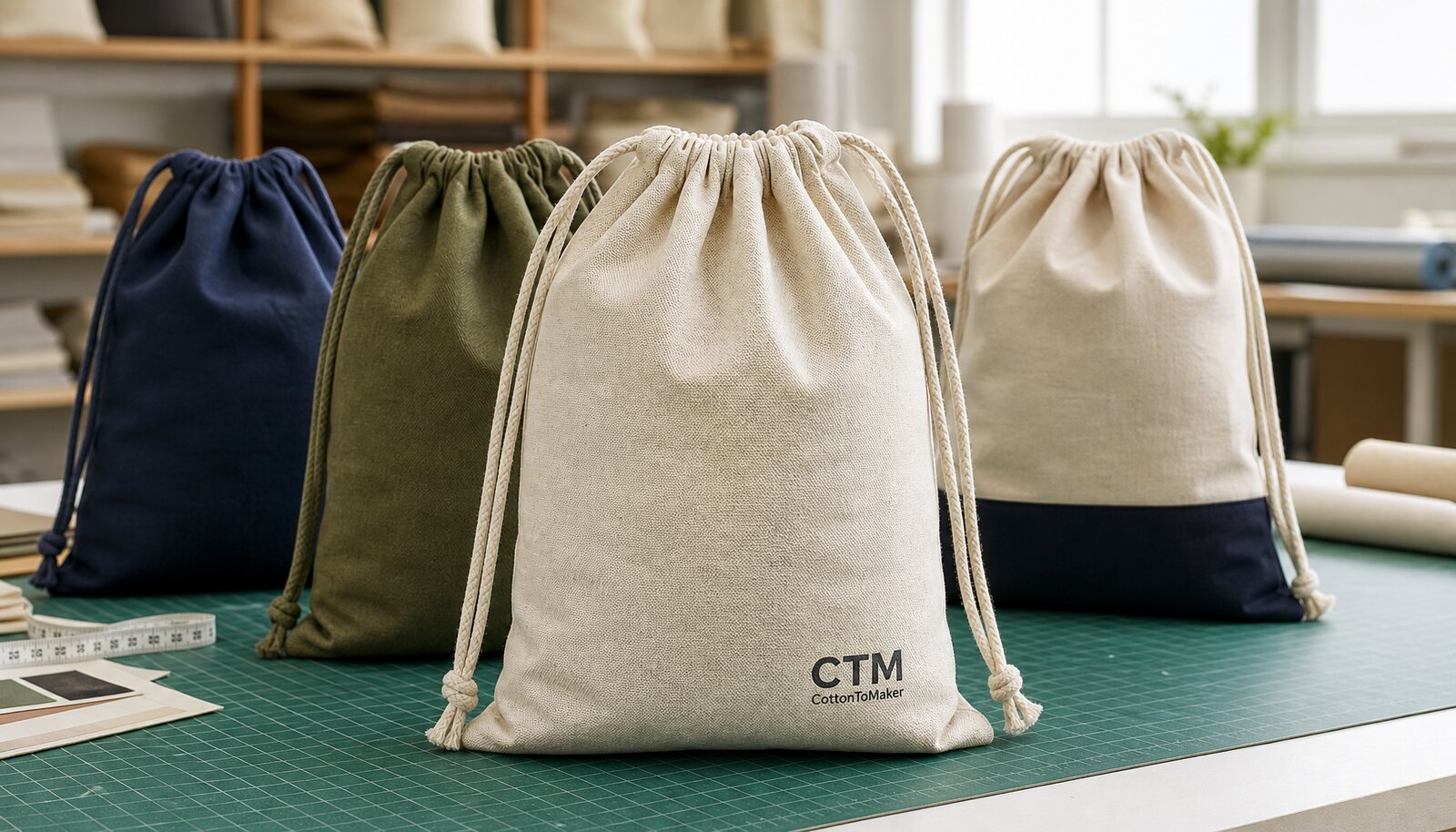
Start With the Pack-Out Problem, Not the Logo
Custom drawstring bags fail most often when the buyer starts with the artwork and only later defines the product it has to carry. The better sequence is simple: identify the contents, the weight, the packing speed, and whether the bag is a giveaway, a retail accessory, or a reusable pack-out item. A 120 GSM cotton pouch for a jewelry kit has a different construction target than a 180 GSM canvas bag for a bottle set. The print can be perfect and the order can still fail if the bag sags, tears at the channel, or closes badly once filled.
The use case should also decide how the bag is judged at receipt. If it is going into a retail box, specify the usable internal space and the fit around the item, not just the nominal size. If it is for event packing, the opening needs to close reliably at line speed, because a slow drawcord or a loose channel creates labor bottlenecks. For custom drawstring bags, the buyer who defines performance first usually gets a cleaner quote, fewer sample revisions, and less argument later about what the factory meant by “standard quality.”
- Define the contents first: apparel, cosmetics, bottles, sample kits, or accessories.
- State whether the bag is for one-time promotion or repeated retail use.
- Write the size as finished dimensions, not only the cut size.
- Call out any must-fit item, such as a 330 ml bottle or folded T-shirt.
- If the bag is touchpoint packaging, specify the expected shelf appearance and hand-feel.
Specify Fabric Weight, Weave, and Shrinkage Together
For custom drawstring bags, GSM is only useful when it is tied to a real use case. Lightweight cotton in the 100 to 120 GSM range can work for low-load promotional items, but it usually gives a softer hand and less opacity. Midweight cotton around 120 to 160 GSM is the practical range for most buyer programs because it balances price, print quality, and shape retention. Heavier canvas above 180 GSM starts to feel more premium and carries corners and bottles better, but it also changes sewing time, freight weight, and carton count.
GSM by itself does not tell you enough. Yarn quality, weave density, finishing, and pre-shrinking change the way the bag behaves after printing and after handling. A loose weave at the same GSM can look thinner than a tighter weave and can let small text fill in when printed. If the bag must hold a shape or survive washing, ask the supplier to state whether the cloth is raw, bleached, enzyme-washed, or pre-shrunk, and make the fabric spec part of the approval record instead of a verbal note.
- 100 to 120 GSM: lowest-cost promotional use, lighter contents, softer drape.
- 120 to 160 GSM: balanced retail and gift use, better opacity and structure.
- 180 GSM and above: premium feel, higher durability, better shape retention.
- Ask whether the fabric is raw, bleached, washed, dyed, recycled, or pre-shrunk.
- If size consistency matters, ask for the shrinkage basis used to set the finished dimensions.
Build the Bag Structure Around the Load Path
The same logo can sit on several bag constructions, but the factory cost and failure risk change with every structural choice. A flat pouch is cheaper than a gusseted pouch because it uses less fabric and fewer operations. A side gusset or bottom gusset adds usable volume and makes room for bottles, boxed goods, or folded garments, but it also changes seam layout, carton packing density, and the way the bag hangs when filled. If the bag must stand up to repeated opening, specify the opening geometry and the reinforcing details up front rather than assuming the supplier will choose the right version.
Drawcord design deserves the same level of attention. Cotton cord gives a more natural look and usually matches cotton fabric better visually, while polyester cord can be stronger and more abrasion resistant. Single-cord bags can be acceptable for simple giveaways, but double-cord construction usually feels more balanced and more deliberate in retail settings. Ask how the cord passes through the channel, what keeps it from fraying, and whether the bag needs bartacks or extra stitching where the cord load enters the seam. Those details are small on paper and expensive to fix after bulk sewing begins.
- Flat pouch: lower cost, better for lightweight kits and small accessories.
- Side or bottom gusset: better for boxed goods, bottles, and thicker packs.
- Single cord: simpler and cheaper, but less premium in appearance.
- Double cord: better symmetry, easier opening, and more retail-ready.
- If the bag is reused often, ask for reinforcement at the cord channel and stress points.
Choose Print and Branding Based on Production Reality
For custom drawstring bags, print method should follow the artwork and fabric, not the other way around. Screen printing is still the most practical choice for one- or two-color logos on cotton because it is durable, repeatable, and easy to price at scale. DTF or transfer printing is useful when the artwork contains gradients, fine detail, or multiple colors, especially at lower volumes. Woven labels, sewn patches, and small woven tags are a good option when the buyer wants a quieter premium look or wants to avoid relying on ink holdout on coarse fabric. The right method is the one the factory can repeat at production speed with acceptable defect risk.
The main quoting mistake is approving a method that looks good in a mockup but is weak in production. Fine type can close up on textured cotton. Thin reversed lines can disappear. Transfer prints can look crisp on day one and still fail if the press settings are unstable or if the film is low grade. Do not approve artwork only from a digital proof. Ask the supplier to confirm the smallest text size, smallest line weight, and the exact print placement tolerance they will hold on the bulk run. If the logo depends on a tight Pantone match, make the color target part of the sample sign-off and not just a note in the email thread.
- Use screen print for simple logos and larger filled areas.
- Use DTF or heat transfer for multi-color short runs or small detail.
- Use woven labels or patches when the brand wants a premium textile finish.
- Confirm print placement with measured distances from the top and side edges.
- Ask for the minimum text size and line thickness before approving artwork.
Write the RFQ So Quotes Can Be Compared on Equal Terms
A vague RFQ produces quotes that cannot be compared. If one supplier is pricing a 100 GSM bag with a one-color screen print and another is quoting a 140 GSM bag with a woven label and individual polybags, the unit price means almost nothing. The buyer needs a line-item structure that separates fabric, cord, seam finish, print, packing, carton work, and freight term. That makes it obvious where the price is coming from and where the supplier may have substituted a cheaper material or a different process without saying so. A good RFQ should be detailed enough that two factories can read it and build the same bag.
MOQ should also be visible in the quote rather than hidden in the back-and-forth. Standard fabric and standard sizing usually support lower minimums because the factory does not need a custom dye run or extra setup. Custom dyed cloth, special cord colors, custom labels, or unusual dimensions raise MOQ because they increase waste and setup time. If the project is a trial order, ask for a standard-spec version first and list the upgrade items separately. That keeps the first order honest and gives you a clean path to scale only after the design proves itself in use.
- Ask for price breaks at 500, 1,000, 3,000, and 5,000 units if the project may scale.
- Separate product price from tooling, screens, plates, labels, and packing cost.
- Ask whether the quote is EXW, FOB, or DDP before comparing suppliers.
- Request carton count, carton dimensions, and gross weight for freight planning.
- If the order may repeat, ask the factory to keep the exact spec revision on file.
Use Samples to Prove the Commercial Spec, Not Just the Artwork
A pre-production sample for custom drawstring bags should prove three things: the bag fits the intended item, the logo stays legible at actual size, and the sewing is clean enough for the intended use. A sample that looks good in isolation can still be misleading if it is made slowly by the best operator in the room, so the buyer should ask for an approval checklist and, where volume matters, photos of the actual production setup. That helps separate a presentation sample from a run sample. The goal is not a perfect one-off; the goal is a repeatable bag the factory can make at scale.
When reviewing a sample, look beyond the logo. Check seam alignment, cord movement, stitch tension, and whether the bag collapses properly when empty. Measure the finished dimensions after trimming and sewing, because a bag that starts out right on the cut table may still come out undersized after shrinkage and seam loss. If the bag will be washed or handled repeatedly, the sample should also be rubbed, pulled, and folded to see whether the fabric pills, the print cracks, or the cord channel stretches. Approval should be based on the actual commercial use case, not on whether the sample photograph looks good.
- Measure finished width, height, and gusset depth on the sample.
- Pull the cord several times to test friction and channel behavior.
- Compare the sample against the agreed fabric swatch and thread color.
- Check the logo at normal viewing distance, not only under close inspection.
- If the bag must carry weight, test it with the intended load before approving.
Put QC Into the PO: AQL, Pull Tests, Color Checks, and Carton Drop Criteria
QC for custom drawstring bags needs to be practical, not decorative. The final inspection standard should be stated in the purchase order, including the AQL level, defect definitions, and the checks the inspector must actually perform. A common starting point is AQL 2.5 for major defects and 4.0 for minor defects, but the buyer can tighten that if the program is retail-critical or loosen it if the bag is a low-risk giveaway. Major defects should include open seams, wrong size beyond tolerance, broken cords, severe print misplacement, and carton count errors. Minor defects should include small loose threads, minor print variation, or light packing wrinkles if those are acceptable to the end use.
For validation, ask for evidence rather than verbal assurance. A seam pull test is useful when the bag carries weight or has a gusset that will take stress. Dry rub and wet rub checks help if the bag is dyed or printed and will be handled often. If the bag is washable, ask for a wash reference at the agreed method so you can confirm shrinkage, bleeding, and print durability. Carton handling matters too: a filled master carton should survive rough handling without bursting, and a simple drop or edge-impact check can reveal weak cartons, poor inner packing, or load shifts before the shipment leaves the factory.
- Use an agreed AQL in the PO and ask the factory to classify major and minor defects.
- Record seam pull results, print rub results, and any wash-related checks in the report.
- Ask for color matching against a physical swatch or signed-off sample under standard light.
- Confirm that filled cartons survive a rough-handling or drop check without damage to the bags.
- Require photo evidence of the inspection, carton count, and carton labels before release.
Packing, Cartonization, and Warehouse Receipt Are Part of the Product
Packing is often treated as an afterthought, but for custom drawstring bags it changes labor, freight, and warehouse acceptance. Bulk packing is fine for distribution programs where the bags will be unpacked and inserted elsewhere. Individual polybagging or labeled retail packing is better for shelf-ready or e-commerce use. If the buyer does not specify packing, the factory will usually choose the cheapest workable method, which may not be the one the warehouse expects. That can create a receiving problem even when the bags themselves are correct.
Ask for carton dimensions, carton count, gross weight, and whether the cartons are single wall or double wall. Those figures matter for freight comparison, pallet build, and storage fees. Bags compress well, but cords, inserts, and tags can make the cartons less uniform than expected. If the order is shipping into multiple destinations, carton marks and SKU separation should be part of the quote. A clear packing spec also reduces the chance that the supplier mixes sizes or colors when production is complete.
- Define whether bags are bulk packed, folded, or individually bagged.
- Specify if polybags need warning text, suffocation labels, or retail barcode stickers.
- Request outer carton marks with SKU, color, size, and quantity.
- Confirm whether cartons are export-grade single wall or double wall.
- If the shipment is warehouse-bound, confirm pallet pattern and carton weight limits.
Compare Landed Cost, Not Just the Factory Number
A low unit price can still be the expensive choice once freight, packing, and defect risk are added. For custom drawstring bags, the landed cost should include the product price, print setup, packing, carton charges, inspection cost, and the shipping mode required to meet the schedule. A slightly higher factory quote may be the cheaper total option if the supplier can pack denser cartons, cut rework, or deliver a cleaner inspection result. If the buyer only compares ex-works numbers, the final landed cost can be misleading by a wide margin.
Supplier type matters too. A direct factory is usually best for repeat volume and tighter control over construction. A local decorator can be better for small rush orders or a very short reorder window. A trading company can add value if it consolidates multiple SKUs, handles inspection, or manages export paperwork, but that service should be visible in the price. The buyer should know what is being paid for and what is being hidden inside the margin. If the supplier will not break out product cost from service cost, the quote is harder to trust and harder to benchmark later.
- Compare quotes on the same basis: same fabric, same print, same packing, same Incoterm.
- Include freight and duty estimates before selecting the winner.
- Use sample failure cost as part of the comparison if the launch is time-sensitive.
- Prefer the route that reduces rework, not only the route with the lowest ex-works number.
- If the order will repeat, treat repeatability as part of the value, not just the first-shipment price.
Freeze the Spec for Reorders, or the Product Will Drift
A clean spec sheet is what turns a one-time order into a repeatable program. For custom drawstring bags, the record should include a flat sketch or artwork placement diagram, finished dimensions, fabric GSM, cord type, print method, placement, packing method, carton data, and tolerance ranges. It should also include the approved sample reference and the date of sign-off. If the bag has a retail role, add barcode placement and label requirements so the factory does not improvise on later runs. This is the easiest way to prevent the second order from becoming a different product with the same SKU.
Once the spec is frozen, keep it stable unless there is a deliberate reason to change it. If a new supplier proposes a different seam, a lighter fabric, or another print method, the quote should say exactly what changed and why. Otherwise, the buyer is not comparing suppliers; the buyer is comparing different products. That is the fastest way to lose leverage on cost while thinking the sourcing process is working. Reorders go faster and cleaner when the approved sample, the inspection standard, and the packing method all travel together as one controlled document set.
- Keep one signed-off spec sheet and reference sample for every SKU.
- Record fabric, cord, print, and packing revisions so reorders do not drift.
- Store the approved swatch and print color reference with the spec file.
- Use the same carton count and folding method unless the warehouse requests a change.
- If a supplier suggests a change, require a written reason and a sample update.
Specification comparison for buyers
| Spec decision | Recommended option | When it fits | Buyer risk to check |
|---|---|---|---|
| Fabric weight | 120 to 140 GSM cotton for light retail; 150 to 180 GSM canvas for heavier contents | Gift packaging, event kits, retail add-ons, and reusable pouches where the bag must feel substantial in hand | Ask the factory for the target GSM tolerance, usually plus or minus 5 percent, and confirm the fabric does not go translucent when filled |
| Fabric finish | Pre-shrunk or stabilized cotton when fit matters after washing; natural or bleached finish when color consistency matters | Retail programs, washable bags, and any order where repeatability across reorders is important | Request the wash or shrinkage basis used for the fabric; if washability matters, ask for an approved result at a defined wash method and measure change in finished size |
| Bag structure | Flat pouch for low-cost kits; side gusset or bottom gusset for boxed goods and bottles | Apparel, cosmetics, sample sets, and kits with irregular shapes or rigid contents | Confirm gusset depth, seam reinforcement at stress points, and whether the quoted size is cut size or finished size |
| Seam spec | Clean overlock or folded seam with consistent seam allowance and no loose tails | Retail packaging and repeated-use bags that will be opened often and handled on shelf | Ask for stitch density, seam allowance, and a pull test result on a filled sample; weak seams often fail only after loading |
| Cord spec | Cotton cord for a natural look; polyester cord for better abrasion resistance and lower cost | Brands that care about feel, repeated opening, or more durable daily use | Specify cord diameter, cut length, cord end finish, and whether the cord channel is reinforced; thin cords can fray or cut into the fabric |
| Print method | Screen print for one to two spot colors; DTF or transfer for gradients or short runs; woven label for premium branding | When the logo, artwork detail, and quantity all point to a method the factory can run repeatably | Ask for minimum text size, line thickness, cure settings, and color tolerance; fine copy can fill in or crack on coarse fabric |
| Color fastness | Use tested dye or print ink if the bag will be washed, rubbed, or handled heavily | Retail bags, premium giveaways, and any project where the customer will keep the bag long enough to notice wear | Request dry rub, wet rub, and wash references if the bag is dyed or printed; bleeding and scuffing are common rejection points |
| Size tolerance | Finished size called out with tolerance bands, not just nominal size | When the bag must fit a boxed item, bottle set, brochure pack, or folded garment | A 0.5 to 1 cm shift can be normal after sewing; specify what is acceptable for width, height, and gusset depth |
| Packing method | Bulk pack for distribution; individual polybag or labeled pack for retail and e-commerce | Warehouse programs, marketplace fulfillment, and retail shelf readiness | Confirm inner pack count, carton quantity, carton size, and whether warning labels or barcodes are required |
Buyer checklist before sampling
- Finished size in cm or inches, plus the tolerance you will accept on width, height, and gusset depth
- Fabric type, weave, GSM, finish, and whether the cloth is natural, bleached, dyed, washed, or recycled
- Cord type, cord diameter, cord length, cord end finish, and whether the ends need knots, heat sealing, or metal tips
- Print method, number of colors, print size, placement, Pantone references, and minimum line or text size
- Internal capacity target or must-fit item, such as a bottle set, folded T-shirt, cosmetic kit, or brochure pack
- Packing format, inner pack count, carton quantity, barcode labels, polybags, inserts, and any warning label requirements
- Sample approval standard, including how color, seam quality, print alignment, and hand-feel will be judged
- Expected order quantity by size and color, plus whether reorders are likely
- Delivery term and destination, so the supplier can quote EXW, FOB, or DDP on a comparable basis
- Any compliance needs, such as REACH, CPSIA, packaging warnings, recycled-content claims, or country-of-origin marking
Factory quote questions to send
- What is the exact fabric composition, weave, GSM, and finishing method you are pricing?
- Are the dimensions quoted as cut size or finished size after sewing, and what tolerance do you allow?
- Which seam construction and stitch density are included in the price?
- What cord material, cord diameter, cut length, and cord-end finish are included?
- Which print method are you quoting, and what setup fee applies per color, screen, plate, or transfer?
- What is the minimum text size and line thickness you can hold at production speed on this fabric?
- Does the quote include labels, tags, inserts, inner polybags, and carton markings, or are those extra?
- What is the MOQ per size, per color, and per print method?
- What is the sample lead time, bulk production lead time, and packing lead time from final approval?
- What inspection standard do you follow before shipment, and can you share the checklist or report format?
Quality-control points to confirm
- Inspect incoming fabric for GSM, weave consistency, color, and visible flaws before cutting
- Measure finished size after trimming and sewing, not just cut size
- Check seam allowance, stitch density, and thread tail trimming on each production batch
- Run a seam pull test on a filled sample and record the load or failure point
- Verify cord length, channel width, and smooth draw action with repeated open-and-close cycles
- Confirm print position, color match, and cure quality against the signed-off sample
- Perform dry rub and wet rub checks for printed or dyed bags when handling wear matters
- If washability is part of the requirement, confirm shrinkage, bleeding, and print durability after the agreed wash method
- Use a final inspection plan with an agreed AQL, commonly 2.5 major and 4.0 minor unless the buyer sets a different standard
- Check outer carton count, carton labels, pallet marks, and a carton drop or rough-handling check before shipment