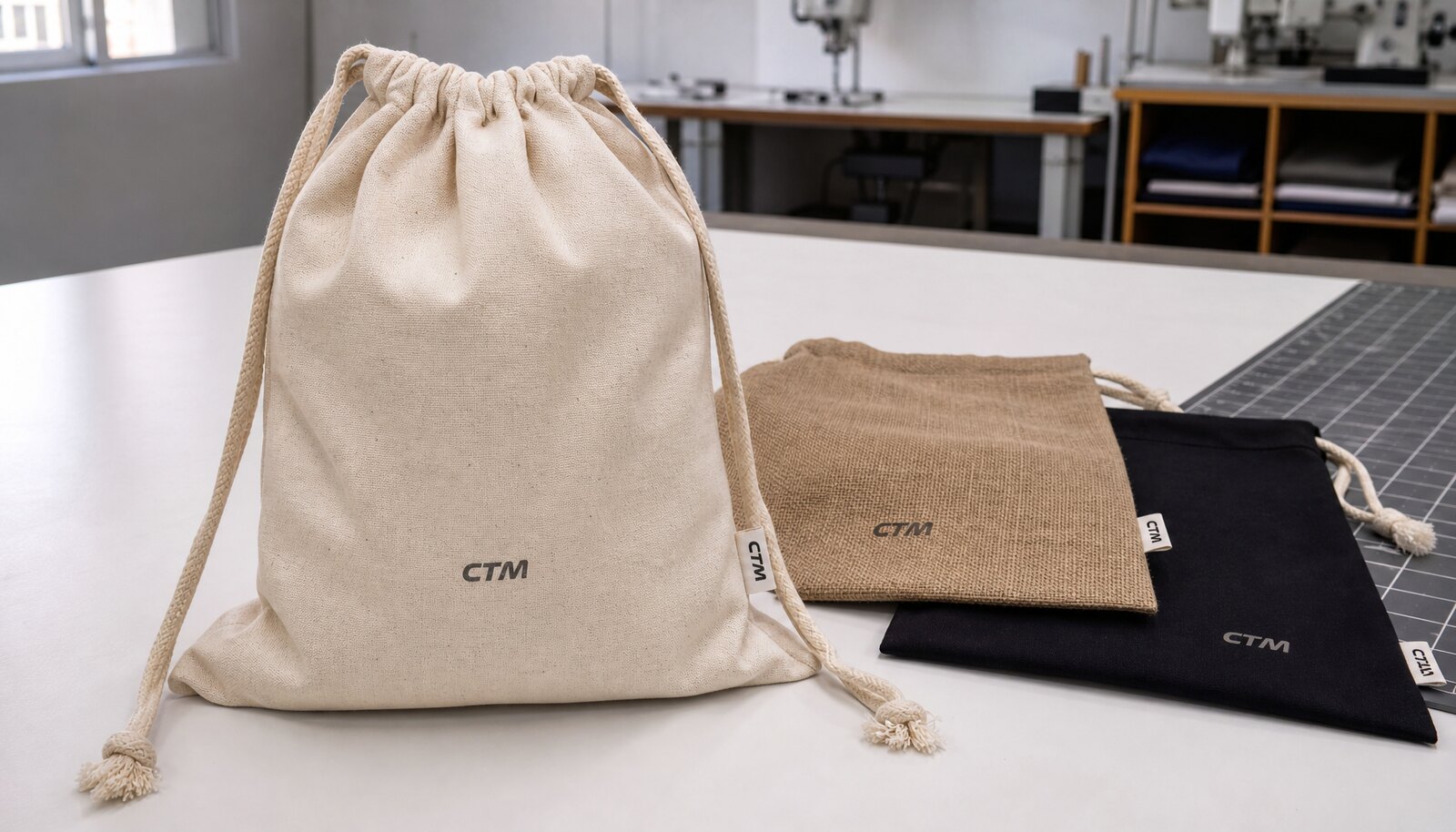
Start With The Job The Bag Has To Do
Most RFQs for custom drawstring bags bulk start with a logo file and a quantity. That is backwards. The right starting point is the job the bag has to do. A bag that holds a light accessory insert does not need the same fabric weight, seam strength, or pack format as a retail bag that will be reused many times. If you define the job first, the factory can price the right build instead of guessing at a generic pouch and padding the quote later.
The use case also determines how much margin the bag has for abuse. A short-life event giveaway can tolerate thinner fabric and a simpler closure. A bag used in retail or direct-to-consumer packaging needs cleaner stitching, better structure, and a cord that does not twist or fray during packing. Buyers get into trouble when they specify a visually nice sample but never state the weight, size, or reuse expectation that the bag has to survive in real use.
- State the maximum item weight or contents the bag must carry.
- Separate retail use from giveaway use, because the quality target is different.
- Tell the supplier whether the bag is a primary package, a secondary pouch, or a carry bag.
Choose Fabric Weight And Material By Use, Not Habit
Fabric choice drives appearance, durability, print behavior, and freight volume. Use a GSM-to-use matrix instead of relying on habit. A practical starting point is 70-90 gsm nonwoven for short-life promotional use, 100-120 gsm cotton for light accessories and inserts, 140-160 gsm cotton or canvas for a more substantial retail feel, and 180-220 gsm canvas or twill when the bag needs to look premium and be reused often. If moisture resistance or a smoother print face matters, 210D polyester can be a better fit than cotton.
The number alone is not enough. Ask whether the GSM refers to raw fabric, finished fabric, or the actual bag weight after sewing, because suppliers do not always label that the same way. Also check whether the material is preshrunk or likely to move after washing or humidity exposure. A bag that shrinks after approval can pull the print off-center or make the closure sit unevenly. If the pack is retail-facing, request a swatch and judge opacity, drape, and stiffness in normal warehouse light, not only on a screen.
Cord choice belongs in the same decision. A premium cotton bag with a thin or scratchy cord reads as a lower-grade product even when the body fabric is strong. Polyester cord is usually easier to pack and more uniform in bulk, while cotton cord better matches a natural look. If the bag is going on shelves, ask the supplier to show the cord ends and how they are finished. Frayed cord ends create receiving issues and make the first impression worse than the printed logo ever can.
- Use the GSM as the buying spec, not the fabric name alone.
- Ask for fabric composition, weave, and finish on the quote.
- Match cord quality to the value of the bag, not just the lowest unit price.
Lock Down Size, Construction, And Closure Details
Size is more than a width and height. For drawstring bags, the usable interior depends on whether the bag is flat or gusseted, how much seam allowance the factory uses, and how the top channel is built. A flat pouch is efficient for slim items and inserts. A gusseted bag works better for bulkier products and gives the contents room to sit without distorting the artwork. If you leave that choice open, different suppliers may quote different structures and you will not be comparing the same bag.
Put tolerances in the brief. For most small and medium bags, finished length and width should stay within plus or minus 0.25 in (6 mm) on the sample and production run; larger bags can often tolerate plus or minus 0.5 in (12 mm). A gusset depth target usually needs a tighter band, around plus or minus 0.125 to 0.25 in (3 to 6 mm). Cord length should also be controlled, because a cord that is too short makes closure awkward and a cord that is too long increases material cost and packing time. Keep the seam allowance and top channel consistent from sample to bulk so the approved size stays meaningful.
Drawstring performance matters as much as dimensions. A bag that opens smoothly but closes unevenly creates complaints at receiving and retail. The cord should move cleanly without cutting into the fabric or bunching inside the channel. If the bag will hold a product with sharp corners, consider reinforcing the lower corners or widening the opening. Small construction changes can save more cost than switching suppliers, because they reduce rejects and make pack-out faster.
- Provide finished dimensions, gusset depth, and whether the bag is flat or box-style.
- Set the allowed tolerance for size and cord length in writing.
- Confirm the seam allowance and channel construction on the approved sample.
Pick Decoration Based On Artwork Complexity And Fabric Behavior
Decoration should follow the artwork and the fabric, not the supplier's default process. Screen print is usually the most stable choice for simple logos, bold shapes, and high-volume runs on cotton or canvas. It has the cleanest setup for bulk orders when the artwork has one or two colors and does not depend on tiny text. DTF or transfer can handle more detailed artwork, gradients, or shorter runs, but it adds process control and can change the hand feel on the bag surface. Embroidery has its place on premium pieces, but it works best on smaller marks and fabric that can support the stitch density without puckering.
The print zone needs room to breathe. Keep the logo away from the side seam, the cord channel, and any fold line that will distort the fabric after sewing. A design that looks centered in a digital proof can shift once it is attached to the finished bag. For textured canvas, small text below about 6 pt often becomes fragile or hard to read. If exact color is important, approve a physical print target or production reference rather than trusting a PDF alone. That is especially important when a brand wants one specific shade across multiple reorder cycles.
Do not add decoration layers unless they help the buyer decision. A woven label, hangtag, or side tab can improve retail presentation, but each one adds setup, labor, and another inspection point. In bulk procurement, the cleaner path is usually the one that keeps the bag readable and consistent, not the one that adds every possible branding element.
- Use screen print for simple bulk logos on cotton or canvas.
- Use DTF or transfer only when the artwork needs fine detail or low-MOQ flexibility.
- Keep print placement clear of seams, folds, and the cord channel.
Build An RFQ The Factory Can Price Without Guessing
A useful RFQ for custom drawstring bags bulk contains the same information every supplier needs to quote the same item. At minimum, it should include the finished size, fabric family, GSM, color, construction style, cord material, decoration method, print area, inner pack, carton spec, quantity by SKU, and trade term. If any of those fields are missing, suppliers will fill the gap with their own assumptions and the quotes will drift apart. That is where most procurement noise comes from.
Treat the RFQ as a spec sheet, not a sales inquiry. State whether the bag is flat or gusseted, whether the closure is a simple channel or a reinforced top hem, and whether the decoration needs to wrap across the front only or onto other panels. If the order splits across several sizes or colors, give the breakdown by SKU so the factory can calculate cutting efficiency and setup cost correctly. The goal is not just a quote. The goal is a quote that can survive comparison, sampling, and final inspection without surprise change orders.
- Include finished size, tolerance, GSM, color, and construction in one spec block.
- Break quantity out by SKU, size, color, and artwork version.
- State the sample stage and the approval milestone that starts production.
Understand MOQ And Lead Time Before You Choose A Route
MOQ is not a single number. It usually reflects fabric cutting efficiency, print setup, packing labor, and how many variants sit under one order. A factory may quote a low MOQ for one color and one print, then raise the floor once you add sizes, cord colors, or multiple artwork versions. That is normal. What matters is whether the supplier explains the minimum in a way that lets you model your real buy. If you are ordering 6,000 units across three sizes, you need to know whether the price tier is based on total volume or per-SKU quantity.
Lead time works the same way. The quote clock often starts only after artwork and sample approval, not when the inquiry lands. If the bag needs custom fabric sourcing, a new cord color, or a fresh print screen, the schedule usually extends. Direct factory sourcing gives the cleanest control over repeatable specs. Trading companies can help when you are buying a mixed basket of goods, but they can hide the factory layer and make it harder to challenge drift. Local decoration works well for urgent reorders or short campaigns, provided the blank bag is already approved and the decorator can match the print standard.
- Check MOQ by size, color, and artwork version, not just by total order value.
- Ask when production lead time starts and what approvals must happen first.
- Use local decoration only when the blank bag spec is already locked.
Compare Quotes By Landed Cost, Not By Headline Unit Price
Headline unit price is only one piece of the economics. On bulk orders, a difference of $0.03 per unit is only $300 on 10,000 pieces, so freight, setup, packing, and destination charges can erase the apparent savings fast. The right way to compare suppliers is to normalize every quote to the same trade term and then add the non-unit costs. If duty applies on your lane, include that too. A quote that looks cheaper on the first line can end up more expensive once the shipment reaches your warehouse.
Here is a simple comparison on 10,000 bags. Supplier A quotes $0.41 per bag EXW, plus $240 in screen setup, $1,080 in freight, and $280 in destination charges. Total landed cost is $5,700, or $0.57 per bag. Supplier B quotes $0.46 per bag with setup included, a tighter carton pack that lowers freight to $820, and $220 in destination charges. Total landed cost is $5,640, or $0.564 per bag. The higher unit price wins because the rest of the quote is cleaner. That is why buyers who only compare the per-piece number often choose the wrong supplier.
The same logic applies to overrun and underrun policy. If the factory can only invoice a range, you need to know whether the shortfall is inside the quoted tolerance or whether a replacement batch is required. Final land cost is the only number that tells you what the bag actually costs after it lands in your building.
- Use the same Incoterm across every quote before you compare anything.
- Add freight, destination charges, duty, and any repack labor into the landed view.
- Check whether setup is included or billed separately from the unit price.
Specify Packing And Cartons Before The Sample Gets Approved
Packing decisions affect freight, warehouse handling, and retail readiness. A bag can be sewn correctly and still create avoidable cost if it is folded inconsistently or packed into cartons that are too large. Bulk pack is the lowest-cost freight option, but it can wrinkle printed surfaces and make unit counts harder to verify. Polybagging protects the print and keeps the count cleaner, but it adds material cost and carton volume. If the bags go to retail or a distributor, the fold method, barcode placement, and carton marking need to be part of the approval, not an afterthought.
A practical pack example is one folded bag per polybag, 50 pieces per inner, 500 pieces per master carton, with carton dimensions chosen so the gross weight stays under about 50 lb (23 kg) if manual handling is expected. That is only an example, not a universal rule. The right pack spec depends on the size of the bag and the destination workflow. What matters is consistency: the approved fold should match the production fold, carton labels should match the PO, and the packing list should reflect the same SKU and color language that the warehouse team uses. If those pieces drift, receiving time rises and inventory errors follow.
Carton size also changes freight. A slightly larger carton can add cubic volume that matters more than the unit weight of a drawstring bag. Ask for carton dimensions before you approve the shipping plan, especially if the lane is air freight or parcel-based. A bag program with good unit pricing can still miss margin if the packing spec is loose.
- Write the fold method, inner count, and carton count into the pack spec.
- Keep master cartons light enough for the receiving team to handle safely.
- Request carton dimensions before you approve freight or route planning.
Set QC Thresholds That Catch Real Defects
QC becomes useful only when the thresholds are specific. Start with zero tolerance for critical defects: open seams, missing cord, wrong artwork, wrong fabric, contamination, unreadable barcodes, or the wrong colorway. Those defects break the order and should not pass. Major defects are the ones that affect use or shelf presentation. Examples include dimensions outside tolerance, print shift that is obvious at normal viewing distance, broken stitches in visible areas, holes, or shade variation between cartons that a buyer could see without measuring tools. Minor defects are cosmetic only, such as loose threads under 10 mm, tiny ink specks, or fold marks that do not affect function.
The measurement method matters as much as the threshold. Measure the bag laid flat without stretching it. Check print placement against a fixed seam or fold reference, not against the eye. Review cartons from more than one part of the shipment so you do not miss a mix of good and bad product hidden in one corner. If you use AQL, a common starting point is 2.5 for major defects and 4.0 for minor defects, with zero tolerance for critical failures. If the bag is retail bound, barcode scans should be part of the sample check, and the folded unit should match the approved pack standard exactly.
A short load test is worth doing before shipment release. Use the actual product or a similar weight for at least 30 seconds. The bag should close smoothly, the cord channel should not distort, and the seam should not pop or twist. That is a simple test, but it catches many failures that a visual inspection alone will miss.
- Use zero tolerance for critical defects and define them clearly in the PO.
- Measure dimensions laid flat and print placement from a fixed reference point.
- Run a short load test on the seam, cord channel, and closure before release.
Close The Loop Before Shipment Leaves The Factory
A good final review is not just a photo approval. It is the last chance to tie the production lot to the sample and the PO. Ask for a pre-ship photo set that shows the bag front, back, print close-up, seam close-up, folded unit, carton labels, and carton count. If the photos show a different cord color, a shifted print, or a different fold than the approved sample, hold the shipment until it is corrected. The point is not to create extra steps. The point is to stop a spec drift before freight costs turn a small issue into a warehouse problem.
Keep the final document pack simple and complete: approved sample reference, spec sheet, packing list, carton marks, inspection report, and invoice basis. If the order has an agreed overrun or underrun range, make sure that range appears in the paper trail so the receiving team knows what to expect. Drawstring bags are a low-complexity product only when the spec is stable. The best procurement result is not the lowest quote on day one. It is the bag that arrives with the same fabric, print, and pack standard you approved.
For repeat programs, archive the approved sample photo and the last production details as the baseline for the next order. That reduces back-and-forth on reorders and makes it easier to detect when a supplier is quietly changing fabric weight or pack style to save cost.
- Request a pre-ship photo set that includes the bag, the fold, the carton, and the labels.
- Hold shipment if the lot differs from the approved sample in fabric, print, cord, or pack.
- Archive the approved sample and production details for the next reorder.
Specification comparison for buyers
| Spec decision | Recommended starting point | Best fit | Buyer risk to check |
|---|---|---|---|
| Fabric weight | 70-90 gsm nonwoven for short-life promo, 100-120 gsm cotton for light inserts, 140-160 gsm cotton or canvas for retail, 180-220 gsm canvas or twill for premium reuse | Match the bag to the load and the expected life of the program | Ask for exact GSM, not just fabric family, and keep the approved swatch on file |
| Construction | Flat bag for narrow contents, gusseted bag for bulkier items, double-stitched stress points for heavier use | Product inserts, gift kits, and reusable retail packaging | Confirm finished size, gusset depth, seam allowance, and whether the bag is single- or double-stitched |
| Cord material | Cotton cord for a premium natural look, polyester cord for lower cost and cleaner packing, tipped ends for retail handling | Brands that care about presentation versus low-cost promotional runs | Check cord diameter, finish, and whether the ends are knotted, heat-sealed, or tipped |
| Decoration method | Screen print for simple bulk logos, DTF or transfer for fine detail, embroidery only for small premium marks | Simple artwork at volume versus detailed artwork at lower MOQ | Compare setup cost, color count, hand feel, and durability on the approved fabric |
| Finished size | Size the bag to the contents plus closure room, with tolerance stated in the RFQ | Avoids overstuffing, strain on seams, and poor closure performance | Require finished dimensions and tolerance in writing, not just a reference sample |
| Pack format | Bulk pack for freight efficiency, polybagged for retail, folded and barcode-labeled for warehouse flow | Distribution, retail, or direct-to-consumer programs | Specify inner count, carton count, fold method, and label placement before approval |
| Carton spec | Use cartons sized to keep gross weight and cubic volume under control, with one carton spec per SKU | Lower freight per unit and easier receiving | Ask for carton dimensions, gross weight, and carton markings before you release the PO |
Buyer checklist before sampling
- Define the bag's job first: retail carry bag, product insert, gift pouch, or event giveaway, and state the maximum item weight it must hold.
- Lock the fabric family and GSM before requesting price so every supplier quotes the same material basis.
- Specify finished size, gusset depth if any, cord material, cord length, and whether the bag is flat or box-style.
- Set the decoration method, maximum print area, number of colors, and exact print placement on the panel.
- State the quantity by SKU, color, and artwork version so setup and MOQ can be priced correctly.
- Ask for the sample stage in writing: mockup, blank sample, pre-production sample, or production reference sample.
- Write the pack spec: bulk, polybagged, folded, barcode-labeled, inner count, and master carton count.
- Compare quotes on the same trade term and include freight, destination charges, and duty where relevant.
- Set dimensional tolerance, print placement tolerance, shade tolerance, and overrun or underrun limits before approval.
- Hold one approved sample against the PO so final inspection has a clear production standard.
Factory quote questions to send
- What exact fabric, GSM, weave, and finish are included in the quoted price, and is the sample made from the same material lot?
- What is the finished size tolerance for length, width, and gusset depth, and what is the accepted print placement tolerance?
- Which charges are included in unit price: screens, plates, labels, inner packs, cartons, and any special folding?
- How is MOQ calculated by size, color, and artwork version, and what changes the price tier?
- When does lead time start: artwork approval, sample approval, deposit receipt, or purchase order confirmation?
- What is the overrun or underrun policy, and how is the final invoice calculated if the run is short or long?
- Can you share carton dimensions, gross weight, and estimated cartons per 1,000 units for this spec?
- What inspection standard do you use before shipment, and can you provide a recent final inspection photo set?
- What trade term is the quote based on, and which freight, destination, or customs charges are excluded?
- If I change cord color, print position, or fabric weight, which line items move and by how much?
Quality-control points to confirm
- Measure finished length and width laid flat without stretching. A practical starting tolerance is plus or minus 0.25 in (6 mm) on smaller bags and plus or minus 0.5 in (12 mm) on larger bags.
- Check gusset depth, if used, within plus or minus 0.125 to 0.25 in (3 to 6 mm) of the approved spec.
- Set print placement tolerance at plus or minus 0.25 in (6 mm) from the approved reference point, with no crowding into seams or the cord channel.
- Use zero tolerance for critical defects: open seams, missing cord, wrong artwork, wrong fabric, unreadable barcode, contamination, or the wrong colorway.
- Treat major defects as failures that affect use or shelf presentation: seams that pull, holes, broken stitches across visible areas, and print shift that is obvious at normal viewing distance.
- Treat minor defects as cosmetic only: loose threads under 10 mm, light fold marks, or tiny ink specks that are not visible at arm's length.
- Use AQL 2.5 for major defects and AQL 4.0 for minor defects if your internal standard does not already define a tighter rule.
- Run a simple load test with the actual product or a similar weight for at least 30 seconds. The seam, cord channel, and closure should hold without pop, twist, or distortion.
- Check cartons from more than one location in the shipment, not only the top layer. Count accuracy should match the PO and carton marks should be legible.
- If the bags are retail bound, barcode scans should read cleanly on the sample scan set, and carton labels should match the packing list exactly.