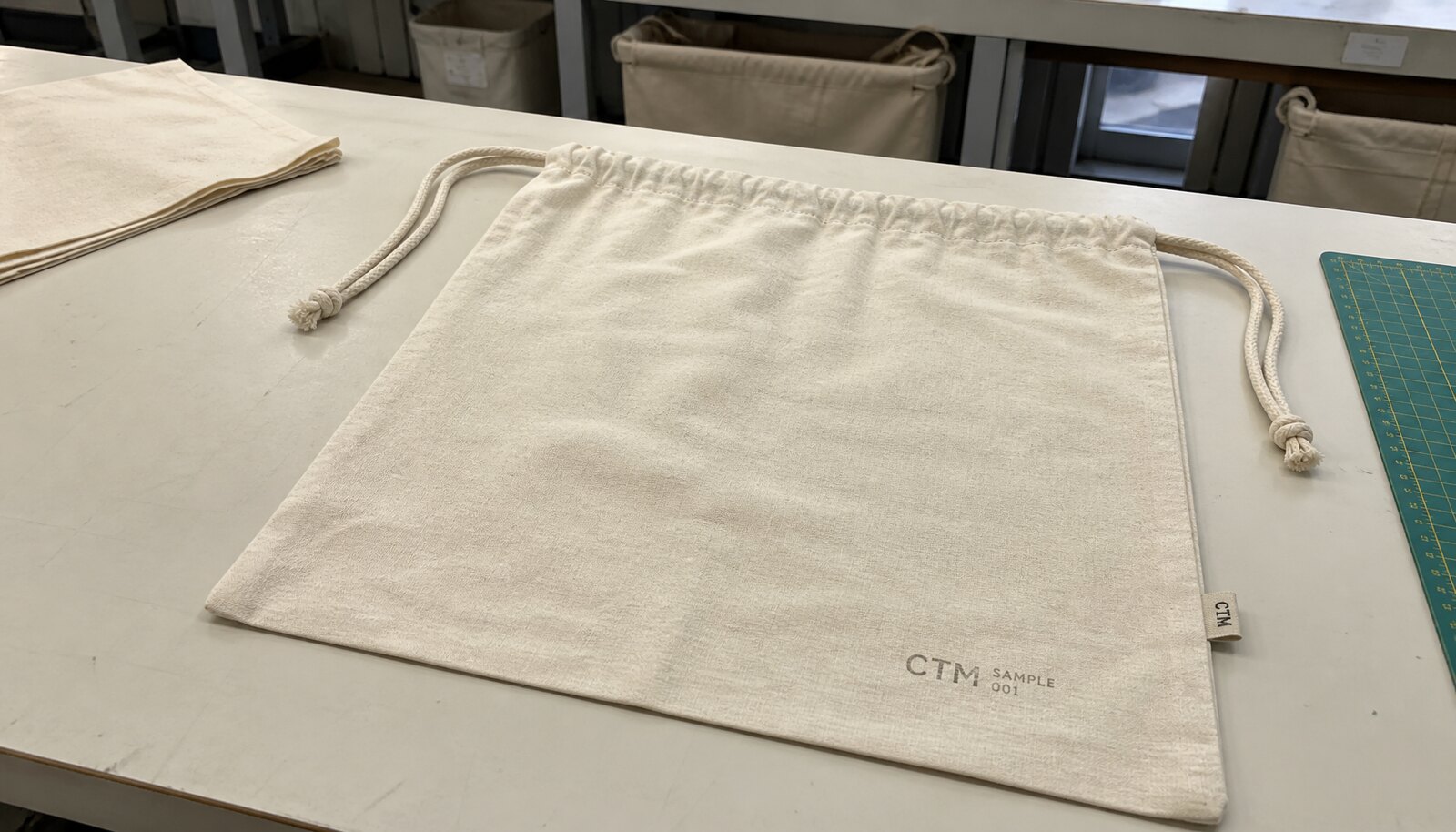
What “No Minimum” Really Means in Drawstring Bag Sourcing
In procurement terms, a custom drawstring bag no minimum does not mean the supplier can build any material, any decoration, and any pack format in any quantity. It usually means the factory is willing to take a low-volume order if the buyer stays inside a standard production lane. That lane is often defined by stocked fabric, a common bag size, a familiar closure style, and a decoration method that does not force large setup or raw-material commitments.
The most common mistake is to treat no minimum as a universal exemption from MOQ. In practice, the minimum often shifts rather than disappears. A supplier may accept 100 bags if the fabric is already in stock, but still require a minimum for custom dyeing, special cord colors, woven labels, metal tips, or branded cartons. For buyers, the real question is not whether there is a minimum somewhere in the chain; it is where the minimum sits and how much it changes the landed cost.
For small purchases, the commercial risk is not just price. It is spec drift. If one supplier quotes a lightweight promotional bag and another quotes a heavier retail-grade bag, the quotes look comparable only on paper. Procurement teams should assume that no-minimum suppliers are selling a limited production model unless proven otherwise. The job is to identify which parts of the spec are flexible and which parts are effectively fixed.
- No minimum usually applies to one or two production variables, not every material in the bag.
- Stock fabric and stock colors are the easiest way to keep a small order open.
- The more the bag departs from the supplier’s standard construction, the more the hidden MOQ reappears.
Spec First: What to Lock Before You Request Quotes
The fastest way to make a small run expensive is to send a vague RFQ. Procurement buyers need a spec sheet precise enough for one factory to quote against another on equal terms. At minimum, define the finished size, fabric family, fabric weight, closure style, drawcord type, print area, and packaging format. Without those details, suppliers will fill in the blanks with their own assumptions, and the quote spread will not be useful.
For a cotton drawstring bag, fabric weight changes both appearance and function. A light promotional bag can work when contents are brochure packs, event handouts, or sample inserts. A bag expected to feel more retail-ready, survive repeated handling, or carry heavier items often needs a sturdier woven cotton or canvas build. Rather than relying on words like “premium” or “strong,” state the use case in practical terms: apparel, stationery, cosmetics, lightweight gifts, or multi-item sample kits.
The closure system also needs to be defined in production language. Not every drawstring bag uses the same cord path, channel depth, tip finish, or knot style. Buyers should specify whether they want a single-cord pull, double-cord construction, a sewn channel, metal aglet tips, knotted ends, or a simple cut-and-seal finish. These details affect labor time, look, functionality, and the chance of snagging during use.
Artwork should be written the same way. Say whether the design is one-color screen print, two-color logo, fine text, tonal art, digital print, embroidery, woven patch, or heat transfer. A supplier cannot price a clear decoration route if the buyer only says “make it branded.” If the print has tight type or gradients, ask early whether the chosen method will survive the intended use and whether the art should be simplified before approval.
- State finished dimensions in centimeters and identify whether the measurement is flat, open, or filled.
- Define fabric weight in GSM or another agreed basis, not just as light, medium, or heavy.
- Specify the artwork complexity so the supplier can choose the right decoration method instead of guessing.
- Call out closure details: cord count, tip finish, channel type, and whether knots or stoppers are required.
Material Choices That Change the Quote and the Risk
The material choice is often the biggest driver of both price and performance. Cotton remains common because it prints well, folds neatly, and gives a natural handfeel. But cotton is not one thing. Buyers should ask about weave density, yarn thickness, pre-shrink treatment, and whether the fabric is plain weave, canvas, or another construction. Two bags can both be described as “cotton” and still behave very differently in use.
If the bag is intended for lightweight gifting or sample distribution, a lighter woven cotton may be enough. If the bag will be reused, carry heavier contents, or sit in a retail environment, a denser fabric with better body retention is usually more appropriate. The procurement issue is not a generic GSM number by itself; it is whether the cloth holds its shape, prints cleanly, and resists seam distortion after loading. Buyers should ask for actual fabric swatches or production photos, not just a number in a quote.
Color choice also has sourcing implications. Stock natural, white, and a few common dyed colors are usually easier to source at low quantities. Custom dyed fabric adds lead time, matching risk, and possible shade variation between lots. If the brand requires a close color match, ask whether a lab dip is available, what tolerance the supplier uses, and how reorders will be matched later. For small programs, a stock body with decoration is often lower risk than chasing a fully custom fabric color.
Trim and finish details are easy to overlook but often visible to the end user. Cord material, cord thickness, knot consistency, metal tips, woven labels, and inside seam finish all affect the bag’s feel and perceived quality. If the bag is meant to support a premium brand story, do not let the supplier replace a stitched label with a loose printed tag or swap a finished tip for a raw cut end without approval.
- Ask for the exact weave or bag body construction, not just “cotton.”
- Use stock colors when speed and order size matter more than exact shade control.
- Treat trim, cord, and label details as part of the spec, not as optional decoration.
How to Filter Suppliers Before You Sample
For a low-quantity order, supplier fit matters as much as the quote. A direct factory is usually best when the buyer wants repeatability, clear accountability, and the ability to hold the same production route for future reorders. A trading company can help when multiple variants must be consolidated or when the buyer needs support across more than one factory, but the tradeoff is usually less transparency on the actual production source and more room for hidden margin layers.
A regional converter or local decorator can be practical when the bag is built from blank stock and the order is urgent. That route is often faster for a small event run or a quick promotional cycle, but the menu of fabrics, cord colors, and finishing options may be narrower. Buyers who need exact textile control, branded trim, or retail-grade finishing should not assume that fast local service is equivalent to factory control. Speed solves schedule risk; it does not automatically solve specification risk.
A useful filter is not “who is cheapest?” but “who is structurally fit for the bag I need?” Ask whether the supplier has made the same bag family before, whether stock fabric is already available, whether the print method is routine for them, and whether they can show a real production photo rather than a generic catalog image. If the answer is vague, the quote may still be usable, but the sampling burden will be higher and the production risk less predictable.
Before award, verify who actually owns each step. Some suppliers quote like a factory but outsource sewing, decoration, or packing. That is not automatically a problem, but it becomes a problem when the buyer assumes one quality system and receives another. Ask where the cloth is cut, who does the printing, where final inspection happens, and whether the supplier can control the same production team on reorders.
- Direct factories fit stable specs and repeat orders.
- Trading routes help with consolidation, but quote transparency is usually weaker.
- Regional decorators help with speed, but they may have fewer fabric and finish options.
- Ask for actual production photos from the same fabric family, not just a similar bag silhouette.
- Confirm whether sewing, printing, and packing happen in-house or through subcontractors.
A Practical Sourcing Matrix for Procurement Decisions
The right supplier route depends on measurable thresholds, not general preference. For a buyer who needs only a few dozen or a few hundred bags, the key question is whether the supplier already has a compatible base body in stock. If the answer is yes, low-volume sourcing becomes much more realistic. If the answer is no and the supplier must cut new material, source custom trim, or prepare a special decoration setup, the apparent no-minimum offer often becomes expensive fast.
Artwork complexity is the next decision point. A simple one-color logo on a stock body can usually move through a standard production line with fewer surprises. A gradient logo, tiny legal text, or artwork that crosses a seam needs more proof. In those cases, buyers should prioritize print capability and registration control over base price. Retail-facing brands should also check how the bag folds, how the print appears after folding, and whether the finish looks clean when packed with other items.
The most overlooked variable is what happens after goods arrive. If the bag will be repacked by the warehouse, inserted into another product carton, or labeled later, bulk pack may be acceptable. If the bag must go directly to stores, event attendees, or consumers, then the supplier needs to deliver a more controlled presentation. The lowest-cost supplier is not necessarily the best buyer route if it creates rework in receiving or distribution.
- Use supplier route to match the bag’s job, not just the unit price.
- A more expensive route can still be the lower-risk option if it reduces rework or rejects.
- If one spec element is critical, prioritize suppliers with that capability even if the base price is higher.
Where the Quote Really Moves on Small Orders
Small orders are expensive because fixed work does not shrink in proportion to quantity. Design review, machine setup, print preparation, material cutting, packing instructions, and carton labeling all take effort even if the order is only a few dozen or a few hundred pieces. Procurement teams should therefore focus on the cost drivers that move price the most: fabric weight, decoration method, trim, packing, and whether the supplier is sourcing standard stock or making a custom element.
Print method is often the largest variable. Screen print is usually efficient for a simple solid-color logo when the artwork is stable and the print area is not too large. Digital print or heat transfer can support more complex graphics and lower quantities, but the buyer should verify line clarity, rub behavior, and whether the printed area will crack, peel, or distort when the bag is folded. Embroidery or stitched patches can improve perceived quality, yet they add labor and may require stitch density, thread shade, and placement approval.
Packaging also changes the commercial picture. A plain bulk-packed bag may look cheapest on the quote, but if the receiving process needs individual polybags, barcode labels, inserts, or retail-ready cartons, that cost will show up later either in supplier pricing or in internal labor. For procurement, the right comparison is not the factory’s base unit price; it is the landed cost per sellable unit at the receiving dock.
One more cost driver is the limit of the supplier’s standard process. If you ask for a nonstandard cord color, special aglet, custom label, or unusual fold style, the factory may still accept the order but will often recover the extra work through setup charges or a higher unit rate. Ask the supplier to identify which elements are standard, which are optional, and which require separate approval before you compare offers.
- More logo colors usually mean more setup cost, not just more ink.
- Metal tips, custom stoppers, woven labels, and stitched patches can move the quote more than expected.
- Bulk pack is cheaper at source, but may add downstream handling cost if the warehouse must rework units.
- Ask which spec items are standard and which trigger separate setup or tooling charges.
How to Read Quotes Without Getting Misled
A useful quote is more than a number. It should tell you what is included, what is excluded, and what assumptions sit under the price. For no-minimum orders, those assumptions matter because suppliers may use different base fabrics, packing formats, carton counts, or shipping terms and still present the quote as if it were comparable. If one supplier is quoting ex-factory and another is quoting delivered, the difference is not a price difference; it is a basis difference.
Procurement should insist on quote normalization. That means comparing the same size, the same fabric, the same decoration method, the same pack level, the same carton quantity, and the same Incoterms. If one supplier offers a lower unit price but uses a lighter fabric or excludes polybags, the apparent savings can disappear once the total receiving cost is calculated. A clean RFQ should force suppliers to quote against a shared basis and list every extra charge separately.
The other thing to watch is repeatability. Ask which elements of the quote are stable on reorder and which charges can recur. Some suppliers only waive setup once. Others may re-charge for file processing, sampling, or small-run print adjustments. For a procurement team, those one-time costs are not necessarily bad, but they must be visible so the first-round price does not hide later costs.
If the quote is missing technical detail, treat that as a sourcing signal. An order for a simple bag should not require guesswork about size, stitching, closure, or packing. When a supplier does not answer those basics cleanly, the follow-up risk is usually higher than the quoted savings. A precise quote is not paperwork for its own sake; it is evidence that the supplier can control the job.
- Compare only after normalizing spec, pack, and shipping term.
- Ask which setup charges are one-time and which may recur on reorder.
- Do not compare a bulk-packed quote to a retail-ready quote without adjusting for handling cost.
- Treat missing technical detail as a risk signal, not just a documentation gap.
Sampling: What a Physical Sample Must Prove
For small-run sourcing, a sample is not just a visual check. It is a production test. The sample should prove that the bag can be made to the written spec, that the decoration survives the chosen material, and that the bag functions under real handling. That means measuring the sample, checking the cord movement, assessing the seam line, and verifying whether the logo remains readable once the fabric flexes or folds.
A good approval process uses both a physical sample and a written reference. The physical sample shows the real fabric hand, stitch behavior, print edge, and trim quality. The written reference locks the size, print placement, and any color calls. If the supplier later swaps the cord, changes the cloth, or moves the logo slightly, procurement should treat that as a change, not a harmless variance. Small orders are especially vulnerable to this kind of drift because the supplier may assume there is less scrutiny.
When sample charges are involved, do not focus only on whether the fee is credited later. Also ask what exactly the sample represents. Is it hand-finished, machine-finished, or taken from production materials? Is the sample representative of the final carton pack or just the bag body? A sample that hides packing or trim variation does not fully protect the buyer.
For buyers who need a quick approval cycle, use a short sample checklist before sign-off: size check, fabric feel, stitch quality, drawcord movement, logo position, pack format, and carton marking. If any one of those items is off, reject the sample or require a revised approval. Fast approval is valuable only when it is tied to the same spec that will ship.
- Measure the sample using the same method expected in production.
- Approve both the physical sample and the final artwork file.
- Treat any change in cord, cloth, print position, or trim as a new approval point.
- Confirm whether the sample is hand-made or production-representative.
Quality Control Standards You Can Actually Use
Quality control for a custom drawstring bag no minimum order should be written as acceptance criteria, not as general advice. A procurement buyer should define defect classes and tolerance limits before production starts. The most practical structure is critical, major, and minor defects, with clear examples under each. Critical defects are functional failures or safety issues, such as broken cords, torn seams, severe contamination, or wrong SKU mixing. Major defects are issues that make the bag unsellable or unacceptable to the end user, such as unreadable branding, major print misalignment, or significant size out of tolerance. Minor defects are appearance issues that do not compromise function, such as small loose threads or slight shade variation within an acceptable range.
Because bag programs are often small, sample plans do not need to be overengineered, but they do need to be explicit. For a promotional run, the buyer may focus on carton count, workmanship, and obvious visual defects. For retail or gifting use, the buyer should tighten the visible standard and include pack appearance, barcode readability, and carton finish. If the supplier uses AQL, ask which level is used for critical, major, and minor defects and whether the inspection is conducted in-line, final, or pre-shipment.
Packaging inspection deserves its own rule set. Wrong carton count, mixed SKUs, poor barcode placement, or crushed polybags can turn an otherwise acceptable bag into a receiving problem. The inspection checklist should state whether the unit is to be polybagged, whether seals must be clean, whether labels must scan, and whether outer cartons need export marks or handling symbols. This is where many small orders lose time: the bag itself passes, but the packaging forces rework at the warehouse.
It also helps to define simple measurable checks for the bag body itself. The buyer can request a tolerance on finished size, a seam inspection standard, a drawcord symmetry check, and a basic rub test for the print. The goal is not to create a lab specification for a simple pouch. The goal is to prevent subjective acceptance and to give the factory a clear target before it starts sewing.
- Use critical/major/minor defect classes instead of vague language like “good quality.”
- Request the supplier’s AQL level or inspection sheet for the exact order.
- Inspect packaging as a separate QC step: seal, barcode, carton count, and carton marks.
- Reject visible oil marks, stains, holes, strong odor, mixed SKUs, or carton damage that affects saleable condition.
- Add simple measurable checks: size tolerance, seam line, cord symmetry, and print durability.
Packing, Cartons, and the Hidden Cost of Rework
Packing is one of the easiest places to underestimate total cost. A bulk-packed drawstring bag may be fine for a trade show handout or internal use, but it can create extra labor if the receiving team must count, label, and repack every unit. Conversely, an individually polybagged bag with barcode and insert card may look more expensive at source yet reduce warehouse touches and make distribution faster. Procurement should evaluate the order in the context of the actual downstream workflow.
Carton dimensions also affect freight and damage risk. An oversized carton wastes cubic space and may increase transport cost. An undersized carton may crush the bag body or create wrinkles in the print and packaging. Ask the supplier to quote outer carton size, carton quantity, gross weight, and whether the carton is single-wall or double-wall. If the bags will be palletized, confirm pallet pattern and carton stack height so the freight team can estimate load efficiency before shipping is booked.
For cross-border orders, packaging details need to be locked before final award, not after production starts. Changes to pack format can alter labor time, carton count, or freight class. That is why buyers should ask for pack rules in the RFQ itself: bulk or polybag, insert card yes/no, barcode label placement, export mark text, and any retail-ready folding standard. The more precise the packaging spec, the less likely the landed cost will drift after order confirmation.
Do not ignore odor, dust, and presentation quality if the bag will be opened directly by consumers or retail staff. Cotton bags can arrive with lint, fold marks, or packaging odor if the factory does not control packing and storage conditions. If appearance matters at opening, ask the factory how the bags are stored before packing, whether cartons are lined or sealed, and whether the product is cleaned or brushed before shipping.
- State whether the bag should ship bulk packed, individually polybagged, or retail-ready.
- Ask for carton dimensions, gross weight, and stackability before production.
- Include barcode labels, insert cards, and carton mark rules in the RFQ, not later in email.
- Ask how the factory prevents lint, odor, and dust before packing.
Specification comparison for buyers
| Buyer's need | Best supplier route | Decision threshold | What to verify before award |
|---|---|---|---|
| Ultra-small promo run | Factory with stocked bag bodies and standard decoration | Best when the design can stay close to the supplier’s existing pattern and packing | Confirm whether the quote minimum is truly zero or whether setup, print, or packing still has a floor |
| Retail presentation matters | Factory or converter with controlled finishing | Choose this when logo placement, stitch quality, fold presentation, and pack appearance matter more than the lowest unit cost | Request a physical sample, a measurement sheet, and a photoset of the exact pack format |
| Artwork is complex | Digital print or heat-transfer-capable supplier | Best when the logo has gradients, small type, halftones, or multiple colors that are difficult in screen print | Confirm line clarity, rub resistance, wash or flex behavior, and whether the art crosses seams or cord channels |
| Several colors or sizes in one PO | Trading company or consolidator with multiple stocked options | Useful when one buyer needs multiple SKUs but each SKU volume is too low to justify separate factory runs | Check setup fees, carton fees, and whether every variant has its own lead time |
| Need rapid replenishment | Regional decorator with blank inventory | Best when the bag can stay standard and speed matters more than full textile customization | Verify in-stock depth, same-day or next-day cutoff, and the exact freight term |
| Strict repeatability | Direct factory with documented QC flow | Use when the bag will reorder across branches or seasons and consistency is non-negotiable | Ask for the measurement method, defect classification, and carton count controls |
| Best landed-cost control | Factory-direct quote on one complete spec | Best when you can lock size, fabric, print, and pack before RFQ | Normalize all offers to the same Incoterms, carton basis, and packing level |
| Private-label gift packaging | Factory that can add woven label, embroidery, or stitched patch | Useful when brand presentation matters more than the lowest ex-works price | Verify trim source, stitch density, placement tolerance, and sample-to-production match |
Buyer checklist before sampling
- Define the bag’s job first: giveaway, retail insert, subscription pack, sample kit, event handout, or lightweight carry bag.
- Lock finished size, fabric type, fabric weight, closure style, drawcord type, and print area before sending RFQs.
- State whether you will accept stock colors only or require custom dyeing, and whether a lab dip or color standard is needed.
- Specify print method preference and whether the artwork includes gradients, small type, or fine-line details.
- Set packaging requirements: bulk pack, individual polybag, barcode label, insert card, or retail-ready carton marks.
- Name the sample approver and the final sign-off date before production starts.
- Ask suppliers to quote the same Incoterms, same carton quantity, same packing basis, and same sample-charge rules.
- Confirm whether the supplier is factory-direct, a trading company, a regional converter, or a local decorator.
- Request a defect standard or inspection sheet, not just a promise of 'good quality.'
- Normalize all quotes to the same spec before comparing unit price or landed cost.
Factory quote questions to send
- What minimum applies by fabric, color, print method, and trim if I order this custom drawstring bag no minimum target quantity?
- Is the price factory-direct, through a trading company, or through a local service partner?
- What exact fabric weight, finished size, drawcord type, seam allowance, and stitching construction are included in the quote?
- What setup charges apply for screen print, plate making, embroidery digitizing, file prep, or color matching?
- What is the sample cost, sample lead time, and whether sample charges are credited after order confirmation?
- What packing is included in the quote, including polybag, insert card, carton size, carton quantity, and shipping marks?
- What inspection standard do you use before shipment, and can you share your defect classes or QC sheet?
- Which freight terms are you quoting, and what costs are excluded from the unit price?
- Can you quote the same bag on both a production and sample basis so we can compare piece price versus true landed cost?
- If we reorder, which elements stay stable and which charges may recur?
Quality-control points to confirm
- Finished size should stay within the agreed tolerance, and the supplier should use the same measurement method on samples and production.
- Fabric weight should match the approved spec within an agreed tolerance, and the base cloth or weave should be identified on the approval sheet.
- Drawcord length should be even on both sides, knots or end tips must be secure, and fraying at cut ends should be controlled.
- Seams should be straight, with no skipped stitches, loose threads at stress points, or weak corners around the cord channel.
- Print should be legible, correctly placed, and durable under expected use; obvious cracking, smearing, poor registration, or ghosting should be rejected.
- Color shade should match the approved sample or lab dip, especially when multiple bags must sit together in one retail set.
- Carton count, carton labeling, and pack method must match the purchase order so units are not missing, doubled, or mixed by SKU.
- No visible oil marks, stains, holes, strong odor, loose lint, or foreign contamination should be accepted on finished goods.
- For packed goods, inspect polybag seal integrity, barcode readability, insert card alignment, and carton compression damage before shipment release.
- Set a documented defect class standard, such as critical/major/minor, and confirm the sample lot acceptance rule before mass production.