Start With the Real Use Case, Not Only the Target Price
For wholesale custom drawstring backpacks, the first specification should be the carrying scenario. A giveaway backpack for a conference does not need the same fabric weight, strap strength, or finishing as a retail drawstring gym bag.
Before asking for a quotation, buyers should define the expected load, distribution channel, target user, and required product life. This prevents suppliers from quoting the cheapest possible version when the order actually needs a stronger construction.
- Event giveaway: lighter fabric, simple printing, cost-focused packing
- Retail product: cleaner stitching, stronger fabric, barcode or hangtag requirements
- School or sports use: reinforced corners, thicker cord, higher seam strength
- Premium brand campaign: better fabric handfeel, custom color, controlled print matching
- Ecommerce fulfillment: individual packing, carton drop resistance, consistent folding size
Choose Fabric by Strength, Print Result, and Budget
Fabric selection has the biggest impact on both unit cost and product performance. Cotton, canvas, polyester, and recycled fabrics can all be used for drawstring backpacks, but they behave differently during printing, sewing, and daily use.
Procurement teams should request fabric weight in GSM or ounce, not only a general material name. A quote that says cotton drawstring backpack is not detailed enough for comparison.
- Comparison table to include: cotton 5 oz for light promotions, cotton canvas 8 to 10 oz for stronger retail bags, polyester 210D or 300D for water resistance and lower cost, recycled cotton or recycled polyester for sustainability programs
- Cotton gives a natural handfeel and accepts screen printing well, but it may shrink slightly if washed
- Canvas gives better structure and load support, but increases shipping weight and cost
- Polyester is lighter and more moisture-resistant, but may look less natural for eco-positioned brands
- Recycled fabrics require clear certification checks if the claim will appear on packaging or product labels
Specify Size and Capacity Before Artwork Approval
Many quality issues come from choosing a size based only on appearance. A drawstring backpack must hold the intended items without pulling the top opening out of shape or stressing the bottom corners.
For wholesale orders, size should be confirmed with finished dimensions, tolerance, and the practical load expectation. If the bag will carry shoes, bottles, catalogs, or apparel, the supplier should test the sample with similar contents.
- Common adult size: around 34 x 42 cm for events, sports, and general promotion
- Larger retail size: around 38 x 45 cm when shoes, apparel, or thicker items are expected
- Children’s size: smaller body width and cord length to reduce dragging and discomfort
- Tolerance should normally be confirmed, such as plus or minus 1 cm depending on fabric and sewing method
- Flat dimensions are not the same as usable capacity, especially with thick canvas or lined construction
Confirm Drawstring and Reinforcement Details
The drawstring system is where low-cost backpacks often fail. Thin cord, weak corner stitching, or poor grommet placement can cause early breakage even if the body fabric looks acceptable.
Buyers should specify the cord material, cord diameter, attachment method, and reinforcement before sampling. These details are small in appearance but important for bulk quality control.
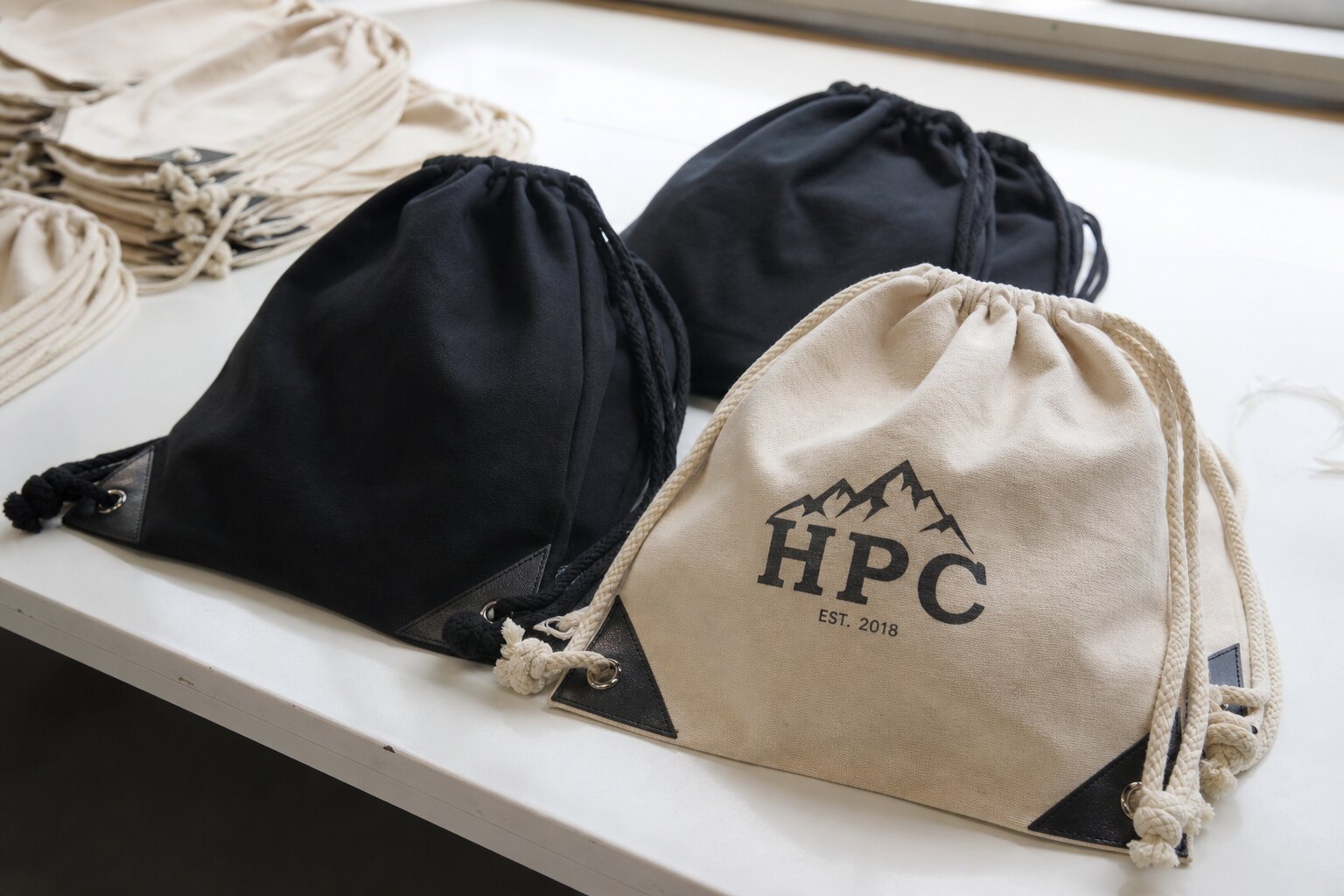
- Checklist to include: cord type, cord thickness, cord color, metal eyelet or fabric loop, corner patch material, bartack position, seam allowance, pull strength test
- Cotton cord matches natural cotton bags but can absorb moisture and fray faster
- Polyester cord is durable and stable for sports or outdoor use
- Metal eyelets look clean but must be checked for rust resistance and secure setting
- Fabric corner loops avoid metal parts and are suitable for softer eco-style backpacks
Match Branding Method to Fabric and Order Quantity
Logo printing on drawstring backpacks should be chosen based on fabric texture, logo detail, color count, and wash or abrasion expectations. The wrong method can make a good bag look cheap or cause the print to crack after use.
For most custom drawstring backpacks wholesale orders, screen printing is the practical option. Heat transfer, embroidery, woven labels, and patch branding may be better for certain designs or retail positioning.
- Screen printing: good for simple logos, solid colors, and medium to large bulk orders
- Heat transfer: suitable for gradients or detailed artwork, but needs adhesion testing on textured fabric
- Embroidery: premium feel, best for smaller logos, adds cost and may pucker light fabric
- Woven label: stable and clean for retail branding, especially on canvas or recycled fabric bags
- Rubber or leather patch: stronger brand effect, usually used for higher unit value products
Prepare an RFQ That Suppliers Can Quote Accurately
A useful RFQ should allow different suppliers to quote the same product, not their own interpretation of a drawstring backpack. Without clear specifications, price comparison becomes unreliable.
Procurement teams should include quantity, fabric, size, branding artwork, packing method, delivery destination, and compliance requirements in the first inquiry. This reduces back-and-forth and helps identify suppliers who understand bulk production.
- Required RFQ fields: material and weight, finished size, cord type, reinforcement, logo method, logo size and placement, order quantity, packing, shipping term, target delivery date
- Attach artwork in vector format when available, such as AI, PDF, or EPS
- State whether the product is for promotion, retail sale, ecommerce, school use, or event distribution
- Ask whether sample cost can be refunded after bulk order confirmation
- Request carton size and gross weight if freight cost affects sourcing decisions
Check Sample Quality Before Releasing Bulk Production
The approved sample should become the production reference. Buyers should not approve a sample only by looking at photos, especially when the order involves custom fabric, special color matching, or retail packing.
Sample review should cover both appearance and function. A backpack can look correct on the table but fail when loaded or pulled repeatedly.
- Sample checklist to include: finished size, fabric weight, color match, logo position, print clarity, seam straightness, drawstring smoothness, corner strength, packing layout
- Load the sample with realistic contents and check whether the bottom corners distort
- Pull the cords several times to confirm the top channel is smooth and not too tight
- Inspect print edges on textured canvas because rough fabric can reduce logo sharpness
- Confirm the sample is signed, photographed, or sealed as the production standard
Understand MOQ, Pricing, and Lead Time Drivers
MOQ for custom drawstring backpacks depends on fabric availability, dyeing requirements, printing setup, and packing complexity. A supplier may accept a lower MOQ for stock fabric but require higher quantities for custom-dyed material or special trims.
Unit price should be reviewed together with production risk. The lowest quote may remove reinforcement, use lighter fabric, or reduce inspection time unless the specification is locked.
- Main cost drivers: fabric weight, backpack size, logo color count, reinforcement, cord quality, packing method, and inspection standard
- Stock fabric usually gives faster lead time and lower MOQ
- Custom Pantone fabric requires more time and a higher starting quantity
- Multiple logo colors add printing setup cost and longer production control time
- Individual polybags, hangtags, barcode labels, or retail cartons increase labor and packing cost